 Created by renowned Harvard health care professionals.


Sprained Wrist: Symptoms, Treatment, Recovery Time and the Carpal Tunnel Connection
A sprained wrist from a fall is common and usually heals with rest. But the swelling and inflammation it leaves can settle in the carpal tunnel at the base of the palm and lead to carpal tunnel syndrome. Our doctors explain symptoms, sprained or broken, treatment, recovery time and how to prevent it.


Sprained Wrist: What Our Doctors Want You to Know
Written by Jeff Conley, President of First Hand Medical · Medically reviewed by Dr. Benjamin E. Bierbaum, MD, orthopedic surgeon and hand specialist, clinical professor of orthopedic surgery, Harvard Medical School · Last reviewed: November 2026
A sprained wrist is one of the most common injuries there is, usually from a fall onto an outstretched hand. Most sprains heal with rest and time. But a sprain does not always end when the bruise fades. The swelling and inflammation from the injury can settle in the tight space at the base of the palm, raise the pressure on the median nerve and start carpal tunnel syndrome.
Our doctors see this all the time: patients who fell, sprained a wrist, and weeks or months later started waking up with numb, tingling fingers. This guide covers sprained wrist symptoms, how to tell if your wrist is sprained or broken, sprained wrist treatment and recovery time, and how to keep a sprain from turning into carpal tunnel.
On This Page
What Is a Sprained Wrist? A Wrist Injury From Fall or Twist
A wrist sprain is an injury to the ligaments, the tough bands of tissue that hold the wrist bones together.3 The ligament is stretched, partly torn or torn through.
The classic cause is a wrist injury from fall onto an outstretched hand.1 Doctors call it a FOOSH injury: Fall On an OutStretched Hand. The hand hits the ground, the wrist bends sharply back, and the ligaments take the force. Slipping on ice, tripping on a curb, falling off a bike or a ladder, and contact sports are the usual stories. A sudden hard twist can sprain a wrist too.

Sprained Wrist Symptoms
A sprained wrist is usually painful, and it may also bring swelling, bruising and tenderness to the touch.1 Other common signs are:
- Pain when you move, bend or put weight on the wrist
- A popping or tearing feeling at the moment of the fall
- Warmth over the injured area
- Stiffness and less range of motion
- A weak grip
A mild sprain can show little swelling at all, so a wrist that looks normal can still be injured. Pain that does not settle deserves a doctor’s look.
Sprain vs Strain: Wrist Ligament or Wrist Tendon?
Sprain vs strain: wrist injuries come in both kinds. A sprain injures a ligament, which connects bone to bone. A strain injures a muscle or tendon, which connects muscle to bone. A fall usually causes a sprain; overuse and lifting usually cause a strain. Both cause swelling, and both can add pressure near the carpal tunnel.
Wrist Sprain vs. Fracture: How to Tell If Wrist Is Sprained or Broken
Wondering how to tell if wrist is sprained or broken? You cannot always tell by looking. A fracture can be mistaken for a mild or moderate sprain, and if it is missed it may not heal properly.2 Only an exam and an X-ray settle it.

Call your doctor right away if your wrist looks deformed, is severely swollen, or hurts too much to move normally.3
Scaphoid Fracture: The Break Mistaken for a Sprain
The scaphoid is a small bone at the base of the thumb side of the wrist. A scaphoid fracture is the most common break that gets mistaken for a sprain.2 Tenderness in the small hollow at the base of the thumb after a fall is a reason to get an X-ray, even if the wrist otherwise feels like a sprain.
Ligament Sprain Wrist Grades: Mild, Moderate and Severe
Doctors grade a wrist ligament sprain by how badly the ligament is damaged:4
- Grade 1 (mild): the ligament is stretched but not torn. Mild pain and slight swelling.
- Grade 2 (moderate): the ligament is partly torn. More pain, swelling and bruising, and some loss of motion.
- Grade 3 (severe): the ligament is torn through or pulled away from the bone. Severe sprains may need surgery to repair the torn ligament.1
Higher grades take longer to heal and leave more swelling behind, and more swelling means more chance of trouble in the carpal tunnel.
How a Sprained Wrist From a Fall Can Lead to Carpal Tunnel
Our doctors have patients who get carpal tunnel from a fall with a sprained wrist all the time. The connection is inflammation. When ligaments are injured, the body floods the area with fluid and inflammation to start healing. That is normal. The problem is where it goes.
The Carpal Tunnel is not in the wrist, it is at the base of the palm between the two major muscles of the hand. It sits right next to the injured wrist ligaments, and it is already tightly packed with nine tendons and the median nerve. Swelling and entrapped inflammation in the soft tissue in and around the carpal tunnel squeeze the median nerve and restrict blood flow and lymphatic fluid transport. The nerve becomes irritated, short of oxygen and compressed.
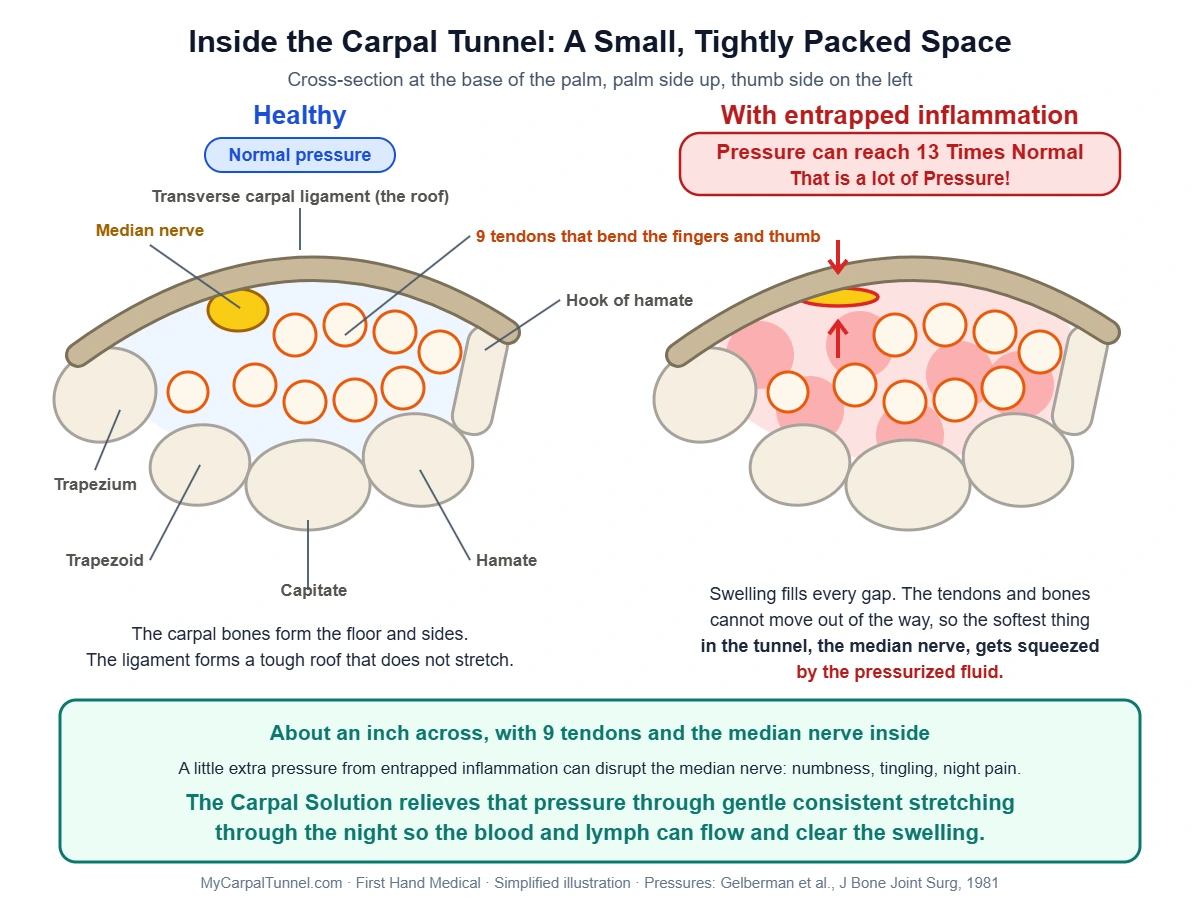
Pressure can reach 13 times normal. Healthy hands measure about 2.5 mmHg inside the carpal tunnel; hands with carpal tunnel syndrome averaged 32 mmHg.5 The tunnel’s walls are bone and a tough ligament, so they cannot stretch to make room. See Nerve Compression Syndrome for the full research.
The research backs up what our doctors see:
- In a large UK study, people with a previous wrist fracture were about 2.3 times as likely to develop carpal tunnel syndrome.6
- After wrist fractures, carpal tunnel can start at the time of injury, weeks later, or months later.7 Acute carpal tunnel after a wrist fracture is caused by raised pressure inside the carpal tunnel.8
A sprain is a smaller injury than a fracture, but the mechanism is the same: swelling that gets trapped raises the pressure. That is why a sprain that seems healed can leave numb, tingling fingers behind, especially at night. Read more in Hand Injuries That Mimic or Lead to Carpal Tunnel.
Important: numbness or tingling that starts right after a fall needs a doctor promptly, because sudden pressure on the nerve after an injury can be urgent.
This is why our doctors treat post-sprain carpal tunnel the way they treat any carpal tunnel: by clearing the trapped inflammation. Once a fracture is ruled out and the acute phase has passed, the Carpal Solution’s gentle overnight stretch restores flexibility to the soft tissue at the base of the palm and lets blood and lymph carry the leftover swelling away, before it settles into a chronic squeeze on the median nerve.
Sprained Wrist Treatment: The First Days and Weeks
Most mild sprains get better with home care.4 Moderate and severe sprains need a doctor, and sometimes therapy or surgery.1 For the first few days, home sprained wrist treatment follows RICE:2
- Rest the wrist from lifting and gripping.
- Ice for 15 to 20 minutes at a time, wrapped in a cloth, never directly on the skin.
- Compression with a light wrap, never tight enough to cause numbness.
- Elevation above the heart to help fluid drain.
Splints Are the Right Tool for a Sprain, for a Short Time
This is one of the few places our doctors recommend a splint. Splints are the right tool for fractures and sprains, where holding a joint still lets it heal. Use one for as long as your doctor advises, then wean off it. Worn long term, a splint does two separate kinds of harm: unused muscles weaken (muscle atrophy), and restricted blood circulation and lymph flow reduce the nutrients needed for healing and slow the clearing of inflammation, so soft tissue heals more slowly.9
Wrist Sprain Management After the First Week
- Move gently. Once your doctor says it is safe, gentle motion keeps blood and lymph moving through the wrist and hand.
- A cold plunge to calm inflammation. Our doctors’ protocol is the hand and forearm in cold water at about 43°F for 20 minutes, never colder than 41°F (44 to 48°F for people with Raynaud’s, diabetic nerve issues or poor circulation). It is cold enough to stop new inflammation that day.
- Electrolytes and water. Plenty of water with potassium citrate and magnesium citrate helps lymph fluid carry swelling away and prevents cramping. See magnesium for carpal tunnel.
- No squeeze balls or grip putty while healing. Gripping raises carpal tunnel pressure. Strength comes back once the swelling is gone (see weak wrists).
Sprained Wrist Recovery Time: How Long Does a Sprained Wrist Take to Heal?
Sprained wrist recovery time depends on the grade. Mild sprains usually improve with home treatment, while higher-grade injuries need more advanced treatment and take longer to recover.1 Severe sprains with a torn ligament can take months.
Even a mild wrist injury that does not improve quickly should be checked by a doctor, especially if the pain persists, to avoid long-term problems such as chronic pain, stiffness and arthritis.2
Watch for a second phase. If the sprain pain fades but you start waking at night with numb or tingling thumb, index and middle fingers, or you start dropping things, the swelling may have moved into the carpal tunnel. That is the time to treat the pressure, not to wait.
If numbness or tingling in the thumb, index and middle fingers lingers after the wrist pain itself has healed, that is the sign of the carpal tunnel connection, and the point where our doctors add the Carpal Solution.
Where the Carpal Solution Fits After a Sprained Wrist
Once your doctor has ruled out a fracture or a fully torn ligament and the first sharp pain has settled, the leftover swelling is what keeps the hand from fully recovering. Conservative-first care that follows medicine’s “Do No Harm” principle starts there, at home, without downtime or risk.
The Carpal Solution’s targeted passive stretching restores flexibility to the injured soft tissue, relieves pressure on the median nerve, relieves restrictions on blood circulation and lets lymph fluid flow freely to clear out the swelling. It is your body that does the healing; the Carpal Solution just jump-starts the natural healing preempted by excess pressure from inflammation and swelling.
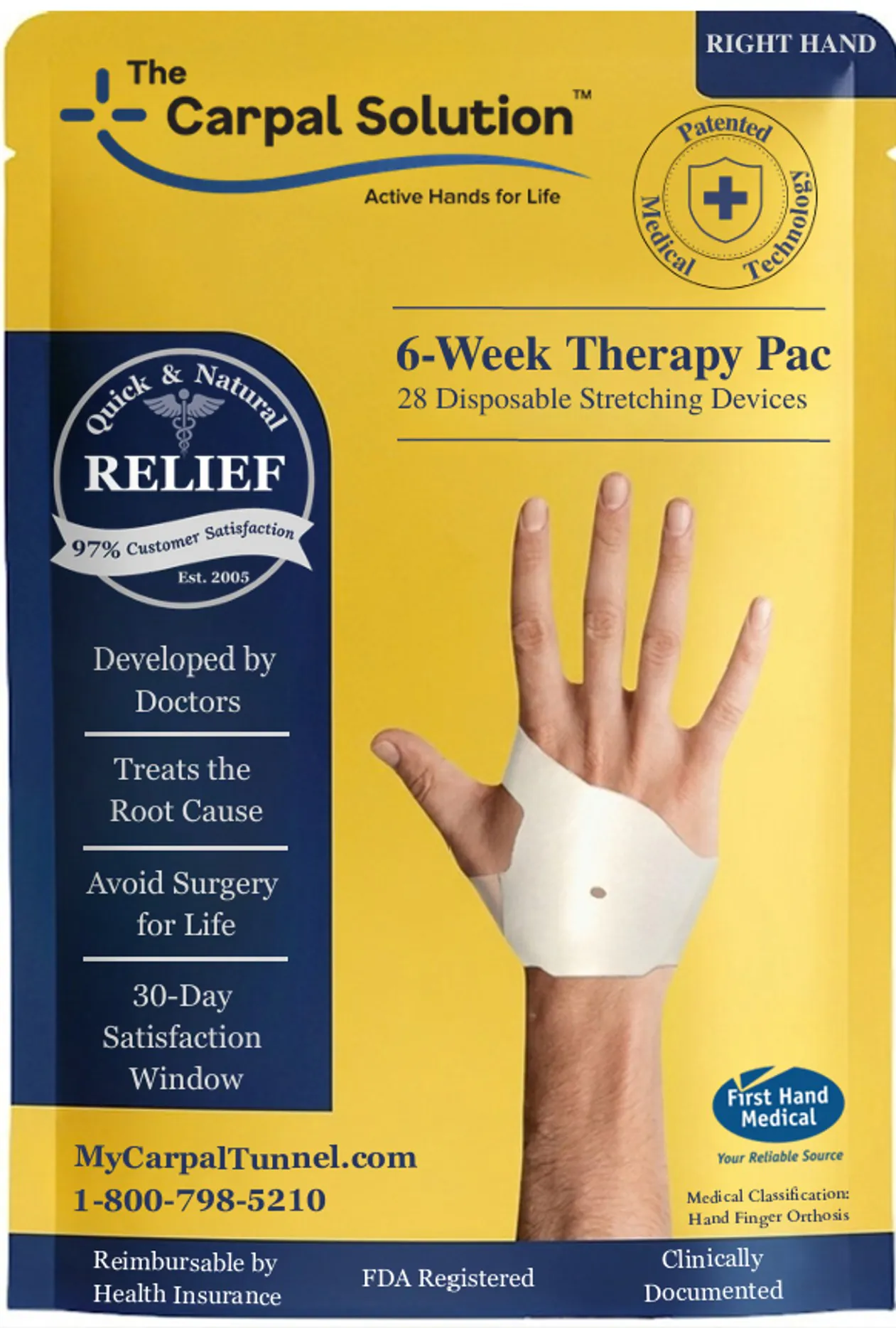
Unlike a rigid splint, it works through the night without holding the hand still, so the muscles stay active and blood and lymph keep moving.
- Most people are better from their worst symptoms in two to three weeks.
- About 90% of people reach complete remission in 6 weeks.
- 97% patient satisfaction over 21 years, 4.9 out of 5 stars, and over 100,000 people helped.
Compare that with surgery: carpal tunnel surgery has a patient satisfaction rate lower than 69%, because about 31% of patients report lingering or recurring symptoms, and no patient is satisfied with lingering symptoms.10 Waiting weeks for a hand specialist does not mean waiting with nothing to do. Order the Carpal Solution.
When Healing Needs a Doctor’s Help and Professional Medical Evaluation
- Constant numbness that does not improve or loss of feeling in the fingertips that does not improve in 4 to 8 weeks.
- Extreme loss of the muscle at the base of the thumb, with loss of grip strength that does not improve over 6 to 8 weeks.
- Worsening symptoms over 6 to 8 weeks while using the best conservative treatments
- Symptoms that begin suddenly after hand or wrist trauma, a fracture or severe sprain from a fall or auto accident.
- Odd Symptoms that are not consistent with the Carpal Tunnel Symptoms listed on this website, that might be indicative of other nerve issues. A nerve conductivity study can clear up the confusion with minimal costs and not too much pain and no risk.
These signs may mean more advanced nerve involvement or a different condition and deserve professional medical evaluation and in person consultation. Home treatment can be used alongside professional in-person medical care while you wait for the healthcare delivery system to fit you into their schedule. There is no reason to wait doing nothing. You can start proven natural conservative treatment with good patient reviews while you wait for your appointments. If your symptoms start improving over 6 to 8 weeks, then you know you are on the right track and surgery is not necessary.
Sprained Wrist FAQ
What are the symptoms of a sprained wrist?
Pain, especially when you move or load the wrist, plus swelling, bruising, tenderness, warmth and stiffness. A popping feeling at the moment of the fall points to a more serious sprain.
How can I tell if my wrist is sprained or broken?
Not reliably by looking. A deformed wrist, severe swelling, pain that stops you moving it, or tenderness at the base of the thumb are reasons to get an X-ray. A scaphoid fracture is often mistaken for a sprain.
What is the best sprained wrist treatment?
Rest, ice, light compression and elevation for the first days, a splint for as long as your doctor advises, then gentle motion. Moderate and severe sprains need a doctor and sometimes therapy or surgery.
How long does a sprained wrist take to heal?
Mild sprains usually improve with home care, while higher-grade sprains take longer, and a torn ligament can take months. A wrist that is not clearly improving should be checked by a doctor.
Can a sprained wrist cause carpal tunnel?
Yes. Swelling and inflammation from the injury can settle in the carpal tunnel at the base of the palm, raise the pressure on the median nerve and cause numbness and tingling, sometimes weeks or months later. Our doctors see it all the time.
Should I wear a splint for a sprained wrist?
Yes, for a short time. Splints are the right tool for sprains and fractures. Wean off as your doctor advises, because long-term splinting weakens muscles and slows soft-tissue healing.
What is a FOOSH injury?
A Fall On an OutStretched Hand. It is the most common cause of wrist sprains and wrist fractures.
When can I use the Carpal Solution after a sprained wrist?
After your doctor has ruled out a fracture or a fully torn ligament and the first sharp pain has settled. It clears leftover swelling and relieves pressure on the median nerve through the night.
Sources
- American Academy of Orthopaedic Surgeons. Wrist sprains. OrthoInfo. Link
- Boston Medical Center. Sprained wrist treatment. Link
- Harvard Health Publishing. Wrist sprain. Link
- Healthdirect Australia. Sprained wrist. Link
- Gelberman RH, Hergenroeder PT, Hargens AR, Lundborg GN, Akeson WH. The carpal tunnel syndrome: a study of carpal canal pressures. Journal of Bone and Joint Surgery (American). 1981;63(3):380–383. Link
- Geoghegan JM, Clark DI, Bainbridge LC, Smith C, Hubbard R. Risk factors in carpal tunnel syndrome. Journal of Hand Surgery (British). 2004;29(4):315–320. Link
- Radiographic predictors of delayed carpal tunnel syndrome after distal radius fracture in the elderly. Hand. 2022;17(4):652–658. Link
- The rate and associated risk factors for acute carpal tunnel syndrome. European Journal of Orthopaedic Surgery & Traumatology. 2021;31:981–987. Link
- Wall BT, et al. Substantial skeletal muscle loss occurs during only 5 days of disuse. Acta Physiologica. 2014;210(3):600–611. Link
- Bland JD. Do nerve conduction studies predict the outcome of carpal tunnel decompression? Muscle & Nerve. 2001;24(7):935–940. Link
Our doctors’ position is offered as medical opinion based on the research above and two decades of clinical experience. We encourage you to read the sources and do your own research.

Developed by First Hand Medical’s Team of Doctors and Medical Professionals
The Carpal Solution Treatment Kit was developed by our expert team of medical doctors who have worked at and led some of the top medical institutions in the World – Including Harvard Medical, Tufts Medical, UCSD Medical School, Florida State Medical School, and The Ohio State University Medical School. We treat root causes with clinically proven conservative treatments. The results: Quick Natural Relief of All Your Carpal Tunnel Symptoms without complications. Meet The Medical Team Backing The Carpal Solution at First Hand Medical

Order Your Six Week Carpal Tunnel Treatment Now
The ONLY treatment for carpal tunnel that comes with a no questions asked 30-Day Satisfaction Window and in-house dedicated pain relief team.

