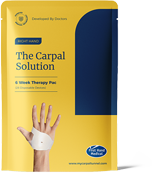
 Created by renowned Harvard health care professionals.

The Carpal Solution Fits the "Conservative First" Medical Approach
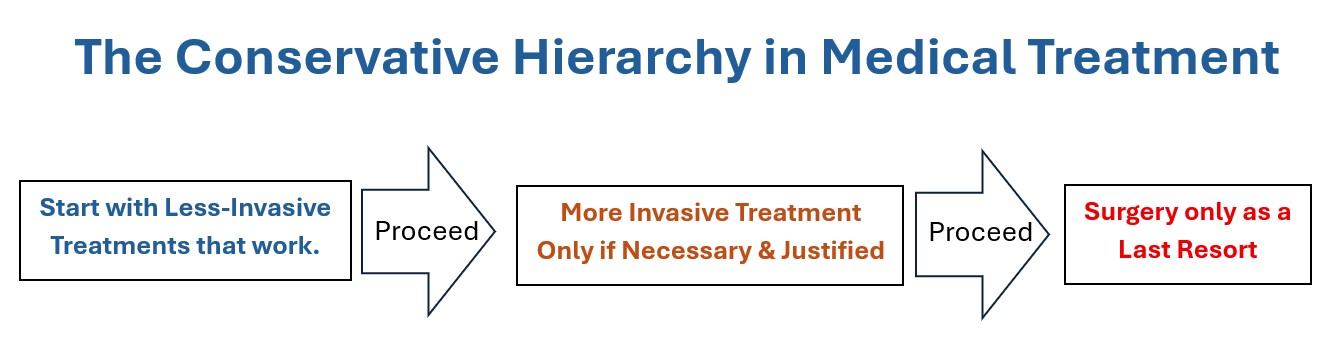
When treating Carpal Tunnel Syndrome, modern medicine follows a "conservative-first" hierarchy—starting with gentle, non-invasive therapies to target root causes before escalating to higher-risk interventions like injections or surgery. Learn how prioritizing lower-risk solutions helps protect your long-term health and prevents recurring complications from multiplying.

Understanding the "Conservative First" Medical Approach
When you’re diagnosed with a condition like Carpal Tunnel Syndrome (CTS), it’s easy to feel like your only options are “wear a brace and hope” or “get surgery.” In reality, medicine generally follows a more deliberate path — a hierarchy of treatment intensity — that starts with the least invasive options and escalates only when necessary.
This conservative hierarchy makes sense generally in medicine, because it’s well understood that more invasive treatments carry more risk. For a chronic, recurring condition like CTS, that principle matters even more: whatever treatment is chosen often must to be repeated when symptoms come back, so avoiding unnecessary escalation isn’t just about comfort — it’s about not accumulating risk over years of flare-ups.
Understanding this hierarchy helps you ask better questions, set realistic expectations, and avoid jumping to more aggressive interventions before gentler ones have had a fair chance to work.
The Conservative Hierarchy of Treatment in Medicine is broadly endorsed by medical professionals as a hallmark of medicine and conforms with the oldest and most foundational principle in medical ethics: in Latin, “primum non nocere”; in English: “First, Do No Harm”. “Conservative First” protects the patient from risks and unnecessary complications and downtime.
Here’s how Conservative First applies specifically to CTS:
1. Lifestyle & behavioral changes designed to prevent or slow down the formation of new Inflammation
The first line of defense in almost any condition is adjusting daily habits — diet, movement patterns, sleep position, and workload. For CTS, this step is a mixed bag:
- Diet can play a supporting role, particularly around managing inflammation and conditions (like diabetes or hypothyroidism) that are known risk factors for CTS.
- Rest, while often the go-to advice for musculoskeletal issues, isn’t very practical here. Most people can’t simply stop using their hands, and prolonged immobility can contribute to stiffness rather than solve the underlying problem.
- Daytime stretching of the wrist and fingers can help maintain mobility and reduce tension in the tissues around the carpal tunnel. Most people find it is hard to allocate enough time during the day with daytime stretching and exercise to make much of an impact on reducing their symptoms.
- Grip-strengthening exercises, on the other hand, are often counterproductive early on — they can increase pressure inside the carpal tunnel and aggravate symptoms rather than relieve them. Once you have healed from Carpal Tunnel Syndrome, grip strength exercises can be helpful, but usually they are not needed. We humans get a lot of gripping action in our daily lives. For most people, they do not need any additional gripping action to regain their grip strength. Once the pressure is off the median nerve, grip strength returns relatively quickly for most people unless they have severe muscle wasting from years of neglecting natural treatment of CTS.
The takeaway: not every “lifestyle fix” that works for other conditions applies cleanly to CTS. Some help, some don’t, and a few can actually make things worse. It is important to follow our guidelines on this website to avoid getting worse while trying to heal.
2. Conservative, non-invasive therapy designed to naturally disperse the trapped inflammation
This is the most sensible tier to prioritize for CTS — it’s the approach most directly aimed at the root cause rather than just the symptoms. It includes:
- Guided, passive stretching during sleep provided by the Carpal Solution Treatment Kit. This provides over 220 hours of passive targeted stretching around the Carpal Tunnel while you sleep over 6 weeks. There is no other way to duplicate this consistent gentle targeted stretching. The consistency of routine targeted stretching jump-starts your body’s natural healing and then your body disperses the trapped inflammation.
- Physical therapy at home guided by medical professionals on this website: such as cold water plunges, daytime stretching, staying hydrated, taking electrolyte, etc. can help accelerate your recovery. You will get an email confirmation when your order the Carpal Solution that provides a link to the Persistent Symptoms Protocol developed by our doctors for patients with “Persistent Symptoms of Carpal Tunnel”. Any patient can accelerate their recovery using the Carpal Solution Treatment Kit by combining it with the physical therapy recommendations in the Persistent Symptoms Protocol.
- Avoiding Intense High Overuse during the healing period, some normal use is helpful to maintain muscle and movement of lymphatic fluid through activity, but avoid intense overuse during the six week healing process using the Carpal Solution Treatment at night.
- Ergonomic changes to workstations, tools, and posture
- Nerve-gliding and mobility exercises supervised by a clinician
The goal at this stage is to naturally release the trapped inflammation and restricted mobility around the median nerve, without immobilizing the wrist or introducing the risks that come with injections, medication, or surgery. It’s worth noting that CTS has multiple contributing causes (repetitive strain, anatomy, systemic conditions like diabetes), so conservative therapy isn’t a guaranteed fix for everyone — but it’s the strongest, lowest-risk first attempt, and the tier this hierarchy encourages patients to spend the most time in before moving on.
3. Splinting and rigid braces
Splinting — especially wearing a neutral-position wrist splint at night — is a commonly recommended early intervention for mild to moderate CTS, since it keeps the wrist out of the flexed positions that raise pressure in the carpal tunnel while you sleep.
That said, splints have real limitations:
- They’re most helpful in the early stages, with diminishing benefit for more advanced or long-standing cases.
- Extended, all-day rigid bracing can lead to muscle atrophy and further injure the soft tissue around the wrist and forearm — the immobilization that helps in the short term works against the joint over time.
- A splint manages symptoms rather than resolving the underlying nerve compression.
In short: useful as a short-term or nighttime tool, but not a long-term substitute for addressing mobility and inflammation directly — and not something most clinicians recommend wearing continuously without a plan to taper off.
4. Minimally invasive procedures
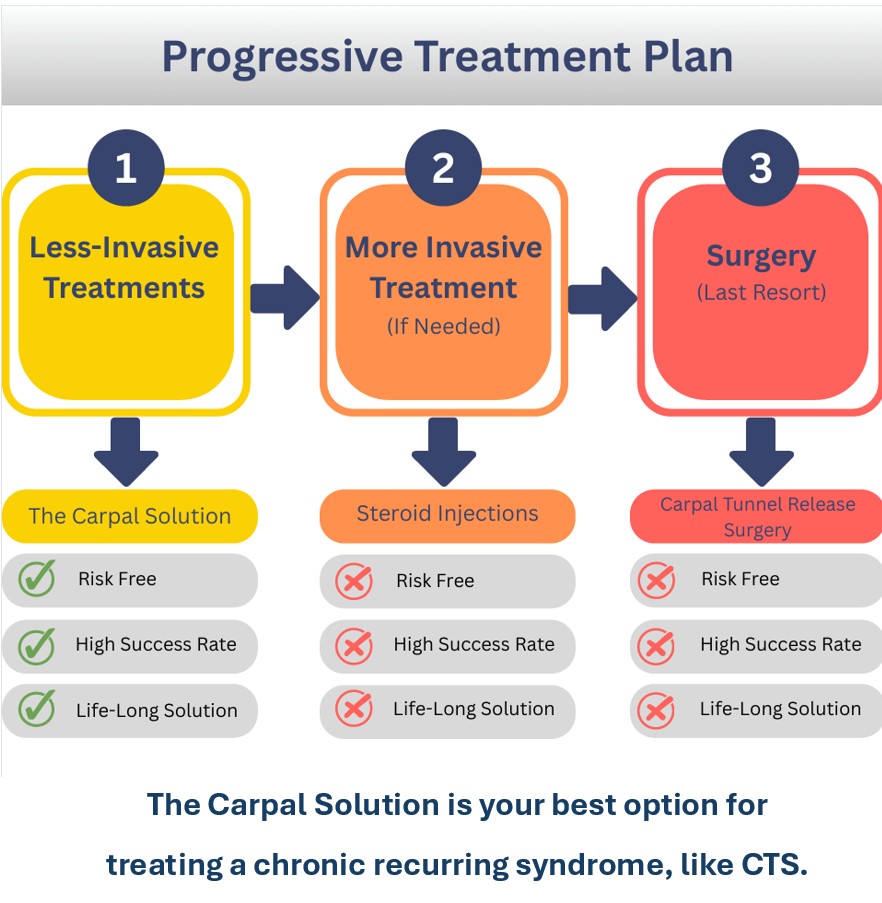
When conservative measures have been tried for at least 3 months, the next step is to move to a more invasive treatment: a corticosteroid injection into the carpal tunnel. These shots can be painful, but can provide temporary symptom relief by reducing inflammation around the nerve. Patients report a 50% success rate with Steroid Injections. This is a relatively low success rate for an invasive procedure that carries significant risk.
Essentially, if you are ready to jump off a cliff due to the discomfort and annoying symptoms of CTS, then definitely get a steroid injection, before you do anything rash. It is a more desperate measure given the low success rate and the risk exposure. Animal studies have shown joint deterioration with repeated exposure to these corticosteroid injections. This is why medical schools recommend fewer than 2 injections in any one joint over the course of a lifetime.
The trade-off is real risk: repeated steroid injections carry a risk of joint deterioration, along with a chance of tendon or soft tissue changes over time. Injections are generally viewed as a bridge — useful for buying time or confirming a diagnosis — rather than a repeatable long-term strategy. This is why injections are considered one of the last options, in the conservative hierarchy of medical treatments as applied to CTS.
5. Medication
Medication is generally not appropriate for a chronic, recurring condition like CTS. Oral options might include NSAIDs, and in more persistent cases, drugs like Prednisone or Gabapentin aimed at inflammation or nerve pain — but all of them carry side-effect profiles that become harder to justify the longer, and the more often, they’re used:
- NSAIDs address inflammation and pain broadly but don’t resolve nerve compression.
- Prednisone and similar corticosteroid medications bring their own long-term risks (bone density loss, blood sugar effects, tissue deterioration and more) when used repeatedly for a chronic recurring condition.
- Gabapentin and other nerve-pain medications treat the sensation of the problem, not the mechanical cause. Gabapentin is potentially addictive and is only approved as a epilepsy anti-seizure treatment by the FDA. It is not labeled as a carpal tunnel treatment. It should be avoided altogether for the treatment of CTS.
- None of these options address the mechanical root of the problem — pressure on the median nerve caused by excess swelling, also known as excess inflammation that gets trapped.
This tier is usually about symptom masking or minimization while other approaches are given time to work, not a standalone long-term solution — and for a condition that tends to recur, repeated courses of medication are one of the higher-risk treatment choices on the treatment hierarchy.
6. Carpal Tunnel Surgery
Surgical release of the transverse carpal ligament is effective about 50 to 60% of the time based on patient surveys for severe, or rapidly worsening CTS symptoms.
Surgeons claim a high success rate of 90%.
So, why do the surgeons report a higher success rate than patients report?
That is a question worth addressing. Hand Surgeons’ definition of success with carpal tunnel surgery is if one of the symptoms improves with surgery, then surgery was successful. However, patients do not agree with this definition of success. Patient don’t deem the surgical procedure to be successful unless all of their symptoms are resolved. Hence the discrepancy in reporting treatment outcomes.
As with most conditions, surgery is the last resort: it’s invasive, requires recovery time, and — like any surgery — carries inherent risks (such as routine scar tissue, blot clots, infection, permanent nerve damage if the scapple nicks the median nerve, reactions to anesthesia, etc. It’s typically reserved for cases where conservative and minimally invasive options have been attempted for several months and haven’t provided adequate relief, or where nerve inhibition and symptoms are progressing rapidly.
Carpal Tunnel recurs even after a “successful carpal tunnel surgery” a relatively high percentage of the time within 3 to 7 years. So, it begs the question:
Was the invasive surgical procedure really a success, if the syndrome recurs?
Most patients think not.
The facts are that a surgical procedure with a 50-60% success rate based on patient surveys is generally considered a low success rate in modern medicine. Also, you add to that low success rate based on patient reviews, the relative high recurrence rate of the Carpal Tunnel Syndrome after surgery — and, well, the overall conclusions of most patients armed with the facts is:
That Carpal Tunnel Surgery is not the best option and should be avoided if at all possible using conservative therapies with high patient reviews that are backed by doctors.
If a patient has a physiological condition causing excess systemic inflammation, the likelihood of recurrence of the syndrome after any treatment is high. It would be malpractice to perform Carpal Tunnel Surgery in such cases of extreme systemic inflammation like those resulting from diabetes, thyroid conditions, any auto-immune condition, gum disease, etc. You can learn more about physisiological conditions that cause excess systemic inflammation by typing that subject into the search bar at the top or at the bottom of the website.
Hence, we are back to strongly recommending a concerted effort of using The Carpal Solution combined with physical therapy at home, to manage your carpal tunnel syndrome in the least invasive way possible, consistent with the generally agree upon Conservative Hierarchy of Medical Treatment.
Why the Hierarchy Matters
The point of stepping through this hierarchy isn’t to avoid effective treatment — it’s to match the intensity of the intervention to the actual severity of the problem, and to exhaust lower-risk options before accepting the trade-offs of higher-risk ones. For CTS specifically, that generally means:
- Skip impractical advice (like “just rest”) and focus on the lifestyle changes that actually help.
- Everyone should start First with the Carpal Solution Treatment Kit. It is the least invasive treatment that works well, is backed by Medical Doctors, has a 20 year success rate with patients and receives high patient satisfaction reviews on independent review sites. It also comes with a money back guarantee provided by First Hand Medical, a reliable medical company, founded by our medical team, which includes some of the highest credentialed medical professionals in the world. This is a product and a medical team you can trust and rely upon.
- Prioritize conservative therapy and ergonomic changes early — including passive stretching devices like Carpal Solution — since they address the root cause directly, naturally, with the fewest downsides. Our medical clinic recommends the Carpal Solution should be tried for at least 3 months, before moving on to more invasive procedures with higher risks, more complications and downtime.
- Use splints strategically, especially at night, rather than as a long-term, all-day solution that risks muscle atrophy.
- Treat injections and medication as bridges, not destinations — both carry real risks (joint deterioration, side effects from drugs like Prednisone or Gabapentin) that compound if repeated for a recurring condition.
- Reserve surgery for cases where it’s genuinely warranted and consider it a last resort, there is no rush to try and avoid “Permanent Nerve Damage”. You have time to make a well-informed medical treatment decision guided by the generally agreed upon Conservative Hierarchy of Medical Treatment.
Because Carpal Tunnel Syndrome is a recurring condition, choosing the least invasive treatment isn’t just the safest path—it’s the smartest long-term strategy. Before accepting the risks of rigid braces, steroids, or surgical release, prioritize gentle, doctor-backed non-invasive therapy. Take the first step toward lasting, natural relief today and experience what consistent, targeted recovery can do for your hand health.
"First, Do No Harm" — in Latin, "primum non nocere"
Foundational Principle of Ethics in Medicine
“Do no harm” — in Latin, primum non nocere (“first, do no harm”) — is one of the oldest and most foundational principles in medical ethics. Here’s the essence of this concept:
Before trying to actively help a patient, a physician should make sure they aren’t making things worse. Every intervention — a drug, a surgery, a test — carries some risk of harm alongside its potential benefit. The principle says that risk has to be taken seriously and weighed carefully, not just brushed aside in the pursuit of doing something.
Where Did This Power Simple Phrase Derive?
It’s often attributed to the Hippocratic tradition, though the exact Latin phrase doesn’t actually appear in the Hippocratic Oath itself — historians trace the specific wording to a later era (often credited to the 19th-century physician Thomas Sydenham, though attribution is debated). The spirit of it does run through the original Oath, which includes a pledge to help the sick according to one’s ability and judgment, and to keep them from harm.
How Do No Harm Functions in Modern Medical Ethics
Today it’s usually called nonmaleficence, and it’s one of four classic pillars of medical ethics (alongside beneficence, autonomy, and justice):
-
Nonmaleficence – avoid causing harm
-
Beneficence – act in the patient’s best interest
-
Autonomy – respect the patient’s right to make their own decisions
-
Justice – be fair in how care and resources are distributed
Pragmatic Nuances of Do No Harm
In practice, almost no medical treatment is risk-free — chemotherapy is toxic, surgery involves cutting into the body, medications have side effects. So “do no harm” isn’t a literal ban on any risk. It’s better understood as: don’t cause harm that isn’t justified by a reasonable expectation of benefit. This is why doctors talk about a risk-benefit analysis for nearly every decision — the question isn’t “could this hurt the patient” (almost anything could) but “does the potential benefit outweigh the potential harm, and the question has be asked in every case:
“Is there a less harmful way to get the same benefit?”
It also underlies more specific norms, like avoiding unnecessary tests or procedures, being cautious with treatments of unproven benefit, and stopping interventions that turn out to be doing more harm than good.
“Conservative First” has become a key element of the practice of Medical Ethics. If a less invasive treatment is well documented to work effectively, it should be given plenty of time to play out before moving on to more invasive procedure. This is especially true for chronic recurring conditions, like Carpal Tunnel.
Patients should give The Carpal Solution Treatment Kit at least three months to work,
Before moving on to more invasive procedures with higher risks, more downtime and more complications. Risks and complications with invasive methods can multiply dramatically with recurring conditions, because the treatment has to be repeated.