 Created by renowned Harvard health care professionals.


Left & Right Hand Versions of the Carpal Solution
The Carpal Solution comes in left & right hand versions. Here is how to choose, when to treat both hands, and why carpal tunnel in the dominant hand often takes a little longer to settle.

Written by Julie Sunberg, Director of Marketing and Customer Service at First Hand Medical · Clinically reviewed by Alan Ward, MOT, OTR, Master Occupational Therapist and Vice President of Precision Rehabilitation · Last reviewed: November 2026
Yes. The Carpal Solution comes in left & right hand versions, so you can treat the hand that is giving you trouble, or both. This page explains how to choose, why carpal tunnel in the dominant hand often takes longer to settle, and how to plan treatment when both hands are involved.
On this page:
- Left & Right Hand Versions Explained
- How Often Both Hands Are Involved
- Carpal Tunnel in the Dominant Hand
- Protecting the Dominant Hand
- Signs the Other Hand Needs Treatment
- Ordering Both Versions
- How to Choose Which Version to Order
- Applying Each Version
- Treating One Hand or Both
- When to See a Doctor
- FAQ
Left & Right Hand Versions of the Carpal Solution Explained
The Carpal Solution is a soft, Hypoallergenic (No Latex) stretching device worn during sleep. Its elastic centerpiece sits on the back of the hand, and three tear-away straps attach on the palm around the carpal tunnel. Because your left and right hands are mirror images, the strap layout is mirrored too, so a version made for one hand is not interchangeable with the other.
That is why the Carpal Solution comes in left & right hand versions. Matching the version to the correct hand is a simple first step that makes the stretch line up with the three points on the palm it is designed to target.
How Often Both Hands Are Involved
In our doctors’ clinical experience, about half of users need both left and right hand therapy to overcome their carpal tunnel symptoms, and the other half only need to treat one hand.
Research suggests carpal tunnel is often present in both hands even when only one hurts. In a study of 327 patients tested with nerve conduction studies, 80.7% had carpal tunnel syndrome in both hands, and more than two-thirds (71.2%) of those who felt symptoms in only one hand had nerve changes in both (PMC8699666). Many of those people later develop symptoms in the second hand.
That does not mean everyone needs to treat both hands right away. It does mean it is worth watching the “good” hand for early signs such as night tingling or numb fingertips, and treating it early if they appear.
Carpal Tunnel in the Dominant Hand
Carpal tunnel occurs more often in the dominant hand, in both right- and left-handed people. The dominant hand does more gripping, typing, lifting and fine work, so its soft tissue carries more strain and more inflammation.
In our experience, the dominant hand usually takes longer to respond to therapy in chronic cases. It keeps working hard every day while it heals, and it often has more long-standing tightness in the soft tissue. If carpal tunnel in the dominant hand is slower to improve than in the other hand, that is normal. Keep going with the protocol, and ease up on heavy or repetitive use where you can.
Carpal tunnel in the dominant hand can also affect the forearm. The muscles that bend the fingers and thumb sit in the forearm, and their nine tendons pass through the carpal tunnel beside the median nerve, so aching, weakness and, over time, forearm and thumb muscle atrophy are common on the busier side.
Protecting Carpal Tunnel in the Dominant Hand During the Day
Night treatment does the heavy lifting, but daytime habits decide how much strain the dominant hand carries while it heals. Small changes help:
- Share the load. Carry bags, open doors and stir pots with the non-dominant hand when you can.
- Lighten your grip. Use pens, tools and kitchen utensils with thicker, softer handles so you can hold them with less force.
- Keep the wrist straight. At the keyboard and mouse, keep the wrist level rather than bent up or down, and let the forearm rest on the desk or armrest.
- Take micro-breaks. Every 30 to 60 minutes, open and relax your hands. Gentle stretches are a bonus: up to 6 sets of 10 a day, holding 15 seconds and resting 30 seconds.
- Skip grip trainers. Squeeze balls and putty add pressure inside the carpal tunnel while you are healing.
- Wear compression gloves by day. They can spur natural healing by increasing blood circulation and insulate the hand from everyday bumps; gloves by day with the Carpal Solution at night is one of the best combination therapies.
Signs the Other Hand Needs Treatment Too
Because carpal tunnel is so often present in both hands, it pays to watch the “good” hand. Early signs include waking with tingling or numbness in the thumb, index and middle fingers, needing to shake the hand out in the morning, fingertips that feel puffy or “asleep,” and dropping small objects. If any of these appear, add the matching version of the Carpal Solution early, while symptoms are mild and easiest to reverse.
When both hands are involved, you can treat them together. Many people simply apply the left & right hand versions at bedtime and follow the same six-week schedule for each. If one hand settles first, carry on with the other until it catches up, then use prevention nights on both.
Common Patterns We See With Left & Right Hand Versions
Every hand is different, but a few patterns come up again and again when people choose between the left & right hand versions:
The Desk Worker
A right-handed office worker usually notices symptoms first in the mouse hand. That is classic carpal tunnel in the dominant hand: hours of small, repetitive movements with the wrist bent. Many start with the right-hand version, then add the left a few weeks later when the keyboard hand starts tingling too.
The Hands-On Trade
Mechanics, electricians, hairdressers and dental professionals often use both hands hard all day. Symptoms tend to appear in both hands, with the dominant side worse. Treating both from the start, with a little extra patience for the dominant hand, usually works best.
The New Parent
Lifting and feeding a baby loads both wrists, often with the wrists bent. Symptoms frequently show up on both sides, sometimes worse on the side used to carry the baby rather than the writing hand.
The Musician
Pianists, guitarists and drummers can develop symptoms in either hand depending on the instrument. A guitarist’s fretting hand may be affected first even if it is not the dominant hand, so choose the version based on symptoms, not on which hand you write with.
Whatever your pattern, the principle is the same: treat the hand or hands that have symptoms, watch the other for early signs, and give carpal tunnel in the dominant hand a little extra time and protection while it heals.
Ordering Left & Right Hand Versions
When you order, choose the version for each hand you plan to treat. If you are not sure whether the second hand will need it, you can start with one and add the other later; each version follows its own six-week protocol. After remission, prevention nights from once a week to once every six months help keep symptoms away in both hands.
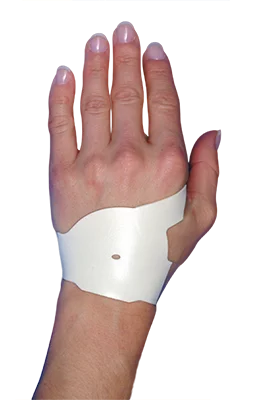
How to Choose Between the Left & Right Hand Versions
Start with the hand that bothers you most; for many people that means carpal tunnel in the dominant hand. A simple self-check helps:
- Which hand wakes you at night with numbness, tingling or pain?
- Which hand drops things, fumbles buttons or feels weak when you grip?
- Which thumb, index and middle fingers feel numb or “asleep”?
- Does the other hand have any of these signs, even mildly?
If only one hand is affected, order that version. If both hands have symptoms, order both. In our doctors’ clinical experience, people with three or more classic symptoms can be about 95% confident they have carpal tunnel syndrome, but you should still see a doctor for an evaluation; other conditions can cause similar hand symptoms. Review the carpal tunnel symptoms.
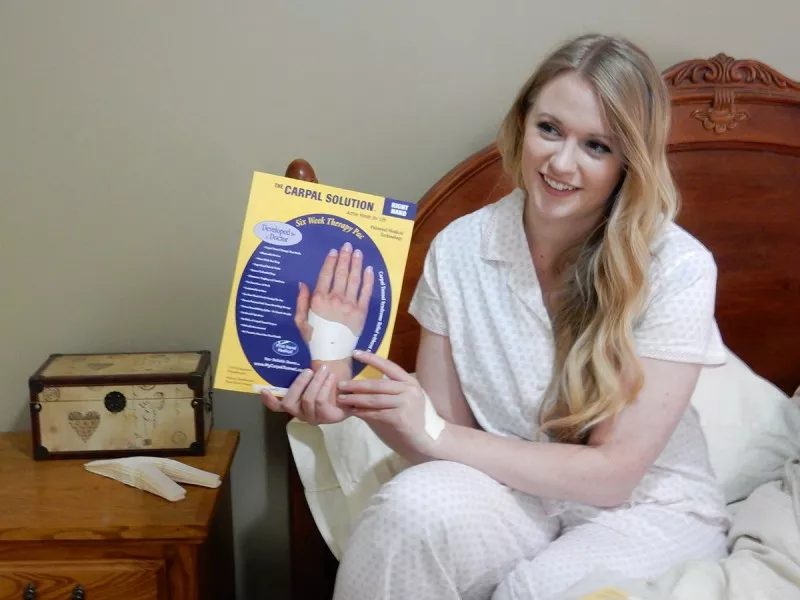
Applying the Left & Right Hand Versions
Both versions go on the same way, mirrored for each hand:
- Place the Carpal Solution on the back of the hand, adhesive side down, and attach the first strap below the little finger on the palm.
- Set the tension with the second strap below the thumb, stretching the circle in the elastic centerpiece into an oval at least 1.5 times its original size.
- Attach the third strap above the thumb, keeping the straps from overlapping on the palm.
The left-hand instructions are the mirror image of the right. See the pictures and video on how to apply the Carpal Solution. If you are treating both hands, apply the non-dominant hand first, while your dominant hand is free to do the fiddly work.
Treating One Hand or Both Hands
Whether you use one version or both, the schedule is the same:
| Stage | Schedule | What most people notice |
|---|---|---|
| Weeks 1–2 | Every night | Most people are better from their worst symptoms in two to three weeks. |
| Weeks 3–6 | Every other night | Over 90% of people reach remission by 6 weeks. |
| Higher inflammation | 8 to 12 weeks | About 10% of people are 50–70% better at 6 weeks and need 8 to 12 weeks. |
| After remission | Once a week to once every six months | Prevention nights keep symptoms away. |
Many people wear both at the same time without any trouble, because the device is soft and does not lock the wrist. If one hand recovers first, you can stop treating that hand and continue with the other, often the dominant one, until it catches up. Over the six-week protocol, each hand receives over 220 hours of targeted passive stretching.
The stretch restores flexibility to the injured soft tissue, relieves pressure on the median nerve, frees blood circulation and lets lymph fluid clear out the swelling, so your body can do the healing. Remission usually lasts 5 to 7 years for most people, ranging from 1 to 17 years. If you have had surgery on either hand, wait 3 months after surgery before treating that hand.
Why Not Just Wear Splints on Both Hands?
A splint holds the wrist in a neutral position, which can reduce pain from movement, but it does not promote healing from carpal tunnel syndrome. It causes muscle atrophy and stiffness, and a tight splint restricts blood circulation and lymphatic fluid exchange. Wearing rigid splints on both hands at night also makes simple things, like getting up for a glass of water, awkward. Our medical team has observed that splints give some relief at first but aggravate symptoms in the long run; in one study, 14 days in a cast cost healthy young men about 8% of muscle size and 23% of strength (Wall et al., 2014).

Neurologists, including Dr. James S. Zu, MD, PhD, of Edison, New Jersey, call the Carpal Solution a better first line of defense for carpal tunnel syndrome. It has 97% patient satisfaction over 21 years and 4.9 out of 5 stars, comes with a 30-Day Patient Satisfaction Guarantee, and is billed under HCPCS code L3924; many plans reimburse 70 to 80% (see insurance coverage).
Surgery should be the last resort, especially when both hands are involved: carpal tunnel surgery has a patient satisfaction rate lower than 69%, as about 31% of patients report lingering or recurring symptoms, and no patient is satisfied with lingering symptoms. The average new-patient appointment wait is 31 days (AMN Healthcare, 2025), and you can start treating both hands while you wait; see relief while waiting for carpal tunnel treatment. For general background, see the NINDS carpal tunnel syndrome fact sheet.
When Healing Needs a Doctor’s Help and Professional Medical Evaluation
- Constant numbness that does not improve or loss of feeling in the fingertips that does not improve in 4 to 8 weeks.
- Extreme loss of the muscle at the base of the thumb, with loss of grip strength that does not improve over 6 to 8 weeks.
- Worsening symptoms over 6 to 8 weeks while using the best conservative treatments
- Symptoms that begin suddenly after hand or wrist trauma, a fracture or severe sprain from a fall or auto accident.
- Odd Symptoms that are not consistent with the Carpal Tunnel Symptoms listed on this website, that might be indicative of other nerve issues. A nerve conductivity study can clear up the confusion with minimal costs and not too much pain and no risk.
These signs may mean more advanced nerve involvement or a different condition and deserve professional medical evaluation and in person consultation. Home treatment can be used alongside professional in-person medical care while you wait for the healthcare delivery system to fit you into their schedule. There is no reason to wait doing nothing. You can start proven natural conservative treatment with good patient reviews while you wait for your appointments. If your symptoms start improving over 6 to 8 weeks, then you know you are on the right track and surgery is not necessary.
Left & Right Hand Versions: FAQ
Is there a right hand and left hand version of the Carpal Solution?
Yes. Because the hands are mirror images, each version is shaped for one hand. Order the version for the hand you are treating, or both.
Can I use a right-hand version on my left hand?
No. The strap layout is mirrored, so it would not line up with the three points on the palm it is designed to stretch.
Should I treat both hands if only one hurts?
Start with the symptomatic hand and watch the other for early signs. Nerve testing often finds carpal tunnel in both hands even when only one is symptomatic.
Why is carpal tunnel in the dominant hand slower to improve?
The dominant hand keeps working hard while it heals and often has more long-standing tightness. It usually catches up with a little more time.
Can I wear both at the same time?
Yes. Many people do. The Carpal Solution is soft and does not lock the wrist, so sleeping with both on is comfortable for most people.
Is the schedule different for two hands?
No. Each hand follows the same six-week protocol: every night for two weeks, then every other night through week six.
Are both versions covered by insurance?
The Carpal Solution is billed under HCPCS code L3924, and many health insurance plans reimburse 70 to 80%. It also comes with a 30-Day Patient Satisfaction Guarantee from First Hand Medical.
What if carpal tunnel in the dominant hand comes back sooner?
That is common, because the dominant hand works harder. Use prevention nights more often on that side, from once a week to once every few months, and repeat the six-week protocol on that hand if symptoms fully return.
Can left-handed people use the same approach?
Yes. For left-handed people, the left hand is usually the busier one, so carpal tunnel in the dominant hand means the left side. Order the left-hand version for it and follow the same schedule.
What if I am not sure which version I need?
Call First Hand Medical at 1-800-798-5210 before you order. The team can walk you through choosing the left & right hand versions for your symptoms.

Order Your Six Week Carpal Tunnel Treatment Now
The ONLY treatment for carpal tunnel that comes with a no questions asked 30-Day Patient Satisfaction Guarantee and in-house dedicated pain relief team.


