 Created by renowned Harvard health care professionals.


Could Neck and Shoulder Pain Be Carpal Tunnel?
“Pinched Nerves” can happen in any joint of the body, but one of the most common pinched nerves is the Median Nerve in the Carpal Tunnel. This pressure on the Nerve from trapped inflammation can affect every muscle and joint between the tips of the fingers and the cortex of the brain.


Written by Jeff Conley, President of First Hand Medical · Medically reviewed by Michelle Robin, DC, chiropractor and wellness expert, founder of Your Wellness Connection in Kansas City · Last reviewed: November 2026
Table of Contents
Neck and Shoulder Pain and the Median Nerve
Neck and shoulder pain has many possible causes, and this page explains why some people with carpal tunnel syndrome feel it far from the wrist. People are often confused when they have pain, tingling or numbness in one place when the nerve being pinched is somewhere else. Nerve problems are like that. They can be unpredictable and confusing, and they can be difficult to diagnose even for a doctor.
“Pinched nerves” can happen in many places in the body, but one of the most common is the median nerve in the carpal tunnel. The median nerve forms from nerve roots in the neck, passes the shoulder, and runs down the arm, through the carpal tunnel and into the hand. When it is pinched at the wrist, the pain is not always limited to the hand.


What the Research Says About Carpal Tunnel and Neck and Shoulder Pain
Carpal tunnel affects the hand, fingers and wrist, but many patients also report pain higher up the arm. Patients often find it hard to believe that this discomfort can come from a pinched nerve in the wrist. The research backs them up:
- In a 2024 case–control study, 63% of people with carpal tunnel syndrome reported shoulder pain, compared with 5% of people without it (Akrivos et al., Journal of Hand Surgery, European Volume, 2024).
- Doctors at a chronic pain referral center found that many patients with unexplained shoulder pain and stiffness had unrecognized carpal tunnel and cubital tunnel syndromes, and treating the nerve compression improved shoulder function (Hagiwara et al., Plastic and Reconstructive Surgery Global Open, 2022).
- Pain that spreads above the wrist is commonly reported in carpal tunnel syndrome (Zanette et al., Journal of the Peripheral Nervous System, 2007).
Neck pain is reported less often than shoulder pain. A pinched nerve in the neck can also cause carpal tunnel-like symptoms, and some people have pressure on the nerve in both places. That is why doctors check the neck whenever arm and hand symptoms appear.
Neck and Shoulder Pain: Why a Diagnosis Matters
Neck and shoulder pain can also come from muscle strain, arthritis in the neck or a problem in the shoulder itself, so an accurate diagnosis comes first. If neck and shoulder pain comes with arm numbness, weakness or pain that spreads, see a doctor. Pain in the neck and shoulder together with chest pain, trouble breathing or sudden severe symptoms needs urgent medical care. For general background, see the NINDS carpal tunnel syndrome fact sheet.
Our doctors’ experience over two decades shows that people with three or more of the symptoms listed on this website can be about 95% confident they have carpal tunnel syndrome. This is clinical experience, not a published statistic. You should still get an in-person evaluation and a formal diagnosis from a doctor. With that level of confidence, you can start a natural, non-invasive treatment developed by doctors, like the Carpal Solution, while you wait for your appointment.

Neck and Shoulder Pain With Hand Numbness: Causes and Double Crush Syndrome
When neck or shoulder pain comes with numbness or tingling in the hand, the source can be the neck, the shoulder region, the wrist, or more than one place at once. Sorting out which one matters, because the right treatment depends on where the nerve is being squeezed.
Neck and Shoulder Pain Causes That Affect the Hand
- A pinched nerve in the neck (cervical radiculopathy): a disc or bone spur presses on a nerve root as it leaves the spine, sending pain, numbness or tingling down the arm.
- Muscle tension and posture: long hours at a desk or phone, with the head forward and shoulders rounded, tighten the neck and shoulder muscles.
- Thoracic outlet compression: nerves and vessels squeezed between the collarbone and first rib, often worse with arms overhead.
- Carpal tunnel syndrome: pressure on the median nerve at the wrist, which can also send aching up the forearm. See can carpal tunnel cause neck and shoulder pain.
Neck Pain and Hand Numbness: Cervical Radiculopathy vs. Carpal Tunnel
Neck Pain, Numb Fingers or Both?
Neck pain and hand numbness together point first to the neck, but the two conditions can look alike. In cervical radiculopathy vs carpal tunnel, a few clues help:
- Neck source: pain that starts in the neck and shoots down the arm, symptoms that change when you turn or tilt your head, and numbness that can reach the back of the hand or the forearm. Neck pain, numb fingers, or neck pain with tingling in hands that follows a stripe down the arm suggests a nerve root.
- Wrist source: numbness and tingling in the thumb, index and middle fingers on the palm side, worse at night, eased by shaking the hand out, with little or no neck pain. See the full carpal tunnel symptoms list.
Shoulder Pain and Hand Numbness
Shoulder pain and hand numbness at the same time are often a sign that a nerve is irritated higher up, in the neck or the space under the collarbone.
Shoulder Pain, Numb Fingers: Which Nerve Is It?
Shoulder pain, numb fingers on the pinky side can point to the ulnar nerve or thoracic outlet; numbness on the thumb side points to the median nerve, at the neck or the wrist.
Double Crush Syndrome: When It Is Both
Double crush syndrome is the idea, first described by Upton and McComas in The Lancet in 1973, that a nerve squeezed in one place (such as the neck) becomes more vulnerable to being squeezed in a second place (such as the carpal tunnel). People with both can have stubborn symptoms that do not fully clear until both spots are addressed. The good news is that relieving pressure at the wrist often helps a great deal, even when the neck is also involved. Targeted passive stretching with the Carpal Solution at night relieves pressure on the median nerve at the wrist, without the risks of surgery, which has a patient satisfaction rate lower than 69%.
A doctor can sort out the source with an exam, and if needed nerve conduction studies and EMG. Call 911 right away for sudden numbness or weakness on one side with face drooping, speech or vision changes, or for shoulder or arm pain with chest pain or shortness of breath.
RIGHT HAND INSTRUCTIONS:
Apply the Carpal Solution before Retiring to Bed in 3 Easy Steps
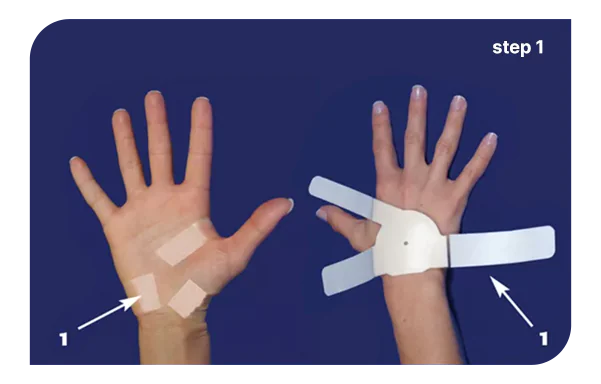
STEP 1: Place the Carpal Solution on the Back of the hand as shown with adhesive side down. Attach 1st strap below little finger securing it on the palm. Tear away excess tape to prevent overlap of straps on palm.
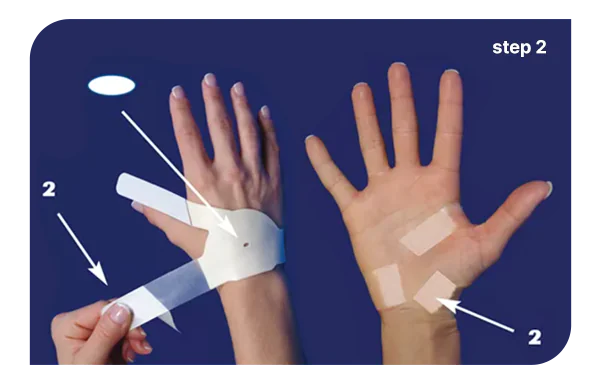
STEP 2: Self apply the appropriate tension to the Carpal Solution with 2nd strap below the thumb and attached on palm side of hand as shown. Adjust tension by stretching circular hole on back of hand in the elastic centerpiece to an oval shape. The diameter should be at least 1.5 times the original.
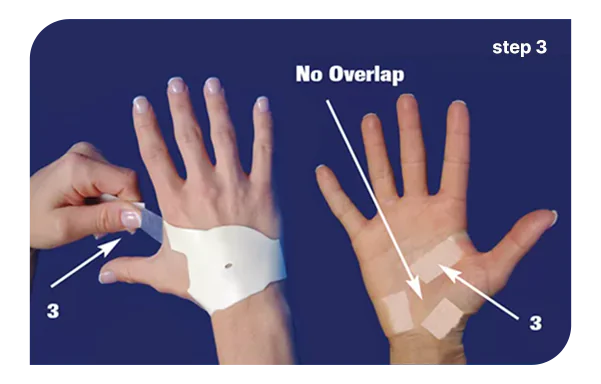
STEP 3: Self apply the appropriate tension to the Carpal Solution with 3rd strap above the thumb. Tear-away straps should be aligned so there is no overlap of straps on palm side of hand. The Carpal Solution begins to relieve symptoms usually within twenty minutes of placement.
Treating Neck and Shoulder Pain From Carpal Tunnel at Home
Doctors developed the Carpal Solution working with patients. It gently stretches the tight tissue around the carpal tunnel while you sleep, giving over 220 hours of targeted stretching in the six-week protocol. In our doctors’ two decades of experience:
- Relief of the worst symptoms often begins in two to three weeks.
- About 90% of patients get complete remission in six weeks. About 10%, often people with excess inflammation in the body, are 40 to 70% better at six weeks and reach full remission in 10 to 12 weeks.
- The Carpal Solution has a 97% patient satisfaction rate and 4.9 out of 5 stars on independent review sites like Google Reviews. Over 100,000 people have used it.
All without the risks, complications and downtime of carpal tunnel surgery, which has a patient satisfaction rate lower than 69%. About 31% of patients report lingering or recurring symptoms after surgery (Bland, Muscle & Nerve, 2001), and no patient is satisfied with lingering symptoms.
Everyone has to wait in the healthcare system; the average new-patient doctor appointment takes 31 days (AMN Healthcare, 2025). If carpal tunnel is behind your neck and shoulder pain, you can start relieving it at home while you wait. Read more in The Waiting in Healthcare.
When Healing Needs a Doctor’s Help and Professional Medical Evaluation
- Constant numbness that does not improve or loss of feeling in the fingertips that does not improve in 4 to 8 weeks.
- Extreme loss of the muscle at the base of the thumb, with loss of grip strength that does not improve over 6 to 8 weeks.
- Worsening symptoms over 6 to 8 weeks while using the best conservative treatments
- Symptoms that begin suddenly after hand or wrist trauma, a fracture or severe sprain from a fall or auto accident.
- Odd Symptoms that are not consistent with the Carpal Tunnel Symptoms listed on this website, that might be indicative of other nerve issues. A nerve conductivity study can clear up the confusion with minimal costs and not too much pain and no risk.
These signs may mean more advanced nerve involvement or a different condition and deserve professional medical evaluation and in person consultation. Home treatment can be used alongside professional in-person medical care while you wait for the healthcare delivery system to fit you into their schedule. There is no reason to wait doing nothing. You can start proven natural conservative treatment with good patient reviews while you wait for your appointments. If your symptoms start improving over 6 to 8 weeks, then you know you are on the right track and surgery is not necessary.
Watch videos of people who “Cured” their Carpal Tunnel Naturally and Avoided the Risks of Carpal Tunnel Surgery!






Sources
- Akrivos VS, Koutalos AA, Varitimidis SE. Association between carpal tunnel syndrome and shoulder pain: a case–control study. J Hand Surg Eur, 2024.
- Hagiwara Y, et al. “Idiopathic” shoulder pain and dysfunction from carpal tunnel syndrome and cubital tunnel syndrome. Plast Reconstr Surg Glob Open, 2022.
- Zanette G, Marani S, Tamburin S. Proximal pain in patients with carpal tunnel syndrome: a clinical-neurophysiological study. J Peripher Nerv Syst, 2007.
- Bland JD. Do nerve conduction studies predict the outcome of carpal tunnel decompression? Muscle & Nerve, 2001.
- AMN Healthcare. 2025 Survey of Physician Appointment Wait Times.