 Created by renowned Harvard health care professionals.


Symptoms After Carpal Tunnel Surgery: Why They Happen and What to Do Next
Symptoms after carpal tunnel surgery can persist or come back, and it helps to understand why before you decide what to do next. About 31% of patients report lingering or recurring symptoms, so patient satisfaction with surgery is lower than 69%. Our doctors explain why, what numbness after carpal tunnel surgery can mean, and the safe, non-invasive option many patients use three months after surgery.


Written by Jeff Conley, President, First Hand Medical · Medically reviewed by Michael E. Ruff, MD, orthopedic hand surgeon and associate clinical professor of orthopedic surgery at Ohio State University · Last reviewed: November 2026
Patients are often surprised to find that they still have carpal tunnel symptoms even after carpal tunnel release surgery. It can be extremely disappointing, and even frustrating, to go through the risks and recovery of an operation only to keep waking up with numb, tingling or painful hands. If that is where you are, you are not alone, and there is still hope.
This page explains why symptoms after carpal tunnel surgery happen, how common they are, what numbness after carpal tunnel surgery can mean, and what you can safely do next.

On this page:
- Why Do I Still Have Symptoms After Surgery?
- What Happens in Carpal Tunnel Surgery
- Common Symptoms After Carpal Tunnel Surgery
- How Often Symptoms Linger or Return
- Numbness After Carpal Tunnel Surgery
- Questions to Ask Your Doctor
- There Is Still Hope After Surgery
- The Carpal Solution vs. Surgery
- When to See a Doctor
- FAQ
Why Do I Still Have Symptoms After Carpal Tunnel Surgery?
Carpal tunnel syndrome is caused by entrapped inflammation and swelling that create pressure on the median nerve inside the carpal tunnel. Surgery aims to relieve that pressure by making more room. But surgery does not remove the inflammation that started the problem, it adds its own swelling and scar tissue, and it cannot instantly repair a nerve that has been squeezed for months or years.
That is why symptoms after carpal tunnel surgery are fairly common. Some people never get full relief, some improve and then slide back, and a smaller group ends up worse than before.
What Happens in Carpal Tunnel Surgery
 In carpal tunnel release, the surgeon cuts the transverse carpal ligament, the tough band that forms the roof of the carpal tunnel, and then closes the skin over it. The hope is that the ligament heals back together with more space for the nerve. Sometimes it does, and other times it heals back with about the same space as before.
Sometimes the ligament heals with even less space than before surgery, because of scar tissue. In that case, carpal tunnel symptoms can get much worse after surgery than they were before the procedure. For how the nerve itself recovers, with or without an operation, see our carpal tunnel healing timeline.
Surgery also does not change the anatomy that makes the tunnel so crowded. The tunnel holds the median nerve and nine tendons that bend the fingers and thumb, driven by muscles in the forearm. The same hand use and inflammation that caused the first episode can crowd the space again.
Common Symptoms After Carpal Tunnel Surgery
Some discomfort is expected while the incision heals, so not all symptoms after carpal tunnel surgery are a warning sign. What matters is which symptoms after carpal tunnel surgery linger or return. Common symptoms after carpal tunnel surgery include:
- Numbness and tingling in the thumb, index and middle fingers that does not clear, or comes back.
- Night waking from numb or painful hands, the same pattern as before surgery.
- Pillar pain: aching at the base of the palm on either side of the scar, especially when pushing up or gripping.
- Scar tenderness and sensitivity over the incision.
- Weakness in grip and pinch, dropping things, and trouble with buttons or small objects.
- Forearm aching and fatigue, since the forearm muscles drive the tendons that pass through the tunnel.
- Stiffness in the wrist and fingers after time in a post-operative splint.
How Often Symptoms Linger or Return After Surgery
Patient surveys show that carpal tunnel surgery has a patient satisfaction rate lower than 69%. About 31% of patients report lingering or recurring symptoms after surgery, and no patient is satisfied with lingering symptoms (Bland, Muscle & Nerve, 2001). For about 8% of people, symptoms are actually worse after surgery than before (Bland, Muscle & Nerve, 2007: a review of 209 studies covering 32,936 operations). This is one of the reasons surgery is considered a last resort.
 Even when surgery is successful, symptoms often come back. In one published study, 57% of patients had at least some symptoms return within five and a half years (Nancollas et al., 1995, reviewed in Louie, Earp and Blazar, Hand, 2012).
Based on two decades of clinical experience with patients, our doctors estimate that symptoms return for 80 to 90% of patients within 10 years. That is not a statistically researched figure; it is their best estimate until the work is done to follow carpal tunnel patients for 10 years or more, as other orthopedic fields do for hip and knee replacements.
Why so little certainty? Published recurrence rates range from about 4% to 57%, a spread that shows how poorly this question has been studied. Studies define recurrence differently, follow patients for only a few years and lose many of them along the way. The lowest figures count only repeat operations, a biased approach that ignores patient satisfaction and the patient’s perspective, so they are not credible. Read more about carpal tunnel recurrence after surgery.
Repeat surgery is no easy answer. Second carpal tunnel surgeries have a patient satisfaction rate between 16% and 40%, with more scar tissue and damage to the structures around the carpal tunnel from the first operation. That is one more reason to explore the alternatives to carpal tunnel surgery before any operation, and before a second one. See also when carpal tunnel surgery fails.
Numbness After Carpal Tunnel Surgery
Numbness after carpal tunnel surgery is one of the most common complaints. Nerve tissue heals slowly, so numbness after carpal tunnel surgery can take time to fade. A median nerve that was compressed for a long time may take many months to recover, or may never recover fully. Swelling and scar tissue around the healing ligament can also keep pressure on the nerve.
Numbness that is slowly improving week by week is a different situation from numbness that stays the same, spreads or comes back after a period of relief. Tell your surgeon about any numbness after carpal tunnel surgery that is constant, worsening, or comes with new weakness or thinning of the muscles at the base of the thumb.
Weakness deserves the same attention as numbness after carpal tunnel surgery. Immobilization after surgery and months of nerve compression can both weaken the hand and forearm. In one study of healthy young men, 14 days in a cast cost about 8% of muscle size and 23% of strength (Wall et al., Acta Physiologica, 2014). Forearm and thumb muscle atrophy should never be ignored.
Questions to Ask About Symptoms After Carpal Tunnel Surgery
If you are dealing with symptoms after carpal tunnel surgery, a clear conversation with your surgeon or doctor helps you decide what to do next. These questions are a good place to start:
- Is what I feel part of normal healing, or a sign that something else is going on?
- How long should numbness after carpal tunnel surgery take to improve in my case, given how long and how badly my nerve was compressed before the operation?
- Do I need a new nerve conduction study to compare with my test before surgery?
- Could another condition be involved, such as a pinched nerve in the neck, diabetes or a thyroid problem?
- Is there any thinning of the muscles at the base of my thumb, and how will we track my grip and pinch strength?
- What are the risks and expected results of a second surgery, and what conservative options should I try first?
Write down when your symptoms happen, what makes them better or worse, and how often they wake you at night. A simple log makes it easier to see whether symptoms after carpal tunnel surgery are fading, staying the same or coming back.
In our clinical experience, people with three or more classic symptoms, such as night numbness, tingling in the thumb, index and middle fingers, and dropping things, can be about 95% confident that carpal tunnel syndrome is involved, but a doctor’s evaluation is still important, especially after an operation.

There Is Still Hope After Carpal Tunnel Surgery
 If you have had carpal tunnel surgery and still have symptoms, do not despair. There is hope, even for numbness after carpal tunnel surgery. The Carpal Solution Therapy works for a high percentage of patients even after an unsuccessful surgery.
If you have symptoms after carpal tunnel surgery, you must wait at least three months after surgery, so the surgically disturbed tissue can heal, before you use the Carpal Solution Therapy. Then the gentle overnight stretching can go to work.
The Carpal Solution is a soft, Hypoallergenic (No Latex) device worn during sleep. Its gentle, sustained stretch restores flexibility to the injured soft tissue, relieves pressure on the median nerve, frees blood circulation and lets lymph fluid clear out the swelling. Your body does the healing; the Carpal Solution jump-starts it. Over the six-week protocol, it delivers over 220 hours of targeted passive stretching.
| Stage | Schedule | What most people notice |
|---|---|---|
| Before starting | Wait at least 3 months after surgery | Let the surgically disturbed tissue heal first. |
| Weeks 1–2 | Every night | Most people are better from their worst symptoms in two to three weeks. |
| Weeks 3–6 | Every other night | Over 90% of people reach remission by 6 weeks. |
| Higher inflammation | 8 to 12 weeks | About 10% of people are 50–70% better at 6 weeks and need 8 to 12 weeks. |
| After remission | Once a week to once every six months | Prevention nights help keep symptoms away. |
Neurologists, including Dr. James S. Zu, MD, PhD, of Edison, New Jersey, call the Carpal Solution a better first line of defense for carpal tunnel syndrome. Many patients call it their carpal tunnel “cure.” Carpal tunnel syndrome is chronic and recurring and cannot be cured, by surgery or anything else; the Carpal Solution is the next best thing, controlling symptoms at home without downtime, risks, scar tissue or complications.
The Carpal Solution was developed by doctors and has 97% patient satisfaction over 21 years and 4.9 out of 5 stars on independent review sites like Google Reviews. It is safe, comes with a 30-Day Patient Satisfaction Guarantee from First Hand Medical, and is billed under HCPCS code L3924; many plans reimburse 70 to 80%. Remission usually lasts 5 to 7 years, ranging from 1 to 17 years, and prevention nights from once a week to once every six months help keep it.
Support Your Recovery
- Avoid long-term rigid splinting. A splint holds the wrist in a neutral position, which can reduce pain from movement, but it does not promote healing from carpal tunnel syndrome and causes muscle atrophy and stiffness. Our medical team has observed that splints give some relief at first but aggravate symptoms in the long run.
- Use compression gloves by day. They can spur natural healing by increasing blood circulation and insulate the hand from everyday bumps; gloves by day with the Carpal Solution at night is one of the best combination therapies.
- Stretch gently as a bonus. Up to 6 sets of 10, holding 15 seconds and resting 30 seconds, once your surgeon clears you.
- Skip grip trainers. Squeeze balls and putty add pressure inside the carpal tunnel while you are healing.
For more help, read our doctors’ recommendations for persistent carpal tunnel symptoms, persistent symptoms, and treatment after failed carpal tunnel surgery, and see how the Carpal Solution works.
How Does the Carpal Solution Compare to Surgery?
| Carpal tunnel surgery | The Carpal Solution | |
|---|---|---|
| Cost without insurance | $12,000 | $92.95 |
| Patient satisfaction | Lower than 69% | 97% over 21 years |
| Second treatment | Second surgeries: 16% to 40% patient satisfaction | Repeat the six-week protocol at home |
| Downtime | 2 months up to one year | None; worn during sleep |
| Risks | Surgical complications, scar tissue | No surgical risks or scar tissue |
Many patients with symptoms after carpal tunnel surgery ask: why go through a long rehabilitation after surgery, and the risks of an operation, when patient satisfaction is lower than 69% and even successful surgery so often sees symptoms return? That is a very good question. Before you submit to surgery, or to a second surgery, try a doctor-developed treatment protocol with high patient satisfaction and no surgical risks.
The waiting is real too. The average new-patient appointment wait is 31 days (AMN Healthcare, 2025), and seeing a surgeon again or scheduling a second operation can take longer. A safe, non-invasive treatment can relieve the sleep loss, numbness and pain while you wait; read about relief while waiting for carpal tunnel treatment.
The answer is clear. Try a treatment for symptoms after carpal tunnel surgery with no risk, no recovery time and high patient satisfaction before you consider another operation. For general medical background, see the NINDS fact sheet on carpal tunnel syndrome, and talk with your surgeon or doctor if symptoms after carpal tunnel surgery get worse.
When Healing Needs a Doctor’s Help and Professional Medical Evaluation
- Constant numbness that does not improve or loss of feeling in the fingertips that does not improve in 4 to 8 weeks.
- Extreme loss of the muscle at the base of the thumb, with loss of grip strength that does not improve over 6 to 8 weeks.
- Worsening symptoms over 6 to 8 weeks while using the best conservative treatments
- Symptoms that begin suddenly after hand or wrist trauma, a fracture or severe sprain from a fall or auto accident.
- Odd Symptoms that are not consistent with the Carpal Tunnel Symptoms listed on this website, that might be indicative of other nerve issues. A nerve conductivity study can clear up the confusion with minimal costs and not too much pain and no risk.
These signs may mean more advanced nerve involvement or a different condition and deserve professional medical evaluation and in person consultation. Home treatment can be used alongside professional in-person medical care while you wait for the healthcare delivery system to fit you into their schedule. There is no reason to wait doing nothing. You can start proven natural conservative treatment with good patient reviews while you wait for your appointments. If your symptoms start improving over 6 to 8 weeks, then you know you are on the right track and surgery is not necessary.
Symptoms After Carpal Tunnel Surgery: FAQ
Is it normal to have symptoms after carpal tunnel surgery?
Some soreness while the incision heals is expected. Lingering or returning symptoms are also common: about 31% of patients report lingering or recurring symptoms, which is why patient satisfaction with surgery is lower than 69%.
How long does numbness after carpal tunnel surgery last?
It varies. A nerve that was compressed for a long time can take many months to recover and may not recover fully. Tell your surgeon if numbness is constant, worsening or comes with new weakness.
Can carpal tunnel come back after surgery?
Yes. In one study, 57% of patients had at least some symptoms return within five and a half years, and our doctors estimate 80 to 90% within 10 years from clinical experience (not a statistically researched figure).
Should I have a second surgery?
Second carpal tunnel surgeries have a patient satisfaction rate between 16% and 40%. Try conservative treatment first and discuss the risks carefully with your surgeon.
When can I use the Carpal Solution after surgery?
Wait at least three months after surgery so the surgically disturbed tissue can heal, then follow the six-week protocol.
Why are symptoms sometimes worse after surgery?
Scar tissue can leave the tunnel with as little or even less space than before. About 8% of people say their condition is worse after surgery.
Watch videos of people who “Cured” their Carpal Tunnel Naturally and Avoided the Risks of Carpal Tunnel Surgery!






RIGHT HAND INSTRUCTIONS:
Apply the Carpal Solution before Retiring to Bed in 3 Easy Steps
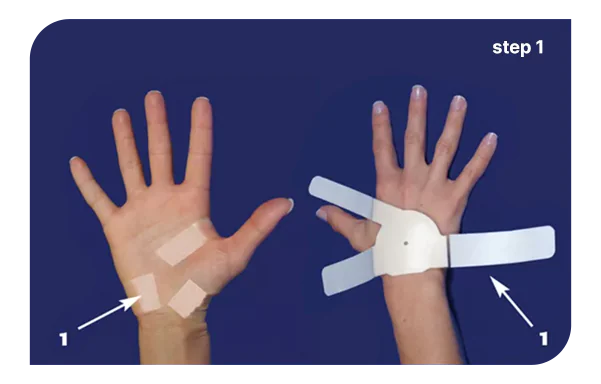
STEP 1: Place the Carpal Solution on the Back of the hand as shown with adhesive side down. Attach 1st strap below little finger securing it on the palm. Tear away excess tape to prevent overlap of straps on palm.
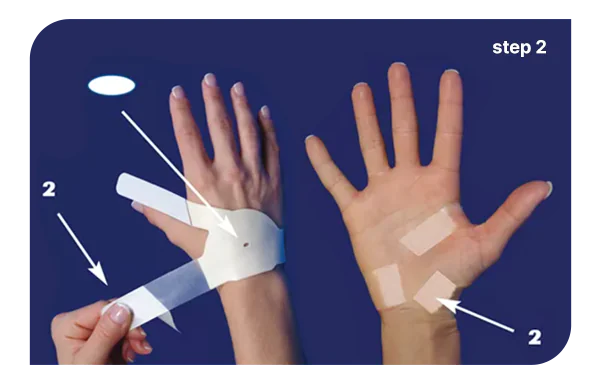
STEP 2: Self apply the appropriate tension to the Carpal Solution with 2nd strap below the thumb and attached on palm side of hand as shown. Adjust tension by stretching circular hole on back of hand in the elastic centerpiece to an oval shape. The diameter should be at least 1.5 times the original.
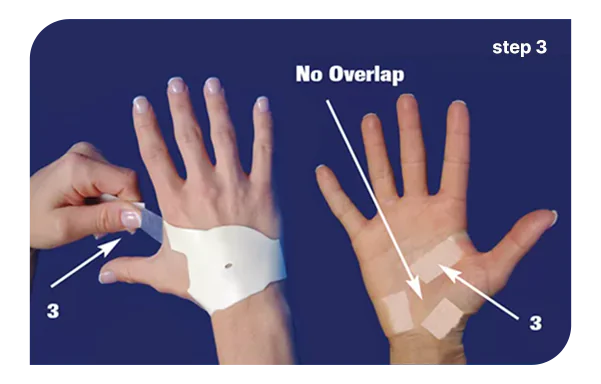
STEP 3: Self apply the appropriate tension to the Carpal Solution with 3rd strap above the thumb. Tear-away straps should be aligned so there is no overlap of straps on palm side of hand. The Carpal Solution begins to relieve symptoms usually within twenty minutes of placement.

Order Your Six Week Carpal Tunnel Treatment Now
The ONLY treatment for carpal tunnel that comes with a no questions asked 30-Day Patient Satisfaction Guarantee and in-house dedicated pain relief team.