 Created by renowned Harvard health care professionals.


Who Should Avoid Carpal Tunnel Surgery? Inflammatory Conditions and Other Red Flags
Since Carpal Tunnel is caused by excess inflammation or lymph fluid that gets entrapped in the Carpal Tunnel space, any patient with chronic physiological conditions that result in recurring inflammation should avoid surgery as a solution. The recurrence rate is too high for these patient groups. Also, anyone who has not first given well reviewed conservative treatments at least 12 weeks to reduce their carpal tunnel symptoms should hold off on surgery until they have tried the conservative first approach that is a hallmark of medical practice. There are solid conservative treatments for Carpal Tunnel Syndrome with 97% patient satisfaction. Here is what you need to know.

Written by Jeff Conley, President, First Hand Medical · Medically reviewed by Dr. Joseph E. Scherger, MD, MPH, family physician and clinical professor, UC San Diego School of Medicine · Last reviewed: November 2026
Who should avoid carpal tunnel surgery? In our doctors’ view, the answer is most people, at least at first. Two groups in particular should think hard before agreeing to an operation: anyone who has not yet given a well-reviewed conservative treatment a fair trial, and anyone living with inflammatory conditions that keep stirring up swelling throughout the body.

Here is the short list. Carpal tunnel surgery should generally be avoided by:
- Everyone who has not tried a well-reviewed conservative treatment for at least 12 weeks.
- People with inflammatory conditions that raise systemic inflammation, including autoimmune conditions such as rheumatoid arthritis, lupus, Crohn’s disease and autoimmune thyroid disease, and other conditions such as diabetes, gum disease, Lyme disease and obesity.
- People who smoke.
- People on blood thinners, who face an extra layer of risk and planning.
- People who have already had carpal tunnel surgery on the same hand.
- Pregnant women, whose symptoms often ease after the baby is born.
- People whose living depends on their hands and who cannot afford weeks of downtime.
Below, our doctors explain each group, what the published research shows and what to do instead. This is not about scaring anyone away from a doctor. It is about choosing the right order: conservative treatment first, surgery last.
Anyone Who Has Not Tried 12 Weeks of Conservative Treatment
Not sure whether you are ready for an operation? Read when to get carpal tunnel surgery and why our doctors recommend trying the Carpal Solution first.
Surgery is a last resort in almost every area of medicine, and carpal tunnel syndrome should be no exception. Yet many people are rushed to the operating table without ever trying a proven, well-reviewed conservative treatment.
Our doctors recommend giving conservative treatment at least 12 weeks before considering surgery. The Carpal Solution’s six-week protocol works for most people: most are better from their worst symptoms in two to three weeks, and over 90% resolve in six weeks. About 10%, usually people with extra systemic inflammation, need 8 to 12 weeks and are usually 50 to 70% better at six weeks. Twelve weeks gives even that group a fair chance.
If your symptoms are improving over the first 6 to 8 weeks, you are on the right track and surgery is not necessary. Read Is Carpal Tunnel Surgery Necessary?
Inflammatory Conditions: Why Surgery Is a Poor Fit
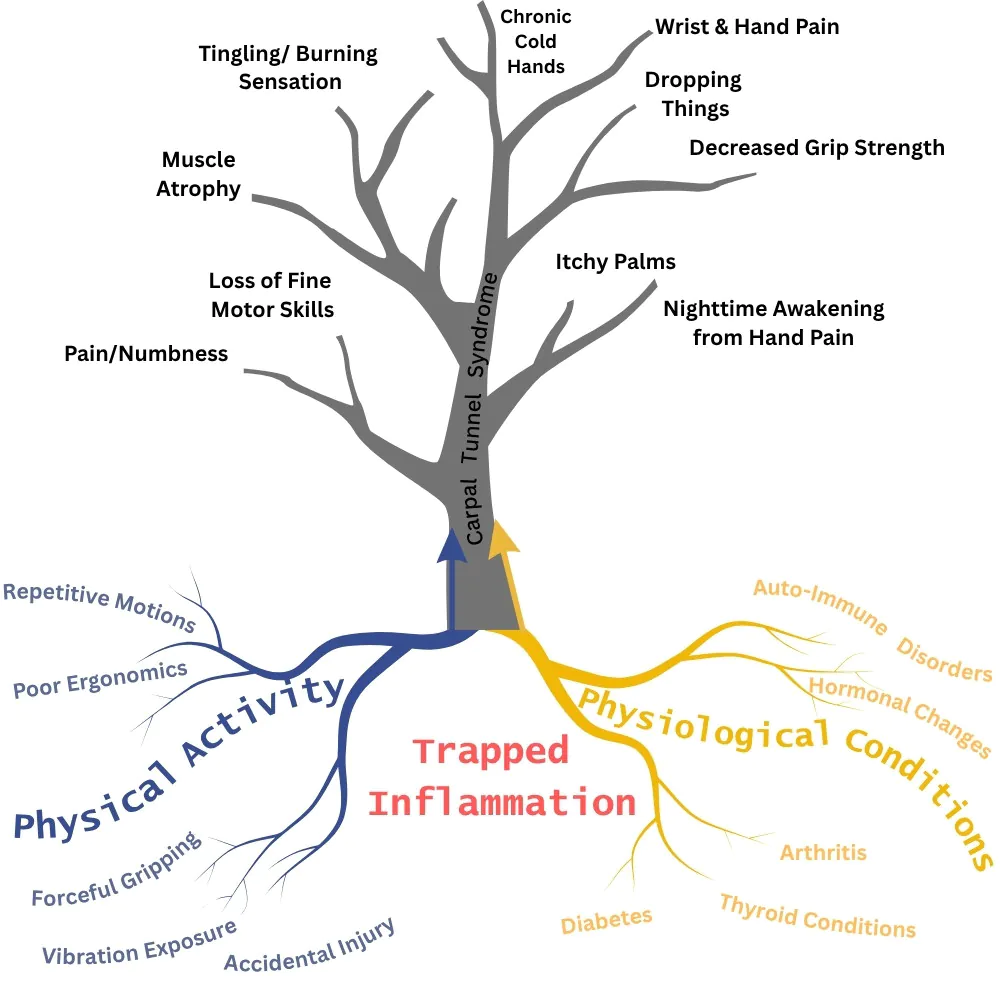
Carpal tunnel syndrome is a chronic, recurring condition brought on by excess inflammation. Swelling and entrapped inflammation in the soft tissue in and around the carpal tunnel squeeze the median nerve and restrict blood flow and lymphatic fluid transport. Some of that inflammation comes from how you use your hands. Much of it, for many people, comes from inflammatory conditions elsewhere in the body.
Surgery cuts the ligament over the carpal tunnel to make more room for the nerve. It does nothing about the inflammation. If you have a physiological condition that keeps generating excess systemic inflammation, the swelling keeps coming back to the same tight space, and so do the symptoms. That is why our doctors consider carpal tunnel surgery a poor way to treat carpal tunnel syndrome for these patients, and why they recommend these patients avoid surgery and treat the inflammation and the soft tissue instead.
An Inflammatory Diseases List for Carpal Tunnel Patients
These are the inflammatory conditions our doctors see most often in patients whose carpal tunnel symptoms keep returning:
- Autoimmune conditions: rheumatoid arthritis, lupus, Crohn’s disease and ulcerative colitis, autoimmune thyroid disease (Hashimoto’s and Graves’), psoriatic arthritis and type 1 diabetes.
- Metabolic conditions: type 2 diabetes, prediabetes and obesity.
- Other thyroid conditions: an underactive thyroid can cause fluid retention around the nerve.
- Chronic infections: gum disease (periodontitis) and Lyme disease.
- Other arthritis: osteoarthritis and gout can add swelling around the wrist.
If you think you might have one of these inflammatory conditions, even if it has not been formally diagnosed, talk with your doctor about testing and treatment. Getting the underlying condition under control helps your hands too. Read how systemic inflammation fuels carpal tunnel and underlying conditions that cause carpal tunnel.
What the Research Shows
Several of these inflammatory conditions raise the risk of carpal tunnel syndrome in the first place. Diabetes, obesity and rheumatoid arthritis are among the best-documented risk factors (Pourmemari and Shiri, Diabetic Medicine, 2016; Myasoedova et al., Arthritis Care & Research, 2025).
The research on surgery is more limited, but it points the same way. In a study of 7,464 patients, smoking and rheumatoid arthritis were independently associated with needing a second carpal tunnel release (Westenberg et al., Plastic and Reconstructive Surgery, 2020). A national database study found that diabetes, tobacco use, psychiatric conditions, cervical spine disease and a history of cubital tunnel release raised the odds of revision surgery within the first year (The Epidemiology of Carpal Tunnel Revision Over a 1-Year Follow-Up Period, 2021). A more recent study comparing open and endoscopic release also identified rheumatoid arthritis as an independent risk factor for revision.
To be fair, the evidence is mixed for some conditions. A meta-analysis of diabetic patients found similar improvement in symptoms and function after surgery to non-diabetic patients, although nerve recovery was weaker (Moradi et al., Journal of Hand Therapy, 2020). And most studies only count repeat operations over a year or two, not symptoms that slowly return over many years.
Our doctors’ two decades of clinical experience fill in that gap: in their experience, patients with inflammatory conditions are the ones whose symptoms most often come back after surgery. That is clinical experience, not a statistically researched figure, and it is the reason for their position.
Gum Disease and Inflammation: The Hidden Source
 Gum disease is one of the most overlooked inflammatory conditions. Periodontal disease inflammation does not stay in the mouth. A 2021 meta-analysis found that people with periodontitis have higher blood levels of C-reactive protein, a standard marker of systemic inflammation, and a 2022 review of 26 randomized trials found that treating periodontitis lowers it (Machado et al., Frontiers in Immunology, 2021; Luthra et al., Journal of Clinical Periodontology, 2022).
The link between gum disease and inflammation elsewhere in the body is one more reason to see your dentist regularly. If you have bleeding gums, receding gums or loose teeth, get them treated before you consider surgery on your hands.
Thyroid Conditions and Carpal Tunnel Surgery
An underactive thyroid causes the body to hold on to fluid, including in the soft tissue around the median nerve. In a small study of patients having carpal tunnel release, those with hypothyroidism improved significantly less after surgery than patients with normal thyroid function (Roshanzamir et al.). If you have thyroid disease, or symptoms such as fatigue, weight gain, feeling cold and dry skin, ask your doctor to check your thyroid levels. Getting your thyroid under control is one of the most effective ways to calm carpal tunnel symptoms, and it is another reason to try conservative treatment before surgery.
Lyme Disease and Carpal Tunnel
Lyme disease is another inflammatory condition that can show up in the hands. In a study of patients with late Lyme disease, about 25% had nerve testing that confirmed carpal tunnel syndrome (Halperin et al., Muscle & Nerve, 1989). If you live in or have traveled to an area with Lyme disease and your carpal tunnel symptoms came with fatigue, joint pain or other unexplained symptoms, ask your doctor about testing. Surgery will not treat an infection.
Smoking and Carpal Tunnel Surgery
Smoking and carpal tunnel make a poor combination. Smoking narrows blood vessels and slows healing, and in the 7,464-patient study above, smoking was independently associated with needing a second carpal tunnel release. If you smoke, quitting helps your hands heal whether or not you ever have surgery.
People on Blood Thinners
If you take a blood thinner such as warfarin, apixaban (Eliquis) or clopidogrel, surgery adds an extra layer of risk and planning. Your surgeon and the doctor who prescribed the blood thinner have to decide together whether to stop it, pause it or operate while you keep taking it. Never stop a blood thinner on your own; stopping it can raise your risk of stroke or a blood clot.
Research shows carpal tunnel release can often be done safely without stopping blood thinners, but the decision still carries risk on both sides, and many people on blood thinners also have the heart and vascular conditions that make any procedure more complicated. A conservative treatment at home avoids that whole decision. Read blood thinners before surgery.
Other People Who Should Avoid Carpal Tunnel Surgery
- People who have already had surgery on the same hand. Second carpal tunnel surgeries have a patient satisfaction rate between 16% and 40%, based on lingering symptoms in the published medical literature. Read symptoms return after carpal tunnel surgery.
- Pregnant women. Fluid retention during pregnancy often causes carpal tunnel symptoms that ease after the baby is born. Conservative treatment is the sensible choice.
- People whose living depends on their hands. Dentists and dental hygienists, surgeons, musicians, hairstylists, mechanics and keyboard workers cannot easily afford weeks of downtime, or lingering numbness and weak grip afterward.
Why Even Healthy Patients Should Be Cautious
Carpal tunnel surgery has a patient satisfaction rate lower than 69%: about 31% of patients report lingering or recurring symptoms, and no patient is satisfied with lingering symptoms. Even after a successful surgery, symptoms often return: the highest published rate is 57% with at least some symptoms returning within five and a half years (Nancollas et al., 1995, reviewed in Louie, Earp and Blazar, Hand, 2012). Based on two decades of clinical experience, our doctors estimate that symptoms return for 80 to 90% of patients within 10 years; that is not a statistically researched figure. Read more about recurrence after surgery.
If those are the odds for an average patient, the case for avoiding surgery is even stronger when inflammatory conditions keep feeding the problem. Read Why Should I Avoid Carpal Tunnel Surgery? and How Long Does Carpal Tunnel Surgery Last?
What to Do Instead: Treat the Inflammation and the Soft Tissue
For people with inflammatory conditions, the best plan works on two fronts at once.
- Treat the soft tissue in your hands. The Carpal Solution’s targeted passive stretching restores flexibility to the injured soft tissue, relieves pressure on the median nerve, relieves restrictions on blood circulation and lets lymph fluid flow freely to clear out the swelling. It is your body that does the healing; the Carpal Solution just jump-starts it. Plan on the full 12 weeks if you have an inflammatory condition.
- Lower the inflammation in your body. Work with your doctor to control diabetes, thyroid disease, autoimmune conditions and gum disease. Stay hydrated, keep up aerobic exercise and eat an anti-inflammatory diet; our doctors recommend Dr. Valter Longo’s The Longevity Diet, Dr. Nicole Avena’s Why Diets Fail and Max Lugavere’s Genius Foods. See carpal tunnel inflammation.
- Use prevention to stay in remission. Because inflammatory conditions do not go away, wear the Carpal Solution as prevention anywhere from one night a week to once every six months.
- Add the Persistent Symptoms Protocol if needed. Cold water plunges, dry needling, deep tissue massage, electrolytes and deep diaphragm breathing can help. See the Persistent Symptoms Protocol.
The Carpal Solution has 97% patient satisfaction over 21 years and 4.9 out of 5 stars on independent review sites like Google Reviews, and over 100,000 people have used it over two decades. Neurologists, including Dr. James S. Zu, MD, PhD, of Edison, New Jersey, call it a better first line of defense. Patients with lupus and arthritis have shared their Patient Experiences: read Lupus and Carpal Tunnel and carpal tunnel and arthritis.
When Healing Needs a Doctor’s Help and Professional Medical Evaluation
- Constant numbness that does not improve or loss of feeling in the fingertips that does not improve in 4 to 8 weeks.
- Extreme loss of the muscle at the base of the thumb, with loss of grip strength that does not improve over 6 to 8 weeks.
- Worsening symptoms over 6 to 8 weeks while using the best conservative treatments
- Symptoms that begin suddenly after hand or wrist trauma, a fracture or severe sprain from a fall or auto accident.
- Odd Symptoms that are not consistent with the Carpal Tunnel Symptoms listed on this website, that might be indicative of other nerve issues. A nerve conductivity study can clear up the confusion with minimal costs and not too much pain and no risk.
These signs may mean more advanced nerve involvement or a different condition and deserve professional medical evaluation and in person consultation. Home treatment can be used alongside professional in-person medical care while you wait for the healthcare delivery system to fit you into their schedule. There is no reason to wait doing nothing. You can start proven natural conservative treatment with good patient reviews while you wait for your appointments. If your symptoms start improving over 6 to 8 weeks, then you know you are on the right track and surgery is not necessary.
Who Should Avoid Carpal Tunnel Surgery: FAQ
Who should avoid carpal tunnel surgery?
Anyone who has not tried a well-reviewed conservative treatment for at least 12 weeks, and people with inflammatory conditions, smokers, people on blood thinners, people who have already had surgery on that hand and pregnant women.
Which inflammatory conditions make carpal tunnel come back?
In our doctors’ experience, autoimmune conditions such as rheumatoid arthritis and lupus, diabetes, thyroid disease, obesity, gum disease and Lyme disease. Published studies link rheumatoid arthritis, diabetes and smoking to higher rates of repeat surgery.
Is carpal tunnel surgery safe if I have diabetes?
Many people with diabetes have surgery, and studies show similar short-term symptom improvement, but nerve recovery is often weaker and diabetes has been linked to more repeat surgery. Try conservative treatment first and work on blood sugar control.
Can gum disease cause inflammation in the body?
Yes. Periodontitis raises C-reactive protein, a marker of systemic inflammation, and treating it lowers that marker.
Should I stop my blood thinner before carpal tunnel surgery?
Never on your own. Only your prescribing doctor and surgeon together can make that decision. Conservative treatment at home avoids the question entirely.
When is surgery the right choice?
When the warning signs above are present, or when 12 weeks of well-reviewed conservative treatment has not helped. Even then, controlling inflammatory conditions first gives surgery its best chance.
References
- Westenberg RF, et al. Revision Carpal Tunnel Release: Risk Factors and Rate of Secondary Surgery. Plastic and Reconstructive Surgery. 2020;145(5):1204-1214.
- The Epidemiology of Carpal Tunnel Revision Over a 1-Year Follow-Up Period. 2021.
- Comparative Analysis of Comorbidities and Outcomes in Endoscopic versus Open Treatment of Carpal Tunnel Release in Patients with Rheumatoid Arthritis (PMC12823191).
- Moradi A, et al. Does diabetes mellitus change the carpal tunnel release outcomes? Journal of Hand Therapy. 2020.
- Pourmemari MH, Shiri R. Diabetes as a risk factor for carpal tunnel syndrome: a systematic review and meta-analysis. Diabetic Medicine. 2016;33(1):10-16.
- Myasoedova E, et al. Carpal tunnel syndrome as an early underrecognized feature of rheumatoid arthritis. Arthritis Care & Research. 2025.
- Machado V, et al. Serum C-Reactive Protein and Periodontitis: A Systematic Review and Meta-Analysis. Frontiers in Immunology. 2021;12:706432.
- Luthra S, et al. Treatment of Periodontitis and C-Reactive Protein: A Systematic Review and Meta-Analysis of Randomized Clinical Trials. Journal of Clinical Periodontology. 2022.
- Roshanzamir S, Mortazavi S, Dabbaghmanesh A. Does Hypothyroidism Affect Post-Operative Outcome of Patients Undergoing Carpal Tunnel Release? (PMC5074759).
- Halperin JJ, et al. Carpal tunnel syndrome in Lyme borreliosis. Muscle & Nerve. 1989;12(5):397-400.
- Nancollas MP, et al. Long-term results of carpal tunnel release. Journal of Hand Surgery (British). 1995;20(4):470-474.

Order Your Six Week Carpal Tunnel Treatment Now
The ONLY treatment for carpal tunnel that comes with a no questions asked 30-Day Patient Satisfaction Guarantee and in-house dedicated pain relief team.
Watch videos of people who “Cured” their Carpal Tunnel Naturally and Avoided the Risks of Carpal Tunnel Surgery!