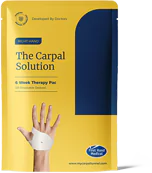
 Created by renowned Harvard health care professionals.


Mild Carpal Tunnel Treatment: What to Do First
Mild carpal tunnel treatment works best when you start early and treat the nights. If your symptoms come and go and your grip is still strong, the nerve is irritated but not damaged. Here is what our doctors recommend you do first, how the options compare, and the mistakes that keep mild carpal tunnel from getting better.

Written by Jeff Conley, First Hand Medical · Medically reviewed by William Shucart, MD, neurosurgeon and former chair of the Department of Neurosurgery at Tufts Medical School · Last reviewed: November 2026
Mild carpal tunnel treatment is simpler than most people expect. When symptoms come and go, mostly at night, and your grip is still strong, the median nerve is irritated but not damaged. That is the stage where gentle, natural treatment at home works best, and where you can usually stop carpal tunnel from progressing.
This guide explains how to tell if your carpal tunnel is mild, what our doctors recommend you do first, how the common options compare, and the mistakes that keep mild carpal tunnel from getting better.
Table of Contents
Mild Carpal Tunnel Treatment: The Short Answer
- Start at home, right away. Mild carpal tunnel responds best to conservative care, and there is no reason to wait for an appointment to begin.
- Treat the nights first. Most mild symptoms start during sleep, when bent wrists raise pressure in the tunnel. Passive stretching at night works during those hours.
- Add simple daytime habits: gentle stretches, straight wrists and short breaks from gripping.
- Give it 4 to 6 weeks. Improvement in that window shows the treatment is working and that surgery is not necessary.
- Skip what doesn’t help: pills, vitamin B6 and rigid daytime braces don’t treat the cause.
What Counts as Mild Carpal Tunnel?

Mild carpal tunnel syndrome usually looks like this:
- Tingling or numbness in the thumb, index, middle and part of the ring finger that comes and goes.
- Symptoms that are worst at night or on waking, and get better when you shake or move your hands.
- Flare-ups after driving, holding a phone, typing or gripping tools.
- Normal grip and pinch strength, with no flattening of the muscle at the base of the thumb.
At this stage, the nerve is short of blood flow and irritated by pressure, but its structure is intact. If nerve tests are done, they show only mild slowing, or may even be normal. Doctors can often recognize carpal tunnel from your symptoms alone: the American Academy of Orthopaedic Surgeons now supports a simple six-question clinical tool, the CTS-6, as an accurate way to diagnose it (AAOS guideline summary, 2025).
Not sure where you stand? Take our carpal tunnel self-test, compare your symptoms with the common carpal tunnel symptoms, and read the signs of carpal tunnel.
Why Mild Is the Best Time to Treat
Carpal tunnel syndrome is an entrapment syndrome. Inflammation and swelling build up inside the narrow tunnel at the wrist and squeeze the median nerve, along with the small blood vessels and lymph channels around it. As blood flow and lymph drainage slow, fluid stays trapped and pressure climbs. Bring that pressure down early, and the nerve usually recovers fully.
Research shows that time is the key factor. In a study of 196 people with untreated carpal tunnel, many improved, and a short duration of symptoms was the strongest predictor of getting better (Neurology, 2001). On average, though, carpal tunnel that is left alone for years tends to slowly progress. Read What Happens If Carpal Tunnel Is Left Untreated?
That makes mild carpal tunnel treatment the best investment you can make in your hands. It is easier, faster and more complete than treating later, and starting a gentle, natural treatment never closes any doors. Our doctors explain the reasoning in Why Start with the Best Conservative Treatment First.
Mild Carpal Tunnel or Something Else?
Before you start mild carpal tunnel treatment, it helps to rule out conditions that can feel similar. Carpal tunnel symptoms follow the median nerve: the thumb, index finger, middle finger and the thumb side of the ring finger. Symptoms outside that pattern may point somewhere else.
- Little finger numbness usually involves the ulnar nerve at the elbow, not the carpal tunnel.
- Neck pain with tingling down the arm can come from a pinched nerve in the neck. See neck and shoulder pain.
- Pain on the thumb side of the wrist when you move the thumb often means tendonitis. See wrist tendonitis vs. carpal tunnel.
- A finger that catches or locks suggests trigger finger.
- Joint pain and stiffness at the base of the thumb may be arthritis, which can also occur alongside carpal tunnel. See arthritis and carpal tunnel.
Many people have more than one of these at the same time. If your symptoms don’t fit the usual pattern, a doctor’s exam, and sometimes a nerve conduction study, can sort it out. You can still start gentle mild carpal tunnel treatment at home while you wait to be seen.
Mild Carpal Tunnel Treatment: What to Do First
Here is the conservative-first plan our doctors recommend as treatment for mild carpal tunnel. You can start it today, while you wait for any appointments.
Step 1: Treat the Nights With Passive Stretching
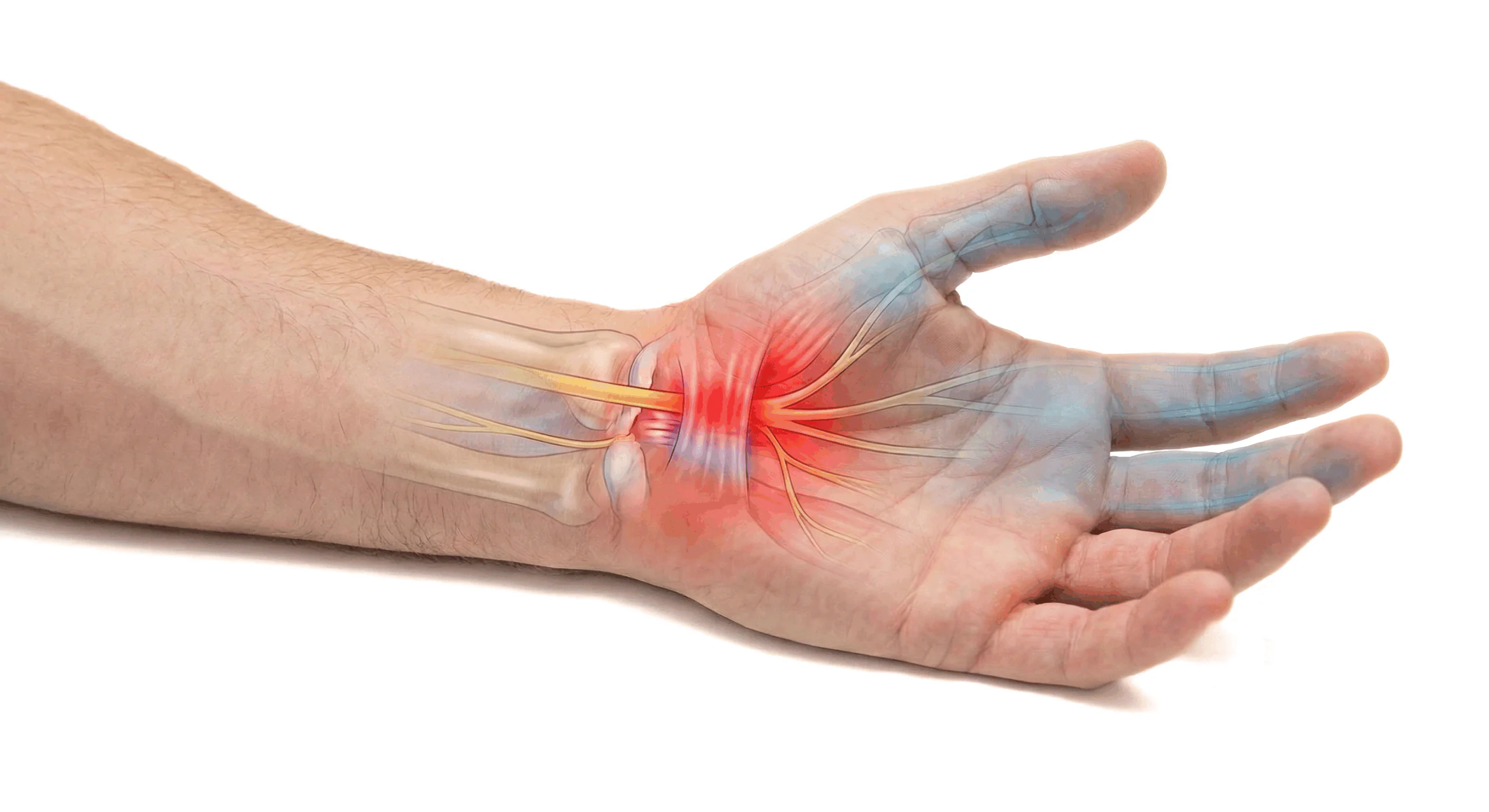
Wear the Carpal Solution while you sleep. Its gentle straps apply light, constant tension to the tissue around the carpal tunnel for 6 to 8 hours, loosening the tight tissue so trapped inflammation can disperse and blood and lymph can flow again. Most people use it nightly for 6 weeks, which adds up to more than 250 hours of passive stretching while you rest. Patients rate it 4.9 out of 5 stars on Google Reviews.
Step 2: Add Daytime Stretches if Your Schedule Allows
Up to 6 sets of 10 reps per day, holding each stretch 15 seconds with 30 seconds’ rest. Daytime discipline is hard to keep up, but combined with night treatment it speeds recovery. Follow the best exercises for carpal tunnel.
Step 3: Keep Your Wrists Straight
Bending the wrist far up or down raises pressure in the tunnel. Keep the keyboard at elbow height, use a lighter grip, take a 1 to 2 minute break every 30 to 60 minutes, and avoid sleeping on curled wrists. Use our ergonomic checklist.
Step 4: Lower Whole-Body Inflammation
Weight, blood sugar and thyroid health all affect inflammation and fluid in the tunnel. Small changes here make mild carpal tunnel less likely to return. Read how systemic inflammation fuels CTS.
Step 5: Track Your Progress for 4 to 6 Weeks
Note night wake-ups, tingling and dropped objects each week. Most people with mild carpal tunnel notice better sleep within 1 to 3 weeks. Improvement over 4 to 6 weeks shows the treatment is working. See the full 6-week healing timeline.
Step 6: Keep It Mild
Carpal tunnel is a chronic, recurring condition, even after surgery. Once you are better, a maintenance night every few weeks or months, and a few nights in a row if symptoms flare, keeps mild carpal tunnel from coming back.
Treatment Options for Mild Carpal Tunnel, Rated
| Option | Evidence | Role in mild carpal tunnel treatment |
|---|---|---|
| Passive stretching at night (Carpal Solution) | Clinical documentation and strong patient-reported results | First step; works on trapped inflammation while you sleep |
| Night splint | Moderate to low; may not help in the short term (Cochrane 2023) | Holds the wrist straight but does not stretch the tissue |
| Manual therapy | Moderate; matched surgery at one year in one trial | Helpful add-on with a trained therapist |
| Nerve and tendon glides | Low (Cochrane 2022) | Safe, free add-on |
| Ergonomics and breaks | Expert consensus | Essential for work-related symptoms |
| Steroid injection | Short-term relief only (AAOS) | Not needed for most mild cases |
| Pills and vitamin B6 | B6 shown ineffective; pills mask symptoms | Not a treatment |
| Surgery | Effective for severe cases | Not a first step for mild carpal tunnel |
Splints hold the wrist still but do not stretch the tight tissue over the tunnel; a 2023 Cochrane review rated the evidence for splinting as low certainty (Cochrane). In one randomized trial, manual physical therapy gave pain relief and function similar to surgery at 6 and 12 months (The Journal of Pain, 2015). The AAOS guidelines find steroid injections give short-term relief but no long-term improvement compared with other conservative care (AAFP, 2025). A systematic review found moderate evidence that vitamin B6 is ineffective (Clinical Rehabilitation, 2007). See Vitamin B6 and Supplements for Carpal Tunnel.
For a deeper comparison, read Natural Remedies for Carpal Tunnel: 10 Options Rated by the Evidence and splints vs. the Carpal Solution.
Common Mistakes With Mild Carpal Tunnel
- Waiting to see if it goes away. Some mild cases settle, but starting treatment early costs nothing and gives the nerve its best chance.
- Treating only the daytime. Night is when pressure builds; night treatment covers the hours that matter most.
- Stopping too soon. Many people feel better in two or three weeks and stop. Finish the full 6 weeks so pressure doesn’t build back up.
- Relying on pain pills, creams or vitamin B6. They may ease symptoms but don’t lower pressure in the tunnel. See carpal tunnel relief cream: what actually helps.
- Wearing a rigid brace all day. Daytime bracing can weaken the hand and get in the way of work without treating the cause.
Mild Carpal Tunnel at Work and in Pregnancy

At work. Stylists, nurses, dentists, mechanics, musicians and keyboard workers are all at higher risk because they use their hands intensely every day. For them, mild carpal tunnel treatment that works at night is especially valuable: there is no downtime and nothing to wear during the workday. See who is at risk for carpal tunnel.
In pregnancy. Fluid changes during pregnancy often bring on mild carpal tunnel, and symptoms usually ease in the weeks or months after delivery. Gentle, drug-free care is a good fit while you wait; check with your obstetrician first. Read pregnancy and carpal tunnel.
What Patients Say
Many patients on our site started mild carpal tunnel treatment while their symptoms were still mild, or wish they had. Kathy, a surgical nurse on California’s Central Coast, could not take weeks off 12-hour shifts. She wore the Carpal Solution every night. For the first three to four weeks she felt little change; around week five it started working, and by week six, in her words, it was gone.
Marcee, a hairstylist, waited 13 or 14 years before treating her carpal tunnel. Within two to three days of starting passive stretching at night, she says, she had about an 80% change in her hands. Watch her video in Hair Stylist Saves Career, or see seven patient videos in How I Cured My Carpal Tunnel Without Surgery. Each story is personal, and results vary.
When Healing Needs a Doctor’s Help and Professional Medical Evaluation
- Constant numbness that does not improve or loss of feeling in the fingertips that does not improve in 4 to 8 weeks.
- Extreme loss of the muscle at the base of the thumb, with loss of grip strength that does not improve over 6 to 8 weeks.
- Worsening symptoms over 6 to 8 weeks while using the best conservative treatments
- Symptoms that begin suddenly after hand or wrist trauma, a fracture or severe sprain from a fall or auto accident.
- Odd Symptoms that are not consistent with the Carpal Tunnel Symptoms listed on this website, that might be indicative of other nerve issues. A nerve conductivity study can clear up the confusion with minimal costs and not too much pain and no risk.
These signs may mean more advanced nerve involvement or a different condition and deserve professional medical evaluation and in person consultation. Home treatment can be used alongside professional in-person medical care while you wait for the healthcare delivery system to fit you into their schedule. There is no reason to wait doing nothing. You can start proven natural conservative treatment with good patient reviews while you wait for your appointments. If your symptoms start improving over 6 to 8 weeks, then you know you are on the right track and surgery is not necessary.
Mild Carpal Tunnel Treatment: FAQ
What is the best mild carpal tunnel treatment?
Our doctors recommend starting with passive stretching at night for 6 weeks, plus daytime stretches, straight wrists and short breaks from gripping. This works on the trapped inflammation behind the symptoms.
Can mild carpal tunnel go away on its own?
Sometimes, especially when symptoms are recent or related to pregnancy. But starting gentle treatment early gives the nerve its best chance and costs nothing.
How long does mild carpal tunnel take to heal?
Many people notice better sleep within 1 to 3 weeks. Improvement over 4 to 6 weeks shows the treatment is working, and a full program runs about 6 weeks.
Do I need a doctor for mild carpal tunnel?
It is wise to let your doctor know, and you can start treatment at home while you wait for an appointment. Seek a professional evaluation if symptoms do not improve over 4 to 8 weeks.
Should I wear a brace for mild carpal tunnel?
A night splint can keep the wrist straight, but it does not stretch the tissue around the tunnel. Rigid daytime braces can weaken the hand. Passive stretching at night works on the cause.
Does mild carpal tunnel need surgery?
Rarely. Mild carpal tunnel treatment starts with conservative care, and most people improve without an operation.
How do I treat mild carpal tunnel at home?
Wear a passive stretching device such as the Carpal Solution at night for 6 weeks, add gentle daytime stretches if your schedule allows, keep your wrists straight at work and in bed, and take short breaks from gripping. Track your symptoms weekly; improvement over 4 to 6 weeks shows the treatment is working.
Sources
- Padua L, et al. (Italian CTS Study Group). Multiperspective follow-up of untreated carpal tunnel syndrome. Neurology. 2001;56(11):1459–1466. doi.org/10.1212/wnl.56.11.1459
- Sadler KP, Torbert DR, Writer JK. Management of carpal tunnel syndrome: guidelines from the AAOS. American Family Physician. 2025;112(3):337–339. AAFP
- Karjalainen TV, et al. Splinting for carpal tunnel syndrome. Cochrane Database of Systematic Reviews. 2023. Cochrane Library
- Fernández-de-las-Peñas C, et al. Manual physical therapy versus surgery for carpal tunnel syndrome. The Journal of Pain. 2015. Summary
- Exercise and mobilisation interventions for carpal tunnel syndrome. Cochrane Database of Systematic Reviews. 2022. Cochrane
- Piazzini DB, et al. A systematic review of conservative treatment of carpal tunnel syndrome. Clinical Rehabilitation. 2007;21(4):299–314. PubMed
Disclosure: First Hand Medical makes the Carpal Solution, and Dr. Shucart is an investor and advisory board member of the company. This article is for education and is not a substitute for advice from your own doctor.