 Created by renowned Harvard health care professionals.


Hand Pain When Gripping: Palm, Finger and Thumb Pain Explained
Hand pain when gripping usually comes from swollen tendon linings crowding the median nerve in the carpal tunnel at the base of the palm, or from trigger finger, thumb arthritis or tendonitis. Our doctors explain the 7 causes by location and what helps.

Hand Pain When Gripping: What Our Doctors Want You to Know
Written by Jeff Conley, President, First Hand Medical · Medically reviewed by Dr. Michael E. Ruff, MD, orthopedic hand surgeon and associate clinical professor of orthopedic surgery, Ohio State University · Last reviewed: November 2026
Hand pain when gripping is one of the most common hand complaints our doctors hear. A coffee mug, a steering wheel, a jar lid or a phone suddenly hurts to hold. Where the pain sits tells you a lot about why.
Every grip pulls on the nine tendons that bend the fingers and thumb. Those tendons run from the forearm muscles through the carpal tunnel, which is not in the wrist; it is at the base of the palm between the two major muscles of the hand. When their linings are swollen, every squeeze crowds the median nerve, and gripping hurts.
On This Page
Key points
- Palm pain when gripping with numb or tingling fingers usually points to the carpal tunnel at the base of the palm.
- Pain at the base of one finger with catching or clicking points to trigger finger.
- Pinching and pressing with the fingertips raise pressure inside the carpal tunnel.
- Skip squeeze balls, putty and grip strengtheners while you heal.
- Conservative-first care that follows medicine’s “Do No Harm” principle comes first; surgery is the last resort.
Why Does My Hand Hurt When Gripping?
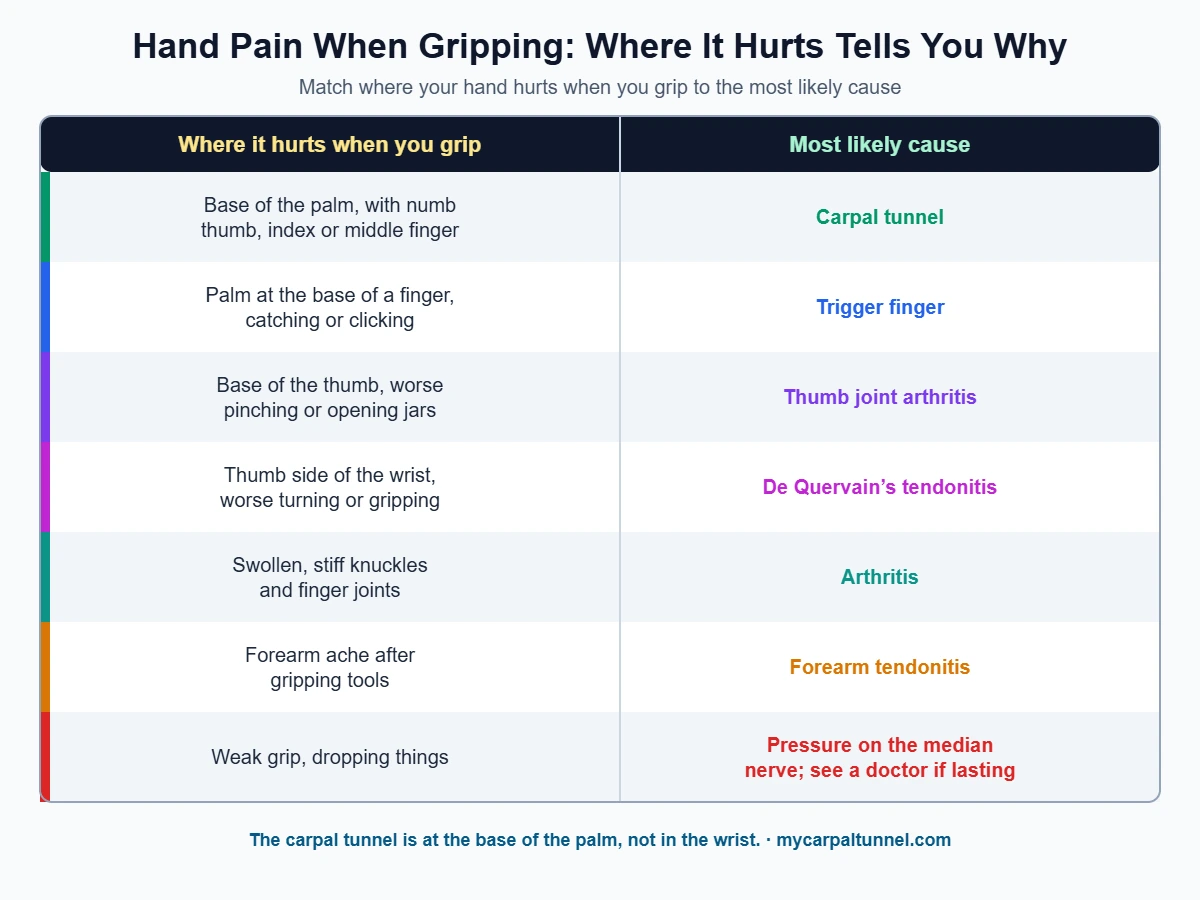
If your hand hurts when gripping, start with the anatomy. The muscles that bend your fingers and thumb live in the forearm. Their nine tendons run through the carpal tunnel at the base of the palm, right beside the median nerve. Every time you grip, those tendons tighten and slide through that tight space.
Healthy tendons glide smoothly. When their linings are swollen and inflamed from repetitive use, gripping crowds the tunnel and squeezes the nerve. Researchers who measured pressure inside the carpal tunnel found that even small fingertip loads raised it significantly, in every wrist position they tested. A pinch grip nearly doubled the pressure compared with pressing with one fingertip.
That is why hand grip pain often comes with numbness, tingling or a weak, clumsy feeling, and why it tends to be worst after a day of gripping tools, a steering wheel or a phone.
Pain When Gripping: 7 Causes by Location
1. Palm Pain When Gripping: Carpal Tunnel
Pain at the base of the palm, often with numb or tingling thumb, index and middle fingers, points to the carpal tunnel. It is usually worse at night and after gripping. See carpal tunnel wrist pain.
2. Finger Pain When Gripping: Trigger Finger
Soreness in the palm at the base of a finger, worse when gripping, squeezing or holding something, with a tender bump or a catching, clicking or locking finger, points to trigger finger. It is common with repetitive gripping, diabetes and rheumatoid arthritis.
3. Base of the Thumb: Thumb Joint Arthritis
Pain at the base of the thumb when you grip, grasp or pinch, especially turning a key or opening a jar, points to arthritis in the thumb’s base joint. See thumb joint pain.
4. Thumb Side of the Wrist: De Quervain’s Tendonitis
Sharp pain on the thumb side of the wrist when you grip or turn your wrist points to De Quervain’s. See severe wrist pain.
5. Knuckles and Finger Joints: Arthritis
Swollen, stiff, aching knuckles that hurt when you grip point to arthritis. See arthritis symptoms in hands.
6. Forearm Ache: Forearm Tendonitis
An ache in the forearm after gripping tools or a racket comes from the same muscles that drive the grip. See forearm tendonitis.
7. A Lump: Ganglion Cyst
A fluid-filled lump near a tendon can hurt when pressed by a grip. See ganglion cysts.
Hand Pain When Making a Fist
Hand pain when making a fist is the same problem from a different angle. A full fist pulls every finger tendon to the end of its range, through the carpal tunnel and the tendon sheaths in the palm and fingers. Swollen linings make that last stretch hurt.
- Pain when making a fist in the morning that eases as you move points to fluid and stiffness that built up overnight, or to arthritis.
- Pain with a click or catch as you close or open the fist points to trigger finger.
- Pain with numb fingers points to the carpal tunnel.
Gentle tendon glides, moving the fingers slowly through a hook, a full fist and a flat fist, help the tendons slide without forcing them. See finger exercises and painful finger joints.
Lose Grip in Hands? When Gripping Turns to Weakness
Pain often comes first. If the pressure on the median nerve continues, the hand grip weak feeling follows: jars feel tighter, pens slip, and you may lose grip in hands just as you lift a cup. A weakening grip in hands has two parts:
- The nerve: the median nerve powers the muscles at the base of the thumb. When it is squeezed long enough, those muscles weaken and can thin.
- The forearm: the muscles that drive your grip are in the forearm. Pain and disuse weaken them too, which costs both strength and dexterity in the thumb and fingers.
A weak grip deserves attention, especially with thumb muscle thinning. See hand weakness, why you keep dropping things and muscle atrophy and carpal tunnel.
Why Grip Strengtheners Can Backfire
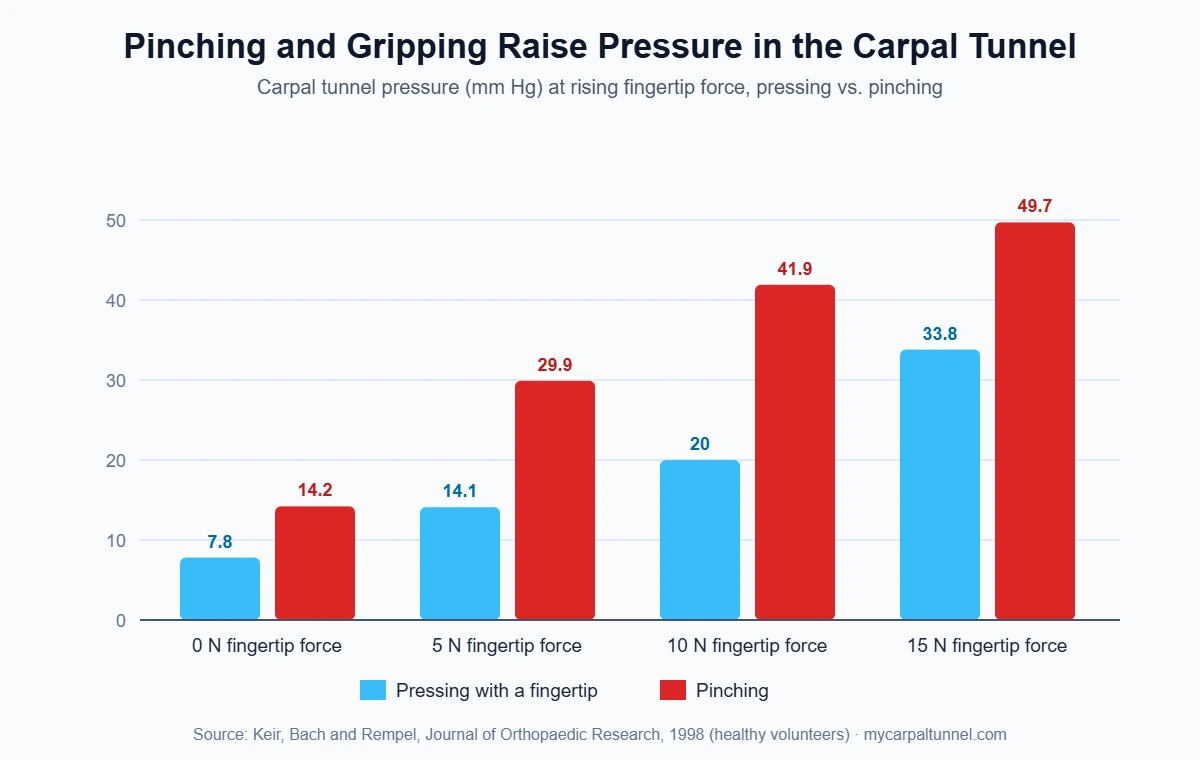
It seems logical to fix a weak, painful grip with a squeeze ball or hand gripper. Our doctors say not yet. In the lab, carpal tunnel pressure rose with every increase in fingertip force, and a pinch grip at the same force raised it about twice as much as pressing with one finger. The researchers warned that relatively low fingertip forces, especially in a pinch grip, raise carpal tunnel pressure to levels that, if prolonged, may cause or worsen carpal tunnel syndrome.
So while you heal, skip squeeze balls, putty and grip strengtheners. Relieve the pressure first; strength returns once the nerve and tendons have room again.
Hand Pain When Gripping at Work and at Home
Most hand grip pain shows up in the same everyday moments. Small changes in how you hold things take pressure off the tendons and the median nerve.
Driving
A tight grip on the steering wheel for a long drive keeps the finger tendons loaded for an hour or more. Hold the wheel lightly at a lower position, relax your fingers at stops, and open and close your hands every so often.
Phones and Tablets
Holding a phone pinches it between the thumb and fingers, the kind of grip that raised carpal tunnel pressure most in the lab. Use a stand, switch hands, or rest the device on a table or pillow.
Tools and Yard Work
Drills, wrenches, rakes and pruners demand a hard, repetitive grip. Choose tools with thick, cushioned handles, keep blades sharp so you push less, and take short breaks to stretch. See repetitive strain injury.
Kitchen Tasks
Opening jars, chopping and carrying heavy pots are classic triggers. Use a jar opener, a sharp knife and two hands to carry.
Mouse, Keyboard and Game Controllers
A mouse or controller gripped tightly for hours keeps the hand in a constant light squeeze. Loosen your grip, take breaks and stretch between sessions. See wrist pain from using a mouse.
Sports and Hobbies
Golf, tennis, climbing, knitting and playing an instrument all load the same tendons. Warm up, ease back after time off, and watch for pain that lasts into the next day.
If hand pain when gripping still follows you through the day, the swelling in the carpal tunnel needs to come down, not just the grip to get lighter.
What Helps Hand Pain When Gripping
- Grip lighter and bigger. Use thicker handles, pen grips and padded tools so your hand does not have to squeeze as hard.
- Avoid the pinch. Hold objects with the whole hand instead of the fingertips when you can.
- Take breaks. Open and stretch your hand every 20 to 30 minutes during gripping work, and switch hands when possible.
- Calm the inflammation. Our doctors recommend a cold plunge at about 43°F for 20 minutes for sore, swollen hands.
- Stretch gently. Daytime stretches and tendon glides keep the tendons moving.
- Think twice about splints. Splints carry two separate harms: muscle atrophy from disuse, and restricted circulation and lymph flow that slows soft-tissue healing.
Our Doctors’ Plan for Hand Grip Pain
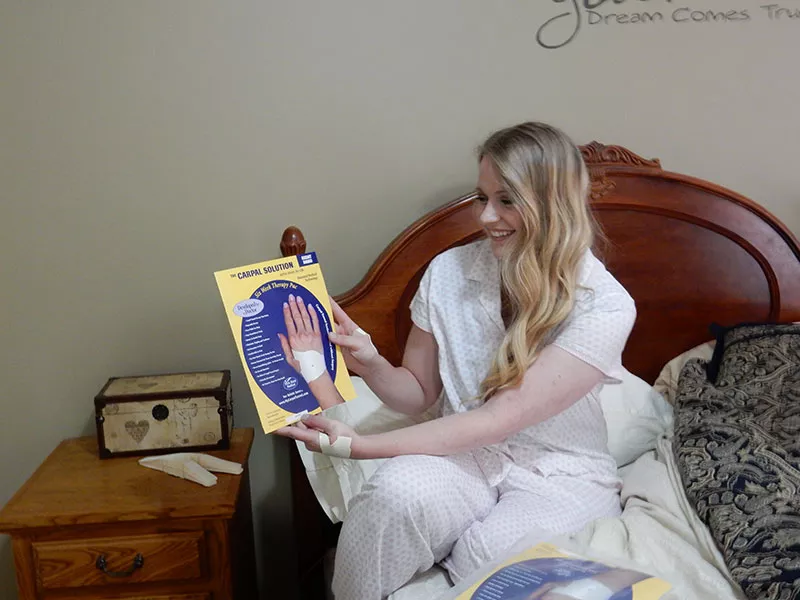
When gripping keeps hurting, especially with numb or tingling fingers, our doctors treat the pressure in the carpal tunnel. Swelling and entrapped inflammation in the soft tissue in and around the carpal tunnel squeeze the median nerve and restrict blood flow and lymphatic fluid transport. The Carpal Solution’s targeted passive stretching restores flexibility to the injured soft tissue, relieves pressure on the median nerve, relieves restrictions on blood circulation and lets lymph fluid flow freely to clear out the swelling. It is your body that does the healing; the Carpal Solution just jump-starts the natural healing preempted by excess pressure from inflammation and swelling. See how the Carpal Solution works.
Most people are better from their worst symptoms in two to three weeks, and about 90% reach complete remission in 6 weeks. The Carpal Solution has 97% patient satisfaction over 21 years, 4.9 out of 5 stars on independent review sites like Google Reviews, and over 100,000 users. By comparison, carpal tunnel surgery has a patient satisfaction rate lower than 69%.
When Healing Needs a Doctor’s Help and Professional Medical Evaluation
- Constant numbness that does not improve or loss of feeling in the fingertips that does not improve in 4 to 8 weeks.
- Extreme loss of the muscle at the base of the thumb, with loss of grip strength that does not improve over 6 to 8 weeks.
- Worsening symptoms over 6 to 8 weeks while using the best conservative treatments
- Symptoms that begin suddenly after hand or wrist trauma, a fracture or severe sprain from a fall or auto accident.
- Odd Symptoms that are not consistent with the Carpal Tunnel Symptoms listed on this website, that might be indicative of other nerve issues. A nerve conductivity study can clear up the confusion with minimal costs and not too much pain and no risk.
These signs may mean more advanced nerve involvement or a different condition and deserve professional medical evaluation and in person consultation. Home treatment can be used alongside professional in-person medical care while you wait for the healthcare delivery system to fit you into their schedule. There is no reason to wait doing nothing. You can start proven natural conservative treatment with good patient reviews while you wait for your appointments. If your symptoms start improving over 6 to 8 weeks, then you know you are on the right track and surgery is not necessary.
Frequently Asked Questions
Why does my hand hurt when I grip something?
Gripping tightens the nine finger tendons that pass through the carpal tunnel at the base of the palm. If their linings are swollen, gripping crowds the median nerve and hurts. Trigger finger, thumb arthritis and tendonitis are other common causes.
What does palm pain when gripping mean?
Pain at the base of the palm, especially with numb or tingling fingers, often points to carpal tunnel. Pain at the base of one finger with catching or clicking points to trigger finger.
Why does it hurt to make a fist?
A full fist pulls every finger tendon to the end of its range. Swollen tendon linings, trigger finger or arthritis make that hurt.
Should I use a grip strengthener for hand pain when gripping?
Not while you heal. Pinching and pressing raise pressure in the carpal tunnel. Relieve the pressure first; strength returns afterward.
Why am I losing grip in my hands?
Long-lasting pressure on the median nerve can weaken the muscles at the base of the thumb, and pain and disuse weaken the forearm muscles that drive the grip. See a doctor if your grip keeps weakening or the thumb muscles look thinner.
Sources
- Rempel D et al. Effects of static fingertip loading on carpal tunnel pressure. Journal of Orthopaedic Research, 1997
- Keir PJ, Bach JM, Rempel DM. Fingertip loading and carpal tunnel pressure: differences between a pinching and a pressing task. Journal of Orthopaedic Research, 1998
- Cleveland Clinic: Trigger finger
- OrthoInfo (AAOS): Trigger finger
- Mayo Clinic: Thumb arthritis
- OrthoInfo (AAOS): Arthritis of the thumb
- Journal of Ultrasound (2012): the nine flexor tendons and the median nerve in the carpal tunnel

Developed by First Hand Medical’s Team of Doctors
The Carpal Solution Treatment Kit was developed by our expert team of medical doctors who have worked at and led some of the top medical institutions in the World – Including Harvard Medical, Tufts Medical, UCSD, UF Health, and The Ohio State University. We treat root causes with clinically proven conservative treatments. The results: Quick Natural Relief of All Your Carpal Tunnel Symptoms without complications.

Order Your Six Week Carpal Tunnel Treatment Now
The ONLY treatment for carpal tunnel that comes with a no questions asked 30-Day Satisfaction Window and in-house dedicated pain relief team.

