 Created by renowned Harvard health care professionals.


Weak Wrists: Causes, Safe Strengthening and the Carpal Tunnel Link
A weak wrist often starts in the forearm muscles, an inflamed tendon or a squeezed median nerve, and splints make it worse. Our medical team explains 7 causes, why to heal first with the Carpal Solution, and 6 exercises to resume with less resistance and less weight.

Weak Wrists: What Our Medical Team Wants You to Know
Written by Julie Sunberg, Director of Marketing and Customer Service, First Hand Medical · Clinically reviewed by Mr. Alan Ward, MOT, OTR, Master Occupational Therapist, VP of Precision Rehabilitation · Last reviewed: November 2026
A weak wrist makes everyday tasks harder: lifting a pan, carrying groceries, opening a door, holding a phone. Most people assume the fix is to start lifting weights. Sometimes that is right. Often it is not, at least not yet.
Our medical team’s message is simple: heal first, then strengthen. If carpal tunnel or an inflamed tendon is behind your weak wrist, use the Carpal Solution to heal first, then resume wrist exercises with less resistance and less weight than before. Strengthening too early adds pressure and slows healing.
On This Page
Key points
- Weak wrists often come from the forearm muscles and the median nerve, not the wrist itself.
- Splints and casts cause muscle atrophy from disuse, a common hidden cause of weak wrists.
- Sudden weakness on one side with face drooping or slurred speech is an emergency: call 911.
- Heal first with the Carpal Solution, then resume wrist exercises with less resistance and less weight.
- Conservative-first care that follows medicine’s “Do No Harm” principle comes first; surgery is the last resort.
Why Does My Wrist Feel Weak?
When your wrist feels weak, the weakness usually starts somewhere else. The muscles that bend and straighten your wrist and fingers live in the forearm. Their tendons cross the wrist, and nine of them run through the carpal tunnel at the base of the palm beside the median nerve. The carpal tunnel is not in the wrist; it is at the base of the palm between the two major muscles of the hand.
So a weak wrist can mean weak or painful forearm muscles, an irritated tendon, a squeezed median nerve, or a loose or worn joint. People often search “why are my wrist so weak” after weeks of pain, a splint or a sudden drop in strength. The answer changes what you should do next.
What Causes Weak Wrists? 7 Causes
1. Carpal Tunnel
A squeezed median nerve weakens the muscles at the base of the thumb, and pain makes the forearm muscles hold back. The wrist and hand feel weak and clumsy, often with numb or tingling fingers. See hand weakness and muscle atrophy and carpal tunnel.
2. Splints and Casts
Holding a wrist still weakens it. In healthy young men, 14 days in a cast cost about 8% of muscle size and about 23% of strength. Splints carry two separate harms: muscle atrophy from disuse, and restricted circulation and lymph flow that slows soft-tissue healing. See why to avoid wrist splints.
3. Tendonitis
Inflamed wrist and forearm tendons hurt under load, so the muscles hold back to protect them. See wrist tendonitis treatment and forearm tendonitis.
4. TFCC Strain or Ligament Injury
A strained cartilage cushion on the pinky side, or a stretched ligament, can make the wrist feel weaker and less stable, especially when twisting or pushing up from a chair.
5. Arthritis
Stiff, swollen joints and pain limit how hard you can push or lift. See arthritis symptoms in hands.
6. An Old Fracture or Sprain
A wrist that was injured and immobilized years ago may never have regained full strength.
7. A Nerve Problem Higher Up
A pinched nerve in the neck or at the elbow can weaken the wrist and hand too. See neck and shoulder pain.
Sudden Wrist Weakness: When to Get Help Now
Most weak wrists develop slowly. Get emergency help right away for sudden weakness or numbness on one side of the body, especially with face drooping, slurred speech, confusion or trouble seeing. Call 911; these can be signs of a stroke.
See a doctor promptly if your wrist feels weak after a fall, if you cannot lift the wrist up, if the thumb muscles look thinner, or if weakness keeps getting worse.
When to Start Exercises for Wrist Strength
Exercises for wrist strength help, but timing matters. While carpal tunnel or tendonitis is active, gripping and lifting add load to swollen tendons. Researchers who measured pressure inside the carpal tunnel found that even small fingertip forces raised it significantly. That is why our medical team says to skip squeeze balls, putty and grip strengtheners while you heal.
- First, heal: use the Carpal Solution at night to relieve the pressure and let the swelling clear. Gentle daytime stretches and a cold plunge at about 43°F for 20 minutes help.
- Then, resume lighter: once pain and numbness are gone, return to wrist exercises with less resistance and less weight than you used before, and build back slowly.
- Always: stop any exercise that brings back numbness, tingling or sharp pain.
For gentle movement while you heal, see carpal tunnel exercises and finger exercises.
How to Strengthen Weak Wrists: 6 Exercises
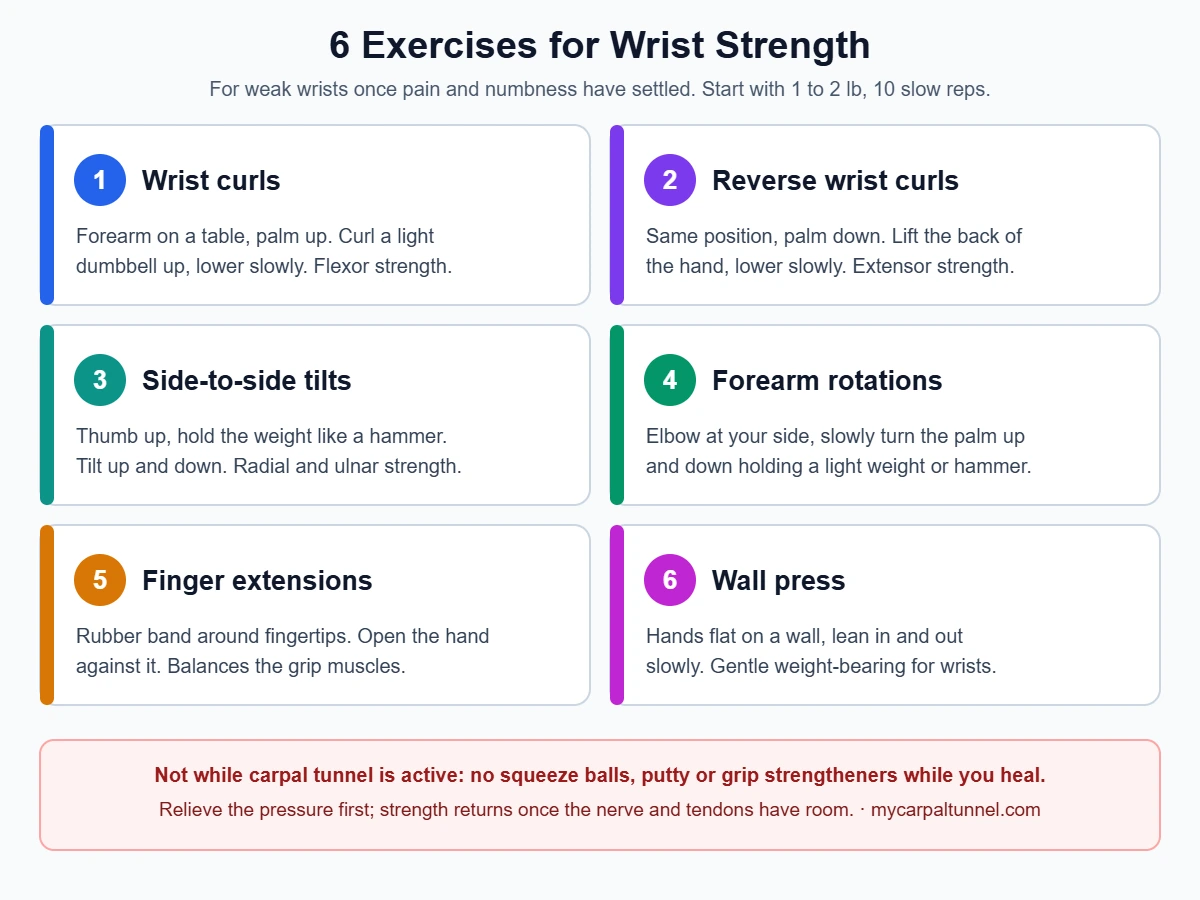
Once you have healed, here is how to strengthen wrists safely. Resume with less resistance and less weight than before: 1 to 2 pounds, or a can of soup, for 10 slow repetitions of each, once a day, 3 days a week. Add a set or a little weight only when the last reps feel easy, and drop back if any numbness or tingling returns.
- Wrist curls: rest your forearm on a table, palm up, hand off the edge. Curl a light dumbbell up, then lower it slowly.
- Reverse wrist curl: same position, palm down. Lift the back of the hand, then lower slowly.
- Side-to-side tilts: thumb up, hold the weight like a hammer and tilt it up and down.
- Forearm rotations: elbow at your side, slowly turn the palm up and down while holding a light weight or a hammer near its head.
- Finger extensions: put a rubber band around your fingertips and open the hand against it. This balances the grip muscles without squeezing.
- Wall press: hands flat on a wall, lean in and push back slowly for gentle weight-bearing.
These weak wrists exercises use light wrist exercises with dumbbells or household items, so you can do them at home.
Wrist Curls and Reverse Wrist Curls: Done Right
Wrist curls and the reverse wrist curl are the two classic exercises for wrist strength, and they are easy to overdo.
- Go light and slow. After healing, restart with less weight than you used before. Wrist strength builds with control, not heavy weight. Take two seconds up and three seconds down.
- Keep the forearm supported. Let only the wrist move.
- Use a loose grip. A tight squeeze loads the finger tendons in the carpal tunnel. Hold the dumbbell just firmly enough to control it.
- Balance the sides. Do reverse curls as often as regular curls so the back of the forearm keeps up.
- Stretch afterward. Gently stretch the forearm flexors and extensors when you finish.
If curls bring back tingling or numbness in the thumb, index or middle finger, stop and treat the carpal tunnel first.

Our Doctors’ Plan When Weak Wrists Come From Carpal Tunnel
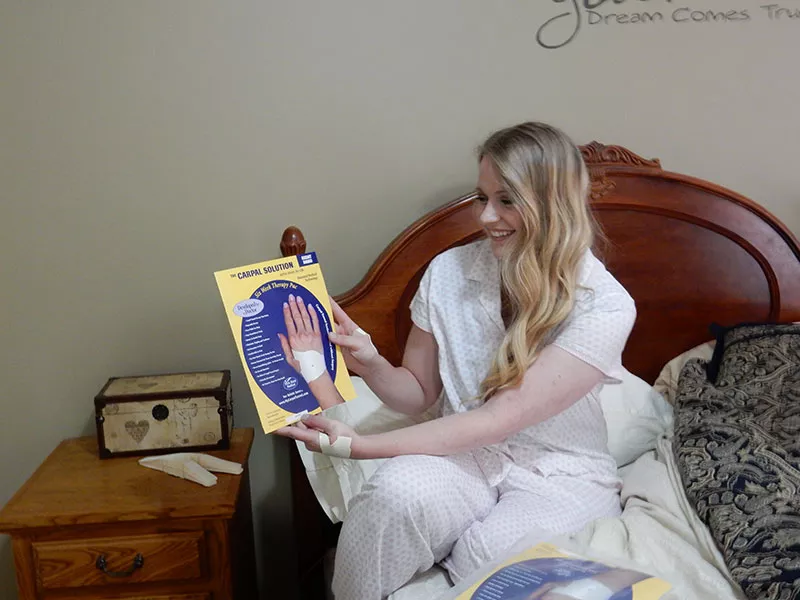
When numb fingers or night pain come with a weak wrist, our doctors treat the pressure before the strength. Swelling and entrapped inflammation in the soft tissue in and around the carpal tunnel squeeze the median nerve and restrict blood flow and lymphatic fluid transport. The Carpal Solution’s targeted passive stretching restores flexibility to the injured soft tissue, relieves pressure on the median nerve, relieves restrictions on blood circulation and lets lymph fluid flow freely to clear out the swelling. It is your body that does the healing; the Carpal Solution just jump-starts the natural healing preempted by excess pressure from inflammation and swelling. See how the Carpal Solution works.
Most people are better from their worst symptoms in two to three weeks, and about 90% reach complete remission in 6 weeks. Heal first with the Carpal Solution; strength returns with normal hand use once the pressure is gone. Then resume the exercises above with less resistance and less weight, and build back gradually. The Carpal Solution has 97% patient satisfaction over 21 years, 4.9 out of 5 stars on independent review sites like Google Reviews, and over 100,000 users. By comparison, carpal tunnel surgery has a patient satisfaction rate lower than 69%.
When Healing Needs a Doctor’s Help and Professional Medical Evaluation
- Constant numbness that does not improve or loss of feeling in the fingertips that does not improve in 4 to 8 weeks.
- Extreme loss of the muscle at the base of the thumb, with loss of grip strength that does not improve over 6 to 8 weeks.
- Worsening symptoms over 6 to 8 weeks while using the best conservative treatments
- Symptoms that begin suddenly after hand or wrist trauma, a fracture or severe sprain from a fall or auto accident.
- Odd Symptoms that are not consistent with the Carpal Tunnel Symptoms listed on this website, that might be indicative of other nerve issues. A nerve conductivity study can clear up the confusion with minimal costs and not too much pain and no risk.
These signs may mean more advanced nerve involvement or a different condition and deserve professional medical evaluation and in person consultation. Home treatment can be used alongside professional in-person medical care while you wait for the healthcare delivery system to fit you into their schedule. There is no reason to wait doing nothing. You can start proven natural conservative treatment with good patient reviews while you wait for your appointments. If your symptoms start improving over 6 to 8 weeks, then you know you are on the right track and surgery is not necessary.
Frequently Asked Questions
Why are my wrists so weak?
Weak wrists usually come from weak or painful forearm muscles, an inflamed tendon, a squeezed median nerve in the carpal tunnel, or muscle loss after a splint or cast. Arthritis and old injuries can also play a part.
How do I strengthen weak wrists?
Heal first, using the Carpal Solution if carpal tunnel is involved. Then resume light wrist curls, reverse wrist curls, side-to-side tilts, forearm rotations, finger extensions and wall presses with less resistance and less weight, 10 slow reps with 1 to 2 pounds, 3 days a week.
Should I do wrist strengthening exercises with carpal tunnel?
Not while it is active. Gripping raises pressure in the carpal tunnel. Use the Carpal Solution to heal first, then resume wrist exercises with less resistance and less weight.
Can a wrist brace cause weak wrists?
Yes. Holding a wrist still weakens its muscles from disuse, and in one study 14 days in a cast cost about 23% of strength.
When is a weak wrist an emergency?
Call 911 for sudden weakness on one side of the body, especially with face drooping, slurred speech or confusion.
Sources
- Wall BT et al. Acta Physiologica, 2014: loss of muscle size and strength after immobilization
- Rempel D et al. Effects of static fingertip loading on carpal tunnel pressure. Journal of Orthopaedic Research, 1997
- Journal of Ultrasound (2012): the nine flexor tendons and the median nerve in the carpal tunnel
- Cleveland Clinic: TFCC tear
- CDC: Signs and symptoms of stroke

Developed by First Hand Medical’s Team of Doctors
The Carpal Solution Treatment Kit was developed by our expert team of medical doctors who have worked at and led some of the top medical institutions in the World – Including Harvard Medical, Tufts Medical, UCSD, UF Health, and The Ohio State University. We treat root causes with clinically proven conservative treatments. The results: Quick Natural Relief of All Your Carpal Tunnel Symptoms without complications.

Order Your Six Week Carpal Tunnel Treatment Now
The ONLY treatment for carpal tunnel that comes with a no questions asked 30-Day Satisfaction Window and in-house dedicated pain relief team.

