 Created by renowned Harvard health care professionals.


Raynaud's Syndrome: Symptoms, Causes, Treatment and the Carpal Tunnel Connection
Raynaud's syndrome turns fingers white, then blue, then red in the cold. Our doctors explain Raynaud's symptoms, what causes Raynaud's, how to tell it from carpal tunnel, why so many people have both, and what helps.


Raynaud's Syndrome: What Our Doctors Want You to Know
Written by Julie Sunberg, Director of Marketing and Customer Service, First Hand Medical · Medically reviewed by Dr. Joseph E. Scherger, MD, MPH, family physician and clinical professor, UC San Diego School of Medicine · Last reviewed: November 2026
Raynaud’s syndrome makes the small arteries in the fingers clamp down in the cold or under stress. The fingers turn white, then blue, then red as the blood rushes back, and they can feel numb, cold and then throbbing. It is common, and for most people it is a nuisance rather than a danger. For some, it is a sign of another condition that needs a doctor’s care.
Raynaud’s also overlaps with carpal tunnel syndrome more than most people realize. Both cause numb, tingling fingers, and many people have both. This guide explains Raynaud’s symptoms, what causes Raynaud’s, how to tell it from carpal tunnel, and what helps.
Our doctors’ advice in one line: keep your hands warm, find out whether your Raynaud’s is primary or secondary, and if carpal tunnel is part of the picture, relieve the pressure on the nerve gently at night with the Carpal Solution.
On This Page
What Is Raynaud's Syndrome? Raynaud's Disease vs. Raynaud's Phenomenon
Raynaud’s syndrome is an exaggerated response of the blood vessels to cold or stress. The small arteries that feed the fingers, and sometimes the toes, nose and ears, go into spasm and shut down blood flow for a while. When they open again, blood rushes back in.1
You will see three names for the same thing:
- Raynaud’s disease or primary Raynaud’s: it happens on its own, with no other disease behind it. It is the more common form and is usually mild.1
- Raynaud’s phenomenon: the medical name for the attacks themselves, whatever the cause.
- Secondary Raynaud’s, or Raynaud’s syndrome in the strict sense: caused by another condition, such as lupus or scleroderma. It tends to be more severe.1
It is common. A review of 33 studies estimated that primary Raynaud’s affects about 5% of people,2 and 80 to 90% of all cases are the primary kind.3 It is more common in women, in people with a family history of it, and in people who live in cold climates.1
Raynaud's Symptoms: White, Blue, Then Red

A Raynaud’s attack usually comes in three color phases:
- White. The small arteries clamp shut and the fingers go pale, cold and numb.
- Blue. The trapped blood runs low on oxygen and the skin turns bluish.
- Red. The arteries open, blood rushes back, and the fingers flush red, tingle, throb or burn.1
Not everyone sees all three colors. Many people only notice the white phase. Attacks often start in one or two fingers and can spread to others, and they usually affect both hands.
Why Are My Fingers Turning White?
Fingers turning white in the cold, in an air-conditioned room or when you reach into the freezer is the classic sign of Raynaud’s. Raynaud’s fingers are sharply white, often with a clear line where the color stops, and they warm up again once you are out of the cold. If a white or blue fingertip does not warm up, or a sore appears on the fingertip, see a doctor promptly.
What Causes Raynaud's?
What causes Raynaud’s in the first place is not fully understood.1 What sets off an attack is better known:
- Cold, including handling ice or walking into air conditioning
- Emotional stress
- Nicotine from smoking or vaping, which narrows blood vessels (see alcohol, caffeine and smoking)
- Some medicines, such as beta blockers12
- Years of using vibrating tools, which can cause hand arm vibration syndrome13
Primary and Secondary Raynaud’s
Secondary Raynaud’s is caused by another disease, by exposure to cold or certain chemicals, and it needs treatment of that underlying condition.1 Clues that it may be secondary include attacks that start later in adult life, attacks in only one hand or a few fingers, sores on the fingertips, or attacks along with joint pain, rashes, tight skin or tiredness.
Is Raynaud’s an Autoimmune Disease?
Primary Raynaud’s is not an autoimmune disease. The secondary kind often comes with one. The attacks occur in almost all people with scleroderma,5 and it is common with lupus, rheumatoid arthritis and Sjögren’s syndrome. A doctor can check with blood tests.1
Raynaud’s and Lupus
Raynaud’s and lupus often travel together, and lupus is one of the conditions doctors look for when the attacks are secondary.1 Our doctors pay close attention here for another reason: autoimmune conditions such as lupus and rheumatoid arthritis raise inflammation throughout the body, and that excess systemic inflammation also feeds carpal tunnel syndrome. Read more in Carpal Tunnel Inflammation.
Carpal Tunnel and Raynaud's: Why So Many People Have Both
Carpal tunnel and Raynaud’s both cause numb, tingling, “dead” fingers, so they are easy to confuse. They also show up together far more often than chance would predict:
- In a study of 93 people with carpal tunnel syndrome, 36% also had Raynaud’s, compared with 12% of people without carpal tunnel.6
- When 30 people with carpal tunnel had their hands placed in cold water and blood flow measured, 60% showed Raynaud’s.7
- A pooled analysis of 8 studies put the figure at about 15.5%.8
- A large national health cohort found Raynaud’s syndrome was a risk factor for developing carpal tunnel syndrome.9

Why would they go together? The nerve fibers that control blood vessels in the fingers travel inside the median nerve through the carpal tunnel. When researchers followed 18 people who had both conditions after their carpal tunnel was released, 14 of them improved, and the authors suggested that pressure in the carpal tunnel may irritate those blood-vessel nerve fibers.10
That study used surgery. Our doctors start with the conservative path: relieve the same pressure without surgery. Carpal tunnel surgery has a patient satisfaction rate lower than 69%, because about 31% of patients report lingering or recurring symptoms, and no patient is satisfied with lingering symptoms. The Carpal Tunnel is not in the wrist, it is at the base of the palm between the two major muscles of the hand, and pressure there can reach 13 times normal.
Raynaud's Treatment: What Helps
Most people with primary Raynaud’s control it by staying warm and changing a few habits.1 During an attack, get out of the cold and warm your hands gently in warm, not hot, water or with a heating pad.1 If attacks are frequent or severe, a doctor may prescribe a calcium channel blocker, the usual first-line medicine, which relaxes the small arteries.11 Severe secondary cases are managed by a specialist, usually a rheumatologist.1
Raynaud’s Natural Treatment at Home
- Keep your whole body warm. A warm core keeps blood flowing to the hands.
- Quit smoking and vaping, and limit caffeine.4
- Manage stress, which can trigger attacks.1
- Ask your doctor whether any of your medicines can narrow blood vessels.4
- Keep moving. Gentle activity keeps blood circulating to the fingers.
Raynaud’s Gloves and Keeping Hands Warm
Good Raynaud’s gloves are warm and loose. Mittens keep fingers warmer than gloves, and a thin liner under them adds warmth. Heated gloves and hand warmers help in deep cold (see heated gloves and wrist wraps). Avoid anything tight. Tight gloves, wrist braces and splints squeeze the hand and restrict blood circulation, the last thing cold, spasming fingers need.
A Word About Cold Plunges
Our doctors use a cold plunge at about 43°F for 20 minutes to calm carpal tunnel inflammation. People with Raynaud’s must be more careful: use 44 to 48°F, never during an attack, ask your doctor first, and stop if your fingers turn white.
Where the Carpal Solution Fits
The Carpal Solution is a treatment for carpal tunnel syndrome, not for Raynaud’s itself. It matters here because so many people have both, and because numbness from carpal tunnel is often blamed on Raynaud’s or the cold. Conservative-first care that follows medicine’s “Do No Harm” principle starts with what is safe to do at home.
Swelling and entrapped inflammation in the soft tissue in and around the carpal tunnel squeeze the median nerve and restrict blood flow and lymphatic fluid transport. The Carpal Solution’s targeted passive stretching restores flexibility to the injured soft tissue, relieves pressure on the median nerve, relieves restrictions on blood circulation and lets lymph fluid flow freely to clear out the swelling. Nothing is cut or injected. The Carpal Solution restarts the healing that trapped inflammation and swelling had stalled, and your body does the rest.
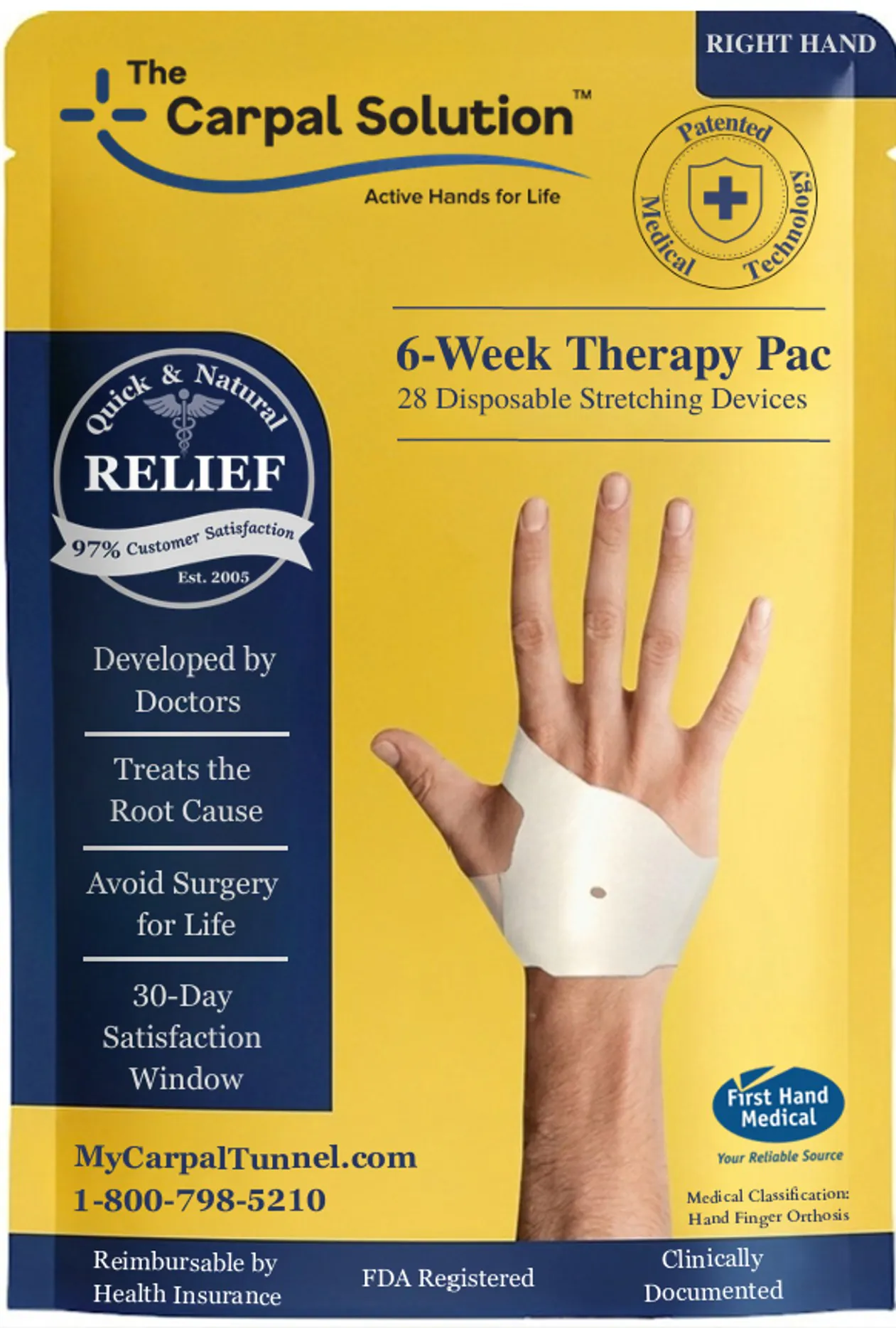
- Most people are better from their worst symptoms in two to three weeks.
- About 90% of people reach complete remission in 6 weeks.
- 97% patient satisfaction over 21 years, 4.9 out of 5 stars, and over 100,000 people helped.
If you have Raynaud’s, keep your hands warm under the covers while you wear it. Waiting weeks for a rheumatologist or a nerve test does not mean waiting with nothing to do. Order the Carpal Solution.
When Healing Needs a Doctor’s Help and Professional Medical Evaluation
- Constant numbness that does not improve or loss of feeling in the fingertips that does not improve in 4 to 8 weeks.
- Extreme loss of the muscle at the base of the thumb, with loss of grip strength that does not improve over 6 to 8 weeks.
- Worsening symptoms over 6 to 8 weeks while using the best conservative treatments
- Symptoms that begin suddenly after hand or wrist trauma, a fracture or severe sprain from a fall or auto accident.
- Odd Symptoms that are not consistent with the Carpal Tunnel Symptoms listed on this website, that might be indicative of other nerve issues. A nerve conductivity study can clear up the confusion with minimal costs and not too much pain and no risk.
These signs may mean more advanced nerve involvement or a different condition and deserve professional medical evaluation and in person consultation. Home treatment can be used alongside professional in-person medical care while you wait for the healthcare delivery system to fit you into their schedule. There is no reason to wait doing nothing. You can start proven natural conservative treatment with good patient reviews while you wait for your appointments. If your symptoms start improving over 6 to 8 weeks, then you know you are on the right track and surgery is not necessary.
Raynaud's Syndrome FAQ
What is Raynaud’s syndrome?
Raynaud’s syndrome is a condition in which the small arteries in the fingers, and sometimes the toes, spasm in the cold or under stress. The fingers turn white, then blue, then red as blood returns, and they can feel numb, cold and throbbing.
What are the symptoms of Raynaud’s?
Fingers turning white or blue in the cold, numbness and coldness during the attack, then redness, tingling, throbbing or burning as they warm up. Attacks usually affect both hands and can involve the toes, nose and ears.
What causes Raynaud’s?
The cause of primary Raynaud’s is not fully known. Attacks are triggered by cold, stress, nicotine and some medicines. Secondary Raynaud’s is caused by another condition, such as scleroderma, lupus or rheumatoid arthritis, or by years of using vibrating tools.
Is Raynaud’s an autoimmune disease?
Primary Raynaud’s is not. Secondary Raynaud’s often comes with an autoimmune disease such as scleroderma, lupus, rheumatoid arthritis or Sjögren’s syndrome. Blood tests can help your doctor tell the difference.
Is it Raynaud’s or carpal tunnel?
Raynaud’s changes the color of the fingers in the cold. Carpal tunnel numbs the thumb, index and middle fingers, often at night, with no color change. Many people have both: in one study, 36% of people with carpal tunnel syndrome also had Raynaud’s.
What is the best Raynaud’s treatment?
Staying warm, quitting nicotine, managing stress and wearing warm, loose mittens or gloves control most cases. For frequent or severe attacks, doctors usually start with a calcium channel blocker. Secondary Raynaud’s needs treatment of the underlying disease.
What are the best Raynaud’s gloves?
Warm, loose mittens with a thin liner, or heated gloves in deep cold. Avoid tight gloves, braces and splints, which restrict circulation.
Can the Carpal Solution help if I have Raynaud’s?
The Carpal Solution treats carpal tunnel syndrome, not Raynaud’s itself. If you have both, relieving the pressure in the carpal tunnel at night can ease carpal tunnel numbness and restore circulation and lymph flow in the soft tissue around it. Keep your hands warm while you wear it.
Sources
- National Institute of Arthritis and Musculoskeletal and Skin Diseases. Raynaud’s phenomenon. Link
- Garner R, Kumari R, Lanyon P, Doherty M, Zhang W. Prevalence, risk factors and associations of primary Raynaud’s phenomenon: systematic review and meta-analysis of observational studies. BMJ Open. 2015;5(3):e006389. Link
- Review: Raynaud’s phenomenon, diagnosis and management (80 to 90% of cases are primary). PubMed Central. Link
- Review: pharmacologic and nonpharmacologic management of Raynaud’s phenomenon (avoid cold, stress, caffeine, smoking and vasoconstrictive medicines). PubMed Central. Link
- Review: Raynaud’s phenomenon and digital ulcers in systemic sclerosis. Therapeutics and Clinical Risk Management. 2015;11. Link
- Pal B, et al. Raynaud’s phenomenon in idiopathic carpal tunnel syndrome. 1996 (93 patients, 57 controls). Link
- Chung MS, et al. Raynaud’s phenomenon in patients with idiopathic carpal tunnel syndrome, cold provocation test (30 patients). Journal of Bone and Joint Surgery (British). 1999;81-B(6):1017–1019. Link
- Meta-analysis: prevalence of Raynaud’s syndrome in patients with carpal tunnel syndrome (8 studies, 675 people). 2011. Link
- Risk factors for carpal tunnel syndrome in a national health screening cohort. Journal of Clinical Neurology. 2021;17(4):524–533. Link
- Chung MS, Gong HS, Baek GH. Raynaud’s phenomenon after carpal tunnel release in idiopathic carpal tunnel syndrome (18 patients). Journal of Bone and Joint Surgery (British). 2000;82-B(6):818–819. Link
- Review: Raynaud’s phenomenon in primary care, calcium channel blockers as first-line treatment. PubMed Central. Link
- Pal B. Paraesthesia. BMJ. 2002;324(7352):1501. Link
- Carpal tunnel syndrome and Raynaud’s phenomenon: a narrative review. Occupational Medicine. 2022;72(3):170–176. Link
Our doctors’ position is offered as medical opinion based on the research above and two decades of clinical experience. We encourage you to read the sources and do your own research.
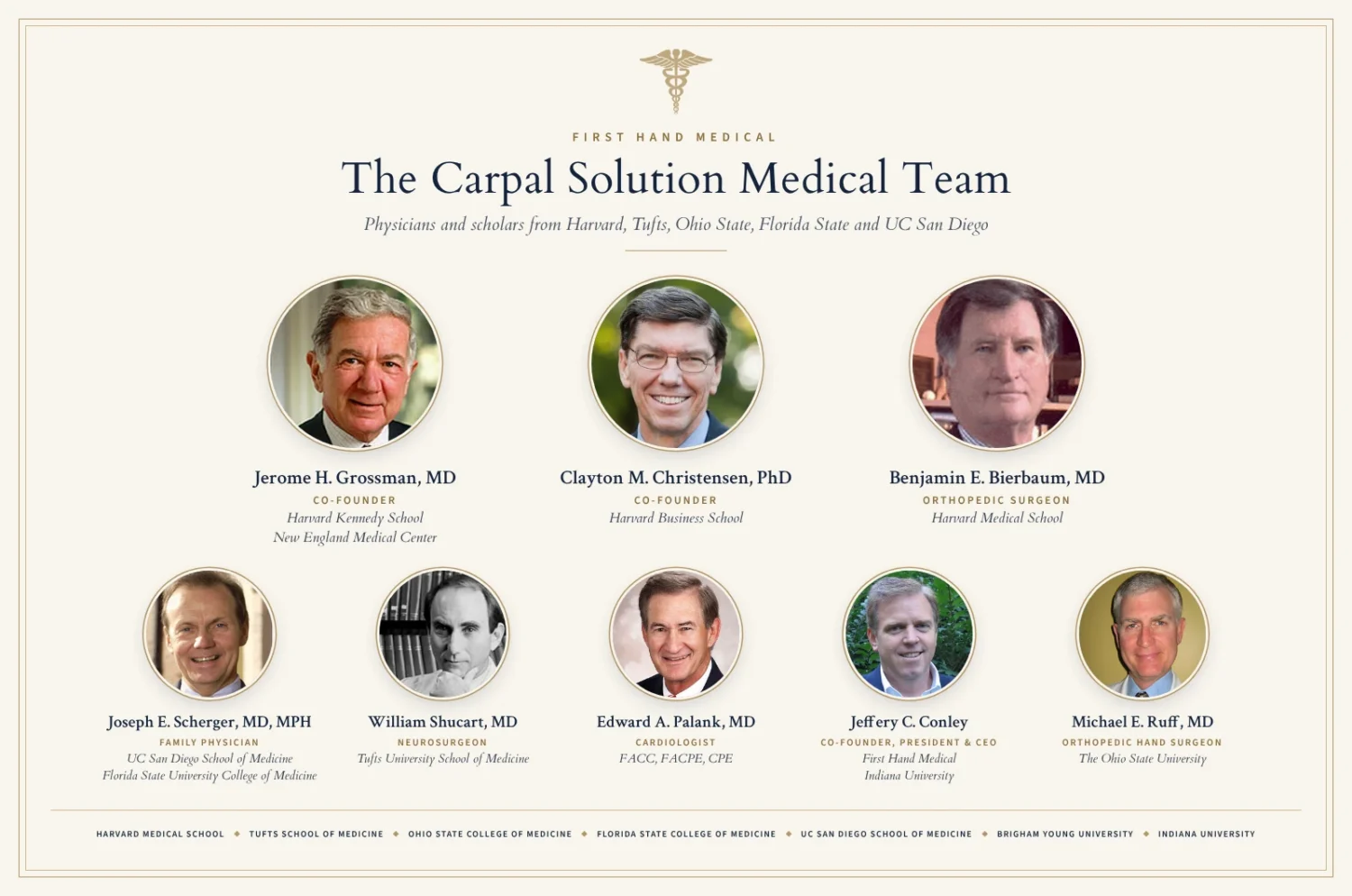
Developed by First Hand Medical’s Team of Doctors and Medical Professionals
The Carpal Solution Treatment Kit was developed by our expert team of medical doctors who have worked at and led some of the top medical institutions in the World – Including Harvard Medical, Tufts Medical, UCSD Medical School, Florida State Medical School, and The Ohio State University Medical School. We treat root causes with clinically proven conservative treatments. The results: Quick Natural Relief of All Your Carpal Tunnel Symptoms without complications. Meet The Medical Team Backing The Carpal Solution at First Hand Medical

Order Your Six Week Carpal Tunnel Treatment Now
The ONLY treatment for carpal tunnel that comes with a no questions asked 30-Day Satisfaction Window and in-house dedicated pain relief team.

