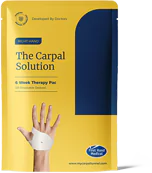
 Created by renowned Harvard health care professionals.


Tattoo Artist Carpal Tunnel: How Joseph Kept His Steady Hand

Tattoo artist carpal tunnel threatens the one thing an artist cannot work without: a steady, sensitive hand. Joseph, a master tattoo artist in San Francisco, lived with it for five years. Splints helped only at first, his grip weakened, his fingers went numb, and then his clinic cancelled his appointment. Here is how he got about 80% better in three weeks without surgery, what the research says about tattooing and the hands, and what artists can do.
Table of Contents
Joseph’s Story: “I Have a Reputation to Maintain”
“Five years ago I was tested by a neurologist who found that I had a carpal tunnel condition in my right hand. At that time he did not recommend physiotherapy treatment nor did he recommend surgery. I am not sure why, I am a Tattoo Artist and use my hands intensely most days.
He just gave me those uncomfortable wrist splints that helped a little in the beginning.
Overtime, however, my hand condition has worsened. I started losing muscle and grip strength.
I was frequently awakened at night with numbness in the right forearm and often in both arms and hands. My wrist joints ached. The middle fingers of my right hand were numb constantly.

I commenced my own search for carpal tunnel remedies when my symptoms became acute and started to affect my work. After all, I have a reputation to maintain as one of the best at my trade.
I set up an appointment with my clinic to seek help. But, Access to my primary care physician was deferred by the cancellation of my appointment by the clinic. I felt desperate. I needed help now.
I did not want to pay the extra expense and huge copays of an emergency hospital visit. It seems my health insurance cost more and covers less every year.
Besides, I have heard they usually just do corticosteroid injections and refer you to an orthopedic surgeon in emergency rooms. I did not want that.
I know that surgery means a lot of downtime for a person like me and it comes back. Not to mention the risks – Way too many issues for a person who depends on their hands for their livelihood like I do.
In my search, I found a natural treatment developed by Doctors of all things. Imagine that.
I started using The Carpal Solution treatment on the right hand only. In the first ten days there was a noticeable improvement at night and the condition has improved during the day too. Each day I see more improvement in my Carpal Tunnel Condition.
It does not slow me down at work anymore. I am now about 80% better after just three weeks and I am confident I will get complete relief as I finish the Six Week treatment regimen.
I feel so much better and don’t worry any more.
Thank you for your help.”
Joseph, Master Tattoo Artist, San Francisco, California
Why Tattoo Artist Carpal Tunnel Is So Common
Tattoo artists hold a vibrating machine in a precise grip for hours, stretch skin with the other hand and hunch over clients.
Research confirms the toll. In a national survey of 448 French tattoo artists, finger pain was reported by 41.5%, and most artists with finger pain, muscle pain or carpal tunnel symptoms and tingling said those problems began after they started tattooing (Kluger, International Journal of Occupational Medicine and Environmental Health, 2017).
An Ohio State University study that measured muscle activity during real tattoo sessions found that discomfort over the past year was reported by more than half of artists in the neck, shoulders, hands, wrists and back (Keester and Sommerich, Applied Ergonomics, 2017). Researchers are now studying how machine vibration affects the median nerve in tattoo artists.
The anatomy explains why the hands suffer. The muscles that move your fingers and thumb live in the forearm, and their nine tendons run through the carpal tunnel beside the median nerve. A steady pinch on the machine keeps those tendons loaded all session. When their linings swell, swelling and entrapped inflammation in the soft tissue in and around the carpal tunnel squeeze the median nerve and restrict blood flow and lymphatic fluid transport, so the nerve becomes irritated, short of oxygen and compressed. That is why Joseph felt numbness in his forearm and fingers, not just his wrist. Read more about what causes carpal tunnel syndrome.
Splints, Muscle Loss and a Weaker Grip
 Joseph’s neurologist gave him wrist splints. They helped a little at first; then, over time, he lost muscle and grip strength and his symptoms got worse.
That is exactly what our medical team has seen in tattoo artist carpal tunnel and many other hand-intensive jobs for two decades. A splint holds the wrist in a neutral position, which can reduce pain from movement, but it does not promote healing from carpal tunnel syndrome.
Immobilizing any limb leads to muscle atrophy over time (about 8% of muscle size and 23% of strength lost after 14 days in a cast; Wall and colleagues, Acta Physiologica, 2014), and a tight splint compresses the hand, wrist and forearm, restricting blood circulation and lymphatic fluid exchange, which slows the dispersion of swelling. For tattoo artist carpal tunnel, where fine control is everything, that is the wrong trade. Read more about muscle atrophy and carpal tunnel.
A Cancelled Appointment and the Waiting
 When Joseph’s symptoms became acute, his clinic cancelled his appointment, and he did not want the cost of an emergency room visit. The waiting is real for everyone: the average wait for a new-patient physician appointment is 31 days (AMN Healthcare, 2025), and specialists and surgery schedules add more. For a self-employed artist with tattoo artist carpal tunnel, every week of numb fingers can mean lost bookings. You do not have to wait doing nothing; you can start safe, natural treatment at home while you wait for your appointments. Read more about waiting for carpal tunnel treatment. If you have constant numbness, weakness or thumb muscle thinning, tell your doctor’s office so they can see you sooner.
How Joseph Treated Tattoo Artist Carpal Tunnel While Working
The Carpal Solution is worn at night, so Joseph never missed a day in the shop. Its targeted passive stretching restores flexibility to the injured soft tissue, relieves pressure on the median nerve, relieves restrictions on blood circulation and lets lymph fluid flow freely to clear out the swelling. It is your body that does the healing; the Carpal Solution just jump-starts the natural healing preempted by excess pressure from inflammation and swelling. The six-week protocol gives over 220 hours of targeted stretching while you sleep, something no daytime routine can match.
Joseph noticed improvement at night within ten days and was about 80% better at three weeks. That matches our doctors’ experience: most people are better from their worst symptoms in two to three weeks, and over 90% resolve in six weeks; about 10%, with excess systemic inflammation, need 8 to 12 weeks and are usually 50 to 70% better at six weeks.
Over 100,000 people have used the Carpal Solution over two decades, with 97% patient satisfaction over 21 years and 4.9 out of 5 stars on independent review sites like Google Reviews. It has a 30-Day Patient Satisfaction Guarantee, and health insurance reimburses 70 to 80% for many patients. Neurologists, including Dr. James S. Zu, MD, PhD, of Edison, New Jersey, call the Carpal Solution a better first line of defense for carpal tunnel syndrome.
Tips for the Tattoo Shop
 These habits help keep tattoo artist carpal tunnel from coming back once your hands feel better:
- Choose a lighter machine with less vibration, and use a thicker, cushioned grip so you can hold it with less pinch force.
- Keep your working wrist as straight as you can; adjust the client, chair and armrest instead of bending your wrist.
- Break long sessions into blocks and open and close your hands between passes.
- Balance big pieces with smaller ones in your schedule, as Ohio State researchers suggest, and vary the body parts you work on.
- Keep your hands warm, stay hydrated and move between clients; a short walk or a few shoulder rolls between pieces helps circulation in your arms and hands.
- Use prevention nights with the Carpal Solution, from once a week to once every six months, especially before big convention weekends.
Tattoo artist carpal tunnel is common, but it does not have to end a career or force you to cancel bookings for weeks after surgery. Treating the swelling at night, pacing your sessions and choosing gentler equipment let most artists keep working while their hands recover. Carpal tunnel is chronic and recurring: remission usually lasts 5 to 7 years for most people, from as little as 1 year to as long as 17, and the harder you use your hands, the sooner it can come back. Other artists and hand professionals have shared their stories too; see the hair stylist who saved her career and dentists with carpal tunnel.
Why Joseph Avoided Surgery
Joseph knew surgery meant downtime, that symptoms can come back, and that the risks were too great for someone whose livelihood depends on his hands.
Carpal tunnel surgery has a patient satisfaction rate lower than 69%, because about 31% of patients report lingering or recurring symptoms, and no patient is satisfied with lingering symptoms (Bland, Muscle & Nerve, 2001). Even after a successful surgery, 57% had at least some symptoms come back within 5.5 years in one study (Nancollas, 1995, reviewed by Louie, Earp and Blazar, HAND, 2012).
Our doctors estimate 80 to 90% within 10 years from two decades of clinical experience; that has not been statistically researched. Second surgeries have a patient satisfaction rate between 16% and 40%. Our doctors also hear from patients who report permanent loss of grip strength or dexterity after surgery (clinical experience). See recurrence after carpal tunnel surgery.
Tattoo Artist Carpal Tunnel: Frequently Asked Questions
Can tattooing cause carpal tunnel?
Long hours gripping a vibrating machine with a bent wrist can contribute to tattoo artist carpal tunnel. In a survey of 448 tattoo artists, most of those with carpal tunnel symptoms or tingling said they began after they started tattooing.
Can I keep tattooing while I treat it?
Yes. The Carpal Solution is worn while you sleep, so there is no downtime. Joseph kept working and said it no longer slowed him down.
Should I wear a wrist splint while I work?
A splint can ease pain from movement for a short time, but it does not heal carpal tunnel and leads to muscle atrophy with long use, which is the last thing an artist needs.
Do lighter, low-vibration tattoo machines help?
They can reduce the load on your hand. A lighter machine with less vibration and a thicker grip lets you hold it with less pinch force, which means less strain on the finger tendons that share the carpal tunnel with the median nerve. Many artists with tattoo artist carpal tunnel find switching machines makes long sessions easier, but it does not clear swelling that is already there.
Is it safe to keep tattooing with numb fingers?
Numb fingertips reduce your feel for depth and pressure, so slow down, take more breaks and book shorter sessions until feeling returns. Constant numbness or a weakening grip is a reason to see a doctor promptly, and to start treating the swelling at night rather than pushing through.
How do I know it is carpal tunnel?
Our doctors’ experience over two decades is that people with three or more of the carpal tunnel symptoms listed on this site can be about 95% confident they have carpal tunnel (clinical experience, not a published statistic). Still get an in-person evaluation and formal diagnosis.
Sources
- Kluger N. National survey of health in the tattoo industry: observational study of 448 French tattooists. International Journal of Occupational Medicine and Environmental Health. 2017.
- Keester DL, Sommerich CM. Investigation of musculoskeletal discomfort, work postures, and muscle activation among practicing tattoo artists. Applied Ergonomics. 2017;58:137-143.
- Median and ulnar nerve function in tattoo artists (Gazi University, ClinicalTrials.gov NCT07496398).
- Wall BT, et al. Acta Physiologica. 2014: muscle size and strength loss after cast immobilization (doi:10.1111/apha.12190).
- Bland JD. Muscle & Nerve. 2001: patient-reported outcomes of 1,268 carpal tunnel operations (PubMed 11410921).
- Louie D, Earp B, Blazar P. Long-term outcomes of carpal tunnel release: a critical review of the literature. HAND. 2012.
- AMN Healthcare. The growing challenges with physician appointment wait times. 2025.
The Carpal Solution provides over 220 hours of targeted, gentle passive stretching during the six-week protocol, developed by doctors. There is no other practical way to deliver that much consistent stretching in such a short time, and you do it while you sleep. Learn how the Carpal Solution works.

The Carpal Solution has 97% patient satisfaction over 21 years among people with Carpal Tunnel Symptoms. It will likely work for you too.
It is the only treatment for Carpal Tunnel that comes with a 30-Day Patient Satisfaction Guarantee and many people are reimbursed 70 to 80% by health insurance.
Not only are there no risks of complications with the Carpal Solution Therapy, as you find with carpal tunnel surgery, but First Hand Medical has also eliminated any financial risk of trying the Carpal Solution.
Learn more about health insurance reimbursement for The Carpal Solution
When Healing Needs a Doctor’s Help and Professional Medical Evaluation
- Constant numbness that does not improve or loss of feeling in the fingertips that does not improve in 4 to 8 weeks.
- Extreme loss of the muscle at the base of the thumb, with loss of grip strength that does not improve over 6 to 8 weeks.
- Worsening symptoms over 6 to 8 weeks while using the best conservative treatments
- Symptoms that begin suddenly after hand or wrist trauma, a fracture or severe sprain from a fall or auto accident.
- Odd Symptoms that are not consistent with the Carpal Tunnel Symptoms listed on this website, that might be indicative of other nerve issues. A nerve conductivity study can clear up the confusion with minimal costs and not too much pain and no risk.
These signs may mean more advanced nerve involvement or a different condition and deserve professional medical evaluation and in person consultation. Home treatment can be used alongside professional in-person medical care while you wait for the healthcare delivery system to fit you into their schedule. There is no reason to wait doing nothing. You can start proven natural conservative treatment with good patient reviews while you wait for your appointments. If your symptoms start improving over 6 to 8 weeks, then you know you are on the right track and surgery is not necessary.