 Created by renowned Harvard health care professionals.


The Median Nerve: Where It Runs, What It Controls and Why It Gets Pinched
The median nerve gives feeling to your thumb, index, middle and half of your ring finger, and it powers your thumb. Our doctors explain where it runs, where it gets pinched and how to take the pressure off without surgery.

The Median Nerve: What Our Doctors Want You to Know
Written by Jeff Conley, President of First Hand Medical · Medically reviewed by Dr. William Shucart, MD, neurosurgeon, clinical professor of neurosurgery, New England Medical Center, former chair of neurosurgery, Tufts · Last reviewed: November 2026
The median nerve is the nerve behind carpal tunnel syndrome. It gives feeling to your thumb, index finger, middle finger and half of your ring finger, and it powers the muscles that let your thumb pinch, grip and touch each fingertip. When it is squeezed, those fingers tingle, go numb and lose strength.
Our doctors’ message is simple: the median nerve is tough but sensitive to pressure. Most of the time it is pinched inside the carpal tunnel at the base of the palm, across from the base of the thumb, by swelling and entrapped inflammation in the soft tissue around it. Take the pressure off early, and the nerve can recover naturally.
On This Page
Key points
- The median nerve runs from the neck to the fingertips and is most often squeezed in the carpal tunnel at the base of the palm.
- Median nerve pain feels like tingling, burning and numbness in the thumb, index and middle fingers, often worst at night.
- Thinning at the base of the thumb means the nerve has been squeezed too long. Act early.
- Conservative-first care that follows medicine’s “Do No Harm” principle takes the pressure off so the nerve can heal.
Where Is the Median Nerve? Its Path From Neck to Fingertips
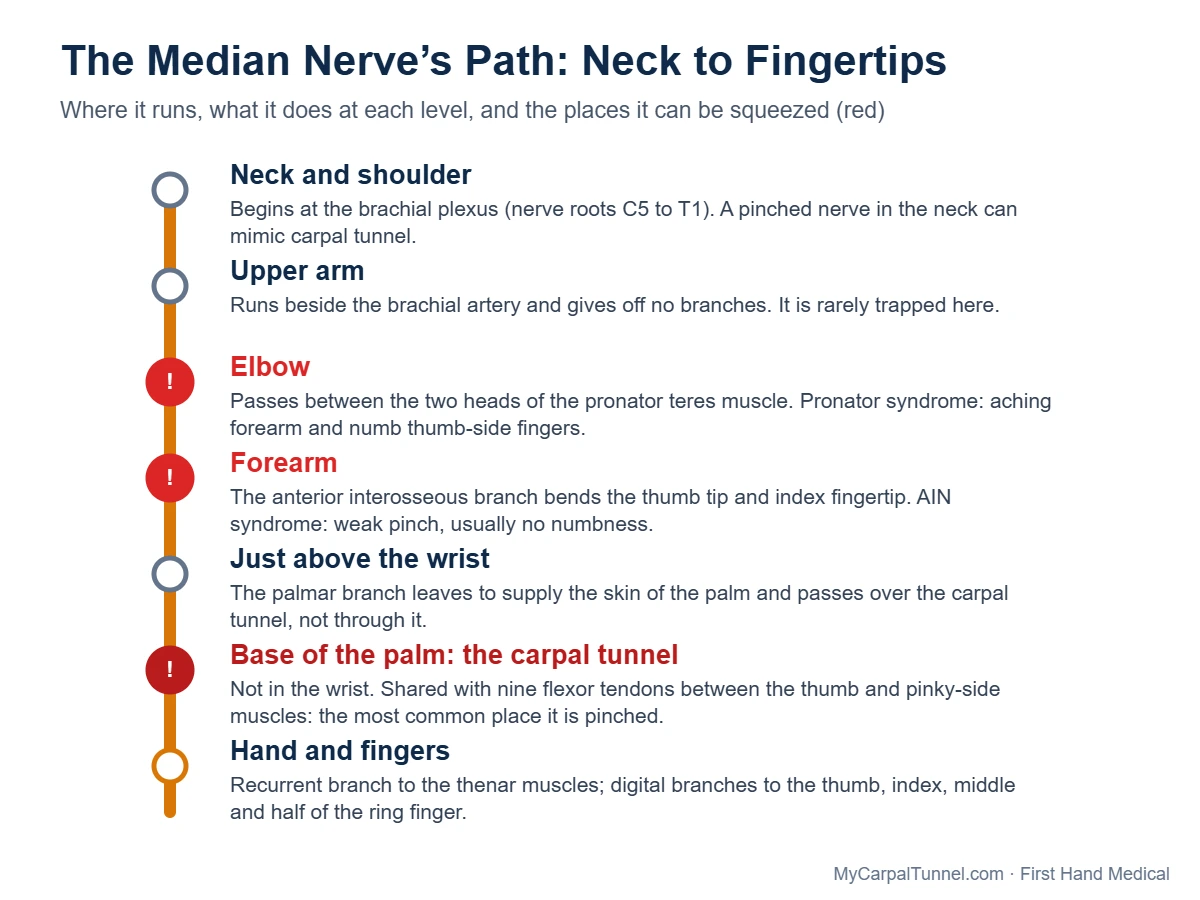
Where is the median nerve? It starts in your neck. Nerve roots from C5 to T1 join in the brachial plexus near the collarbone, and the median nerve forms where two of its cords meet in the armpit. From there it runs down the inside of the upper arm beside the brachial artery without giving off a single branch.
At the elbow it slips under a band of tissue and between the two heads of the pronator teres muscle, then travels down the middle of the forearm between the finger flexor muscles. Just above the wrist it sends a small palmar branch to the skin of the palm. Then the main nerve crosses the wrist crease and runs through the carpal tunnel at the base of the palm, between the thumb muscles and the pinky-side muscles, with nine flexor tendons. Learn more in where the carpal tunnel is and the anatomy of the carpal tunnel.
People, even doctors, often think the carpal tunnel is in the wrist because carpal tunnel causes wrist pain. That pain comes from the squeezing inside the carpal tunnel at the base of the palm, and the pain and numbness can travel up and down the median nerve path, from the fingertips to the forearm, the shoulder and even the neck.
Median Nerve Distribution and Innervation: What It Controls

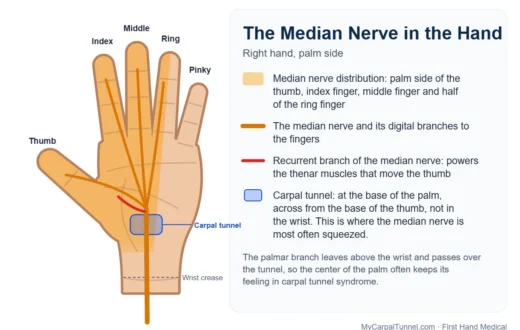
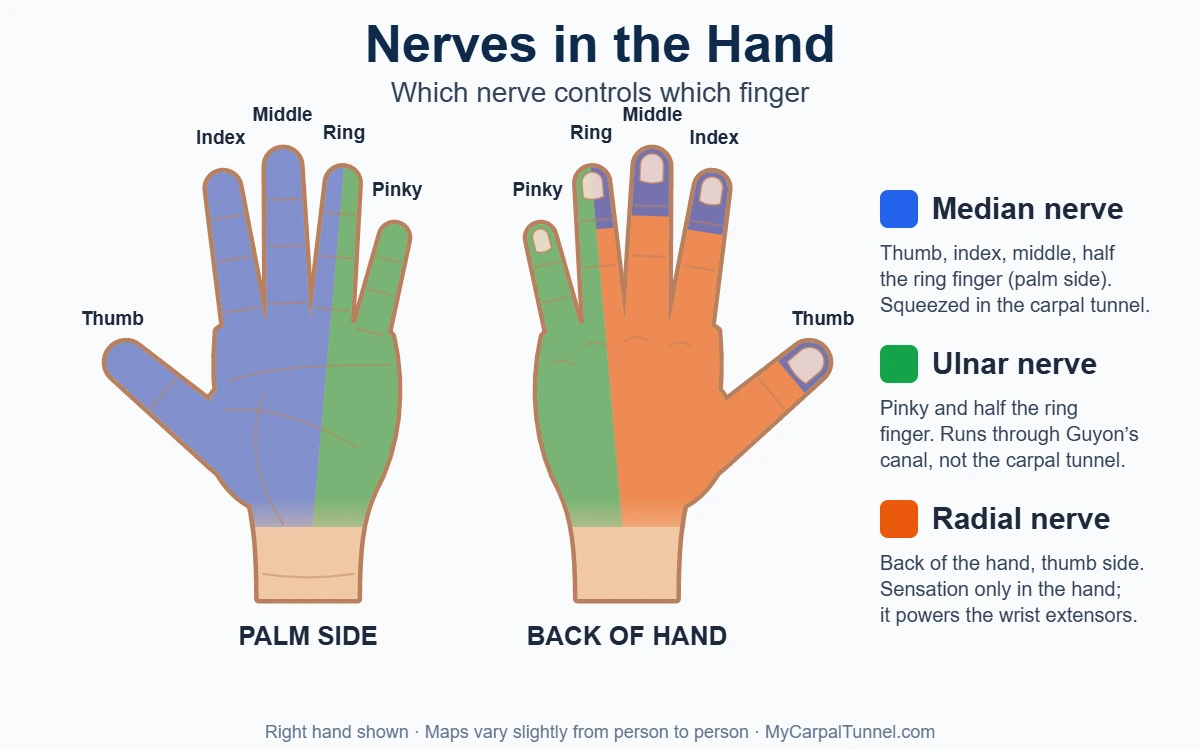
Median nerve distribution is the map of skin the nerve feels for: the palm side of the thumb, index finger, middle finger and the thumb-side half of the ring finger, plus the backs of those fingertips. The pinky and the other half of the ring finger belong to the ulnar nerve, which is why a numb pinky usually points somewhere else (see numb pinky).
Median nerve innervation of muscles is just as important. In the forearm it powers the muscles that bend the wrist, fingers and thumb and turn the palm down: the pronator teres, flexor carpi radialis, palmaris longus, flexor digitorum superficialis, the index and middle finger half of the flexor digitorum profundus, the flexor pollicis longus and the pronator quadratus. Their tendons pass through the carpal tunnel beside the nerve. See nerves in the hand for how the median, ulnar and radial nerves share the work.
The Median Nerve in Hand: Feeling, Fine Motion and Thumb Strength
The median nerve in hand splits into digital branches for feeling and two motor branches: one to the first two lumbrical muscles, which help the index and middle fingers move precisely, and one to the thumb. Doctors call the median nerve the “eye of the hand” because it supplies so much of the feeling you use to button, write and pick up small things.
Recurrent Branch of Median Nerve: The Thumb’s Power Line
The recurrent branch of median nerve curls back from just past the carpal tunnel into the ball of the thumb. It powers the thenar muscles: abductor pollicis brevis, opponens pollicis and part of flexor pollicis brevis. These let your thumb reach across your palm to pinch and grip. When this branch is starved for too long, the thumb base flattens, a sign of muscle atrophy. See thenar eminence pain.
Median Nerve Pain: What It Feels Like
Median nerve pain is nerve pain, not muscle soreness. People describe it as:
- Tingling, pins and needles or burning in the thumb, index and middle fingers
- Numbness that wakes you at night or greets you in the morning
- Electric, shooting pain into the fingers or up the forearm
- Clumsiness, dropping things and a weak pinch
It is often worst at night because many people sleep with bent wrists, which raises pressure inside the tunnel. See why carpal tunnel is worse at night and nerve pain in the hand.
Median Nerve Entrapment: The Places It Gets Pinched
Median nerve entrapment means the nerve is squeezed where it passes through a tight space. Our doctors see the same root cause again and again: swelling and entrapped inflammation in the soft tissue around the nerve raise the pressure, restrict blood flow and slow the lymph fluid that should carry the swelling away. Learn about the root cause of carpal tunnel.
At the Base of the Palm: The Carpal Tunnel
The carpal tunnel is by far the most common site. The Carpal Tunnel is not in the wrist, it is at the base of the palm between the two major muscles of the hand: the thenar muscles at the base of the thumb and the hypothenar muscles on the pinky side. It is a narrow passage, less than 2 square centimeters at its tightest, and the median nerve shares it with nine flexor tendons under the tough transverse carpal ligament. When the tendon linings swell, the nerve is the softest thing in the tunnel, so it takes the pressure.
At the Elbow: Pronator Syndrome
Less often, the nerve is squeezed between the two heads of the pronator teres muscle. This causes an aching forearm and numbness that can include the palm, because the palmar branch is affected too. In carpal tunnel syndrome, the center of the palm usually keeps its feeling. See carpal tunnel and elbow pain.
In the Forearm: Anterior Interosseous Nerve Syndrome
Anterior interosseous nerve syndrome is a rare problem in the motor-only branch of the median nerve. It weakens the muscles that bend the thumb tip and index fingertip, so people cannot make a round “OK” sign, but there is usually no numbness. It needs a doctor’s evaluation.
A pinched nerve in the neck can also mimic median nerve problems, which is why doctors check the whole path.
Median Nerve Injury: Cuts, Fractures and Long-Term Pressure
A median nerve injury can be sudden or slow. Sudden injuries come from cuts at the wrist, broken wrist or elbow bones, and crush injuries. Numbness right after an injury, or after a wrist fracture, needs prompt medical care because the nerve may need urgent treatment.
The slow kind is far more common: months or years of pressure in the carpal tunnel. At first the nerve is only irritated and short of oxygen, and it recovers quickly once the pressure is relieved. Left too long, the protective coating and then the nerve fibers themselves are damaged, and recovery takes much longer. See how long nerve damage takes to heal and permanent nerve damage.
Median Nerve Test: How Doctors Check It
There is no single median nerve test. Doctors combine several quick checks:
- Tinel’s sign: tapping over the carpal tunnel at the base of the palm sends tingling into the fingers.
- Phalen’s test: holding the wrists bent for a minute brings on numbness.
- Carpal compression test: pressing over the tunnel reproduces symptoms.
- Two-point discrimination and thumb strength: checks feeling and the thenar muscles.
- Nerve conduction study and EMG: measure how well signals travel through the nerve.
Read about the carpal tunnel physical exam, carpal tunnel tests and whether you need a nerve conduction study.
Taking Pressure Off the Median Nerve: Our Doctors’ Conservative-First Plan
Medicine’s oldest rule is “first, do no harm.” Our doctors start with the safest treatment that works and save surgery for last.
It starts with pressure. Swelling and entrapped inflammation in the soft tissue in and around the carpal tunnel squeeze the median nerve and restrict blood flow and lymphatic fluid transport. The nerve becomes irritated, short of oxygen and compressed. The Carpal Solution’s targeted passive stretching restores flexibility to the injured soft tissue, relieves pressure on the median nerve, relieves restrictions on blood circulation and lets lymph fluid flow freely to clear out the swelling. It is your body that does the healing; the Carpal Solution just jump-starts the natural healing preempted by excess pressure from inflammation and swelling. See how the Carpal Solution works.
Most people are better from their worst symptoms in two to three weeks, and about 90% reach complete remission in 6 weeks. The Carpal Solution has 97% patient satisfaction over 21 years, 4.9 out of 5 stars on independent review sites like Google Reviews, and over 100,000 users.
- Nightly: wear the Carpal Solution while you sleep, when pressure is highest.
- Daily: gentle stretches and median nerve glides; no squeeze balls or grip exercises while healing.
- Calm new inflammation: a cold water plunge for hands and forearms at about 43°F for 20 minutes.
- Skip rigid splints for long-term use: they cause muscle atrophy from disuse, and they restrict blood circulation and lymph flow, which slows soft-tissue healing. See why to avoid wrist splints.
Surgery cuts the ligament over the nerve, but carpal tunnel surgery has a patient satisfaction rate lower than 69%, because about 31% of patients report lingering or recurring symptoms, and no patient is satisfied with lingering symptoms. Second surgeries have a patient satisfaction rate between 16% and 40%. Waiting for an appointment? Start now: what to do while you wait.
When Healing Needs a Doctor’s Help and Professional Medical Evaluation
- Constant numbness that does not improve or loss of feeling in the fingertips that does not improve in 4 to 8 weeks.
- Extreme loss of the muscle at the base of the thumb, with loss of grip strength that does not improve over 6 to 8 weeks.
- Worsening symptoms over 6 to 8 weeks while using the best conservative treatments
- Symptoms that begin suddenly after hand or wrist trauma, a fracture or severe sprain from a fall or auto accident.
- Odd Symptoms that are not consistent with the Carpal Tunnel Symptoms listed on this website, that might be indicative of other nerve issues. A nerve conductivity study can clear up the confusion with minimal costs and not too much pain and no risk.
These signs may mean more advanced nerve involvement or a different condition and deserve professional medical evaluation and in person consultation. Home treatment can be used alongside professional in-person medical care while you wait for the healthcare delivery system to fit you into their schedule. There is no reason to wait doing nothing. You can start proven natural conservative treatment with good patient reviews while you wait for your appointments. If your symptoms start improving over 6 to 8 weeks, then you know you are on the right track and surgery is not necessary.
Frequently Asked Questions
What does the median nerve do?
It gives feeling to the palm side of the thumb, index finger, middle finger and half of the ring finger, and it powers the forearm muscles that bend the wrist and fingers plus the thenar muscles that move the thumb.
Where is median nerve pain felt?
Mostly in the thumb, index and middle fingers and the thumb side of the ring finger, often with burning or shooting pain into the wrist and forearm. It is usually worst at night.
Can a pinched median nerve heal on its own?
Sometimes mild cases settle, but pressure from swelling and entrapped inflammation often keeps coming back. Our doctors recommend taking the pressure off early, before the nerve is damaged, rather than waiting.
How do you relieve median nerve pain at home?
Relieve the pressure: nightly targeted passive stretching with the Carpal Solution, gentle daytime stretches and nerve glides, a cold water plunge at about 43°F for 20 minutes, and no squeeze balls or long-term rigid splints.
Is median nerve damage permanent?
Not usually when it is caught early. Long-standing pressure can damage the nerve fibers and take much longer to recover. Constant numbness, weakness or thinning at the base of the thumb means see a doctor promptly.
Sources
- StatPearls: Anatomy, Shoulder and Upper Limb, Median Nerve
- StatPearls: Median Nerve Injury
- StatPearls: Pronator Teres Syndrome
- StatPearls: Anterior Interosseous Syndrome
- Journal of Ultrasound (2012): the nine flexor tendons and the median nerve in the carpal tunnel
- Bland, Muscle & Nerve (2001): patient-reported outcome of carpal tunnel surgery in 1,268 operations

Developed by First Hand Medical’s Team of Doctors
The Carpal Solution Treatment Kit was developed by our expert team of medical doctors who have worked at and led some of the top medical institutions in the World – Including Harvard Medical, Tufts Medical, UCSD, UF Health, and The Ohio State University. We treat root causes with clinically proven conservative treatments. The results: Quick Natural Relief of All Your Carpal Tunnel Symptoms without complications.

Order Your Six Week Carpal Tunnel Treatment Now
The ONLY treatment for carpal tunnel that comes with a no questions asked 30-Day Satisfaction Window and in-house dedicated pain relief team.

