Created by renowned Harvard health care professionals.


Forearm Tendonitis: Causes, Relief and the Carpal Tunnel Connection
Forearm tendonitis is inflammation in the tendons that run from your forearm muscles to your fingers and thumb, and it often feeds carpal tunnel. Our doctors explain the symptoms, intersection syndrome, braces and their 5 keys to natural relief.

Forearm Tendonitis: Our Doctors’ Short Answer
Written by Jeff Conley, President, First Hand Medical · Medically reviewed by Dr. Clyde E. Morgan, DC, musculoskeletal expert, co-founder of First Hand Medical and inventor of the Carpal Solution · Last reviewed: November 2026
Forearm tendonitis is inflammation that saturates the tendons running from your forearm muscles to your wrist, fingers and thumb. Tendons are strained every day and normally heal overnight. They become painful and chronic when swelling and entrapped lymph fluid cannot clear, and the same swelling often crowds the carpal tunnel at the base of the palm. Our doctors treat the cause, not just the pain: help the lymph system and blood circulation clear the area, and the body does the healing.
On This Page
Key points
- The muscles that bend and lift your fingers live in the forearm; their tendons cross the wrist, and nine of them pass through the carpal tunnel.
- Forearm tendonitis and carpal tunnel feed each other: swelling in one keeps the other from healing.
- Our doctors’ 5 keys: daily stretching, managing carpal tunnel, cold water plunges, electrolytes and aerobic exercise.
- Conservative-first care that follows medicine’s “Do No Harm” principle comes before injections or surgery.
Forearm Tendonitis Symptoms
Forearm tendonitis symptoms build with use and ease with rest, at least at first. Tendonitis in arm and forearm tendons usually shows up as:
Tendonitis in Arm and Forearm: What It Feels Like
- An aching or burning pain along the forearm that gets worse with gripping, lifting, typing or twisting
- Tenderness when you press along the tendon
- Mild swelling or warmth over the sore spot
- Stiffness first thing in the morning that loosens as you move
- A creaking or squeaking feeling when you move the wrist (more common with intersection syndrome)
- Weaker grip because it hurts to squeeze
Numbness or tingling in the thumb, index and middle fingers is not a tendon symptom. That points to the median nerve, and it often means swollen tendons are crowding the carpal tunnel.
Forearm Tendon Pain: Flexor vs Extensor Tendonitis
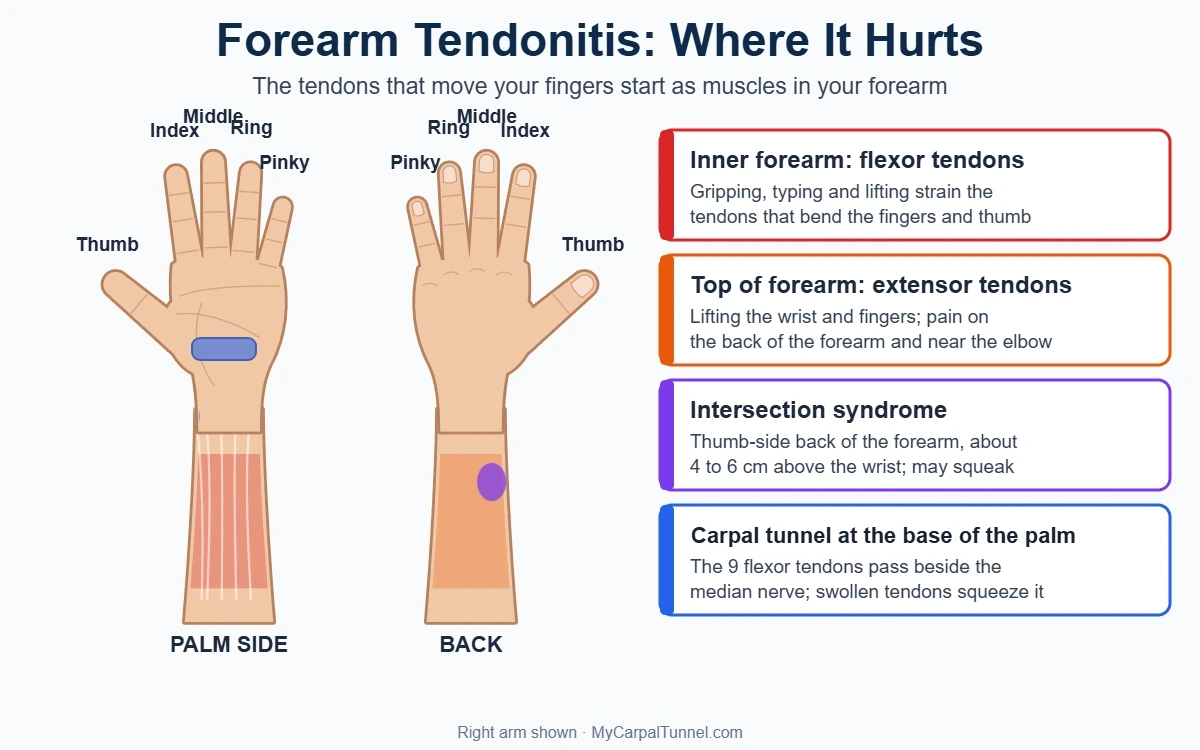
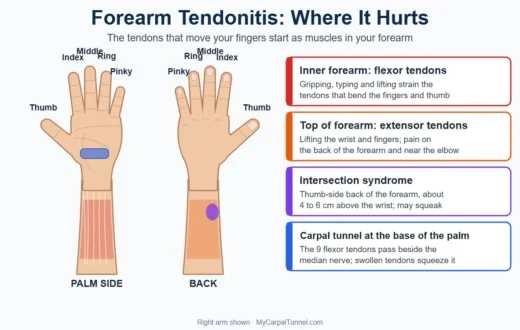
Where the forearm tendon pain sits tells you which tendons are involved:
- Inner forearm (palm side): the flexor tendons that bend the fingers and thumb. Gripping, typing, tools and lifting load them.
- Top of the forearm: extensor tendonitis forearm pain comes from the tendons that lift the wrist and fingers, strained by mouse work, racket sports and repeated lifting with the palm down.
- Near the elbow: pain where the tendons attach at the elbow is often called tennis elbow (outside) or golfer’s elbow (inside). See tennis elbow vs carpal tunnel.
The forearm muscles power most of the hand’s strength and control, which is why forearm tendonitis so often brings weakness with it. See tendons in the wrist and hand and forearm pain.
Intersection Syndrome of the Wrist
Intersection syndrome is a less common forearm tendonitis where two groups of thumb-side extensor tendons cross each other on the back of the forearm. Pain, tenderness and sometimes swelling sit about 4 to 6 cm above the wrist on the thumb side, and the tendons can creak or squeak when the wrist moves. It is common in rowers, weightlifters, racket players and anyone who repeatedly pulls with the wrist extended.
It is easy to confuse with De Quervain’s, but intersection syndrome sits higher up the forearm. Our doctors treat it the same way as other tendonitis: calm the inflammation and clear the swelling.
Strained Forearm Tendon vs Tendonitis
A strained forearm tendon is a sudden overload injury: a heavy lift, a jerk on a rope, a fall. Tendonitis usually builds from repetition. The two overlap, because a strain that cannot clear its swelling can settle into chronic tendonitis.
See a doctor promptly if you felt a pop, cannot bend or straighten a finger, have a visible gap or bulge, or have sudden severe weakness. Those can mean a torn tendon, which needs evaluation.
Forearm Tendonitis and Carpal Tunnel Feed Each Other
Nine tendons that bend the fingers and thumb pass through the carpal tunnel beside the median nerve: four flexor digitorum superficialis tendons, four flexor digitorum profundus tendons and the flexor pollicis longus tendon. They link the forearm muscles to the fingertips. When those tendons and the tissue around them swell with inflammation, they press on the median nerve from the inside out.
Research supports this: studies of carpal tunnel syndrome consistently find thickening of the gliding tissue that wraps the tendons, along with raised pressure inside the tunnel. So forearm tendonitis can feed carpal tunnel, and carpal tunnel swelling can keep tendonitis from healing. Read more in wrist tendonitis treatment and wrist tendonitis vs carpal tunnel.
Why Forearm Tendonitis Lingers
For years, long-lasting tendon pain was described as wear and tear with little inflammation. A 2017 review in The Surgeon concluded that many claims of “no inflammation” in tendon disease rested more on belief than on robust data, and that inflammatory signals play a real part.
In 2026, researchers in the Journal of Orthopaedic Research found that lymphatic drainage from injured tendons slowed below normal by eight weeks, with the tendon still swollen, and proposed that poor fluid clearance keeps inflammation going. That is the heart of our doctors’ approach: when the lymph system is swamped, tendonitis becomes painful and chronic, and clearing the fluid is what lets the tendon heal.
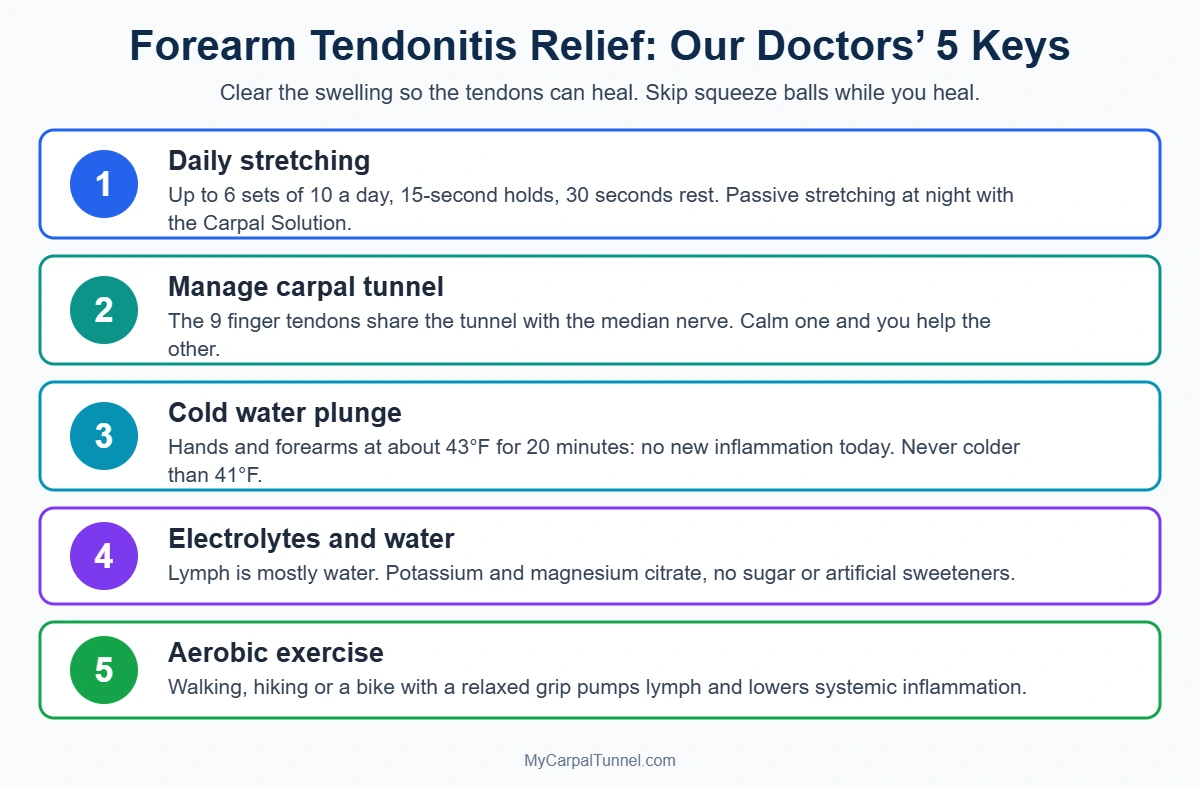
Forearm Tendonitis Relief and Treatment: Our Doctors’ 5 Keys
1. Daily Stretching: Forearm Tendonitis Exercises
Gentle stretching keeps the tendons gliding, moves fluid and restores flexibility. Do daytime stretches up to 6 sets of 10 a day, holding 15 seconds with 30 seconds of rest. See forearm stretches and tendon gliding exercises. Skip grip exercises, squeeze balls and putty while you heal: squeezing loads the same irritated tendons. Long-term discipline is everyone’s weak point, so pair daytime stretches with passive stretching at night.
2. Manage Carpal Tunnel
The Carpal Solution’s targeted passive stretching restores flexibility to the injured soft tissue, relieves pressure on the median nerve, relieves restrictions on blood circulation and lets lymph fluid flow freely to clear out the swelling. It is your body that does the healing; the Carpal Solution just jump-starts the natural healing preempted by excess pressure from inflammation and swelling. Over 220 hours of targeted stretching in six weeks; most people are better from their worst symptoms in two to three weeks, and about 90% get complete remission in 6 weeks.
Dr. Michael Lee Pollard, a chiropractor who used it himself, explains why that matters for tendons: “you increase the circulation of fluid, of blood circulation and lymph flow, and also you allow the blood to bring in proper nutrients for healing and allow the inflammation to leave the area so that healing can take place.”
3. Cold Water Plunges
Submerge the hands and forearms in water at about 43°F for 20 minutes. It has to stay cold enough for the full 20 minutes to slow new inflammation: no new inflammation today. Never use water colder than 41°F; with Raynaud’s, diabetic nerve issues or poor circulation, keep it between 44 and 48°F.
4. Water and Electrolytes
Lymph is mostly water, and it needs fluids and electrolytes to clear swelling. Our doctors favor potassium citrate and magnesium citrate, without sugar or artificial sweeteners.
5. Aerobic Exercise With Minimal Hand Stress
Brisk walking, hiking, stair climbing or a stationary bike with a relaxed grip pump lymph and blood through the whole body, and regular aerobic exercise lowers markers of systemic inflammation.
Brace for Forearm Tendonitis?
A brace or splint can shield a sore forearm from painful movement, but it does not heal tendonitis. Rigid braces carry two separate costs. First, unused muscles weaken from disuse, which is muscle atrophy. Second, a tight brace restricts blood circulation and lymph flow, which slows soft-tissue healing. Braces are necessary for fractures and sprains; for a chronic condition like tendonitis, use one only for temporary relief, never long term.
If you wear a strap or sleeve for comfort during a hard task, keep it loose enough that it does not restrict circulation, and take it off afterward. See why our doctors avoid wrist splints. Compression gloves are different: worn by day, they can spur circulation; see arthritis gloves.
Tendonitis in the Arm Treatment: Injections and Surgery
Steroid injections can calm tendon pain for a while, but they do not fix the swelling and fluid problem that keeps tendonitis coming back. Our doctors recommend clearing the inflammation first with conservative care.
If carpal tunnel is part of the picture, surgery should be the last resort: carpal tunnel surgery has a patient satisfaction rate lower than 69%, because about 31% of patients report lingering or recurring symptoms, and second surgeries have a patient satisfaction rate between 16% and 40%. See recurrence after surgery. Our doctors’ two decades of clinical experience is that people with three or more of the carpal tunnel symptoms listed on this website can be about 95% confident they have carpal tunnel syndrome; get evaluated, and start natural treatment while you wait. See waiting for carpal tunnel treatment and our Persistent Symptoms Protocol.
When Healing Needs a Doctor’s Help and Professional Medical Evaluation
- Constant numbness that does not improve or loss of feeling in the fingertips that does not improve in 4 to 8 weeks.
- Extreme loss of the muscle at the base of the thumb, with loss of grip strength that does not improve over 6 to 8 weeks.
- Worsening symptoms over 6 to 8 weeks while using the best conservative treatments
- Symptoms that begin suddenly after hand or wrist trauma, a fracture or severe sprain from a fall or auto accident.
- Odd Symptoms that are not consistent with the Carpal Tunnel Symptoms listed on this website, that might be indicative of other nerve issues. A nerve conductivity study can clear up the confusion with minimal costs and not too much pain and no risk.
These signs may mean more advanced nerve involvement or a different condition and deserve professional medical evaluation and in person consultation. Home treatment can be used alongside professional in-person medical care while you wait for the healthcare delivery system to fit you into their schedule. There is no reason to wait doing nothing. You can start proven natural conservative treatment with good patient reviews while you wait for your appointments. If your symptoms start improving over 6 to 8 weeks, then you know you are on the right track and surgery is not necessary.
Frequently Asked Questions
What is forearm tendonitis?
Inflammation that saturates the tendons running from the forearm muscles to the wrist, fingers and thumb. It becomes painful and chronic when swelling and entrapped lymph fluid cannot clear.
What are forearm tendonitis symptoms?
An aching or burning pain along the forearm that worsens with gripping, lifting or typing, tenderness over the tendon, mild swelling, morning stiffness and sometimes a creaking feeling.
What causes forearm tendon pain?
Repetitive gripping, typing, mouse work, tools, lifting and racket sports, plus swelling that the lymph system cannot clear. Carpal tunnel swelling at the base of the palm can keep it from healing.
What is extensor tendonitis forearm pain?
Pain on the top of the forearm from the tendons that lift the wrist and fingers, often from mouse work, racket sports or lifting with the palm down.
What is intersection syndrome of the wrist?
A forearm tendonitis where two groups of thumb-side extensor tendons cross, about 4 to 6 cm above the wrist. It can creak and is common in rowers, weightlifters and racket players.
Is a strained forearm tendon the same as tendonitis?
No. A strain is a sudden overload injury; tendonitis usually builds from repetition. A strain that does not clear its swelling can become chronic tendonitis. A pop or loss of finger movement needs a doctor.
What is the best forearm tendonitis treatment?
Our doctors’ 5 keys: daily stretching, managing carpal tunnel with the Carpal Solution, cold water plunges at about 43°F for 20 minutes, water and electrolytes, and aerobic exercise with minimal hand stress.
Should I wear a brace for forearm tendonitis?
Only for short-term relief. A brace does not heal tendonitis; unused muscles weaken, and a tight brace restricts circulation and lymph flow, which slows healing.
What are good forearm tendonitis exercises?
Gentle stretches and tendon glides, up to 6 sets of 10 a day with 15-second holds. Skip squeeze balls and grip putty while you heal.
How long does tendonitis in the arm take to heal?
When the swelling can clear, tendons heal quickly. Many people feel better within weeks once they stretch daily, calm carpal tunnel and use cold water plunges; chronic cases take longer.
Sources
- Inflammation in tendon disease (review). The Surgeon, 2017.
- Lymphatic drainage after tendon injury. Journal of Orthopaedic Research, 2026.
- Subsynovial connective tissue in carpal tunnel syndrome. Journal of Wrist Surgery, 2014.
- Ultrasound anatomy of the carpal tunnel (nine flexor tendons). Journal of Ultrasound, 2012.
- Intersection Syndrome. StatPearls, NCBI Bookshelf.
- Aerobic exercise and inflammatory markers in middle-aged and older adults (meta-analysis). Frontiers in Aging Neuroscience, 2019.
- Wall BT et al. Short-term muscle disuse lowers myofibrillar protein synthesis and induces muscle atrophy. Acta Physiologica, 2014.
- Bland JD. Do nerve conduction studies predict the outcome of carpal tunnel decompression? Muscle & Nerve, 2001.
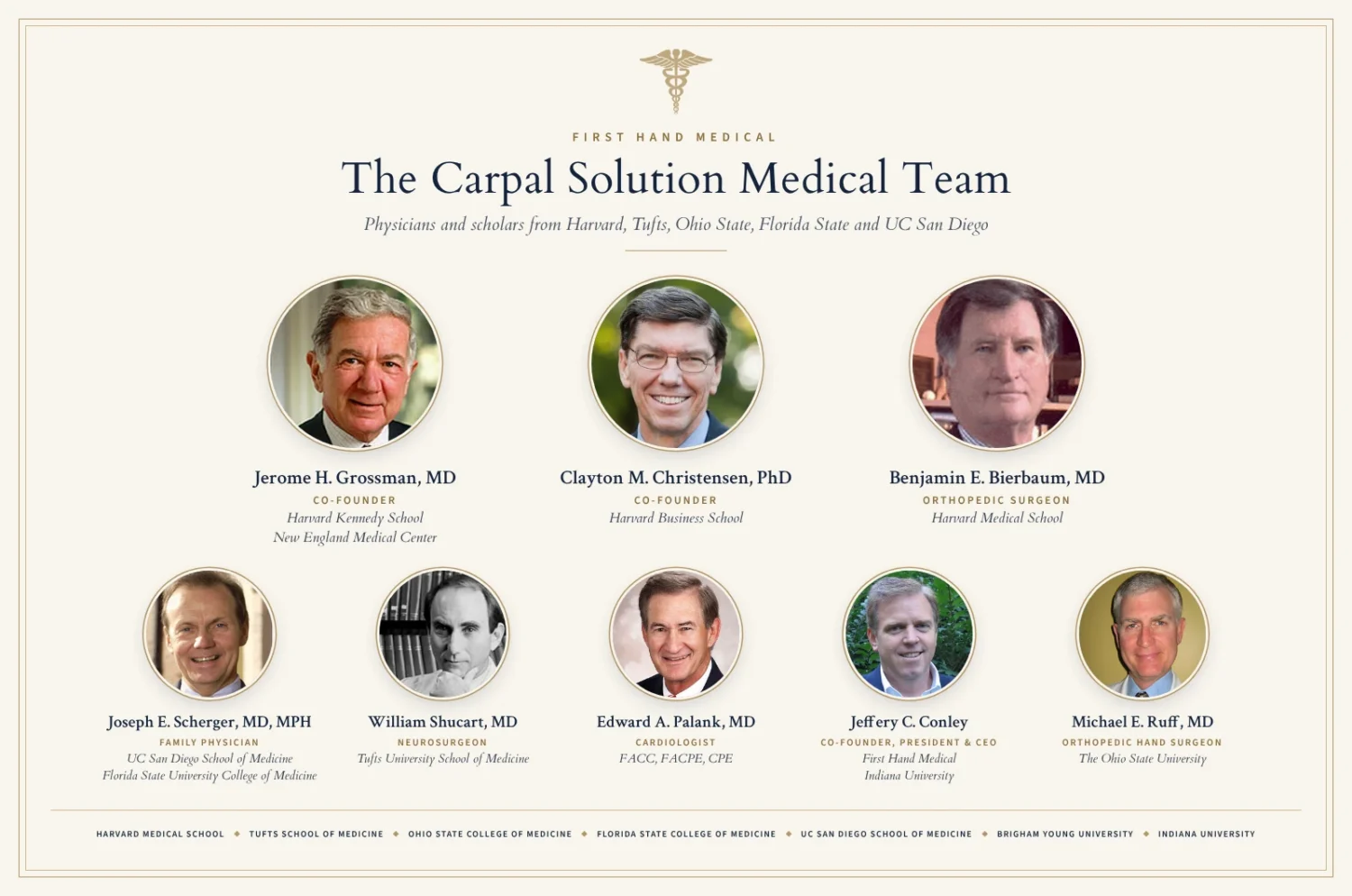
Developed by First Hand Medical’s Team of Doctors and Medical Professionals
The Carpal Solution Treatment Kit was developed by our expert team of medical doctors who have worked at and led some of the top medical institutions in the World – Including Harvard Medical, Tufts Medical, UCSD Medical School, Florida State Medical School, and The Ohio State University Medical School. We treat root causes with clinically proven conservative treatments. The results: Quick Natural Relief of All Your Carpal Tunnel Symptoms without complications. Meet The Medical Team Backing The Carpal Solution at First Hand Medical

Order Your Six Week Carpal Tunnel Treatment Now
The ONLY treatment for carpal tunnel that comes with a no questions asked 30-Day Satisfaction Window and in-house dedicated pain relief team.