 Created by renowned Harvard health care professionals.


Hand Weakness: Causes of Weak Hands and When It Is Carpal Tunnel
Hand weakness usually comes from a squeezed nerve, most often carpal tunnel. Our doctors explain the warning signs of a sudden loss of hand strength, the 8 common causes of weak hands, and how to restore strength naturally.
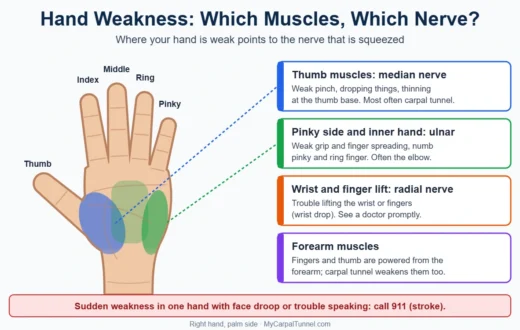

Hand Weakness: What Our Doctors Want You to Know
Written by Julie Sunberg, Director of Marketing and Customer Service, First Hand Medical · Medically reviewed by Dr. William Shucart, MD, neurosurgeon, clinical professor of neurosurgery, New England Medical Center, former chair of neurosurgery, Tufts · Last reviewed: November 2026
Hand weakness shows up in small ways first: a jar that will not open, a coffee cup that slips, buttons that take forever, a pen that tires your fingers. Most weak hands come from a squeezed nerve, and the most common one is the median nerve in the carpal tunnel. Our doctors’ message is clear: sudden weakness is an emergency, but gradual weakness is a signal to act early, take the pressure off the nerve, and give your hand the chance to recover its strength naturally.
On This Page
Key points
- Sudden weakness in one hand with face droop or trouble speaking means call 911.
- Weak pinch, dropping things and numb thumb-side fingers point to carpal tunnel.
- Catch it early: thinning at the base of the thumb is a sign the nerve has been squeezed too long.
- Conservative-first care that follows medicine’s “Do No Harm” principle takes the pressure off, so strength can return.
Sudden Loss of Hand Strength: When to Call 911
A sudden loss of hand strength is different from weakness that builds over weeks. The CDC lists sudden numbness or weakness in the face, arm or leg, especially on one side of the body, as a sign of stroke, along with sudden confusion and trouble speaking, seeing or walking. Use F.A.S.T.: face drooping, arm weakness, speech difficulty, time to call 911.
Sudden weakness after a fall, a cut or a crush injury also needs prompt care, because a nerve or tendon may be damaged. Gradual weakness is the common pattern, and it is the one our doctors can help with at home.
8 Causes of Weak Hands
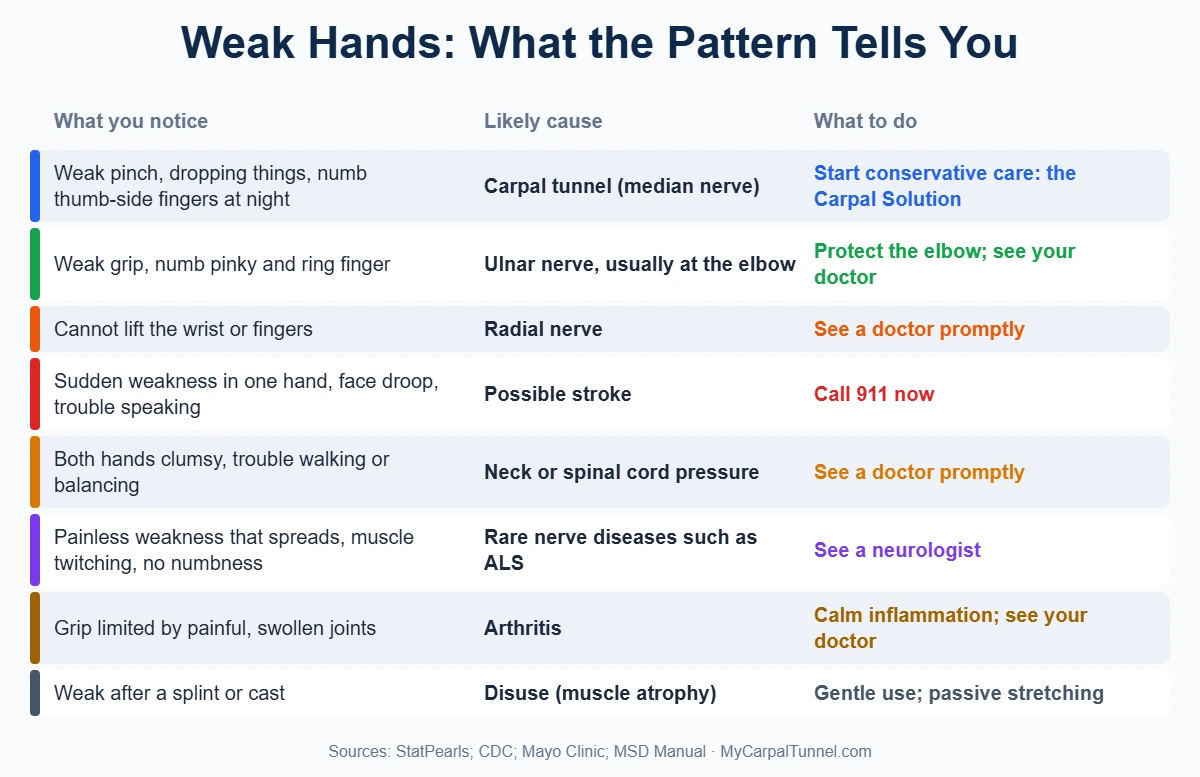
- Carpal tunnel syndrome. The most common cause. As it advances, people notice hand weakness, clumsiness, poorer fine motor control and eventually thinning of the thumb muscles. See muscle atrophy and loss of hand strength and dropping things.
- The ulnar nerve. Pressure at the elbow or wrist weakens grip and finger spreading, with a numb pinky. See numb pinky.
- The radial nerve. Pressure in the upper arm can make it hard to lift the wrist and fingers (wrist drop).
- The neck. A pinched nerve root or spinal cord pressure can weaken one or both hands; both clumsy hands with balance trouble needs a doctor promptly.
- Arthritis. Painful, swollen joints limit grip. See arthritis symptoms in hands.
- Disuse and splints. Unused muscles weaken fast: one study found about 23% of strength was lost after just 14 days in a cast.
- Age and inactivity. Grip strength fades when hands and bodies are not used. See grip strength and longevity.
- Rare nerve diseases. Conditions such as ALS can begin with weakness in the hands, usually without pain or changes in feeling. Painless weakness that keeps spreading needs a neurologist.
Weak Fingers and Weakness of Hands: Pinch vs Grip
Weak fingers come in two kinds, and the difference is a clue. Pinch (thumb to fingertips: buttons, coins, needles, keys) depends on the thenar muscles at the base of the thumb, powered by the median nerve. Weak pinch points to carpal tunnel. See thenar eminence pain.
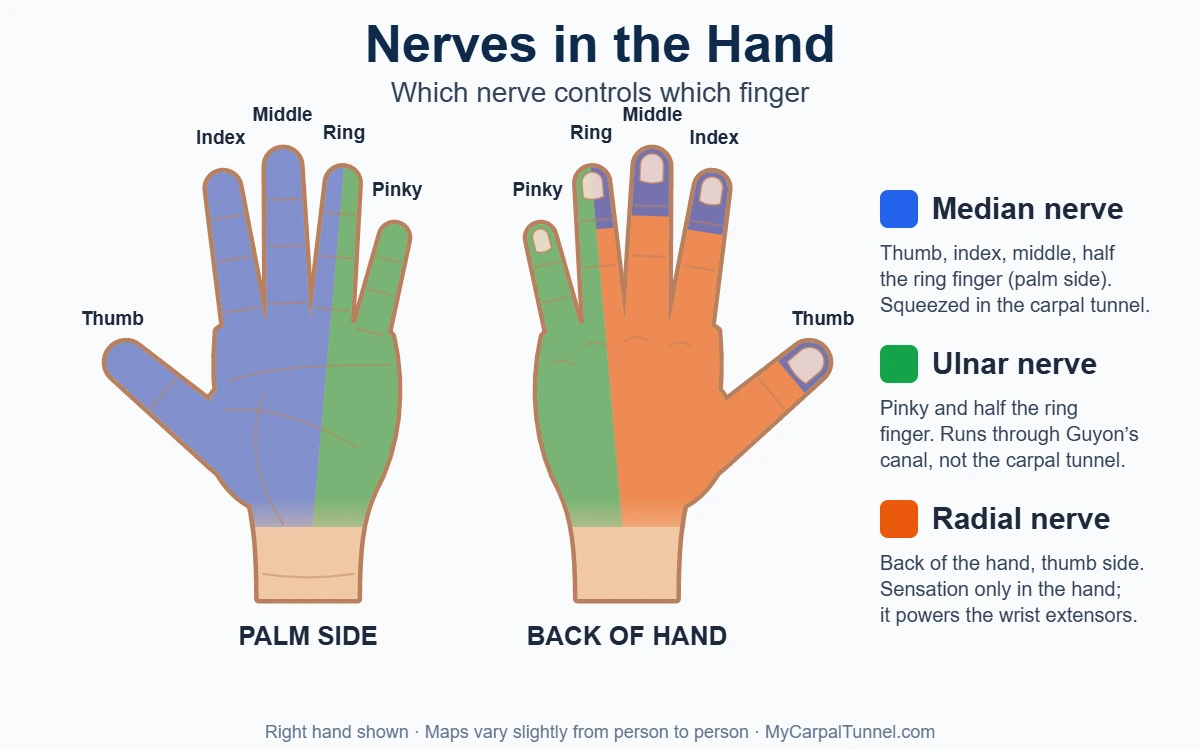
Grip (jars, tools, handles) depends mostly on the forearm muscles that bend the fingers and thumb, whose tendons pass through the carpal tunnel, plus small muscles inside the hand powered by the ulnar nerve. Carpal tunnel weakens the forearm, thumb and fingers together, so weakness of hands often shows up in both pinch and grip. Learn how the nerves in the hand divide the work.
Pain and Weakness in Hands
Pain and weakness in hands often travel together. Pain makes the brain hold back strength to protect the hand, so a sore joint or tendon can make a strong hand feel weak. Arthritis, tendonitis and carpal tunnel all do this. When pain eases, strength usually comes back with it.
When weakness comes with numbness and tingling instead of joint pain, look to a nerve first.
Left Hand Weakness and Right Hand Weakness
Weakness in one hand is usually something local: carpal tunnel or an ulnar nerve on that side. Right hand weakness is common in right-handed people because the dominant hand does more of the gripping, typing and lifting. Left hand weakness gets noticed later, since we lean on it less.
One-sided weakness that comes on suddenly is different: it can be a stroke, so call 911. See carpal tunnel in the left hand and carpal tunnel in the right hand.
Weak Hands and Arms
Weak hands and arms together point upstream: the neck, the shoulder, or a whole-body cause. If both arms are weak and your hands are clumsy, or you have trouble walking or balancing, see a doctor promptly. Weakness with numbness in the arms has its own guide: tingling in arms and hands. If a weak or numb left arm comes with chest discomfort, read numb left arm: heart attack or carpal tunnel?
Why Does My Hand Feel Weak? Losing Strength in Hands Over Time
Losing strength in hands slowly, over months, is usually a nerve that has been under pressure for a long time. At first the nerve is irritated and short of oxygen, and the hand feels clumsy and tired. Later, the muscles the nerve powers begin to thin. That is why our doctors say not to wait: the earlier the pressure comes off, the better the chance of a full recovery.
Look at the base of your thumb. If the fleshy pad looks flatter than the other hand, the median nerve has been squeezed for a while. That deserves a doctor’s evaluation, and it is a reason to start treating the pressure now.
How to Check Your Hand Strength at Home
You do not need special equipment to notice early hand weakness. Try these simple checks with both hands and compare:
- The paper pinch: hold a sheet of paper between your thumb and the side of your index finger while someone gently pulls. A weak side lets go first.
- The button test: time yourself buttoning a shirt. Slower, clumsier fingers point to the median nerve.
- The thumb pad: look at the fleshy base of both thumbs. A flatter pad on one side is a warning sign.
- The jar test: notice whether opening jars or turning keys has become harder over the past few months.
- The finger spread: spread your fingers wide and squeeze them together. Weakness here points to the ulnar nerve.
Doctors measure grip and pinch strength precisely with a dynamometer, which lets you track progress over time. See documenting hand function and the grip strength testing equipment we use. Losing strength in hands on these checks is a reason to start treating the cause now, not later.
Our Doctors’ Plan to Restore Hand Strength
Medicine’s oldest rule is “first, do no harm.” For weak hands from a squeezed nerve, the gentlest effective step is to take the pressure off and let the body heal before reaching for anything more invasive.
At Night: The Carpal Solution
Carpal tunnel starts with pressure. Swelling and entrapped inflammation in the soft tissue in and around the carpal tunnel squeeze the median nerve and restrict blood flow and lymphatic fluid transport. The Carpal Solution’s targeted passive stretching restores flexibility to the injured soft tissue, relieves pressure on the median nerve, relieves restrictions on blood circulation and lets lymph fluid flow freely to clear out the swelling. It is your body that does the healing; the Carpal Solution just jump-starts the natural healing preempted by excess pressure from inflammation and swelling.
- Over 220 hours of targeted stretching in the six-week protocol, while you sleep.
- Most people are better from their worst symptoms in two to three weeks; about 90% get complete remission in 6 weeks.
- 97% patient satisfaction over 21 years and 4.9 out of 5 stars on independent review sites like Google Reviews. Over 100,000 people have used it.

During the Day
- No squeeze balls or grip putty while healing. Squeezing crowds the carpal tunnel. Build strength after the symptoms are gone.
- Passive stretching first. Daytime stretches are a bonus: up to 6 sets of 10, holding 15 seconds with 30 seconds of rest. See forearm stretches.
- Keep using your hands gently. Normal daily use keeps muscles from wasting.
- Splints only for short-term relief. A splint can reduce pain from movement but does not promote healing. Unused muscles weaken (muscle atrophy), and a splint also restricts circulation and lymph flow, which slows soft-tissue healing. See why our doctors avoid wrist splints.
- Aerobic exercise after remission helps keep hands and circulation strong for life.
Surgery Is the Last Resort
Carpal tunnel surgery has a patient satisfaction rate lower than 69%, because about 31% of patients report lingering or recurring symptoms, and no patient is satisfied with lingering symptoms. Second surgeries have a patient satisfaction rate between 16% and 40%. See recurrence after surgery.
Our doctors’ two decades of clinical experience is that people with three or more of the carpal tunnel symptoms listed on this website can be about 95% confident they have carpal tunnel syndrome. Get an in-person evaluation and start natural treatment while you wait; see waiting for carpal tunnel treatment. If symptoms linger, follow our Persistent Symptoms Protocol.
When Healing Needs a Doctor’s Help and Professional Medical Evaluation
- Constant numbness that does not improve or loss of feeling in the fingertips that does not improve in 4 to 8 weeks.
- Extreme loss of the muscle at the base of the thumb, with loss of grip strength that does not improve over 6 to 8 weeks.
- Worsening symptoms over 6 to 8 weeks while using the best conservative treatments
- Symptoms that begin suddenly after hand or wrist trauma, a fracture or severe sprain from a fall or auto accident.
- Odd Symptoms that are not consistent with the Carpal Tunnel Symptoms listed on this website, that might be indicative of other nerve issues. A nerve conductivity study can clear up the confusion with minimal costs and not too much pain and no risk.
These signs may mean more advanced nerve involvement or a different condition and deserve professional medical evaluation and in person consultation. Home treatment can be used alongside professional in-person medical care while you wait for the healthcare delivery system to fit you into their schedule. There is no reason to wait doing nothing. You can start proven natural conservative treatment with good patient reviews while you wait for your appointments. If your symptoms start improving over 6 to 8 weeks, then you know you are on the right track and surgery is not necessary.
Frequently Asked Questions
What causes hand weakness?
The most common cause is carpal tunnel syndrome, which squeezes the median nerve at the base of the palm. Others include the ulnar nerve at the elbow, the radial nerve, a pinched nerve in the neck, arthritis, disuse from splints or casts, aging and, rarely, nerve diseases such as ALS.
Why are my weak hands worse in the morning?
Fluid pools and wrists bend during sleep, raising pressure in the carpal tunnel. Hands often feel clumsy and weak on waking, then loosen with use.
What does a sudden loss of hand strength mean?
Sudden weakness in one hand, especially with face droop, confusion or trouble speaking, can be a stroke. Call 911. Sudden weakness after an injury also needs prompt care.
Why am I losing strength in hands over time?
Gradual weakness usually means a nerve has been under pressure for a long time, most often in the carpal tunnel. The earlier the pressure comes off, the better the chance of recovery.
What causes weak fingers?
Weak pinch points to the median nerve and carpal tunnel. Weak grip and finger spreading point to the forearm muscles and the ulnar nerve.
Why does my hand feel weak but not hurt?
Painless weakness often comes from a squeezed nerve. Painless weakness that spreads, with muscle twitching and no numbness, needs a neurologist.
What causes pain and weakness in hands together?
Arthritis, tendonitis and carpal tunnel. Pain makes the hand hold back strength, so strength often returns as pain eases.
Is left hand weakness or right hand weakness more common?
Right hand weakness is common in right-handed people because the dominant hand works harder. Sudden one-sided weakness in either hand can be a stroke.
Should I squeeze a ball to strengthen weak hands?
Not while you are healing. Squeezing crowds the carpal tunnel. Take the pressure off first with passive stretching and the Carpal Solution, then rebuild strength after symptoms are gone.
Sources
- Carpal Tunnel Syndrome. StatPearls.
- Median Nerve Injury. StatPearls, NCBI Bookshelf.
- Hand Nerve Compression Syndromes. StatPearls, NCBI Bookshelf.
- Signs and Symptoms of Stroke. CDC.
- Amyotrophic lateral sclerosis (ALS). Mayo Clinic.
- ALS and Other Motor Neuron Diseases. MSD Manual.
- Wall BT et al. Short-term muscle disuse lowers myofibrillar protein synthesis and induces muscle atrophy. Acta Physiologica, 2014.
- Bland JD. Do nerve conduction studies predict the outcome of carpal tunnel decompression? Muscle & Nerve, 2001.
- Louie D, Earp B, Blazar P. Long-term outcomes of carpal tunnel release (includes Nancollas 1995). Hand, 2012.

Developed by First Hand Medical’s Team of Doctors
The Carpal Solution Treatment Kit was developed by our expert team of medical doctors who have worked at and led some of the top medical institutions in the World – Including Harvard Medical, Tufts Medical, UCSD, UF Health, and The Ohio State University. We treat root causes with clinically proven conservative treatments. The results: Quick Natural Relief of All Your Carpal Tunnel Symptoms without complications.

Order Your Six Week Carpal Tunnel Treatment Now
The ONLY treatment for carpal tunnel that comes with a no questions asked 30-Day Satisfaction Window and in-house dedicated pain relief team.

