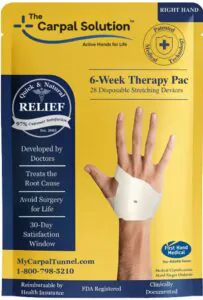
Created by renowned Harvard health care professionals.


Finger Exercises and Finger Stretches for Numb, Stiff or Aching Fingers
Gentle finger exercises and finger stretches ease stiffness and keep tendons gliding. Our doctors show which ones help numb, stiff or aching fingers, which to skip while you heal, and why passive stretching at night matters most.

Finger Exercises: What Our Doctors Want You to Know
Written by Julie Sunberg, Director of Marketing and Customer Service, First Hand Medical · Clinically reviewed by Mr. Alan Ward, MOT, OTR, Master Occupational Therapist, VP of Precision Rehabilitation · Last reviewed: November 2026
Gentle finger exercises keep fingers moving, ease stiffness and help the tendons glide. They are a good daily habit for numb, stiff or aching fingers. But our doctors want you to know two things up front: the right finger exercises are gentle stretches, not squeezing, and daytime exercises alone rarely heal carpal tunnel.
Numbness and tingling usually come from pressure on the median nerve in the carpal tunnel at the base of the palm. Stretching helps, but most people do not keep it up long enough. That is why our doctors pair a few minutes of daytime finger stretches with the deep, passive stretching the Carpal Solution delivers while you sleep.
On This Page
Key points
- Choose gentle finger stretches and glides; skip squeeze balls, putty and grip strengtheners while you heal.
- Hold each stretch about 15 seconds and rest 30 seconds. Never stretch into pain or tingling.
- Numb fingers point to a squeezed nerve. Relieve the pressure, not just the stiffness.
- Conservative-first care that follows medicine’s “Do No Harm” principle comes first; surgery is the last resort.
8 Finger Stretches and Finger Exercises You Can Do Anywhere
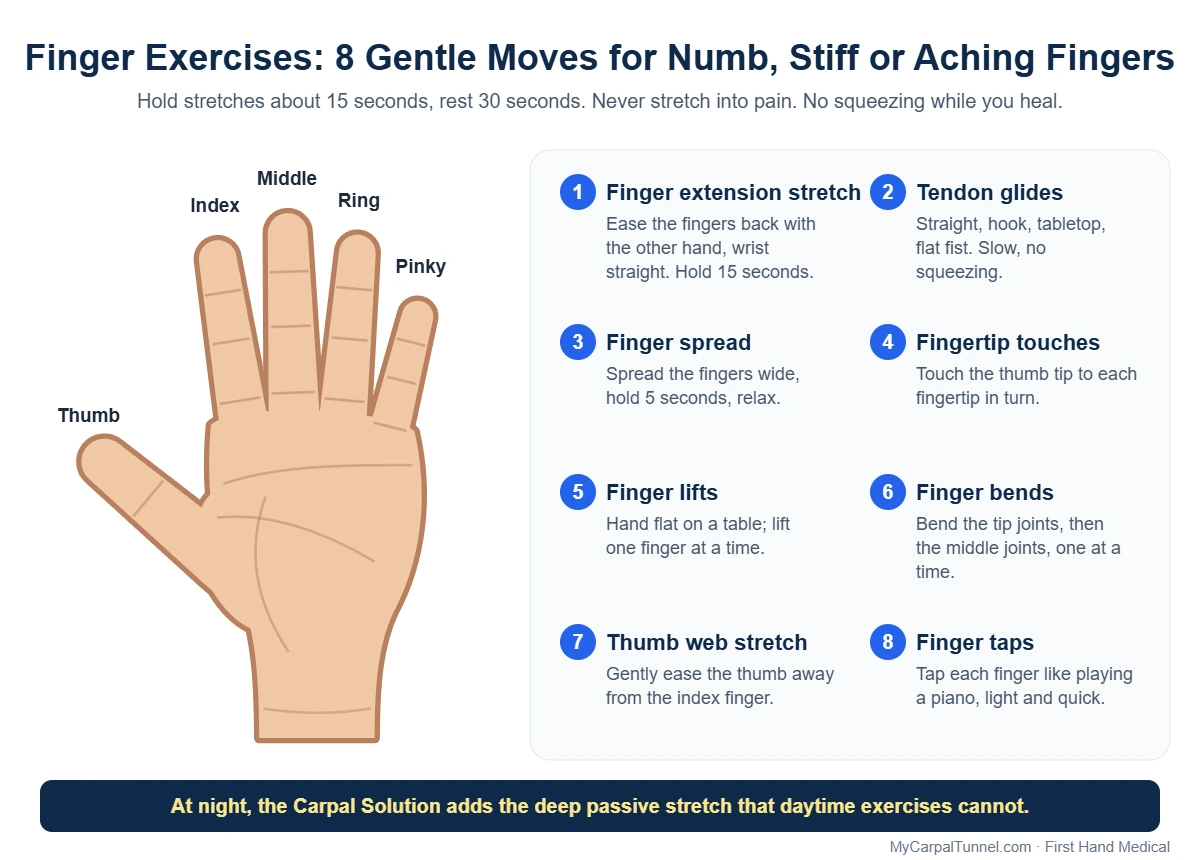
These finger stretches take about five minutes. Do them sitting down with your forearm resting on a table and your wrist straight.
1. Finger Extension Exercises: The Gentle Backward Stretch
Hold your arm out, palm up. With the other hand, gently ease the fingers back until you feel a light stretch in the palm and forearm. Hold about 15 seconds. This is the simplest of the finger extension exercises, and it stretches the same tendons that run through the carpal tunnel.
2. Tendon Glides
Move slowly through five positions: fingers straight, a hook fist, a flat tabletop, a straight fist and a full fist. Do not squeeze. Tendon glides help the nine finger tendons slide smoothly beside the median nerve.
3. Finger Spread
Spread all five fingers as wide as is comfortable, hold five seconds and relax. Repeat five times.
4. Finger Dexterity Exercises: Fingertip Touches and Taps
Touch the tip of your thumb to each fingertip in turn, then tap each finger on the table like playing a piano. These finger dexterity exercises keep fine motion sharp without loading the tendons.
5. Finger Lifts
Lay your hand flat on a table and lift one finger at a time, then lower it slowly.
6. Finger Bends
Bend only the tip joints of the fingers, then only the middle joints. Moving one joint at a time keeps stiff finger joints mobile.
7. Thumb Web Stretch
Gently ease your thumb away from your index finger to open the web space. Hold about 15 seconds.
8. Median Nerve Glide
With the wrist straight, slowly open the fingers and thumb, then turn the palm up. Stop before any tingling. See median nerve glides.
How to Stretch Fingers Safely
Knowing how to stretch fingers safely matters as much as which stretches you choose:
- Warm up first. A minute in warm water or a few gentle hand movements loosens the tissue.
- Stretch, do not strain. A light pull is right; pain, numbness or tingling means back off.
- Hold and rest. Hold about 15 seconds and rest 30 seconds. Up to 6 sets of 10 spread through the day is plenty.
- Keep the wrist straight. Bending the wrist hard raises pressure in the carpal tunnel.
Pair your hand work with forearm stretches, because the muscles that bend your fingers live in the forearm.
Exercises for Numb Fingers and Tingling
Exercises for numb fingers help most when they ease pressure on the nerve. Numbness and tingling in the thumb, index and middle fingers usually come from the median nerve being squeezed in the carpal tunnel, at the base of the palm. Swelling and entrapped inflammation crowd the tunnel, restrict blood flow and slow the lymph fluid that should carry the swelling away.
Gentle tendon glides, nerve glides and extension stretches can help the tissue move and the fluid drain. Exercise for numbness in hands and fingers should never bring the tingling on. If it does, stop. Read how to stop tingling fingers and numb fingertips.
Finger Arthritis Exercises
Finger arthritis exercises focus on gentle range of motion: finger bends, finger lifts, fingertip touches and tendon glides done slowly after warming the hands. A Cochrane review of exercise for hand osteoarthritis found that exercise reduced hand pain and finger joint stiffness, although the evidence was of low quality.
Arthritis and carpal tunnel often feed each other: arthritis adds swelling and scar tissue near the carpal tunnel, and carpal tunnel symptoms return faster when arthritis is present. Our doctors’ position is firm: “No one with arthritis should get carpal tunnel surgery. The risk of excessive scar tissue is off the charts.” See arthritis symptoms in hands and painful finger joints.
Finger Rehab Exercises and Finger Physical Therapy Exercises
After a finger injury, a fracture or hand surgery, finger rehab exercises should follow your surgeon’s or hand therapist’s plan, because the timing depends on what is healing. Finger physical therapy exercises usually start with gentle motion and add load only later.
After carpal tunnel surgery, wait three months before starting the Carpal Solution. A certified hand therapist can tailor a program to your hand.
Hand and Finger Exercises to Skip While You Heal
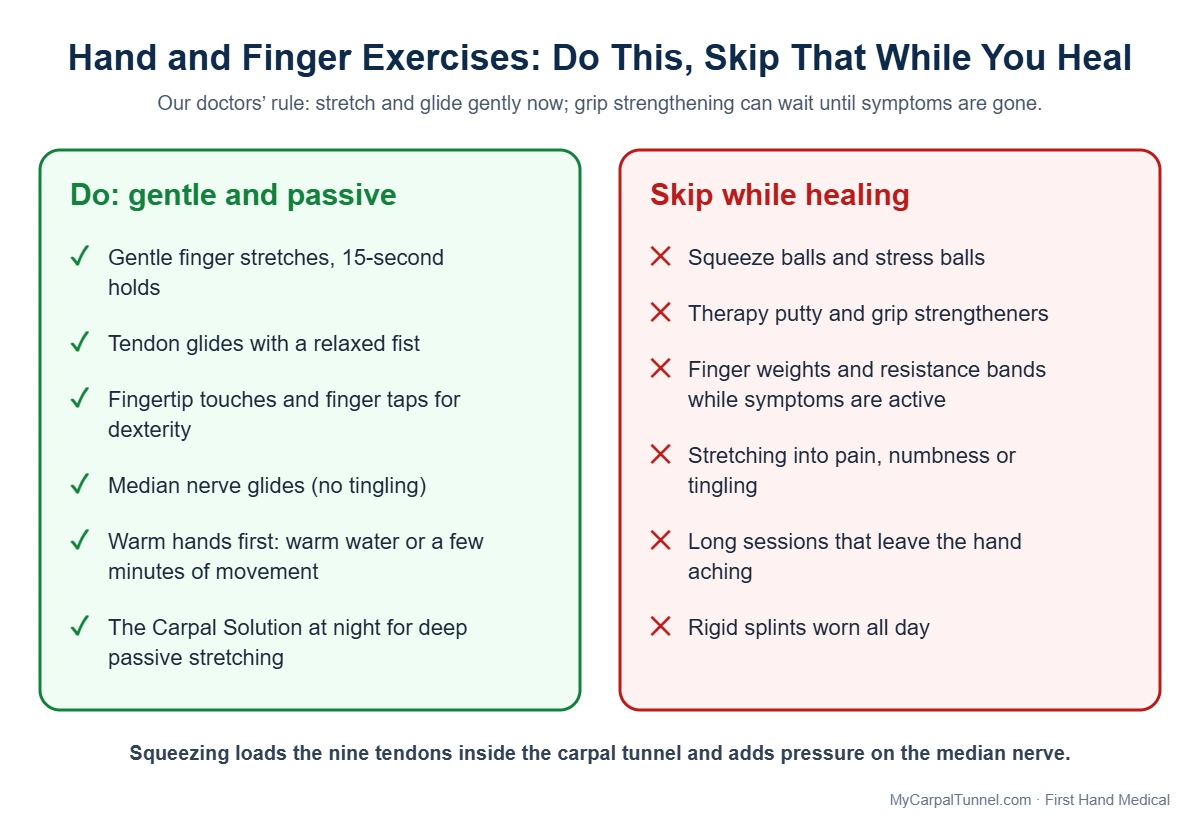
Many hand and finger exercises online are grip exercises: squeeze balls, therapy putty, spring grippers and finger weights. Our doctors advise skipping them while carpal tunnel is healing. Squeezing tightens the nine flexor tendons inside the carpal tunnel and adds pressure on the median nerve. Strength returns on its own once the pressure is gone, and aerobic exercise is welcome after remission.
Skip rigid splints for long-term use too. They cause muscle atrophy from disuse, and they restrict blood circulation and lymph flow, which slows soft-tissue healing. See why to avoid wrist splints.
A Simple Daily Finger Exercise Routine

- Morning: warm water, then tendon glides and finger bends for stiff fingers.
- Workday breaks: a finger extension stretch, finger spread and thumb web stretch every hour or two.
- Evening: fingertip touches, finger taps and a median nerve glide. Calm new inflammation with a cold water plunge for hands and forearms at about 43°F for 20 minutes.
- Night: the Carpal Solution, for the deep passive stretch daytime exercises cannot give.
Why Add Passive Nighttime Stretching to Daytime Finger Stretches
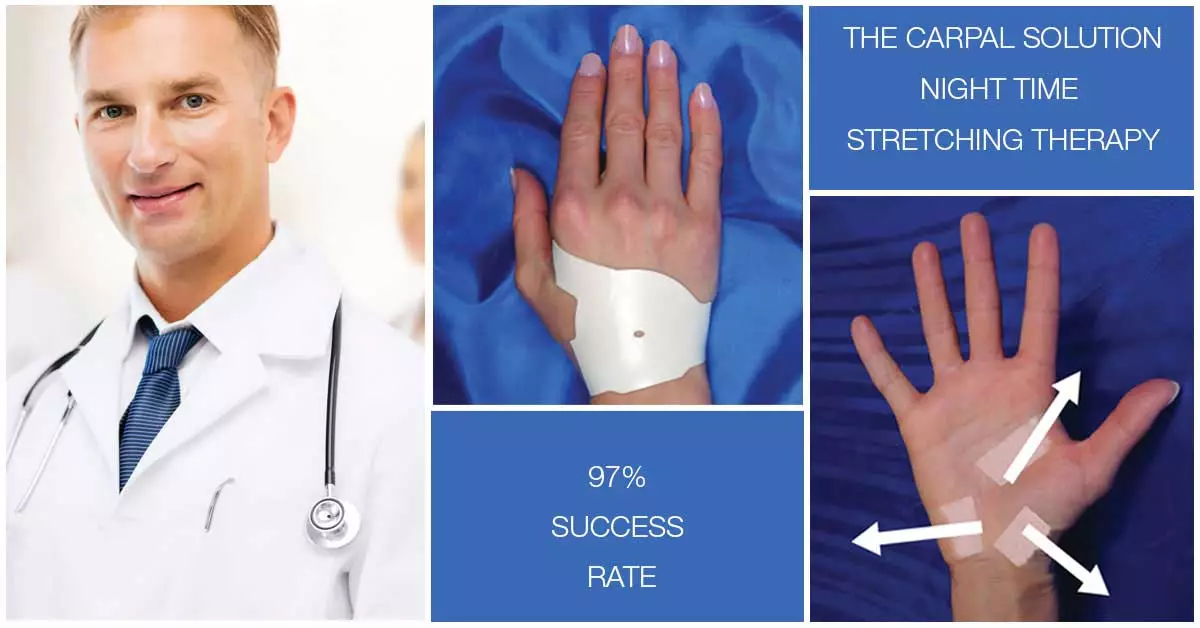
Daytime finger stretches are good for your hands, but on their own they rarely deliver consistent results. Our doctors add passive nighttime stretching for four reasons.
1. Nights Are When Pressure Is Highest
Most people sleep with their wrists and fingers curled. That raises pressure inside the carpal tunnel for hours, which is why numbness and tingling so often wake people up. Stretching at night works during the very hours the tissue is most squeezed. See why carpal tunnel is worse at night.
2. The Dose Is Far Larger
Even a dedicated routine of 6 sets of 10 daytime finger stretches, held 15 seconds each, adds up to about 15 minutes a day, or roughly 10 hours over six weeks. The Carpal Solution delivers over 220 hours of gentle, targeted stretching in its six-week protocol, while you sleep.
3. Passive Stretching Lets the Tissue Let Go
When you stretch yourself, the muscles tend to guard against the pull. During sleep they are relaxed, so a light, steady passive stretch can restore flexibility to the soft tissue, relieve pressure on the median nerve, and let blood and lymph fluid flow freely to clear out the swelling.
4. Consistency Without Willpower
Our doctors find that long-term discipline is most people’s weak point. Busy days crowd out stretching, and symptoms return. Nighttime stretching happens every night without effort, which is why results are more consistent and recovery is faster: most people are better from their worst symptoms in two to three weeks, and about 90% reach complete remission in 6 weeks.
The best plan uses both: daytime finger stretches to keep the fingers moving and the tendons gliding, and passive nighttime stretching to do the deep, steady work. Learn more about passive stretching.
Finger Exercises for Carpal Tunnel: Our Doctors’ Plan
Finger exercises for carpal tunnel help, but research shows their limits: a Cochrane review found only limited, very low-quality evidence that exercise and mobilisation improve carpal tunnel symptoms. Our doctors see why every day. Long-term discipline is most people’s weak point, and a few minutes of stretching cannot match hours of steady, gentle stretch.
It starts with pressure. Swelling and entrapped inflammation in the soft tissue in and around the carpal tunnel squeeze the median nerve and restrict blood flow and lymphatic fluid transport. The Carpal Solution’s targeted passive stretching restores flexibility to the injured soft tissue, relieves pressure on the median nerve, relieves restrictions on blood circulation and lets lymph fluid flow freely to clear out the swelling. It is your body that does the healing; the Carpal Solution just jump-starts the natural healing preempted by excess pressure from inflammation and swelling. See how the Carpal Solution works and passive stretching.
Most people are better from their worst symptoms in two to three weeks, and about 90% reach complete remission in 6 weeks. The Carpal Solution has 97% patient satisfaction over 21 years and 4.9 out of 5 stars on independent review sites like Google Reviews. By comparison, carpal tunnel surgery has a patient satisfaction rate lower than 69%, because about 31% of patients report lingering or recurring symptoms. More routines: hand exercises for carpal tunnel.
When Healing Needs a Doctor’s Help and Professional Medical Evaluation
- Constant numbness that does not improve or loss of feeling in the fingertips that does not improve in 4 to 8 weeks.
- Extreme loss of the muscle at the base of the thumb, with loss of grip strength that does not improve over 6 to 8 weeks.
- Worsening symptoms over 6 to 8 weeks while using the best conservative treatments
- Symptoms that begin suddenly after hand or wrist trauma, a fracture or severe sprain from a fall or auto accident.
- Odd Symptoms that are not consistent with the Carpal Tunnel Symptoms listed on this website, that might be indicative of other nerve issues. A nerve conductivity study can clear up the confusion with minimal costs and not too much pain and no risk.
These signs may mean more advanced nerve involvement or a different condition and deserve professional medical evaluation and in person consultation. Home treatment can be used alongside professional in-person medical care while you wait for the healthcare delivery system to fit you into their schedule. There is no reason to wait doing nothing. You can start proven natural conservative treatment with good patient reviews while you wait for your appointments. If your symptoms start improving over 6 to 8 weeks, then you know you are on the right track and surgery is not necessary.
Frequently Asked Questions
What are the best finger exercises for stiff fingers?
Gentle range-of-motion moves: tendon glides, finger bends, finger lifts and a finger extension stretch, done after warming the hands. Hold stretches about 15 seconds and never push into pain.
Do finger exercises help numb fingers?
They can help the tissue move and fluid drain, but numb fingers usually mean the median nerve is squeezed in the carpal tunnel at the base of the palm. Relieving that pressure, for example with the Carpal Solution at night, matters most.
Should I use a squeeze ball for carpal tunnel?
Not while you are healing. Squeezing tightens the nine tendons inside the carpal tunnel and adds pressure on the median nerve. Our doctors recommend gentle stretching first; strength returns once the pressure is gone.
How often should I do finger stretches?
A few minutes several times a day is enough: about 15-second holds with 30 seconds of rest, up to 6 sets of 10 spread through the day.
Are finger exercises good for arthritis?
Yes, gentle finger arthritis exercises can reduce hand pain and finger joint stiffness. Keep them slow and pain-free, and warm the hands first.
Sources
- Page MJ et al. Exercise and mobilisation interventions for carpal tunnel syndrome. Cochrane Database of Systematic Reviews, 2012
- Østerås N et al. Exercise for hand osteoarthritis. Cochrane Database of Systematic Reviews, 2017
- Journal of Ultrasound (2012): the nine flexor tendons and the median nerve in the carpal tunnel
- Bland, Muscle & Nerve (2001): patient-reported outcome of carpal tunnel surgery in 1,268 operations

Developed by First Hand Medical’s Team of Doctors
The Carpal Solution Treatment Kit was developed by our expert team of medical doctors who have worked at and led some of the top medical institutions in the World – Including Harvard Medical, Tufts Medical, UCSD, UF Health, and The Ohio State University. We treat root causes with clinically proven conservative treatments. The results: Quick Natural Relief of All Your Carpal Tunnel Symptoms without complications.

Order Your Six Week Carpal Tunnel Treatment Now
The ONLY treatment for carpal tunnel that comes with a no questions asked 30-Day Satisfaction Window and in-house dedicated pain relief team.