 Created by renowned Harvard health care professionals.


Carpal Tunnel Physical Exam: How Doctors Confirm Carpal Tunnel Syndrome
The carpal tunnel physical exam is how your doctor confirms carpal tunnel syndrome: a hand diagram, the Durkan compression test, Tinel’s and Phalen’s tests and quick strength checks. Here is what to expect and what to do while you wait.


Carpal Tunnel Physical Exam: What to Expect
The carpal tunnel physical exam is how your doctor confirms carpal tunnel syndrome. In a few minutes, your doctor maps where your symptoms are, checks your hand for nerve and muscle changes and uses simple bedside tests such as the Durkan compression test, Tinel’s sign and Phalen’s test. This guide explains each part of the exam, how to confirm carpal tunnel syndrome step by step, and the most conservative treatment to start while you wait for your appointment.
Written by Jeff Conley, President, First Hand Medical · Medically reviewed by William Shucart, MD, neurosurgeon, clinical professor of neurosurgery at New England Medical Center and former chair of neurosurgery at Tufts · Last reviewed: November 2026
Table of Contents
Key Takeaways
- Carpal tunnel syndrome has a recognizable pattern: numbness and tingling in the thumb, index and middle fingers, often worse at night.
- To confirm carpal tunnel syndrome, doctors combine your symptoms, simple exam tests and, when needed, a nerve conduction study or ultrasound.
- In our doctors’ two decades of experience, three or more classic symptoms make carpal tunnel syndrome about 95% likely. That is clinical experience, not a published statistic.
- Conservative first is a fundamental principle of medicine. The Carpal Solution is the best first treatment, and you can start it while you wait for your appointment.
- Splints cause muscle atrophy and stiffness, steroid injections wear off, and surgery has a patient satisfaction rate lower than 69%.
What Carpal Tunnel Syndrome Is
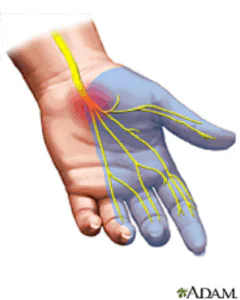
Understanding carpal tunnel syndrome symptoms and diagnosis starts with the anatomy. Carpal tunnel syndrome happens when the median nerve is squeezed inside the carpal tunnel, a narrow, rigid passage at the base of the palm. The nerve shares that space with nine tendons. Their muscles are in the forearm: four tendons come from the flexor digitorum superficialis, four from the flexor digitorum profundus and one from the flexor pollicis longus, and together they bend the fingers and thumb (Journal of Ultrasound, 2012).
When the soft tissue in the tunnel swells, pressure builds on the nerve, and blood flow and lymph drainage slow down. The median nerve gives feeling to the thumb, index, middle and half of the ring finger, and it powers the muscles at the base of the thumb. That is why compression causes numbness, tingling, pain, clumsiness and night waking. Common contributors include repetitive hand use, pregnancy, diabetes, an underactive thyroid, extra body weight and inflammatory arthritis. Read more about the anatomy of the carpal tunnel.
How to Confirm Carpal Tunnel Syndrome in 5 Steps
1. Recognize the Classic Symptoms
- Numbness, tingling or pins and needles in the thumb, index and middle fingers
- Waking at night with hands that feel asleep, and shaking them to get the feeling back
- Dropping things, or trouble with buttons, pens and small objects
- Pain or burning that travels into the palm or up the forearm
- A little finger that feels normal, because it is supplied by a different nerve
In our doctors’ two decades of experience, people with three or more of the carpal tunnel symptoms listed on this website can be about 95% confident they have carpal tunnel syndrome. This is clinical experience, not a published statistic, so you should still get an in-person evaluation and a formal diagnosis. See a doctor promptly if you have constant numbness, weakness or thinning at the base of the thumb.
2. Try Simple Tests at Home
Three quick tests can reproduce carpal tunnel symptoms. Phalen’s test: let your wrists hang down, backs of the hands pressed together, for 60 seconds. Tinel’s sign: tap over the crease at the base of the palm. Durkan’s test: press firmly on the same spot for 30 seconds. Tingling in the thumb, index or middle finger is a positive result. These tests are only moderately accurate, so they point you in the right direction rather than confirm the diagnosis. Try our carpal tunnel self-test.
3. Get a Physical Exam
A doctor will ask when and where your symptoms happen, check the feeling in each finger, test the strength of your thumb and look for thinning of the muscle at its base. Your history and exam are the core of the diagnosis.
4. Add Nerve Testing When Needed

A nerve conduction study, sometimes with electromyography (EMG), measures how well signals pass through the median nerve at the wrist. It is the standard test to confirm carpal tunnel syndrome, grade how severe it is and rule out other nerve problems, at modest cost, with little discomfort and no risk. Read about the carpal tunnel tests doctors use. Ultrasound can show a swollen median nerve and structural causes such as a ganglion cyst. Read more about how carpal tunnel syndrome is diagnosed.
5. Rule Out Look-Alikes
Not every numb hand is carpal tunnel syndrome. A pinched nerve in the neck, cubital tunnel syndrome at the elbow (which affects the ring and little fingers), pronator syndrome in the forearm and diabetic nerve damage can all feel similar. Symptoms that do not fit the usual pattern deserve a nerve study.
Physical Exam for Carpal Tunnel: The Tests Your Doctor Uses
A physical exam for carpal tunnel usually takes only a few minutes and does not hurt. Your doctor combines what you describe with what they can see and feel in your hand. No single bedside test is perfect, so doctors look for several findings that point the same way.
The Katz Hand Diagram
Many doctors start with a hand diagram, sometimes called the Katz hand diagram, where you shade exactly where you feel numbness, tingling and pain. Shading in the thumb, index, middle and half of the ring finger, with the little finger spared, fits carpal tunnel. Shading on the back of the hand or the little finger points elsewhere.
Durkan Test (Carpal Compression Test)
In the Durkan test, the doctor presses both thumbs firmly over the carpal tunnel at the base of your palm for up to 30 seconds. Numbness or tingling in the median nerve fingers is a positive result. Many studies find this carpal compression test at least as useful as Tinel’s and Phalen’s tests.
Tinel’s Sign and Phalen’s Test
For Tinel’s sign, the doctor taps lightly over the median nerve at the wrist; for Phalen’s test, you hold your wrists bent for up to a minute. Tingling in the thumb and first fingers with either test supports carpal tunnel. You can try both at home with our Tinel and Phalen self test.
The Flick Sign: Carpal Tunnel’s Telltale Shake
Your doctor will ask whether you shake or flick your hands to bring the feeling back, especially at night. A yes, called the flick sign, is one of the most telling answers for carpal tunnel.
Strength, Sensation and Thumb Muscle Checks
Your doctor checks light touch and two-point discrimination on your fingertips, tests the strength of the thumb as it lifts away from the palm, and looks for thinning of the muscle at the base of the thumb. They also check the forearm muscles that bend your fingers and thumb, since their tendons pass through the carpal tunnel. Weakness or thinning means the nerve has been under pressure for a while.
Carpal Tunnel Differential Diagnosis: Ruling Out Look-Alikes
Part of every exam is the carpal tunnel differential diagnosis: making sure something else is not causing the symptoms. Your doctor checks your neck (a pinched nerve can cause arm and hand tingling), your elbow (cubital tunnel affects the ring and little fingers), your thumb joint (arthritis) and, when needed, your blood sugar and thyroid. See conditions that mimic carpal tunnel.
Carpal Tunnel Syndrome Physical Exam: When Nerve Tests Are Added
When the exam is clear, many doctors can confirm carpal tunnel syndrome without more testing. A nerve conduction study or ultrasound is usually added when the picture is unclear, symptoms are severe, or surgery is being considered. Read should I get a nerve conduction study? and how carpal tunnel syndrome is diagnosed.
Is the Carpal Tunnel Compression Test Accurate?
The carpal tunnel compression test is one of the more reliable bedside tests, but no single test confirms carpal tunnel on its own. Doctors combine it with your symptom pattern, the hand diagram and the other exam findings. Before your visit, keep a short symptom log and review how to tell if you have carpal tunnel and our main carpal tunnel symptoms page.
The Best First Treatment While You Wait

Once you know the carpal tunnel syndrome symptoms and diagnosis steps, the next question is what to do while you wait. The waiting is real. The average wait for a new-patient doctor appointment is 31 days (AMN Healthcare, 2025), and seeing a neurologist or hand surgeon, or scheduling a nerve study, can take longer. There is no reason to wait doing nothing while your sleep, work and grip suffer. Read more about relief while waiting for carpal tunnel treatment.
Conservative first is a fundamental principle of medicine: start with the safest treatment that works, and save riskier options for when it does not. For carpal tunnel syndrome, our doctors consider the Carpal Solution the best first option.
Why the Carpal Solution Comes First
- It treats the cause. It gently stretches the soft tissue around the carpal tunnel while you sleep, giving the nerve and tendons more room and opening restricted lymph channels so trapped inflammation can drain.
- It works during the hours symptoms are worst. The six-week protocol adds up to over 220 hours of targeted stretching.
- Results you can measure. Most people feel their worst symptoms ease in two to three weeks, and about 90% get complete remission in six weeks. About 10%, often people with excess systemic inflammation, are 40 to 70% better at six weeks and reach full remission in 10 to 12 weeks.
- Patients like it. Over 100,000 people have used it over two decades, with 97% patient satisfaction and 4.9 out of 5 stars on independent review sites like Google Reviews.
- No downtime and no surgical risk. If it works, and for most people it does, you have avoided surgery.
“I’ve had patients that have had carpal tunnel syndrome diagnosed with EMG testing at neurologists, and they’ve been to surgeons and orthopedic hand specialists, and they’ve worn the braces, they’ve had surgical consults, and I’ve turned them on to the Carpal Solution and they’ve done really well with it.”
Dr. Michael Lee Pollard, DC, chiropractor, East Brunswick, New Jersey
Helpers That Speed Healing
Daytime stretches are a bonus: up to 6 sets of 10 a day, holding each stretch for 15 seconds with 30 seconds of rest. Physical and occupational therapy, better ergonomics and the doctors’ faster-recovery techniques for persistent symptoms all add to the Carpal Solution. Skip squeeze balls and grip trainers while you heal. If you are pregnant, carpal tunnel syndrome often improves after delivery, and gentle conservative care is the right start.
Splints, Injections and Surgery
- Wrist splints. A splint holds the wrist in a neutral position, which can reduce pain from movement, but it does not promote healing from carpal tunnel syndrome. It causes muscle atrophy and stiffness, and its tight compression restricts blood circulation and lymphatic fluid exchange, which slows the dispersion of entrapped swelling, the root cause of carpal tunnel syndrome. Our medical team has observed that splints give some relief at first but aggravate symptoms in the long run. Immobilization is great for fractures and sprains, but not for carpal tunnel syndrome. In one study, just 14 days in a cast cost about 8% of muscle size and 23% of strength (Wall, Acta Physiologica, 2014).
- Pain pills. Anti-inflammatory pills did not relieve carpal tunnel symptoms better than a placebo in a Cochrane review (O’Connor, Cochrane, 2003). They do not take pressure off the nerve.
- Steroid injections. They can calm symptoms, but a Cochrane review did not show benefit beyond about one month (Marshall, Cochrane, 2007).
- Surgery. Carpal tunnel surgery has a patient satisfaction rate lower than 69%. About 31% of patients report lingering or recurring symptoms, and no patient is satisfied with lingering symptoms; a surgery that leaves symptoms behind is not a successful surgery (Bland, Muscle & Nerve, 2001). Second surgeries have a patient satisfaction rate between 16% and 40%.
Even after a successful surgery, symptoms often come back. In one published study, 57% of patients had at least some symptoms return within five and a half years (Nancollas, 1995). Based on two decades of clinical experience with patients, our doctors estimate that symptoms return for 80 to 90% of patients within 10 years. That is not a statistically researched figure; it is their best estimate until the work is done to follow carpal tunnel patients for 10 years or more, as other orthopedic fields do for hip and knee replacements.
Why so little certainty? Published recurrence rates range from about 4% to 57%, a spread that shows how poorly this question has been studied. Studies define recurrence differently, follow patients for only a few years and lose many of them along the way. The lowest figures count only repeat operations, a biased approach that ignores patient satisfaction and the patient’s perspective, so they are not credible. Read more about recurrence after surgery. Surgery should be the last resort.
How to Track Your Progress
The Boston Carpal Tunnel Questionnaire is a reliable way to measure carpal tunnel symptoms and hand function. It has a Symptom Severity Scale and a Functional Status Scale, each scored from 1 to 5, where higher scores mean worse symptoms. Take it before you start treatment and every two weeks after.
- Night waking: count how many times a week numbness wakes you.
- Everyday tasks: note whether you can open jars, button a shirt, hold a phone or type for 30 minutes without numbness.
- What to expect with the Carpal Solution: fewer night wakings in the first weeks, the worst symptoms easing in two to three weeks, and remission for most people by six weeks.
If your symptoms start improving over 6 to 8 weeks, you know you are on the right track and surgery is not necessary.
Common Mistakes to Avoid
- Waiting and doing nothing. Start conservative treatment while you wait for appointments and tests.
- Assuming every numb hand is carpal tunnel syndrome. Symptoms that do not fit the pattern deserve a nerve study.
- Wearing splints around the clock. Full-time immobilization adds atrophy and stiffness without treating the cause.
- Relying on pain pills. They do not take pressure off the nerve.
- Rushing into surgery. Give the best conservative treatment a fair trial first.
How to Confirm Carpal Tunnel Syndrome and What to Do First
From Symptoms to Solutions
Carpal tunnel syndrome symptoms and diagnosis come first. To confirm carpal tunnel syndrome, recognize the pattern, try the simple tests, and get a doctor’s exam, adding a nerve study when the picture is unclear. Then follow the principle of conservative first: start the Carpal Solution, track your progress, and keep surgery as the last resort.
When Healing Needs a Doctor’s Help and Professional Medical Evaluation
- Constant numbness that does not improve or loss of feeling in the fingertips that does not improve in 4 to 8 weeks.
- Extreme loss of the muscle at the base of the thumb, with loss of grip strength that does not improve over 6 to 8 weeks.
- Worsening symptoms over 6 to 8 weeks while using the best conservative treatments
- Symptoms that begin suddenly after hand or wrist trauma, a fracture or severe sprain from a fall or auto accident.
- Odd Symptoms that are not consistent with the Carpal Tunnel Symptoms listed on this website, that might be indicative of other nerve issues. A nerve conductivity study can clear up the confusion with minimal costs and not too much pain and no risk.
These signs may mean more advanced nerve involvement or a different condition and deserve professional medical evaluation and in person consultation. Home treatment can be used alongside professional in-person medical care while you wait for the healthcare delivery system to fit you into their schedule. There is no reason to wait doing nothing. You can start proven natural conservative treatment with good patient reviews while you wait for your appointments. If your symptoms start improving over 6 to 8 weeks, then you know you are on the right track and surgery is not necessary.