Created by renowned Harvard health care professionals.


Nerve Compression Syndrome: Why Carpal Tunnel Pressure Can Reach 13 Times Normal
Nerve compression syndrome happens when swelling raises the pressure around a nerve in a tight tunnel of bone and ligament. In carpal tunnel syndrome that pressure can reach 13 times normal. Our doctors explain the research, from simple to technical, and how to relieve the pressure without surgery.

Nerve Compression Syndrome: What Our Doctors Want You to Know
Written by Jeff Conley, President of First Hand Medical · Medically reviewed by Dr. Michael E. Ruff, MD, orthopedic hand surgeon and associate clinical professor of orthopedic surgery, Ohio State University · Last reviewed: November 2026
Nerve compression syndrome is what happens when a nerve is squeezed in a tight space until it can no longer work normally. The squeeze comes from pressure, and in the hand that pressure is usually caused by swelling and entrapped inflammation with nowhere to go. Doctors also call it compression neuropathy, entrapment neuropathy or nerve entrapment. Most people simply call it a pinched nerve.
The most common nerve compression syndrome in the body is carpal tunnel syndrome. When researchers measured it, the pressure inside the carpal tunnel reached 13 times normal. This page explains what that means, starting simple and getting more technical as you go, with every study listed at the end.
Our doctors’ conclusion is just as simple: relieve the pressure and the nerve can recover. That is exactly what the Carpal Solution is designed to do, gently, through the night, without surgery.
On This Page
What Is Nerve Compression? Compression Neuropathy in Plain Language
What is nerve compression? A nerve is a bundle of tiny fibers that carries signals between your brain and your body, like a cable full of wires. Each nerve has its own small blood vessels that bring in oxygen and carry away waste. Squeeze the nerve and two things go wrong: the signals slow down, and the nerve’s own blood supply is choked off.
Compression neuropathy is the medical name for that damage. “Neuropathy” means a nerve that is not working properly, and “compression” tells you why. When it happens in one place again and again, it becomes a nerve compression syndrome: a predictable set of symptoms tied to one nerve and one tight spot.
Peripheral nerve compression always happens in the same kind of place: where a nerve passes through a narrow tunnel of bone and tough ligament. Those walls do not stretch. If the tissue inside the tunnel swells, the pressure has only one place to go, and that is into the nerve.
Nerve Entrapment: Where Nerves Get Trapped
Nerve entrapment, entrapment neuropathy and nerve impingement all describe the same problem at different spots in the body. Carpal tunnel syndrome is the most common entrapment neuropathy, and ulnar nerve compression at the elbow (cubital tunnel syndrome) is among the most frequent.9 The usual sites are:
- Carpal tunnel (median nerve). The Carpal Tunnel is not in the wrist, it is at the base of the palm between the two major muscles of the hand. See Where Is the Carpal Tunnel?
- Cubital tunnel (ulnar nerve) at the inside of the elbow, felt in the ring and little fingers.
- Guyon’s canal (ulnar nerve) on the little-finger side of the base of the palm. See numb pinky and ring finger.
- Radial tunnel (radial nerve) in the upper forearm.
- Nerve roots in the neck, where a pinched nerve can send tingling down the arm. See neck and shoulder pain.
- Fibular (peroneal) nerve at the outside of the knee, and the tarsal tunnel at the ankle.
A nerve entrapment syndrome in the hand is usually easy to tell apart by which fingers it affects. Our pinched nerve in finger guide has a finger-by-finger map.
What Causes Nerve Compression?
What causes nerve compression in the carpal tunnel is not a flaw in your anatomy. It is swelling. Swelling and entrapped inflammation in the soft tissue in and around the carpal tunnel squeeze the median nerve and restrict blood flow and lymphatic fluid transport. The nerve becomes irritated, short of oxygen and compressed.
The tunnel is already full. It holds nine tendons from the forearm muscles that bend the fingers and thumb, their lubricating lining, and the median nerve, all in a space about the width of your thumb. Add a little swelling and the pressure climbs fast. Common triggers are:
- Repetitive gripping, pinching and pressing with the fingertips
- Sleeping with the wrists bent
- Conditions that raise inflammation throughout the body, such as diabetes, thyroid disease and rheumatoid arthritis
- Fluid retention, such as in pregnancy
- Injury to the hand or wrist
Almost 5 million U.S. workers had carpal tunnel syndrome in 2010.11 It is that common because almost everyone uses their hands this way. Read more in The Root Cause of Carpal Tunnel: Trapped Inflammation.
13 Times Normal: The Simple Version
Here is what entrapped inflammation does inside the carpal tunnel. On the left is a healthy tunnel. On the right is the same tunnel when swelling and inflammation are trapped inside it.
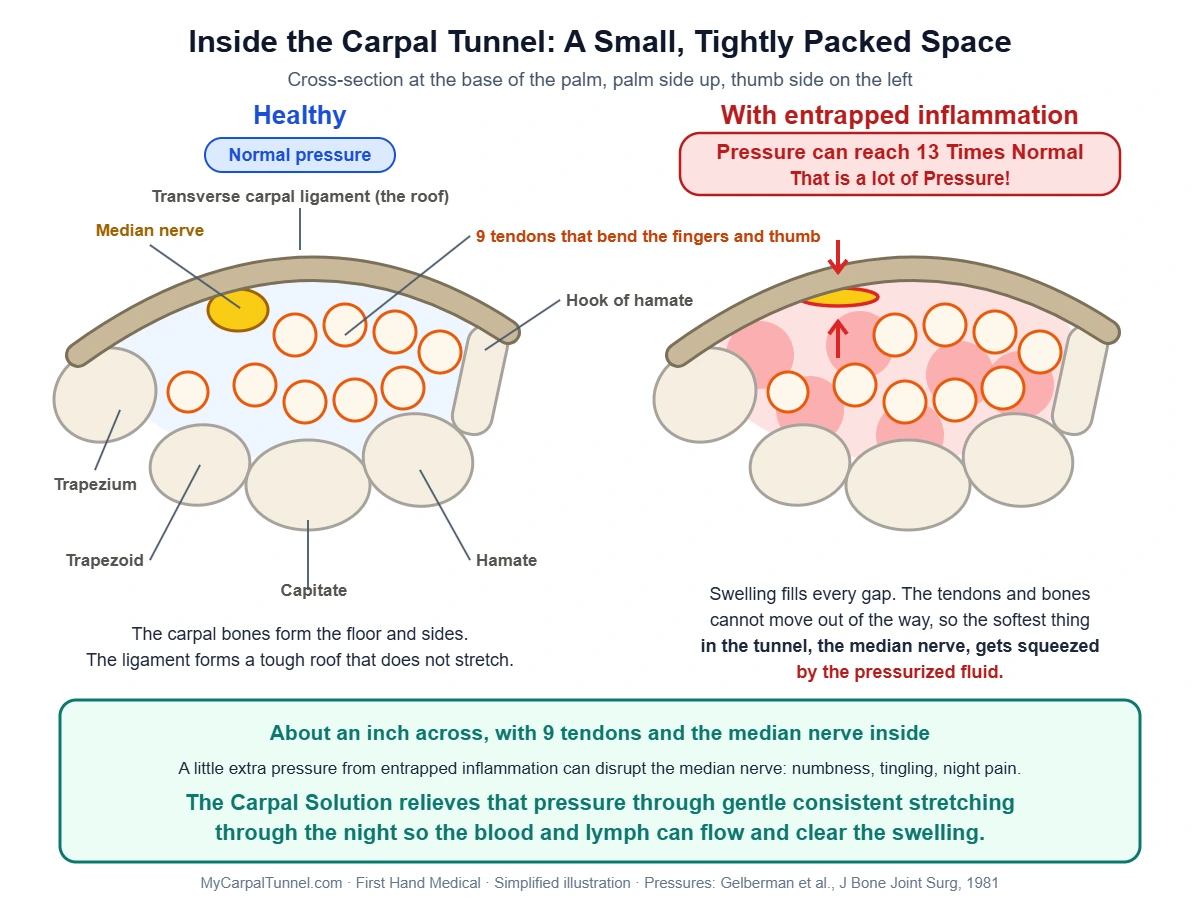
Pressure can reach 13 times normal. Healthy hands measured about 2.5 mmHg inside the carpal tunnel. In people with carpal tunnel syndrome it averaged 32 mmHg, nearly 13 times higher.1 Pump a car tire to 13 times its normal pressure and it would burst. The carpal tunnel cannot burst, because its walls are bone and a tough ligament, so all that pressure squeezes the softest thing inside: the median nerve. That is what causes the numbness, tingling and night pain.
The Carpal Solution relieves that pressure through gentle consistent stretching through the night so the blood and lymph can flow and clear the swelling.
The rest of this page shows where those numbers come from and what they do to the nerve.
The Pressure Measurements: Gelberman’s Carpal Tunnel Study
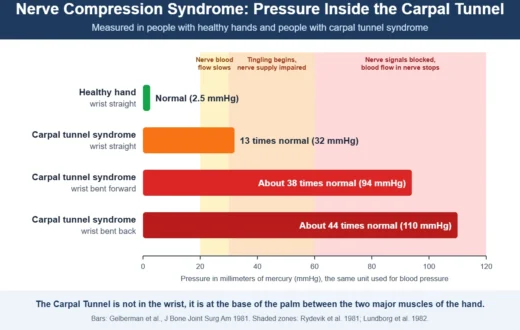
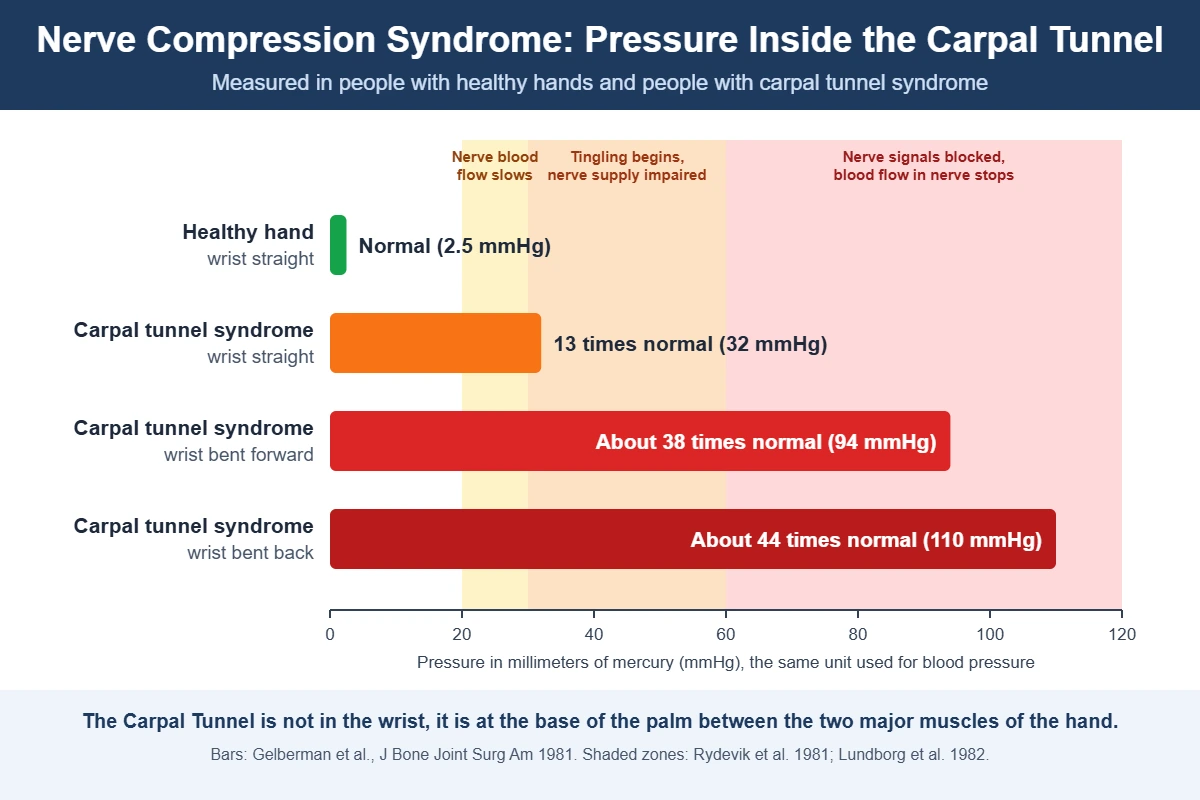
In 1981, Dr. Richard Gelberman and colleagues placed a thin, pressure-sensing catheter inside the carpal tunnel of people with healthy hands and people with carpal tunnel syndrome, then measured the pressure with the wrist in different positions.1 The unit is mmHg, millimeters of mercury, the same unit used for blood pressure.
| Hand and wrist position | Pressure | Compared with normal |
|---|---|---|
| Healthy hand, wrist straight | 2.5 mmHg | Normal |
| Carpal tunnel syndrome, wrist straight | 32 mmHg | About 13 times |
| Carpal tunnel syndrome, wrist bent forward | 94 mmHg | About 38 times |
| Carpal tunnel syndrome, wrist bent back | 110 mmHg | About 44 times |
Two findings matter most. First, the pressure is high even when the wrist is resting straight, so the nerve is under strain all day. Second, bending the wrist multiplies it. That is why symptoms flare at night, when most people sleep with their wrists curled, and why they ease when the pressure comes down.
How Everyday Hand Use Raises the Pressure
Later research from the University of California, San Francisco ergonomics program measured how ordinary hand use changes carpal tunnel pressure:
- Wrist position. The lowest pressure came with the wrist almost straight, about 2 degrees back and 2 degrees toward the little finger. The researchers concluded that splints holding the wrist in the usual 20 to 30 degree “functional” position do not minimize carpal tunnel pressure.5
- Fingertip pressing. Pressing with a fingertip raised the pressure at every wrist angle, and small loads had a large effect.6
- Pinching. In healthy volunteers, a firm pinch raised the pressure to about 50 mmHg, nearly twice as much as pressing with the same force.7
Our doctors use this research in two ways. During the day, take breaks from pinching and pressing, and use tools with bigger handles. At night, use pillows to keep the wrists straight rather than a splint.
A splint can reduce pain from movement, but it does not promote healing. It does two separate kinds of harm. Muscles you do not use weaken, leading to muscle atrophy. Separately, a splint restricts blood circulation and lymph flow, which slows soft-tissue healing. Read our doctors’ position on wrist splints.
What Compression of the Nerve Does, Step by Step
Researchers in Sweden and the United States measured what compression of the nerve does at each pressure level, first in animal nerves and then in human volunteers.

- 20 to 30 mmHg: blood starts backing up in the small veins inside the nerve.2
- About 30 mmHg: in volunteers, this much pressure on the median nerve caused tingling in the hand and mild changes in nerve signals.3
- 40 to 50 mmHg: fresh blood flow into the nerve is impaired.2
- 60 mmHg and above: feeling in the hand was rapidly and completely blocked, and by 60 to 80 mmHg no blood flowed in the nerve at all.2,3
Remember that carpal tunnel syndrome averaged 32 mmHg with the wrist straight and 94 mmHg with it bent. The nerve spends much of the day and night in the zone where it is starved of blood.
There is a second trap. When a nerve is compressed for hours, fluid leaks into the nerve itself and the pressure inside it rises three to four times. Researchers called this a “miniature compartment syndrome.”4 The swelling keeps the pressure up even after the squeeze eases, which is why trapped inflammation becomes a cycle that is hard to break on its own.
If the pressure lasts for months, the damage moves deeper. A review of nerve compression research describes a progression from swelling inside the nerve, to thinning of the insulating myelin that speeds signals, to loss of nerve fibers.8 The early stages can recover once the pressure is relieved. That is why our doctors say not to wait. Read how long nerve damage takes to heal.
Nerve Impingement Symptoms
Nerve impingement symptoms follow the nerve that is squeezed. For the median nerve in the carpal tunnel they are:
- Numbness and tingling in the thumb, index and middle fingers and half of the ring finger
- Symptoms that wake you at night or are worse in the morning
- Burning or aching in the hand that can travel up the forearm, toward the shoulder and even the neck
- Weak grip, dropping things and clumsiness with buttons
- In long-standing cases, thinning of the muscle at the base of the thumb
Carpal tunnel causes wrist pain too, but that pain comes from the squeezing in the carpal tunnel at the base of the palm. Our doctors’ experience over two decades is that people with three or more of the carpal tunnel symptoms on our site can be about 95% confident they have carpal tunnel syndrome. That is clinical experience, not a published statistic, and you should still get an in-person evaluation.
Compartment Syndrome Hand Emergencies vs. Nerve Compression
Compartment syndrome of the hand sounds similar, and it is also about pressure, but it is a different and urgent problem. It happens when pressure builds quickly inside a closed muscle compartment, usually after a crush injury, fracture, burn, severe infection or bleeding. Pressure over about 30 mmHg cuts off blood to the muscles and nerves, and it is treated as a surgical emergency.10
Warning signs include pain far worse than the injury seems to explain, a tense and swollen hand, and pain when the fingers are gently stretched. A compartment syndrome hand emergency is treated within hours. If this happens after an injury, go to an emergency room right away.
Carpal tunnel syndrome is a slow, chronic compression of one nerve. It builds over weeks and months, and it responds to conservative care that brings the pressure down.
Relieving the Pressure: How the Carpal Solution Works
If pressure is the problem, relieving the pressure is the treatment. Conservative-first care that follows medicine’s “Do No Harm” principle starts there, at home, without downtime or risk.
The Carpal Solution’s targeted passive stretching restores flexibility to the injured soft tissue, relieves pressure on the median nerve, relieves restrictions on blood circulation and lets lymph fluid flow freely to clear out the swelling. It is your body that does the healing; the Carpal Solution just jump-starts the natural healing preempted by excess pressure from inflammation and swelling.
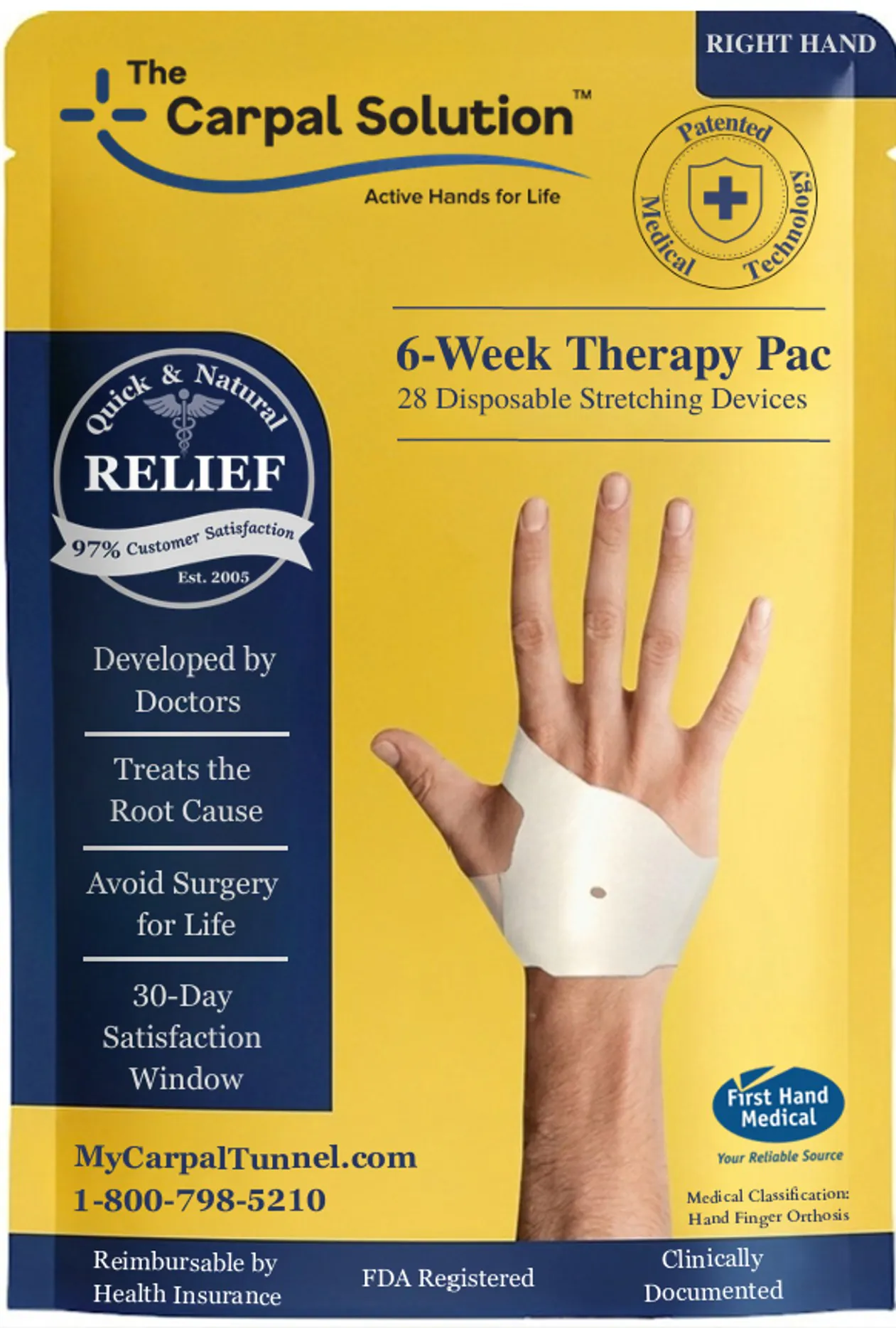
- Most people are better from their worst symptoms in two to three weeks.
- About 90% of people reach complete remission in 6 weeks.
- 97% patient satisfaction over 21 years, 4.9 out of 5 stars, and over 100,000 people helped.
Compare that with surgery. Carpal tunnel surgery cuts the ligament that forms the roof of the tunnel to make more room, but it has a patient satisfaction rate lower than 69%, because about 31% of patients report lingering or recurring symptoms, and no patient is satisfied with lingering symptoms.12 Surgery does not remove the inflammation that raised the pressure in the first place.
Waiting weeks for a specialist does not mean waiting with nothing to do. You can start the Carpal Solution tonight while you wait. Order the Carpal Solution or see how it works.
When Healing Needs a Doctor’s Help and Professional Medical Evaluation
- Constant numbness that does not improve or loss of feeling in the fingertips that does not improve in 4 to 8 weeks.
- Extreme loss of the muscle at the base of the thumb, with loss of grip strength that does not improve over 6 to 8 weeks.
- Worsening symptoms over 6 to 8 weeks while using the best conservative treatments
- Symptoms that begin suddenly after hand or wrist trauma, a fracture or severe sprain from a fall or auto accident.
- Odd Symptoms that are not consistent with the Carpal Tunnel Symptoms listed on this website, that might be indicative of other nerve issues. A nerve conductivity study can clear up the confusion with minimal costs and not too much pain and no risk.
These signs may mean more advanced nerve involvement or a different condition and deserve professional medical evaluation and in person consultation. Home treatment can be used alongside professional in-person medical care while you wait for the healthcare delivery system to fit you into their schedule. There is no reason to wait doing nothing. You can start proven natural conservative treatment with good patient reviews while you wait for your appointments. If your symptoms start improving over 6 to 8 weeks, then you know you are on the right track and surgery is not necessary.
Nerve Compression Syndrome FAQ
What is nerve compression syndrome?
Nerve compression syndrome is damage to a nerve caused by pressure where it passes through a tight tunnel of bone and ligament. Carpal tunnel syndrome is the most common example. Swelling raises the pressure, the nerve loses blood supply, and numbness, tingling and weakness follow.
What causes nerve compression?
In the carpal tunnel, swelling and entrapped inflammation in the soft tissue around the median nerve raise the pressure. Repetitive gripping and pinching, sleeping with bent wrists, diabetes, thyroid disease, rheumatoid arthritis, pregnancy and injury can all add to it.
How much pressure is in the carpal tunnel?
A 1981 study measured about 2.5 mmHg in healthy hands and 32 mmHg in people with carpal tunnel syndrome, nearly 13 times normal. With the wrist bent forward or back it reached 94 and 110 mmHg.
What are nerve impingement symptoms?
Numbness, tingling, burning and weakness in the area the nerve supplies. For the median nerve that means the thumb, index and middle fingers, often worse at night, with a weak grip and dropping things.
Is nerve entrapment the same as a pinched nerve?
Yes. Nerve entrapment, entrapment neuropathy, compression neuropathy, nerve impingement and pinched nerve all describe a nerve squeezed in a tight space. Doctors use the different names for different locations and stages.
Can nerve compression be reversed?
Early compression usually recovers once the pressure is relieved, because the nerve gets its blood supply back. Long-standing compression can damage the insulating myelin and nerve fibers, so it is best not to wait.
Is compartment syndrome of the hand the same as carpal tunnel?
No. Compartment syndrome of the hand is a sudden rise in pressure inside a muscle compartment, usually after a crush injury, fracture or burn. It is a surgical emergency. Carpal tunnel syndrome is a slow, chronic compression of one nerve.
How do you relieve compression of the nerve without surgery?
Bring the pressure down. Take breaks from pinching and pressing, keep the wrists straight at night with pillows, and use the Carpal Solution at night. Its passive stretching relieves pressure on the median nerve and lets blood and lymph clear the swelling.
Sources
- Gelberman RH, Hergenroeder PT, Hargens AR, Lundborg GN, Akeson WH. The carpal tunnel syndrome: a study of carpal canal pressures. Journal of Bone and Joint Surgery (American). 1981;63(3):380–383. Link
- Rydevik B, Lundborg G, Bagge U. Effects of graded compression on intraneural blood flow: an in vivo study on rabbit tibial nerve. Journal of Hand Surgery (American). 1981;6(1):3–12. Link
- Lundborg G, Gelberman RH, Minteer-Convery M, Lee YF, Hargens AR. Median nerve compression in the carpal tunnel: functional response to experimentally induced controlled pressure. Journal of Hand Surgery (American). 1982;7(3):252–259. Link
- Lundborg G, Myers R, Powell H. Nerve compression injury and increased endoneurial fluid pressure: a “miniature compartment syndrome.” Journal of Neurology, Neurosurgery and Psychiatry. 1983;46(12):1119–1124. Link
- Weiss ND, Gordon L, Bloom T, So Y, Rempel DM. Position of the wrist associated with the lowest carpal-tunnel pressure: implications for splint design. Journal of Bone and Joint Surgery (American). 1995;77(11):1695–1699. Link
- Rempel D, Keir PJ, Smutz WP, Hargens A. Effects of static fingertip loading on carpal tunnel pressure. Journal of Orthopaedic Research. 1997;15(3):422–426. Link
- Keir PJ, Bach JM, Rempel DM. Fingertip loading and carpal tunnel pressure: differences between a pinching and a pressing task. Journal of Orthopaedic Research. 1998;16(1):112–115. Link
- Rempel D, Dahlin L, Lundborg G. Pathophysiology of nerve compression syndromes: response of peripheral nerves to loading. Journal of Bone and Joint Surgery (American). 1999;81(11):1600–1610. Link
- Common entrapment neuropathies. Continuum (Minneapolis, Minn.). 2017;23(2):487–511. Link
- Acute compartment syndrome. StatPearls. National Library of Medicine, 2026. Link
- Luckhaupt SE, Dahlhamer JM, Ward BW, Sweeney MH, Sestito JP, Calvert GM. Prevalence and work-relatedness of carpal tunnel syndrome in the working population, United States, 2010 National Health Interview Survey. American Journal of Industrial Medicine. 2013;56(6):615–624. Link
- Bland JD. Do nerve conduction studies predict the outcome of carpal tunnel decompression? Muscle & Nerve. 2001;24(7):935–940. Link
Our doctors’ position is offered as medical opinion based on the research above and two decades of clinical experience. We encourage you to read the sources and do your own research.

Developed by First Hand Medical’s Team of Doctors and Medical Professionals
The Carpal Solution Treatment Kit was developed by our expert team of medical doctors who have worked at and led some of the top medical institutions in the World – Including Harvard Medical, Tufts Medical, UCSD Medical School, Florida State Medical School, and The Ohio State University Medical School. We treat root causes with clinically proven conservative treatments. The results: Quick Natural Relief of All Your Carpal Tunnel Symptoms without complications. Meet The Medical Team Backing The Carpal Solution at First Hand Medical

Order Your Six Week Carpal Tunnel Treatment Now
The ONLY treatment for carpal tunnel that comes with a no questions asked 30-Day Satisfaction Window and in-house dedicated pain relief team.