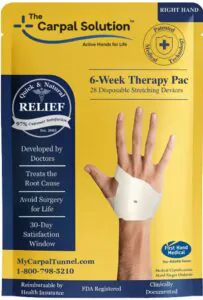
 Created by renowned Harvard health care professionals.


Carpal Tunnel Solution Clinical Study: Sleep, Symptom and Grip Strength Results
The Carpal Tunnel Solution clinical study, led by Dr. Clyde E. Morgan, DC, tested the Carpal Solution in 11 people with carpal tunnel symptoms over two weeks. Here are the participants, the methods and the results for sleep, symptoms and grip strength.


Carpal Tunnel Solution Clinical Study at a Glance
Written by Dr. Clyde E. Morgan, DC, developer of the Carpal Solution, with Dr. Benjamin E. Bierbaum, MD, orthopedic surgeon and hand specialist, and Jeff Conley, President of First Hand Medical · Medically reviewed by Dr. Joseph E. Scherger, MD, MPH, family physician and clinical professor at UC San Diego School of Medicine · Last reviewed: November 2026
This is the overview of the Carpal Tunnel Solution clinical study, the grip-strength trial Dr. Clyde E. Morgan ran to document how the Carpal Solution affects carpal tunnel symptoms, sleep and hand strength. It covers who took part, how they were tested and what changed in two weeks, and links to the full report on each part of the study.
Table of Contents
| Study detail | Carpal Tunnel Solution clinical study |
|---|---|
| Lead investigator | Dr. Clyde E. Morgan, DC, developer of the Carpal Solution |
| Participants | 11 pre-qualified people with carpal tunnel symptoms; 18 hands (7 included both hands) |
| Treatment | The Carpal Solution worn every night for two weeks |
| Measures | Grip strength (Jamar hand dynamometer), pinch strength, nighttime sleep interruption and symptoms |
| Testing schedule | Baseline before treatment, then every Monday, Wednesday and Friday; each test done three times and averaged |
| Symptom relief | 82% of participants |
| Sleep | 82% eliminated (18%) or significantly reduced (64%) sleep interruption from hand pain |
| Grip strength | 55% of participants improved more than 40%; 78% of hands improved 20% or more |
Why the Carpal Solution Clinical Study Was Done
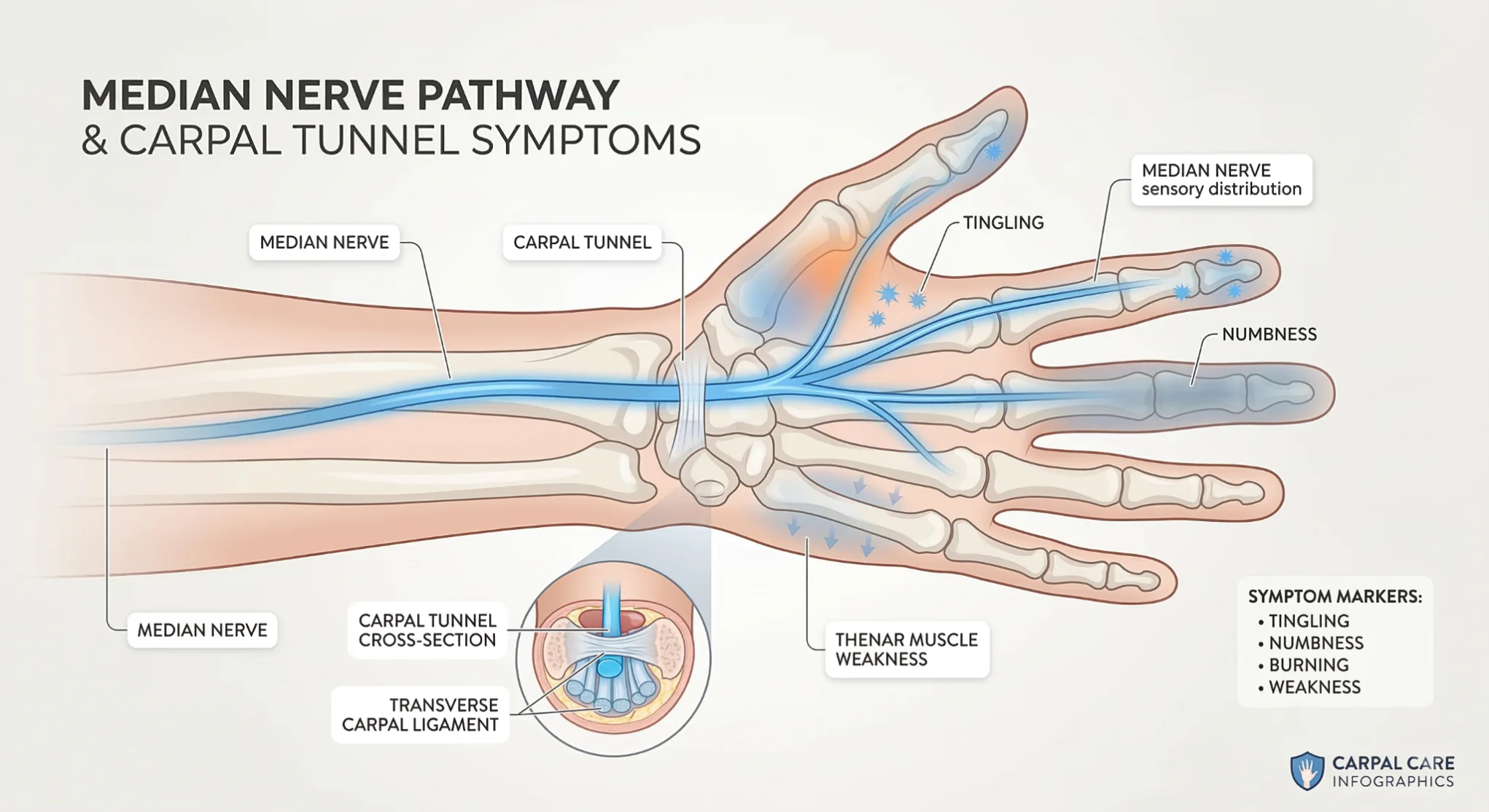
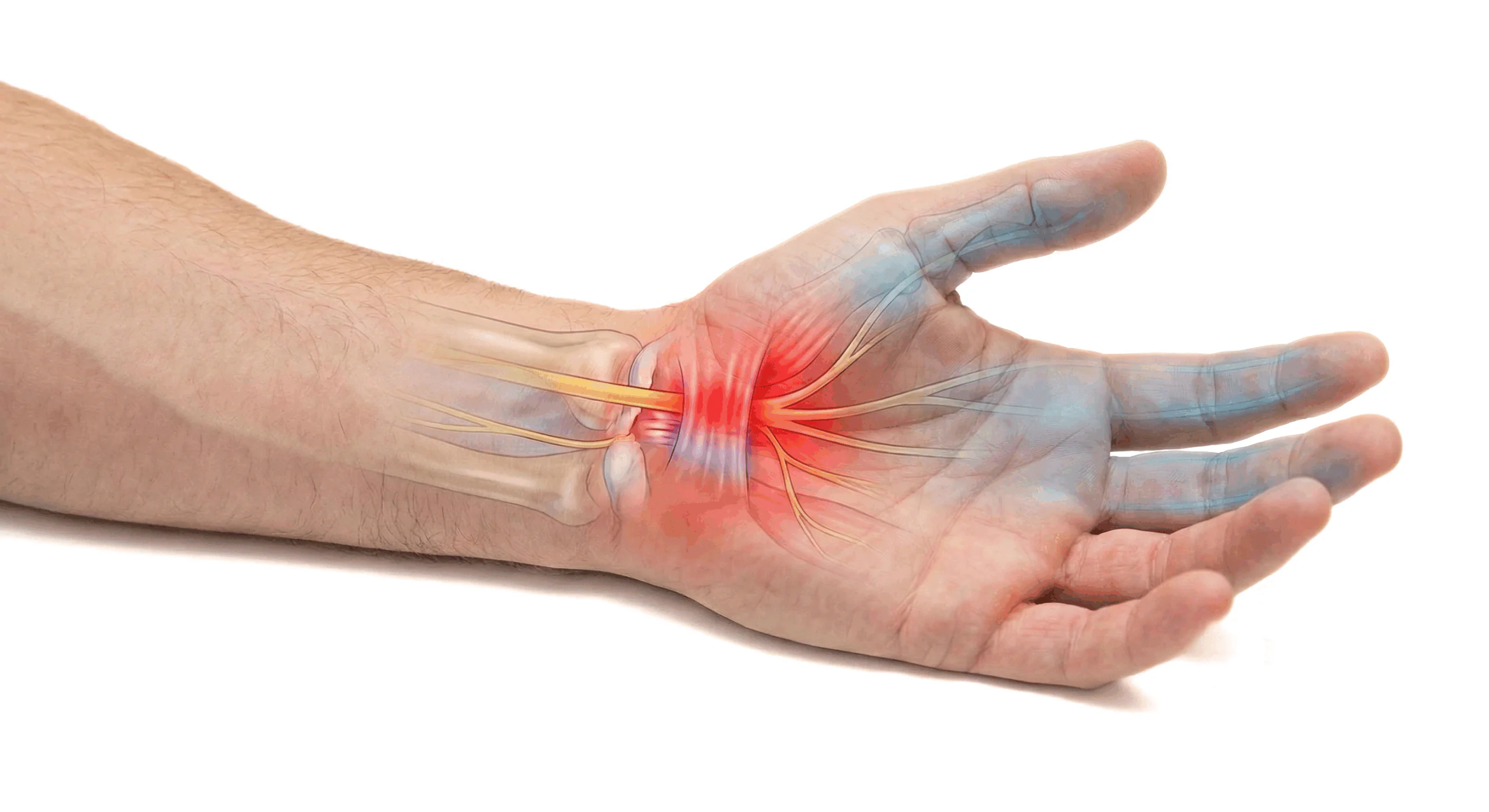
Carpal tunnel syndrome develops when swelling of irritated tendons and soft tissue crowds the carpal tunnel, presses on the median nerve and restricts blood flow. Symptoms are most intense at night when the hand is relaxed, and routine sleep interruption and chronic sleep loss have wide-ranging health effects. Ongoing pain also leads to loss of hand function and grip strength, which limits what people can do at home and at work.
Bureau of Labor Statistics data have long ranked carpal tunnel syndrome among the workplace conditions with the longest time away from work, a median of about 28 days per case compared with about 8 days for all cases. Read more about carpal tunnel and lost time at work.
The Carpal Solution is used on a six-week protocol. To document how quickly it starts to work, Dr. Morgan’s Carpal Solution clinical study had two objectives: relieve nighttime hand pain, numbness and sleep interruption, and restore hand strength, measured objectively with grip and pinch testing.
Eleven pre-qualified participants took part. Seven had symptoms in both hands, so 18 hands were tracked in all. Every participant reported the classic symptoms of carpal tunnel syndrome along with some loss of hand function and grip strength, the point at which many people start looking for treatment. Read more about the study participants and objectives.
How the Carpal Solution Grip Strength Study Measured Results
Symptoms can be hard to measure, so the study used hand strength as an objective yardstick. Grip strength was tested with a Jamar hand dynamometer, and pinch strength with a pinch tester held between the pad of the thumb tip and the end joint of the index finger. Pinch strength is a sensitive measure for carpal tunnel because the muscles involved are supplied by the median nerve. When the nerve is compressed, those muscles weaken, and people notice it as trouble buttoning shirts, turning keys or holding a pen.
Baseline readings were recorded before treatment began. Participants then returned three times a week, on Monday, Wednesday and Friday; every test was repeated three times and the average recorded. Participants kept their usual daily activities, so changes in strength could be traced to the therapy rather than to resting their hands. See the testing equipment and the full test procedure. The same schedule was used for every participant in the Carpal Solution grip strength study.
How the Carpal Solution Works
The Carpal Solution gently tugs simultaneously at three key points surrounding the Carpal Tunnel during sleep
Consistent gentle pulling action applied for 6 to 8 hours per night, while the hand is completely relaxed, decompresses and reshapes the soft tissue around the carpal tunnel and relieves symptoms associated with Carpal Tunnel Syndrome
RIGHT HAND INSTRUCTIONS:
Apply the Carpal Solution before Retiring to Bed in 3 Easy Steps
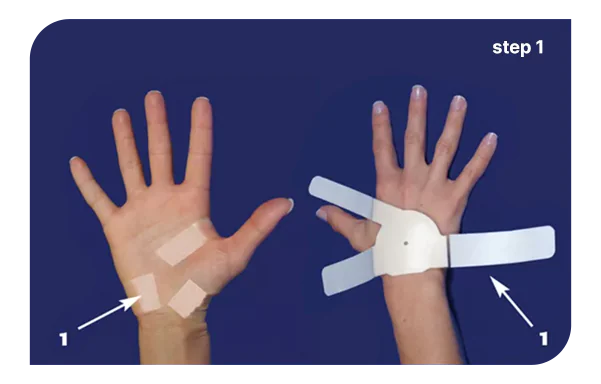
STEP 1: Place the Carpal Solution on the Back of the hand as shown with adhesive side down. Attach 1st strap below little finger securing it on the palm. Tear away excess tape to prevent overlap of straps on palm.
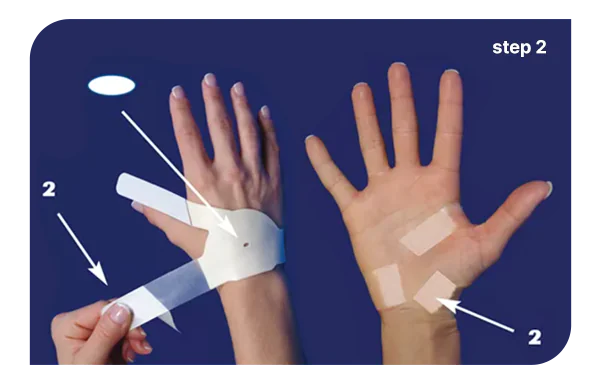
STEP 2: Self apply the appropriate tension to the Carpal Solution with 2nd strap below the thumb and attached on palm side of hand as shown. Adjust tension by stretching circular hole on back of hand in the elastic centerpiece to an oval shape. The diameter should be at least 1.5 times the original.
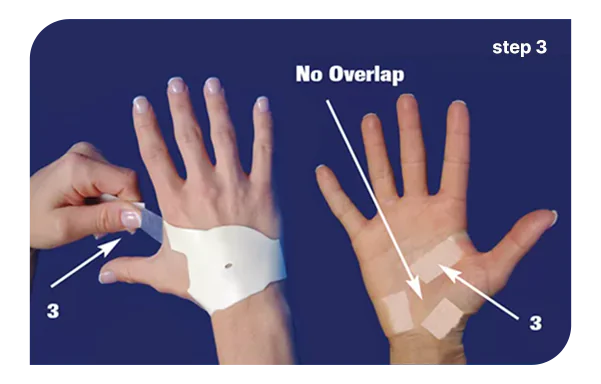
STEP 3: Self apply the appropriate tension to the Carpal Solution with 3rd strap above the thumb. Tear-away straps should be aligned so there is no overlap of straps on palm side of hand. The Carpal Solution begins to relieve symptoms usually within twenty minutes of placement.
The Six-Week Treatment Protocol
Relief is most often noticed within a week in mild cases and six weeks when CTS is chronic
Gentle decompression of soft tissue during sleep combined with active use during the day results in an ideal rhythmic therapy for relief from CTS symptoms with no muscle atrophy. Soft tissue therapy is a slow process. The optimum protocol for Carpal Tunnel Syndrome treatment that has been effective for the majority of patients suffering from chronic CTS symptoms is to wear the Carpal Solution every night for two weeks and then every other night for four weeks.
Carpal Tunnel Stretching Clinical Study Results After Two Weeks
In this carpal tunnel stretching clinical study, after two weeks of nightly treatment, 82% of participants reported relief from carpal tunnel symptoms, along with a meaningful improvement in hand function on grip strength testing.
Sleep. Nighttime hand pain is what wakes most people with carpal tunnel, so sleep was a key measure:
- 18% of participants eliminated sleep interruption from hand pain after just two weeks.
- 64% reported a significant reduction in how often hand pain interrupted their sleep.
- 9% reported a minor improvement but still had sleep interruption.
- 9% reported no improvement.
With 11 participants, each person is about 9% of the group, so these figures reflect two, seven, one and one people.
Grip strength. Six of the eleven participants (55%) had more than a 40% Average Improvement in grip strength in two weeks, and 14 of the 18 hands treated (78%) improved by 20% or more. Among participants with significant relief, Average Improvement ranged from 15.22% to 125.36%. The dominant hand usually responds faster as pain eases. The pinch and grip tables for every participant are in the full clinical study results.
Carpal Solution Study Results in Context: Two Decades of Remission
Over the six-week protocol, the Carpal Solution provides over 220 hours of gentle, targeted stretching. Here is what most people can expect:
- 2 to 3 weeks: most people feel their worst symptoms ease.
- By 6 weeks: about 90% of people get complete remission in six weeks.
- 10 to 12 weeks: about 10% of people, often those with higher overall inflammation, need longer. They are usually 40 to 70% better at 6 weeks.
- Afterward: remission usually lasts 5 to 7 years for most people, ranging from 1 to 17 years. A prevention treatment, from once a week to once every six months, helps keep it there.
Carpal tunnel syndrome is a chronic, recurring condition. The Carpal Solution is the next best thing to a permanent solution: a home treatment you can repeat whenever symptoms return, with no downtime, virtually no risks, no scar tissue and no complications. Neurologists, including Dr. James S. Zu, MD, PhD, of Edison, New Jersey, call the Carpal Solution a better first line of defense for carpal tunnel syndrome. See how to apply the Carpal Solution and the six week carpal tunnel protocol.
Carpal Tunnel Solution Study Notes and Clinical Observations
The Carpal Tunnel Solution clinical study is one part of a larger body of clinical documentation. Dr. Morgan’s notes and two decades of patient follow-up are published in these companion reports:
- Study participants and objectives: who took part and what each objective measured.
- Testing equipment: the Jamar hand dynamometer and pinch tester.
- Test procedure: how pinch and grip strength were measured.
- Clinical study results: the full pinch and grip tables for every participant.
- Treatment trial notes: Dr. Morgan’s notes from the trial.
- Additional observations: clinical notes on treatment and flare-ups.
- Clinical review: Dr. Morgan’s passive stretching approach explained.
- Clinical documentation: two decades of patient-reported outcomes.
What the Carpal Solution Clinical Trial Shows, and What Comes Next
The Carpal Solution clinical trial was an early, two-week study of eleven people. It was designed to document how quickly symptoms, sleep and hand strength begin to change, not to follow people through the full six-week protocol and the years after it. Dr. Morgan has followed patients who completed the six-week protocol for years, and formally documenting those long-term results will take additional work and resources. That is why the results we report come from two sources: this early grip-strength study and two decades of patient experience, with 97% patient satisfaction over 21 years and 4.9 out of 5 stars on independent review sites like Google Reviews from over 100,000 people.
Together, that evidence supports conservative-first care that follows medicine’s “Do No Harm” principle. Carpal tunnel surgery, by comparison, has a patient satisfaction rate lower than 69%: about 31% of patients report lingering or recurring symptoms, and no patient is satisfied with lingering symptoms. Compare carpal tunnel treatment options.
Insurance Reimbursement
With a diagnosis and a doctor’s prescription for a “Hand Finger Orthosis for Carpal Tunnel Syndrome,” the Carpal Solution can be reimbursed under HCPCS code L3924, typically at 70% to 80% depending on your plan. There is also a 30-Day Satisfaction Window.
When Healing Needs a Doctor’s Help and Professional Medical Evaluation
- Constant numbness that does not improve or loss of feeling in the fingertips that does not improve in 4 to 8 weeks.
- Extreme loss of the muscle at the base of the thumb, with loss of grip strength that does not improve over 6 to 8 weeks.
- Worsening symptoms over 6 to 8 weeks while using the best conservative treatments
- Symptoms that begin suddenly after hand or wrist trauma, a fracture or severe sprain from a fall or auto accident.
- Odd Symptoms that are not consistent with the Carpal Tunnel Symptoms listed on this website, that might be indicative of other nerve issues. A nerve conductivity study can clear up the confusion with minimal costs and not too much pain and no risk.
These signs may mean more advanced nerve involvement or a different condition and deserve professional medical evaluation and in person consultation. Home treatment can be used alongside professional in-person medical care while you wait for the healthcare delivery system to fit you into their schedule. There is no reason to wait doing nothing. You can start proven natural conservative treatment with good patient reviews while you wait for your appointments. If your symptoms start improving over 6 to 8 weeks, then you know you are on the right track and surgery is not necessary.
Carpal Solution Clinical Study FAQs
Who conducted the Carpal Tunnel Solution clinical study?
Dr. Clyde E. Morgan, DC, the developer of the Carpal Solution, ran the trial and documented it in a technical paper.
How many people were in the Carpal Solution study?
Eleven pre-qualified participants with carpal tunnel symptoms. Seven had symptoms in both hands and included both, so 18 hands were tracked in all.
What did the Carpal Solution clinical study measure?
Nighttime pain, numbness and sleep interruption, plus grip and pinch strength measured with a Jamar hand dynamometer and a pinch tester at baseline and three times a week.
What were the Carpal Solution study results?
After two weeks, 82% of participants had relief from carpal tunnel symptoms, 82% eliminated or significantly reduced sleep interruption, and 78% of hands improved grip strength by 20% or more.
How long does full treatment take?
The full protocol is six weeks. Most people are better from their worst symptoms in two to three weeks, and about 90% of people get complete remission in six weeks.
Is the Carpal Solution covered by insurance?
With a diagnosis and a doctor’s prescription for a hand finger orthosis, it can be reimbursed under HCPCS code L3924, typically at 70% to 80% depending on your plan.
Sources
- Morgan CE. Carpal Solution clinical trial: technical paper documenting grip strength, pinch strength and sleep over two weeks of nightly treatment. First Hand Medical. Summary of results.
- Bland JD. Do nerve conduction studies predict the outcome of carpal tunnel decompression? Muscle & Nerve. 2001;24(7):935–940. PubMed
- U.S. Bureau of Labor Statistics. Survey of Occupational Injuries and Illnesses: median days away from work by nature of injury or illness. bls.gov

Order Your Six Week Carpal Tunnel Treatment Now
The ONLY treatment for carpal tunnel that comes with a no questions asked 30-Day Satisfaction Window and in-house dedicated pain relief team.