 Created by renowned Harvard health care professionals.


Acupuncture for Carpal Tunnel: Does It Work? What the Research Shows
Five honest answers about acupuncture and dry needling for carpal tunnel syndrome: what they are, what the studies found, safety, and how and why they modalities fit into a conservative-first plan aimed at dispersing entrapped lymph fluid and inflammation and jump-starting the body's natural healing. These modalities are complementary to employing The Carpal Solution nighttime stretching treatment and will accelerate complete rapid recovery for most patients. Most proven natural therapies compliment one another in jump-starting the body's normal healing process of lymph fluid dispersion and movement.

Written by Jeff Conley, First Hand Medical · Medically reviewed by Joseph E. Scherger, MD, MPH, family physician, clinical professor at the UC San Diego School of Medicine and co-founder of First Hand Medical · Last reviewed: November 2026
Acupuncture for carpal tunnel is one of the most popular alternative treatments for people who want to avoid surgery and drugs. Some patients feel real relief from it, and it is generally safe in trained hands. But the best research so far is mixed: in controlled trials, acupuncture often does about as well as sham (fake) acupuncture for symptoms, though one Harvard-affiliated brain-imaging study suggests real acupuncture changes the nerve in ways sham does not.
Here are five honest answers about acupuncture for carpal tunnel syndrome, what the studies actually found, and how acupuncture can fit into a conservative-first plan that also treats the trapped inflammation behind your symptoms every night.
Table of Contents
Acupuncture for Carpal Tunnel: The Short Answer
- It may help some people feel better. Many patients report less pain and tingling during a course of treatment.
- The evidence is mixed. A 2018 Cochrane review found acupuncture for carpal tunnel may have little or no short-term effect compared with sham acupuncture, based on low-certainty evidence.
- It is generally safe. Side effects in trials were mild, such as bruising or soreness where a needle went in.
- It works best as an add-on. Acupuncture does not loosen the tight tissue over the carpal tunnel, so pair it with a treatment that works on the cause every night.
1. What Is Acupuncture for Carpal Tunnel?
Acupuncture uses thin, sterile, single-use needles placed at specific points, usually on the wrist, forearm and hand, and sometimes elsewhere on the body. When people talk about acupuncture for carpal tunnel, they usually mean one of three approaches:
- Manual acupuncture: needles placed and gently turned by hand.
- Electroacupuncture: a mild electric current passed between pairs of needles.
- Laser acupuncture: low-level laser light on acupuncture points instead of needles.
A typical course is a series of sessions over several weeks. Sessions often last 20 to 30 minutes, and many practitioners recommend one or two visits a week at the start.
How Acupuncture Is Thought to Help
Researchers have proposed several ways acupuncture for carpal tunnel syndrome might ease symptoms:
- Pain signaling: needling may change how pain and tingling signals are processed in the spinal cord and brain.
- Local circulation: needling near the wrist may increase blood flow to the area for a short time.
- Brain mapping: carpal tunnel blurs the brain’s map of the fingers, and one study found real acupuncture helped sharpen that map again.
These ideas are plausible, but they are still being studied. None of them directly loosens the transverse carpal ligament or the tight soft tissue that narrows the carpal tunnel, which is why most of our doctors see acupuncture as a helper rather than the main treatment.
What to Expect at an Acupuncture Session for Carpal Tunnel
Your first visit usually starts with questions about your symptoms, work, sleep and health history. Tell the practitioner which fingers go numb, when symptoms are worst and what you have already tried, so the acupuncture for carpal tunnel plan fits your case.
- Needle placement: most points are on the palm side of the wrist, the forearm and the hand, and some practitioners add points on the neck, shoulder or leg.
- The feeling: most people feel a brief pinch, then a dull ache, warmth or heaviness. Sharp pain is not normal, so speak up.
- Time on the table: needles usually stay in for 20 to 30 minutes while you rest.
- Afterward: mild soreness or a small bruise can last a day or two, and most people go back to normal activities the same day.
Questions to Ask Before You Book Acupuncture for Carpal Tunnel
- Are you licensed, and how often do you treat carpal tunnel syndrome?
- Do you use single-use sterile needles?
- How many sessions should it take before I notice a change?
- What does each visit cost, and will you give me a receipt for my insurer?
- Is it fine to keep using my nightly home treatment during the course?
A good practitioner will welcome these questions. Give acupuncture for carpal tunnel a fair trial of several sessions, keep a simple symptom log, and keep a home treatment that works on the cause every night going at the same time.
2. Does Acupuncture Work for Carpal Tunnel? What the Research Shows
Here is what the strongest studies of acupuncture for carpal tunnel have found:
| Study | What it found |
|---|---|
| Cochrane review, Choi et al. 2018 (12 studies, 869 adults) | Acupuncture and laser acupuncture may have little or no effect on symptoms in the short term compared with placebo or sham acupuncture. Comparisons with other treatments were uncertain. The certainty of the evidence was low to very low. |
| Systematic review, Jiménez del Barrio et al. 2018 (32 trials of conservative care) | “Acupuncture seems to be effective, despite limited evidence.” |
| Maeda, Kim, Napadow et al., Brain 2017 (Massachusetts General Hospital) | Real and sham electroacupuncture both improved patient-reported symptoms. Only real acupuncture improved measures at the wrist, and acupuncture at the affected hand also remapped the brain’s hand area. The researchers reported no physiologic improvements from sham acupuncture. |
The honest reading: acupuncture for carpal tunnel is safe and may help some people feel better, but the trials are small, and it is unclear how much of the symptom benefit comes from the needling itself rather than the attention, rest and expectation that come with any treatment. The brain-imaging findings are intriguing and deserve larger studies.
That uncertainty does not mean acupuncture is useless. It means you should not rely on it alone, and you should judge it by your own results over a few weeks.
Dry Needling for Carpal Tunnel: Why It Can Enhance Acupuncture
What Is Dry Needling?
Dry needling is a hands-on treatment in which a trained clinician inserts a thin, solid filament needle through the skin into a tight band or knot in a muscle, called a myofascial trigger point. It comes from Western medicine and the study of muscle pain, not from traditional Chinese medicine. It is called “dry” because nothing is injected, unlike a trigger point injection, which delivers a numbing medicine or steroid through a hollow needle.
Our doctors recommend dry needling with interferential current (IFC), a mild electrical current delivered through the needles to ease pain and boost circulation in the treated tissue. Here is what a session for the hand and wrist usually involves:
- Finding the tight spots: the physical therapist or chiropractor presses along the thumb muscles, palm and forearm to find tender, ropy bands that reproduce your pain or tingling.
- Needling the knot: the needle goes directly into the trigger point. A quick local twitch of the muscle and a brief deep ache or cramp are common and usually signal the muscle is letting go.
- Adding the current: the needles are connected to the interferential current unit for about 15 minutes while you rest. Some clinicians also rotate the needle gently to wind the fascia (the fascial winding technique used in the 2025 trial below).
- Afterward: soreness like after a hard workout can last a day or two. Gentle movement, a cold water plunge in a tall pitcher of ice water and your daytime stretches help.
- Cold Water Plunge – When doing a cold water plunge it is important to do a minimum of 20 minutes in 42 degree F ice water. The water must be 42 degrees F or colder. The colder the water the less comfortable it becomes, so keeping the cold water at or near 42 degrees F is best for optimum compliance by the patient. Cold water plunges are used by athletes all over the world to enable them to keep pounding their bodies and honing their skills everyday intensely.
- If a Cold Water Plunge works for professional and high-level dedicate athletes, it can work for everyone. It slows the formation of new inflammation after intense activity and intense exercise. Dry Needling simulates intense exercise without the intense exertion and the discomfort of movement of injured joints and tissue.
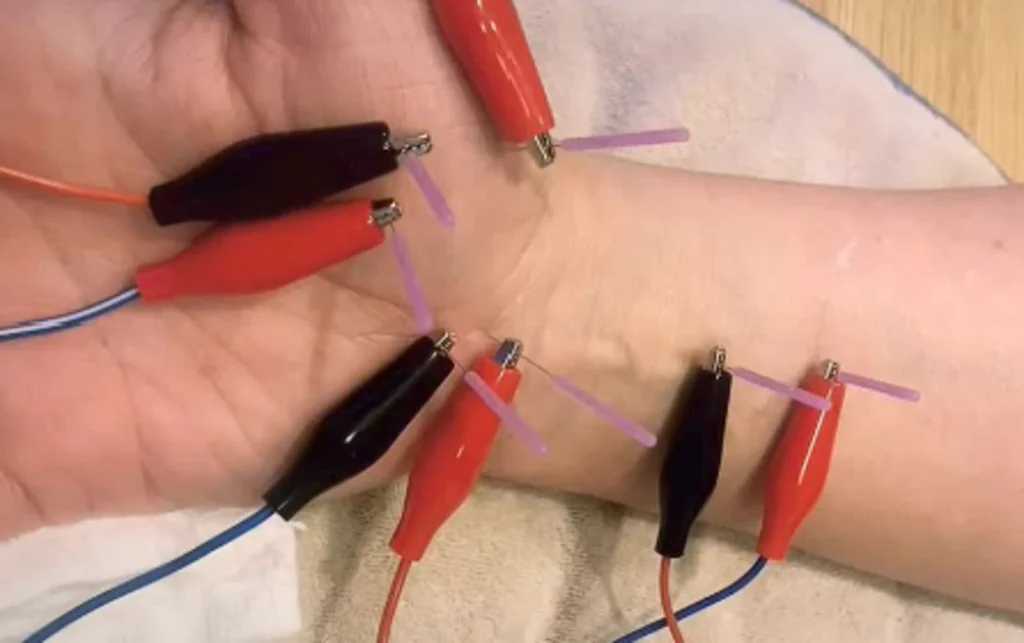
Clinicians may connect the needles to interferential current or to electrical neuromuscular stimulation (e-stim). Both deliver a mild current through the needles to relax the muscle, ease pain and boost circulation, and many patients describe the feeling as a gentle tapping or pulsing. A home TENS unit offers a needle-free way to add electrical stimulation between visits; see TENS Unit for Carpal Tunnel.
Dry needling is done by physical therapists and chiropractors, and by some physicians and acupuncturists with added training. The goal is to relax tight muscle and fascia, improve blood flow and ease the pull of those tissues on the wrist. See how dry needling fits a full therapy program in Physical Therapy for Carpal Tunnel.
How Dry Needling Differs From Acupuncture
Dry needling and acupuncture use the same kind of thin, sterile needles, but they aim at different things. Traditional acupuncture for carpal tunnel places needles at mapped points to influence nerve signaling and pain. Dry needling places needles directly into tight bands and knots in muscle and fascia, such as the thumb muscles at the base of the hand and the forearm muscles that pull on the wrist.
That difference is why dry needling can enhance acupuncture for carpal tunnel. Tight muscle and fascia around the wrist add tension and crowding to an already narrow carpal tunnel. Acupuncture for carpal tunnel works mainly on how pain and tingling are felt, while dry needling works on the tight soft tissue itself, the same tissue our doctors target with nightly passive stretching. Used together, the two cover more ground than either one alone.
What the Research Shows on Dry Needling for Carpal Tunnel
The research on dry needling for carpal tunnel is early but encouraging:
- Fewer surgeries: In a 2025 randomized trial in Spain, 86 wrists with mild or moderate carpal tunnel that had already been recommended for surgery received weekly dry needling for six weeks or stayed on the surgery waiting list. The dry needling group had a 62% lower risk of still needing surgery at 12 weeks, along with less pain and better symptom and function scores. Nerve test results did not change, and side effects were infrequent and minor.
- Stronger grip: In a 2023 pilot trial of 30 manual laborers with mild to moderate carpal tunnel, two sessions of dry needling to trigger points in the thumb muscles improved grip and pinch strength and symptom scores at two weeks compared with no treatment.
These trials are small, and larger studies are needed. Still, they support the conservative-first message: many people who are told they need surgery improve when the tight tissue around the carpal tunnel is treated.
Dry Needling in Our Doctors’ Persistent Symptoms Protocol
Dry needling is part of our doctors’ recommendations for persistent carpal tunnel symptoms, the program for people with high levels of inflammation who find it hard to get ahead of the inflammation curve. Like acupuncture for carpal tunnel, it is an add-on that accelerates recovery, not a replacement for treating the root cause every night:
- Dry needling with interferential current from a physical therapist or chiropractor: about 15 minutes, 1 to 2 times a week, for 2 to 3 weeks.
- The Carpal Solution every night: for persistent symptoms, a total of 10 to 12 weeks of nightly passive stretching, then tapering as symptoms resolve.
- Daytime finger stretches and deep tissue self-massage of the palm and forearm, within comfort and never into pain.
- Alternating hot and cold soaks, plus an anti-inflammatory diet and plenty of water, as described in the protocol.
- Avoid stress balls, hand grippers and rigid wrist splints, except a brace for short periods of heavy lifting.
Expect a soft tissue transition. As tight tissue loosens, symptoms can feel worse for a week or two before they improve, and soft tissue healing takes at least 6 weeks. That is normal and a sign the treatment is working. If you also enjoy acupuncture for carpal tunnel, it can be added for pain relief, and some clinicians offer acupuncture and dry needling in the same visit. Ask about training, since who may perform dry needling varies by state, and keep your nightly home treatment going between sessions.
3. Is Acupuncture Safe for Carpal Tunnel?
Generally, yes. Acupuncture for carpal tunnel is safe when it is done by a licensed practitioner. In the Cochrane review, side effects were mild, such as bruising and pain where a needle went in, and none were serious (not every study reported side effects).
Talk to your doctor first if you take blood thinners, have a bleeding disorder, have a pacemaker (before electroacupuncture), or are pregnant. Choose a licensed acupuncturist (L.Ac.) or a physician trained in acupuncture who uses single-use sterile needles.
4. Why Acupuncture Alone Often Isn’t Enough
Carpal tunnel syndrome is an entrapment syndrome. Inflammation and swelling get trapped in the narrow carpal tunnel, squeezing the median nerve along with the blood vessels and lymph channels that should drain the area. Less drainage means more swelling, and more swelling means more pressure on the nerve.
Acupuncture for carpal tunnel may ease pain and nerve signaling for a while, but it does not directly loosen the tight tissue over the tunnel or keep it loose between sessions. A weekly needling session is also a small part of a week. The other 160-plus hours, including the hours you sleep with your wrists curled, are when carpal tunnel builds.
That is why our doctors recommend pairing any add-on therapy with a treatment that works on the tissue itself, every night, while you sleep.
Acupuncture vs. Other Conservative Treatments
| Treatment | What it does | What the evidence and patients say |
|---|---|---|
| Acupuncture | Needling at wrist and hand points | Safe; may ease symptoms for some; little or no difference from sham in short-term trials |
| Dry needling | Needling of tight muscle knots in the thumb and forearm | Small trials show less pain, better function and fewer surgeries; works on the tight soft tissue |
| Night splint | Holds the wrist straight while you sleep | Can ease night symptoms; does not stretch the tissue; many find rigid splints uncomfortable |
| Steroid injection | Reduces inflammation in the tunnel | Short-term relief; the 2024 AAOS guideline found injections do not provide long-term improvement |
| Pain pills (NSAIDs) | General pain relief | No better than placebo for carpal tunnel in a Cochrane review |
| The Carpal Solution | Gentle passive stretching of the tissue around the tunnel for 6 to 8 hours a night | Treats the tight tissue and trapped inflammation; rated 4.9 out of 5 stars on Google Reviews and Birdeye |
See more options ranked in Alternatives to Carpal Tunnel Surgery: The 10 Best, Ranked and Alternative Medicine for Carpal Tunnel.
5. How to Combine Acupuncture With Treatment at Home
If you enjoy acupuncture for carpal tunnel and it helps you, it can fit alongside a home program that treats the cause every night:
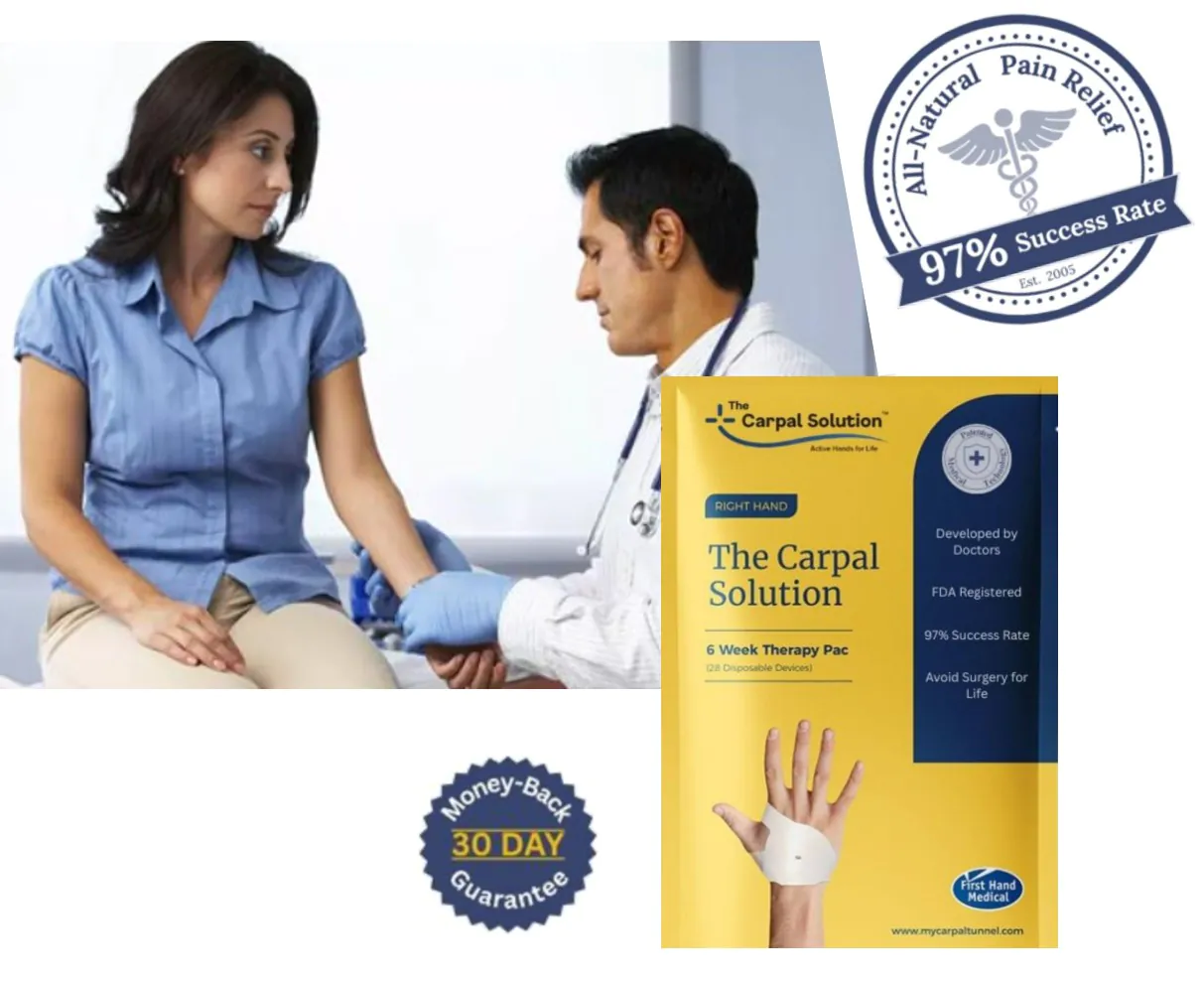
- Passive stretching at night. The Carpal Solution applies gentle, constant tension to three areas around the carpal tunnel for 6 to 8 hours while you sleep, helping trapped inflammation disperse and blood and lymph flow return. Wear it nightly for 6 weeks, or 10 to 12 weeks for persistent symptoms, then as needed. It is rated 4.9 out of 5 stars on Google Reviews and Birdeye.
- Daytime stretching if your day allows: up to 6 sets of 10 reps per day, holding each stretch 15 seconds with 30 seconds of rest. See the best exercises for carpal tunnel. Daytime discipline is hard to keep up, but the combination speeds recovery.
- Acupuncture or dry needling as an add-on, for example acupuncture weekly during the first weeks if it eases your pain. For persistent symptoms, our doctors’ protocol adds dry needling with interferential current 1 to 2 times a week for 2 to 3 weeks.
- Ergonomics and health factors: straight wrists, regular breaks, and attention to weight, blood sugar and thyroid health.
- Track your symptoms each week and reassess at 6 weeks. Improvement in the first 4 to 6 weeks shows the plan is working and surgery is not necessary.
For a wider look at drug-free options, read Natural Remedies for Carpal Tunnel. If symptoms linger, follow our doctors’ recommendations for persistent carpal tunnel symptoms.
What Patients Say About Acupuncture
Two of the patients in our video stories tried acupuncture for carpal tunnel before finding lasting relief with nightly passive stretching.

Diane, a music director in Los Angeles, tried every brace on the market, creams, physical therapy, acupuncture and chiropractic. A hand specialist told her within minutes that she needed surgery. She wore the Carpal Solution every night for six weeks and improved steadily, and she was still using it years later after long playing days.
Anthony, a network engineer in New Jersey, tried ergonomic mice, hand splints, a wrist harness and acupuncture, and a surgeon wanted to operate. With nightly passive stretching he felt better in one to two weeks, and his pain was nearly gone in two to three months.
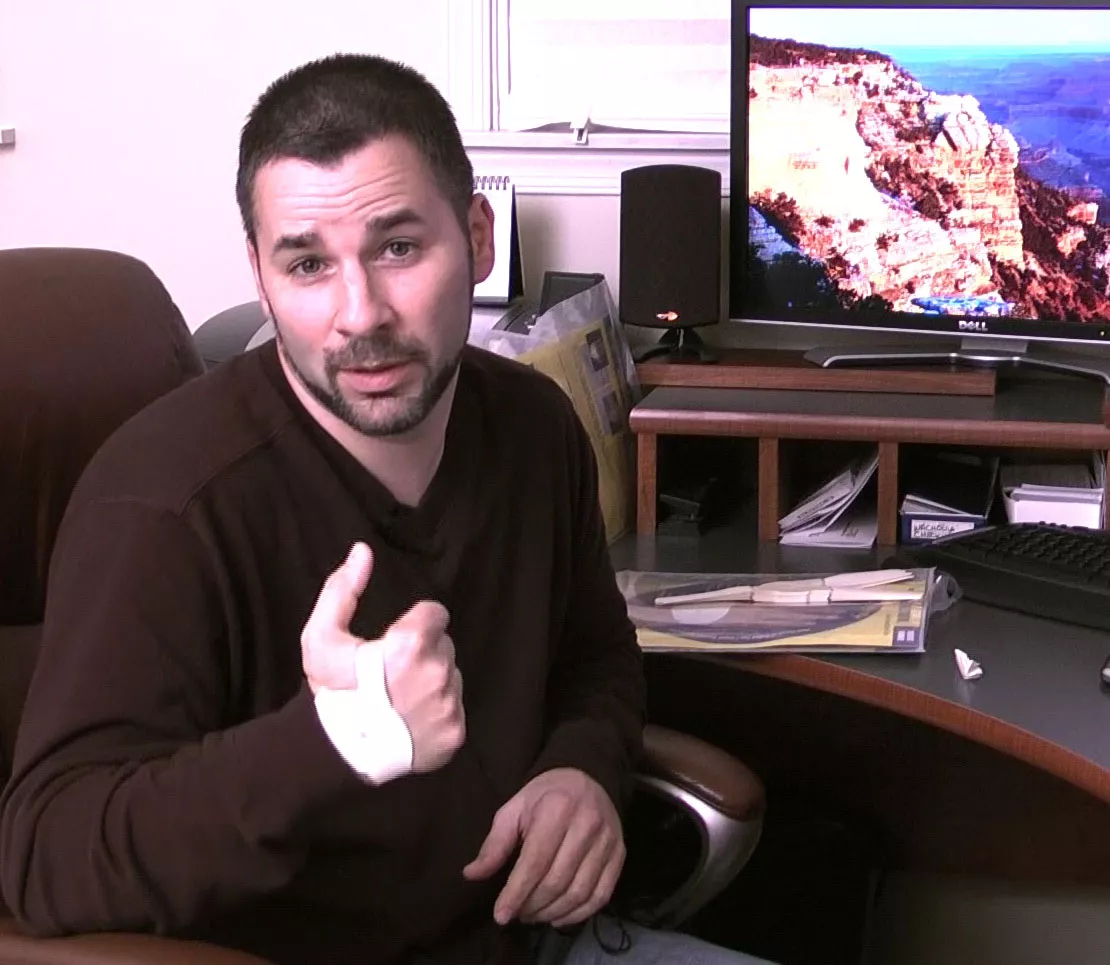
Read their full stories in How I Cured My Carpal Tunnel Without Surgery.
When Healing Needs a Doctor’s Help and Professional Medical Evaluation
- Constant numbness that does not improve or loss of feeling in the fingertips that does not improve in 4 to 8 weeks.
- Extreme loss of the muscle at the base of the thumb, with loss of grip strength that does not improve over 6 to 8 weeks.
- Worsening symptoms over 6 to 8 weeks while using the best conservative treatments
- Symptoms that begin suddenly after hand or wrist trauma, a fracture or severe sprain from a fall or auto accident.
- Odd Symptoms that are not consistent with the Carpal Tunnel Symptoms listed on this website, that might be indicative of other nerve issues. A nerve conductivity study can clear up the confusion with minimal costs and not too much pain and no risk.
These signs may mean more advanced nerve involvement or a different condition and deserve professional medical evaluation and in person consultation. Home treatment can be used alongside professional in-person medical care while you wait for the healthcare delivery system to fit you into their schedule. There is no reason to wait doing nothing. You can start proven natural conservative treatment with good patient reviews while you wait for your appointments. If your symptoms start improving over 6 to 8 weeks, then you know you are on the right track and surgery is not necessary.
The Bottom Line
Acupuncture for carpal tunnel is a safe, reasonable add-on if you like it and it eases your symptoms. The research does not show it works much better than sham treatment in the short term, and it does not treat the tight tissue and trapped inflammation inside the carpal tunnel. Pair it with nightly passive stretching, give the plan 6 weeks, and let your own progress guide you. Mild, moderate and even severe cases deserve a fair trial of conservative care first. Learn more in Is Carpal Tunnel Surgery Necessary? and Can Carpal Tunnel Be Reversed Without Surgery?
Acupuncture for Carpal Tunnel: FAQ
Can carpal tunnel be treated with acupuncture?
Acupuncture for carpal tunnel can ease symptoms for some people, but a 2018 Cochrane review found it may have little or no effect compared with sham acupuncture in the short term. It works best as an add-on, not a replacement for treating the cause.
How many acupuncture sessions does carpal tunnel need?
Trials of acupuncture for carpal tunnel typically used a series of sessions over several weeks. If you see no change after several sessions, it is reasonable to stop and focus on other treatments.
Is electroacupuncture better than regular acupuncture for carpal tunnel?
The evidence is not strong enough to say. A Harvard-affiliated study using electroacupuncture found nerve and brain changes that sham treatment did not produce, but larger trials are needed.
Does insurance cover acupuncture for carpal tunnel?
It depends on your plan. Some insurers cover acupuncture for carpal tunnel and other pain conditions, so call your insurer before booking. The Carpal Solution can also be submitted for health insurance reimbursement.
Is acupuncture better than surgery for carpal tunnel?
They have not been compared directly in good trials. For mild to moderate carpal tunnel, guidelines start with conservative care, and surgery is usually reserved for cases that do not improve with the best conservative treatment.
Can I use acupuncture and the Carpal Solution together?
Yes. Acupuncture sessions during the day and the Carpal Solution at night work on different things and can be used together. Track your symptoms weekly so you can tell what is helping.
What is the difference between dry needling and acupuncture for carpal tunnel?
Acupuncture places needles at mapped points to influence nerve signaling and pain. Dry needling places needles into tight muscle knots and fascia, such as the thumb and forearm muscles, to release tension around the carpal tunnel. Small trials of dry needling show less pain, better function and fewer surgeries, and the two can be combined. Our doctors’ Persistent Symptoms Protocol includes dry needling with interferential current, about 15 minutes, 1 to 2 times a week for 2 to 3 weeks.
Sources
- Choi G-H, Wieland LS, Lee H, Sim H, Lee MS, Shin B-C. Acupuncture and related interventions for the treatment of symptoms associated with carpal tunnel syndrome. Cochrane Database of Systematic Reviews. 2018;(12):CD011215. Cochrane
- Jiménez del Barrio S, et al. Conservative treatment in patients with mild to moderate carpal tunnel syndrome: a systematic review. Neurología. 2018;33:590–601. Elsevier
- Maeda Y, Kim H, Napadow V, et al. Rewiring the primary somatosensory cortex in carpal tunnel syndrome with acupuncture. Brain. 2017. PubMed; Harvard Gazette summary
- American Academy of Orthopaedic Surgeons. Management of Carpal Tunnel Syndrome Evidence-Based Clinical Practice Guideline. 2024. AAOS
- Gascon-Garcia J, López-Marne S, Dominguez-Rubio R, et al. Efficacy of dry needling with the fascial winding technique in reducing the percentage of surgery in carpal tunnel syndrome: a randomized clinical trial. Journal of Bodywork and Movement Therapies. 2025;42:408–416. PubMed
- Rezazadeh M, Aminianfar A, Pahlevan D. Short-term effects of dry needling of thenar muscles in manual laborers with carpal tunnel syndrome: a pilot, randomized controlled study. Physiotherapy Theory and Practice. 2023;39(5):927–937. PubMed
Disclosure: First Hand Medical makes the Carpal Solution, and Dr. Scherger is a co-founder of the company. This article is for education and is not a substitute for advice from your own doctor.