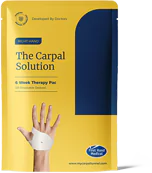
 Created by renowned Harvard health care professionals.


Avoid Wrist Splints: Why Splints and Braces Can Make Carpal Tunnel Worse
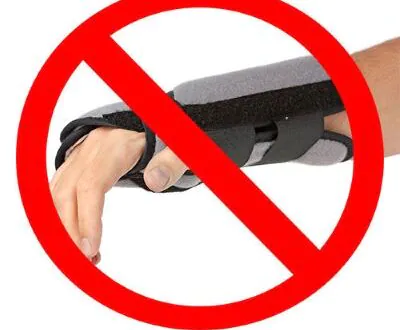
Why Avoid Wrist Splints for Carpal Tunnel?
Written by Julie Sunberg, Director of Marketing and Customer Service at First Hand Medical · Clinically reviewed by Alan Ward, MOT, OTR, Master Occupational Therapist and Vice President of Precision Rehabilitation · Last reviewed: November 2026
Our doctors tell people with carpal tunnel syndrome to avoid wrist splints and rigid braces if they want to treat the condition at its root. This page explains why splints can make carpal tunnel worse over time, how disuse atrophy weakens the forearm, wrist and thumb, and what works better.
On This Page
Wrist splints and rigid braces are restrictive and immobilize the hand and wrist. They sometimes ease pain in the beginning, but they can make carpal tunnel syndrome worse in the long run.
A splint holds the wrist in a neutral position, which can reduce pain from movement, but it does not promote healing from carpal tunnel syndrome. It causes muscle atrophy and stiffness, and its tight compression restricts blood circulation and lymphatic fluid exchange, which slows the dispersion of entrapped swelling, the root cause of carpal tunnel syndrome.
Our medical team has observed that splints give some relief at first but aggravate symptoms in the long run. Immobilization is great for fractures and sprains, but not for carpal tunnel syndrome. The main problems with splints and braces:
- They restrict normal, everyday activities.
- They impair dexterity for fine motor skills.
- They cause muscle atrophy and joint stiffness.
- Rigid components press on and irritate the soft tissue.
- They are inconvenient, uncomfortable, restrictive and bulky.
Why Avoid Wrist Splints? Disuse Atrophy Explained
The main reason to avoid wrist splints is simple: muscles that are not used get smaller and weaker. Doctors call this disuse atrophy, and it starts quickly.
In one study, healthy adults who spent just 14 days in a cast lost about 8% of their muscle size and about 23% of their strength (Wall et al., Acta Physiologica, 2014). Splinting or casting any limb leads to disuse atrophy over time, and the wrist is no exception.
A tight splint also compresses the hand, wrist and forearm, restricting blood circulation and lymphatic fluid exchange. That slows the dispersion of the swelling and entrapped inflammation that cause carpal tunnel in the first place.
Forearm Muscle Atrophy and Carpal Tunnel
Carpal tunnel is not only a wrist problem. The muscles that bend your fingers and thumb live in the forearm, and their nine tendons pass through the carpal tunnel right beside the median nerve: four flexor digitorum superficialis, four flexor digitorum profundus and the flexor pollicis longus.
When a splint keeps those tendons from moving, the forearm muscles that drive them weaken too. Forearm muscle atrophy shows up as lost grip strength, tired forearms and clumsy fingers. The thenar muscles at the base of the thumb are affected as well, because they are powered by the median nerve.
Braces and Splints Are Made for Fractures and Sprains, Not Carpal Tunnel
Hand braces, wrist splints, wrist braces and hand stabilizers were designed to hold broken bones and sprained joints still while they heal. Carpal tunnel syndrome is a different problem.
Carpal tunnel is caused by trapped inflammation in the soft tissue in and around the carpal tunnel. Stretching and motion are what restore flexibility to the injured soft tissue and disperse the trapped inflammation. Immobilization does the opposite: it leads to muscle atrophy, and the rigid parts of a brace can irritate the soft tissue and aggravate carpal tunnel syndrome.
Muscle Atrophy After a Cast or Splint: What to Do Instead
If you have been wearing a splint or cast and notice muscle atrophy in the wrist, forearm or thumb, the goal is to restore movement, blood flow and flexibility gently, not to force strength back.
- Stretch, don’t squeeze. Skip grip balls and putty while you heal. The Carpal Solution gives the soft tissue over 220 hours of targeted passive stretching in the six-week protocol, while you sleep.
- Add daytime stretches as a bonus. Up to six sets of ten, holding each stretch for 15 seconds with 30 seconds of rest.
- Give it time. Muscle atrophy after a cast or splint usually improves as normal hand use returns.
The Better Way: The Carpal Solution Stretching Treatment
The Carpal Solution is a clinically documented, over-the-counter stretching treatment you apply at bedtime in under a minute. Instead of holding the wrist still, it gently stretches the soft tissue while you sleep. It:
- Jump-starts the body’s natural healing processes.
- Disperses trapped inflammation and restores blood circulation.
- Restores flexibility to the soft tissue.
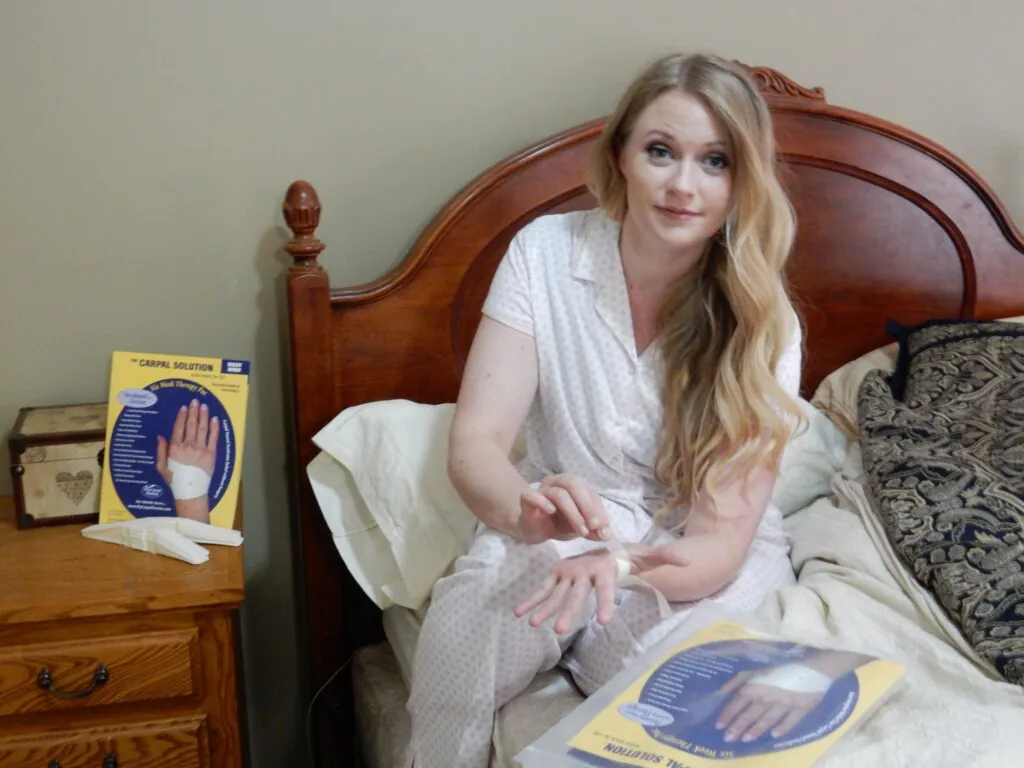
Most people are better from their worst symptoms in two to three weeks, and about 90% get complete remission in six weeks. The other 10%, usually people with excess systemic inflammation, are 40 to 70% better at six weeks and reach full remission in 10 to 12 weeks.
Over 100,000 people have used the Carpal Solution over two decades, with 97% patient satisfaction and 4.9 out of 5 stars on independent review sites like Google Reviews. It is registered with the FDA and was developed by doctors, so you can avoid wrist splints and treat carpal tunnel at home without downtime, risks or scar tissue.

Comparing braces and splints? See our buyer’s guide to the best wrist brace for carpal tunnel, our soft wrist brace vs. hard wrist brace comparison and our carpal tunnel night splint guide.
Avoid Wrist Splints: Frequently Asked Questions
Should I avoid wrist splints if I have carpal tunnel?
Our doctors recommend it for the long term. A splint can ease pain from movement for a while, but it does not promote healing, and over time it weakens the muscles of the forearm, wrist and thumb.
What is disuse atrophy?
Disuse atrophy is the loss of muscle size and strength that happens when a muscle is not used, for example while a limb is held in a cast, sling or splint.
Can a wrist splint cause muscle atrophy?
Yes. Any splint or cast that holds a joint still leads to muscle atrophy over time. In one study, 14 days in a cast cost about 8% of muscle size and 23% of strength.
What should I use instead of a wrist splint at night?
The Carpal Solution. It is worn while you sleep like a splint, but it gently stretches the soft tissue instead of immobilizing the wrist. Pillows can help keep your wrists neutral while you sleep.
How long does muscle atrophy after a cast take to improve?
It usually improves over weeks as normal use returns. If the muscle at the base of your thumb keeps thinning, see your doctor.
When Healing Needs a Doctor’s Help and Professional Medical Evaluation
- Constant numbness that does not improve or loss of feeling in the fingertips that does not improve in 4 to 8 weeks.
- Extreme loss of the muscle at the base of the thumb, with loss of grip strength that does not improve over 6 to 8 weeks.
- Worsening symptoms over 6 to 8 weeks while using the best conservative treatments
- Symptoms that begin suddenly after hand or wrist trauma, a fracture or severe sprain from a fall or auto accident.
- Odd Symptoms that are not consistent with the Carpal Tunnel Symptoms listed on this website, that might be indicative of other nerve issues. A nerve conductivity study can clear up the confusion with minimal costs and not too much pain and no risk.
These signs may mean more advanced nerve involvement or a different condition and deserve professional medical evaluation and in person consultation. Home treatment can be used alongside professional in-person medical care while you wait for the healthcare delivery system to fit you into their schedule. There is no reason to wait doing nothing. You can start proven natural conservative treatment with good patient reviews while you wait for your appointments. If your symptoms start improving over 6 to 8 weeks, then you know you are on the right track and surgery is not necessary.
Sources
- Wall BT, et al. Acta Physiologica, 2014. doi:10.1111/apha.12190
- Journal of Ultrasound, 2012: anatomy of the carpal tunnel and its nine flexor tendons (PMC3558235).
Learn more: How the Carpal Solution works · Braces for carpal tunnel · Carpal splints

Developed by First Hand Medical’s Team of Doctors
The Carpal Solution Treatment Kit was developed by our expert team of medical doctors who have worked at and led some of the top medical institutions in the World – Including Harvard Medical, Tufts Medical, UCSD, UF Health, and The Ohio State University. We treat root causes with clinically proven conservative treatments. The results: Quick Natural Relief of All Your Carpal Tunnel Symptoms without complications.

Order Your Six Week Carpal Tunnel Treatment Now
The ONLY treatment for carpal tunnel that comes with a no questions asked 30-Day Patient Satisfaction Guarantee and in-house dedicated pain relief team.