 Created by renowned Harvard health care professionals.


What is Endoscopic Carpal Tunnel Surgery?
Endoscopic Surgery is a type of surgery that allows the Surgeon to make only two or three small incisions big enough to allow an endoscope and surgical tools on tubes to pass under the skin and through the tissue to the Transverse Carpal Ligament.


Written by Julie Sunberg, Director of Marketing and Customer Service at First Hand Medical · Medically reviewed by Joseph E. Scherger, MD, MPH, family physician, clinical professor, UC San Diego School of Medicine · Last reviewed: November 2026
Question: What Is Endoscopic Carpal Tunnel Surgery?
“What is endoscopic carpal tunnel surgery and is it recommended over open carpal tunnel surgery?” – Brianne, Bellevue, Washington
Table of Contents
How Endoscopic Carpal Tunnel Surgery Works
Thanks for your question, Brianne! Endoscopic carpal tunnel surgery lets the surgeon work through one or two small incisions, just big enough for an endoscope and surgical tools to pass under the skin to the transverse carpal ligament. An endoscope is a thin tube with a camera and light on the end that lets the surgeon see inside the hand without a large incision or cutting through many layers of tissue.
 The surgeon watches a monitor and uses the camera image to guide the operation. Like open surgery, endoscopic carpal tunnel release cuts the transverse carpal ligament to make more room for the median nerve. The goal is the same; only the route is different.
Endoscopic vs Open Carpal Tunnel Surgery
There are potential advantages to endoscopic procedures and also some potential disadvantages and additional risks. The advantage is that endoscopic surgery is less invasive. Less tissue that does not need to be cut is disturbed, so the incision is smaller and early recovery can be faster.
The published research backs this up only partly. A Cochrane review found that people return to work about eight days sooner after endoscopic release on average. Endoscopic release more often caused temporary nerve problems such as numbness and tingling, while open release had more wound problems such as scar tenderness (Vasiliadis et al., Cochrane, 2014). An earlier Cochrane review found that none of the alternatives to standard open release gave better symptom relief in the short or long term (Scholten et al., Cochrane, 2007).
So there is no right answer on which surgery is better. Some surgeons refuse to do endoscopic carpal tunnel surgery because the nerve and tendons sit so close to the ligament that must be cut. That alone tells you something about the risks.
Endoscopic Carpal Tunnel Release Risks
The disadvantage is that the surgeon works remotely by camera in a very small space, where tendons, nerves and ligaments are tightly packed together. There is potential to nick a nerve or a tendon unintentionally when severing the transverse carpal ligament.
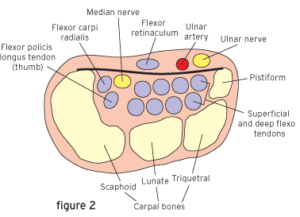 The diagram is enlarged for illustration; in reality the nerve and tendons are millimeters apart. The transverse carpal ligament is like a nylon rope that rests just over the nerve and the tendons. It is usually cut just next to the median nerve to avoid the arteries, the tendons and the ulnar nerve on the other side. The median nerve and nine tendons are packed tightly in the carpal tunnel, so endoscopic surgery requires extreme precision and a lot of experience with the remote scalpel.
Nerves are very sensitive by design. In our doctors’ clinical experience, if the nerve is touched by the scalpel, permanent nerve damage can result, and those symptoms can be much worse than the carpal tunnel symptoms were before surgery. A person can lose motor function and feeling in the hand permanently, or have numbness, tingling and intense shooting pain. Published reviews report that permanent median nerve injury is uncommon and similar with either technique, while temporary nerve problems are more frequent after endoscopic release.
If a tendon is struck it is less serious, but it can be painful and affect the use of the finger it controls. Tendons normally heal, and your body’s healing process will eventually repair the damage.
Whenever you have surgery of any kind, check the surgeon’s credentials carefully. With carpal tunnel surgery it is the same: pick an experienced surgeon with a great reputation among patients.
Endoscopic Carpal Tunnel Surgery Recovery Time
Endoscopic carpal tunnel surgery recovery time is usually a little shorter at the start, with people returning to work about a week sooner on average than after open surgery. Full recovery takes longer for both techniques: rehabilitation after carpal tunnel surgery can take anywhere from six weeks to one year. Read more about carpal tunnel surgery recovery.
Patient Satisfaction Is the Same Problem Either Way
Whichever technique is used, carpal tunnel surgery has a patient satisfaction rate lower than 69%, because about 31% of patients report lingering or recurring symptoms, and no patient is satisfied with lingering symptoms. Second surgeries have a patient satisfaction rate between 16% and 40%.
Even after a successful surgery, symptoms often return: the highest published rate is 57% of patients with at least some symptoms returning within five and a half years (Nancollas et al., 1995). Our doctors estimate 80 to 90% within 10 years, from clinical experience rather than statistical research. Why so little certainty? Few studies follow patients past a few years. Read more about recurrence after surgery.
Getting to surgery also means waiting: for appointments, a nerve test, insurance approval and an opening in a busy surgeon’s schedule. The average new-patient appointment wait is 31 days (AMN Healthcare, 2025). You can start a safe treatment at home while you wait for carpal tunnel treatment.
Try a Natural Treatment First
 Better yet, you may be able to avoid surgery altogether by treating your carpal tunnel with a clinically documented natural stretching therapy developed by doctors to help patients avoid the risks of surgery. Look into the Carpal Solution Carpal Tunnel Treatment. You can try it without risks, without downtime and at minimal cost. It has 97% patient satisfaction over 21 years and 4.9 out of 5 stars on independent review sites, and if it works for you, you can avoid the risks, downtime and expense of carpal tunnel surgery of any type.
Neurologists, including Dr. James S. Zu, MD, PhD, of Edison, New Jersey, call the Carpal Solution a better first line of defense. Most people are better from their worst symptoms in two to three weeks. Kathy, a surgical nurse, shares her experience with the Carpal Solution:
I hope that answers your question. Thanks again for giving us the opportunity to help; I am confident it will help others who are wondering about this issue.
If you have more questions on carpal tunnel surgery, click here or look at the links under Carpal Tunnel Surgery in the menu bar at the top of this page. Learn more about natural carpal tunnel treatment by watching the videos on this page or browsing MyCarpalTunnel.com. For general medical background on endoscopic carpal tunnel surgery, see the NINDS fact sheet on carpal tunnel syndrome.
Endoscopic Carpal Tunnel Surgery FAQs
Is endoscopic carpal tunnel release better than open surgery?
Not clearly. Cochrane reviews found similar symptom relief, a return to work about a week sooner after endoscopic release, more temporary nerve problems with endoscopic release and more scar problems with open release.
What is the endoscopic carpal tunnel surgery recovery time?
Many people return to light work sooner than after open surgery, but full rehabilitation can take six weeks to a year with either technique.
What does an endoscopic carpal tunnel surgery scar look like?
An endoscopic carpal tunnel surgery scar is usually one or two small marks at the wrist or palm instead of one longer palm scar, and scar tenderness is less common than after open release.
Does carpal tunnel come back after endoscopic surgery?
It can. Carpal tunnel syndrome is chronic and recurring, and symptoms can return after either type of surgery.
When Healing Needs a Doctor’s Help and Professional Medical Evaluation
- Constant numbness that does not improve or loss of feeling in the fingertips that does not improve in 4 to 8 weeks.
- Extreme loss of the muscle at the base of the thumb, with loss of grip strength that does not improve over 6 to 8 weeks.
- Worsening symptoms over 6 to 8 weeks while using the best conservative treatments
- Symptoms that begin suddenly after hand or wrist trauma, a fracture or severe sprain from a fall or auto accident.
- Odd Symptoms that are not consistent with the Carpal Tunnel Symptoms listed on this website, that might be indicative of other nerve issues. A nerve conductivity study can clear up the confusion with minimal costs and not too much pain and no risk.
These signs may mean more advanced nerve involvement or a different condition and deserve professional medical evaluation and in person consultation. Home treatment can be used alongside professional in-person medical care while you wait for the healthcare delivery system to fit you into their schedule. There is no reason to wait doing nothing. You can start proven natural conservative treatment with good patient reviews while you wait for your appointments. If your symptoms start improving over 6 to 8 weeks, then you know you are on the right track and surgery is not necessary.

Watch videos of people who “Cured” their Carpal Tunnel Naturally and Avoided the Risks of Carpal Tunnel Surgery!







Order Your Six Week Carpal Tunnel Treatment Now
The ONLY treatment for carpal tunnel that comes with a no questions asked 30-Day Patient Satisfaction Guarantee and in-house dedicated pain relief team.


