 Created by renowned Harvard health care professionals.


What Is Carpal Tunnel Syndrome? Causes, Symptoms and the Essential Basics
Carpal tunnel syndrome is one of the most common nerve problems of the hand. Many people call it just "carpal tunnel," which is actually the name of an important part of the hand's anatomy. Most people think the carpal tunnel is in the wrist, but it sits at the base of the hand, as illustrated below.
The syndrome starts with excess inflammation that gets trapped in the tunnel and puts pressure on the median nerve. The pressure also restricts blood vessels and lymphatic channels, which blocks the normal healing process, so carpal tunnel syndrome becomes cyclical.
It is a chronic, recurring condition, and it is best treated first with natural stretching that helps jump-start the body's own ability to disperse the trapped fluid.


Written by Julie Sunberg, Director of Marketing and Customer Service at First Hand Medical · Medically reviewed by Michael E. Ruff, MD, orthopedic hand surgeon and associate clinical professor of orthopedic surgery at Ohio State University · Last reviewed: November 2026
Table of Contents
What Is Carpal Tunnel Syndrome? The Short Answer
Carpal tunnel syndrome is pressure on the median nerve where it passes through the carpal tunnel, a narrow passage at the base of the palm. The pressure comes from swelling of the tendon linings that share the tunnel with the nerve. It causes numbness, tingling and pain in the thumb, index, middle and part of the ring finger, often worst at night, and over time it can weaken the grip.
Our doctors describe carpal tunnel syndrome as a chronic, recurring condition caused by inflammation that gets trapped in the tunnel. Because the trapped swelling also restricts blood circulation and lymphatic fluid exchange, the body has trouble clearing it on its own, and the condition becomes a cycle. The good news is that it usually responds to conservative treatment that helps the body disperse that swelling.
7 Key Facts About Carpal Tunnel Syndrome
- It is common. In a large Swedish population study, about 3.8% of adults had clinically certain carpal tunnel syndrome, and 2.7% had it confirmed by nerve testing (Atroshi, JAMA, 1999).
- The tunnel is crowded. Nine tendons that bend the fingers and thumb pass through it with the median nerve: four flexor digitorum superficialis, four flexor digitorum profundus and one flexor pollicis longus. Their muscles are in the forearm.
- Night symptoms come first for many people. Waking with numb, tingling hands is one of the most common early signs.
- Three or more symptoms is a strong signal. Our doctors’ two decades of clinical experience is that people with three or more typical symptoms can be about 95% confident they have carpal tunnel syndrome. That comes from clinical experience, not a published statistic.
- Conservative treatment comes first. The Carpal Solution, worn at night, has 97% patient satisfaction over 21 years and 4.9 out of 5 stars, and over 90% of people reach remission by 6 weeks.
- Splints do not heal it. A splint can reduce pain from movement, but it does not promote healing; our medical team has observed that splints give some relief at first but aggravate symptoms in the long run.
- Surgery is the last resort. Carpal tunnel surgery has a patient satisfaction rate lower than 69%, because about 31% of patients report lingering or recurring symptoms.
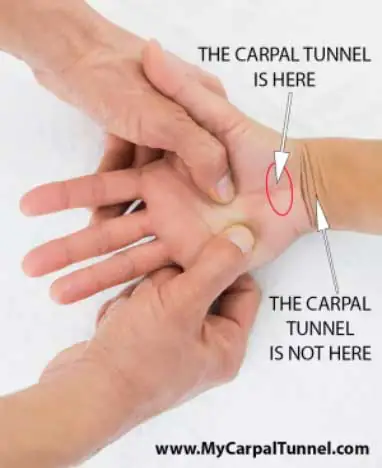
The Carpal Tunnel is literally a tunnel and is located at the base of the hand, just above the wrist between the two largest muscles of the hand.
Often people mistakenly think that the Tunnel is located in the wrist, because when people feel pain and discomfort from Carpal Tunnel Syndrome, it is often concentrated in the joint closest to the Tunnel. However, it is actually located in the base of the hand next to the wrist.
If you want to understand what is going on with your hand when this condition strikes, you need to understand the anatomy.
There are some basic things everyone should know; if they have pain or numbness in the hands, pain in the wrists, tingling fingers, are regularly dropping things, lost sensitivity or fine motor skills in their hands, or if they find their hands wake them up in the night.
There are 27 bones in the hand and wrist
There are 27 bones in the hand and wrist that are carefully resting proximate to one another cushioned and held together by cartilage, muscle, fascia tissue, tendons and ligaments.
Collectively this web of tissue which holds the bones of the hands and wrists together is referred to as “Soft Tissue” because it generally does not show up on an X-Ray image.
This network of soft tissue forms the flexible cushioning system that prevents bone on bone grinding and severe pain in the hands or wrists that can result from bone to bone contact.
The Carpal Tunnel is a narrow protective passage formed by this remarkable combination of soft tissue and hard bones.
It is about the size of a thumb nail in most people, but the size can vary widely between people. The size of the passage is determined by your genes.
What does the Carpal Tunnel look like?
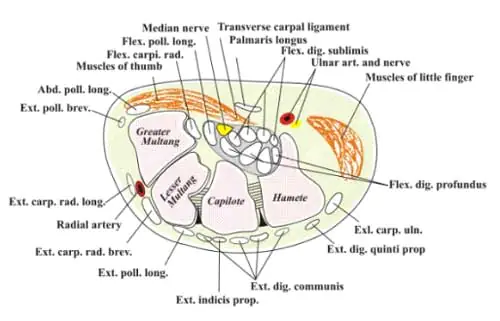
This protective chamber, known as the Carpal Tunnel, is extremely important to healthy hand function, because it houses the Median Nerve, tendons and blood vessels. These, in turn, provide nourishment, movement, muscle control, sensitivity and touch to the fingers, palm, hand and wrist.
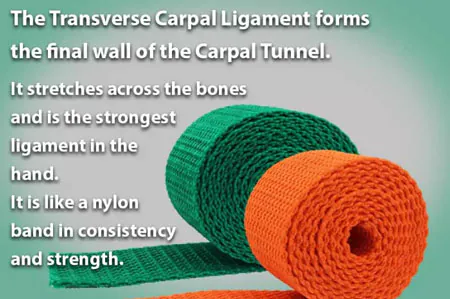
The hard protective walls are made up of eight small bones forming the Carpal Arch on three sides and the largest and strongest ligament of the hand, the Transverse Carpal Ligament, forms the final passage wall on the palm side at the base of the hand.
When conversing with doctors or a surgeon, it can be good to know the other names that they sometimes use to refer to this ligament. These include: Flexor Retinaculum or Anterior Annular Ligament.
The Transverse Carpal Ligament has been likened to a “nylon rope” in its general composition and strength.
It is made of strong fibrous tissue and connected directly to the surrounding bones. It is the largest and strongest ligament of the hand and provides grip strength and stability to the whole hand from the base.
Most individuals take the remarkable dexterity and grip strength of their hand’s functioning parts for granted, often sitting and typing away for hours at their keyboards worry-free. They just expect those hands to work as their hands have always worked for them since their birth.
In general, folks don’t care about the anatomy of their hands or wrists until something goes wrong.
This is common with most health issues.
“The fact that many chronic CTS sufferers get relief from numbness in just a few days while applying Carpal Solution therapy is nothing short of amazing.”
The most common ailment that affects the Transverse Carpal Ligament, this critical passage in the hand, in fact, is known as CTS (Carpal Tunnel Syndrome). It is caused when the Median Nerve is pinched against the hard walls or the tendons which also run through the tunnel by trapped inflammation, also, commonly called swelling.
There are multiple issues that can lead to increased pressure on the Median Nerve.
For example injured soft tissue can contract, pinching the nerve.
One or more of the tendons passing through the tunnel can swell putting pressure on the nerve.
The most common cause is Lymphatic fluid (commonly referred to as swelling) that builds up from injured tissue from repetitive use or trauma or what our doctors call systemic inflammation generated by other physiological ailments, hormonal imbalances, such as menopause, auto-immune conditions, such as diabetes or gum disease. The trapped inflammation creates pinching pressure in this narrow space creating nerve inhibition, which is Carpal Tunnel Syndrome.
More detail can be learned about the causes of this painful and frustrating condition here.
Gentle Stretching for 224 Hours Over 6 Weeks Is the Best First Line Treatment
The muscles of the thumb connect directly to the Transverse Carpal Ligament right over the Median Nerve. It is important to understand this juxtaposition when it comes to treating this dreadful hand condition.
Looking at the cross-sectional diagram of the base of the hand above, it is not hard to imagine how stretching the thumb muscle in the right way could relieve pressure on the Median Nerve biomechanically.
With this in mind you can understand how gentle consistent stretching therapy is the best first line of defense for relieving pressure on the Median Nerve from any cause. The primary cause of Carpal Tunnel Syndrome is excess inflammation which gets trapped in the Carpal Tunnel and puts pressure on the Median Nerve in the Carpal Tunnel.
The targeted stretching provided by the Carpal Solution Stretching Devices during sleep relieves pressure on the blood vessels, restores full blood circulation, and removes the restrictive pressure on the lymphatic channels allowing full lymphatic fluid exchange. These are the two natural processes one’s body uses to disperse excess inflammation and heal naturally. Full blood circulation allows provides full nutrition and oxygenation of the soft tissue needed for fast natural healing.
It is important that any stretching in this area be gentle and consistent for sufficient time in the correct direction. Our Medical Experts find that it is best to stretch gently for a minimum of eight hours during sleep while the hand is relaxed and the body is in a restorative state. This “slow and steady approach” is a much more effective treatment protocol, than high pressure or rapid intense stretching for a few minutes during the day.
There are a lot of moving parts operating in this tight space, so you have to get it right with a device that has been specially designed to stretch gently in the right directions.
Once the pressure is relieved through gentle stretching therapy for eight hours each night, and for 28 nights over the six week protocol; the flexibility is restored to the soft tissue, circulation gets back to normal and your body gets back to its natural healing process.
The cycle is broken and the syndrome usually stays in remission for 5 to 7 years for most people, ranging from 1 to 17 years, after completing the six week Carpal Tunnel stretching protocol.
Diagnosing this syndrome can be tricky. It can present itself with many different symptoms and most people are often confused by what might be causing their Carpal Tunnel Symptoms. Even doctors are sometimes confused by the symptoms and misdiagnose these symptoms until a Nerve Conductivity Study is performed.
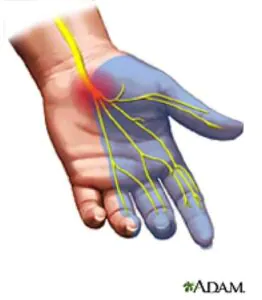
The picture of the hand to the left, shows the pathway of the Median Nerve, so you know what part of the hand is usually affected when the Median Nerve is pinched. You can learn about the most common Symptoms of Carpal Tunnel Syndrome to help you with a self-diagnosis prior to being diagnosed by a physician.
Everyone with this condition tends to have their own unique combination of symptoms and responds to therapy on a different timetable, but the one thing that most have in common is that they need to get relief without resorting to surgery.
Fortunately, you can easily access reliable Carpal Tunnel Treatment in a Six Week Home Therapy that is relatively inexpensive and has 97% patient satisfaction over 21 years.
The Carpal Solution was developed by doctors working with patients and is shipped worldwide from warehouse locations in the USA, Europe, Japan and Brazil. We are adding new warehouses and distributors all over the globe to make it easy for anyone, anywhere to obtain natural relief from CTS.
The treatment allows individuals to put their Carpal Tunnel Syndrome into remission and avoid the risks and potential complications of severing the Transverse Carpal Ligament in a surgical procedure.
Should I consider surgery?

The surgical procedure is definitely a last resort treatment for most people due to many factors. Carpal tunnel surgery has a patient satisfaction rate lower than 69%: about 31% of patients report lingering or recurring symptoms, and no patient is satisfied with lingering symptoms (Bland, Muscle & Nerve, 2001). A surgery that leaves symptoms behind is not a successful surgery, and about 8% of patients say their condition is worse after surgery (Bland, Muscle & Nerve, 2007).
Even after a successful surgery, symptoms often come back: 57% of patients had at least some symptoms return within five and a half years (Nancollas et al., 1995). Based on two decades of clinical experience, our doctors estimate symptoms return for 80 to 90% of patients within 10 years.
This is not a statistically researched figure; it is their best estimate until the work is done to follow carpal tunnel patients for 10 years or more, as other orthopedic fields do for hip and knee replacements. Second surgeries are needed in 16% to 40% of cases. Read more about recurrence after surgery.
Surgery is a bad option for almost any condition, if it has to be repeated.
You can learn more about the prognosis of Carpal Tunnel Surgery.
It is interesting that there are eight small bones that combine to form the Carpal Arch. Doctors have to memorize these in medical school. For those who are interested in the names of the bones of the Carpal Arch and the relative position, here is a brief synopsis:
The eight bones that make up the Carpal Arch are listed in two rows.
The Proximal Row which includes: the Scaphoid, the Lunate, the Triquetrum and the Pisiform.
The second row of bones is The Distal Row, which includes: the Trapezium, the Trapezoid, the Capitate and the Hamate.
As with every aspect of the hand, the left hand is a mirror image of the right hand, and it is the same with the anatomy of the Carpal Tunnel.
For independent background on what is carpal tunnel syndrome, see the NINDS carpal tunnel syndrome fact sheet, and ask your doctor to explain your own diagnosis in plain language.
Knowing “What Is Carpal Tunnel Syndrome”, Empowers You as a Patient
Knowledge is Power! Knowing what is Carpal Tunnel Syndrome and what causes it empowers you to start with patient reviewed conservative treatments like the Carpal Solution Treatment Kit, before you expose yourself to risks with more invasive procedures like, carpal tunnel steroid injections or carpal tunnel surgery. There is no reason to expose yourself to unnecessary risks, if you can jump-start your body’s normal dispersion of lymph fluid with a natural treatment first.
This is why medicine embraces the Conservative First Treatment approach across all classes of diseases and syndrome. In this website you can learn everything you need to know for diagnosing and treating this painful syndrome.
The Carpal Solution has been used by over 100,000 people in over 30 countries to eliminate numbness in hands during sleep.
We continue to earn 97% patient satisfaction over 21 years.
Neurologists call the Carpal Solution The Best First-Line Treatment for Carpal Tunnel Syndrome.
Patients simply call it: “My Carpal Tunnel “Cure”!”
Carpal tunnel syndrome is a chronic, recurring condition that cannot be cured, but the Carpal Solution is the next best thing: it controls symptoms at home without downtime, risks, scar tissue or complications.
Call Toll Free and Speak to
Our Knowledgeable Representatives at: 1-800-798-5210
Carpal Solution Quick-Start Guide

Still have Questions?
We can Help You.
Identify The Best Path to Reliable Quick Carpal Tunnel Relief.
Our Doctors created this guide to help you to confidently put all the pieces of the Carpal Tunnel Puzzle together for a solid carpal tunnel treatment plan for life.
This Quick Start Guide is a simple summary to facilitate sound medical decision-making. We can clear the confusion and help you avoid unnecessary waiting or wasting time on treatments that don’t work, or have too many risks, too much downtime and have a poor overall prognosis.
If you feel like you need a reliable guide created by Doctors with a Proven Natural Treatment Approach that deals with the Root Causes to get quick relief from this chronic recurring condition without complications?
We have condensed everything you need to know about natural carpal tunnel relief in one place:
Root Causes,


Reliable Self-Diagnosis,
Why and How to Avoid Surgery
The Best Natural Carpal Tunnel Treatment, and
The Back-Up Plan for a Life Time of Relief
.
.
Everyone Can Heal Carpal Tunnel Naturally!
There is No Reason to Wait!
Get Started Healing Today!
Click: The Carpal Solution Quick Start Guide
Our doctors’ experience: Over two decades, our doctors have found that people with three or more of the carpal tunnel symptoms listed on this website can be about 95% confident they have carpal tunnel syndrome. This is clinical experience, not a published statistic. You should still get an in-person evaluation and a formal diagnosis from a doctor, and see one promptly if you have constant numbness, weakness or thinning at the base of the thumb.
With that level of confidence, many people start a natural, non-invasive treatment developed by doctors, like the Carpal Solution, with 97% patient satisfaction and 4.9 out of 5 stars on independent review sites like Google Reviews, while they wait for their appointment. The wait is real: a new-patient appointment with a doctor now takes an average of 31 days (AMN Healthcare, 2025), and seeing a neurologist or hand surgeon can mean more waiting.
Who Gets Carpal Tunnel Syndrome?
Anyone can develop carpal tunnel syndrome, but some people are more likely to:
- Women, who are affected more often than men, partly because the carpal tunnel tends to be smaller.
- Adults in middle age, with risk rising with age.
- People who use their hands hard and often: computer work, assembly lines, tools that vibrate, dentistry, hair styling, music and crafts.
- People with conditions that add swelling, such as pregnancy, diabetes, an underactive thyroid, rheumatoid arthritis or extra body weight.
Many people have more than one of these factors. Whatever the trigger, the end result is the same: swelling trapped in a tight space. If you are waiting to see a doctor, the average wait for a new-patient appointment is 31 days (AMN Healthcare, 2025). Read about relief while waiting for carpal tunnel treatment.
When Healing Needs a Doctor’s Help and Professional Medical Evaluation
- Constant numbness that does not improve or loss of feeling in the fingertips that does not improve in 4 to 8 weeks.
- Extreme loss of the muscle at the base of the thumb, with loss of grip strength that does not improve over 6 to 8 weeks.
- Worsening symptoms over 6 to 8 weeks while using the best conservative treatments
- Symptoms that begin suddenly after hand or wrist trauma, a fracture or severe sprain from a fall or auto accident.
- Odd Symptoms that are not consistent with the Carpal Tunnel Symptoms listed on this website, that might be indicative of other nerve issues. A nerve conductivity study can clear up the confusion with minimal costs and not too much pain and no risk.
These signs may mean more advanced nerve involvement or a different condition and deserve professional medical evaluation and in person consultation. Home treatment can be used alongside professional in-person medical care while you wait for the healthcare delivery system to fit you into their schedule. There is no reason to wait doing nothing. You can start proven natural conservative treatment with good patient reviews while you wait for your appointments.
If your symptoms start improving over 6 to 8 weeks, then you know you are on the right track and surgery is not necessary.
Frequently Asked Questions: What Is Carpal Tunnel Syndrome?
What is carpal tunnel syndrome in simple terms?
It is a pinched nerve at the base of the hand. Swelling inside the narrow carpal tunnel presses on the median nerve, causing numbness, tingling and pain in the thumb and first three fingers.
What is the main cause of carpal tunnel syndrome?
Our doctors identify trapped inflammation as the root cause: irritated tendon linings swell, and the swelling gets trapped in the tunnel, pressing on the nerve and blocking the blood and lymph flow that would clear it.
Is carpal tunnel syndrome serious?
It is not life-threatening, but without treatment it can disrupt sleep and weaken the hand. Constant numbness or thinning of the thumb muscle should be checked by a doctor promptly.
Can carpal tunnel syndrome go away on its own?
Mild symptoms sometimes settle, but trapped swelling often keeps the cycle going. Read can carpal tunnel go away on its own?
How is carpal tunnel syndrome treated?
Start with conservative care: the Carpal Solution at night, fewer aggravating activities, better ergonomics and gentle stretches. Most people feel their worst symptoms ease in two to three weeks.
Sources
- Atroshi I, et al. Prevalence of carpal tunnel syndrome in a general population. JAMA. 1999;282(2):153–158.
- Bland JD. Do nerve conduction studies predict the outcome of carpal tunnel decompression? Muscle & Nerve. 2001;24(7):935–940.
- Bland JD. Carpal tunnel syndrome. Muscle & Nerve. 2007.
- Nancollas MP, et al. Long-term results of carpal tunnel release. Journal of Hand Surgery (British). 1995.
- Journal of Ultrasound. Anatomy of the carpal tunnel. 2012. PMC3558235.
- AMN Healthcare. Survey of physician appointment wait times, 2025.


