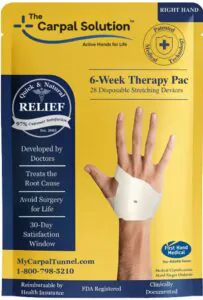
Created by renowned Harvard health care professionals.


Disruptive Innovation in Medicine: 4 Proven Shifts That Make the Carpal Solution a Breakthrough
Disruptive innovation makes medicine simpler, safer and more affordable. In June 2005, the founders of First Hand Medical, Professor Clayton M. Christensen, Dr. Jerome H. Grossman and Jeff Conley, saw carpal tunnel care as primed for disruption. Here is why the Carpal Solution, a natural treatment you use at home while you sleep, fits the four shifts shaping the future of medicine.

Disruptive Innovation in Medicine: The Carpal Solution Story
Written by Jeff Conley, Founder and President of First Hand Medical, with the words of co-founders Professor Clayton M. Christensen and Dr. Jerome H. Grossman, MD · Medically reviewed by Dr. Joseph E. Scherger, MD, MPH, Clinical Professor, UC San Diego School of Medicine · Last reviewed: November 2026
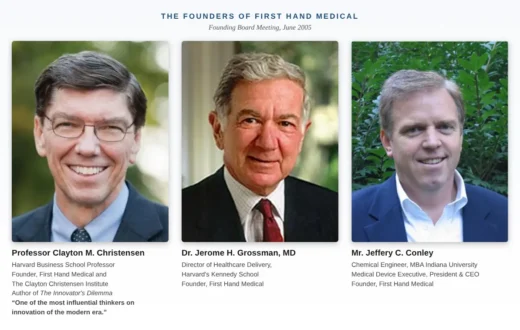
Disruptive innovation is how medicine gets better for patients: a simpler, lower-cost, less invasive way to solve a problem that used to need complex, expensive care. In June 2005, three founders sat down at the first board meeting of First Hand Medical: Professor Clayton M. Christensen of Harvard Business School, the author of the theory of disruption; Dr. Jerome H. Grossman, MD, a leader in healthcare delivery; and Jeff Conley, a chemical engineer and medical device executive.
Their conclusion was direct. The treatment of carpal tunnel syndrome was primed for disruption, and the Carpal Solution was the innovation to do it.
On This Page
- What it is. A disruptive innovation replaces a complex, expensive solution with a simpler, more affordable one that many more people can use.
- Why carpal tunnel. Carpal tunnel surgery has a patient satisfaction rate lower than 69%, and second surgeries fall to 16% to 40%.
- The Carpal Solution. A natural, non-invasive treatment you use at home while you sleep: 97% patient satisfaction over 21 years, 4.9 out of 5 stars, and over 100,000 people helped.
- Four shifts. Complex to simple, hospital to home, expensive to lower cost, invasive to less invasive.
- A win for everyone. Patients, doctors, insurers and the healthcare delivery system all come out ahead.
What Is Disruptive Innovation? Christensen’s Theory of Disruption
Professor Christensen introduced the theory of disruption in The Innovator’s Dilemma (1997). He described disruptive products as typically “cheaper, simpler, smaller, and, frequently, more convenient to use.” That one line explains why a small newcomer can overtake a powerful industry leader.
At the start of most industries, products and services are so expensive and complicated that only people with a lot of money and a lot of skill can use them. Think of the mainframe computer, which needed a room of its own and a team of experts. Disruptive innovation changes that by making the solution simpler and more affordable, so many more people have access to it. The personal computer did exactly that.
Christensen also pointed out something many people miss. A disruptive innovation often uses no new technology at all. It takes proven, well-understood components and delivers them in a simpler, more accessible way. That describes the Carpal Solution well. Gentle passive stretching of soft tissue is a proven principle. The innovation is delivering hundreds of hours of targeted stretching at home, while you sleep, without a clinic visit.
So what is disruptive innovation in medicine? It is moving care that once required a specialist, an operating room and a hospital to simpler tools that patients and primary care doctors can use, often at home. The skill moves out of the operating room and into a well-designed tool.
Disruption in Healthcare: Why Medicine Screams for Change
In The Innovator’s Prescription (2009), Professor Christensen and his co-authors, Dr. Jerome H. Grossman and Dr. Jason Hwang, opened with a line that became famous: “Today’s health-care industry screams for disruption.”
Their argument was simple. Healthcare costs keep rising because so much of medicine is still delivered in high-cost institutions by highly trained specialists. As diagnosis becomes more precise and treatment becomes more rules-based, care can move to lower-cost settings and simpler tools. Christensen argued that health care becomes affordable by making lower-cost venues of care more capable, not by expecting large hospitals to charge less.
Dr. Atul Gawande, the Harvard surgeon and writer, reached a complementary conclusion from inside the operating room. In The Checklist Manifesto (2009) he wrote, “Medicine has become the art of managing extreme complexity.” In his New Yorker essay “The Cost Conundrum,” he showed that McAllen, Texas, one of the most expensive healthcare markets in the country, did not deliver better care than lower-cost El Paso. Spending more did not buy better results.
Disruption in healthcare is overdue in carpal tunnel care. A chronic, recurring condition is routinely sent down a long path of specialists, nerve studies, injections and surgery, and many patients still end up with lingering symptoms. Our doctors believe medicine can do better, and that the better way is simpler.
June 2005: The Founders’ Vision for Disruptive Innovation in Carpal Tunnel Care
First Hand Medical was founded on one idea: carpal tunnel care was ready for a disruptive innovation. Here is what each founder said at the company’s first board meeting and Medical Advisory Board meeting in June 2005.
Dr. Jerome H. Grossman, MD
“No area of medicine is more primed for disruption than the diagnosis and treatment of carpal tunnel syndrome (CTS). The patient satisfaction rate with surgery, steroid injections and splinting is low, with lots of complications, and CTS is a chronic recurring condition caused by entrapped lymph fluid and inflammation. There must be a simpler and better way to jump-start the body’s natural healing to disperse the entrapped inflammation.
The Carpal Solution Treatment Kit appears like it could be the best solution as a disruptive innovation to fix this sector of medicine. We need to make this innovative treatment approach available to patients and providers as soon as possible. I joined the team at First Hand Medical as a founder and agreed to lead its Medical Advisory Board to deliver on this objective.”
Dr. Grossman was Director of the Health Care Delivery Policy Program at Harvard’s Kennedy School. Read more about Dr. Jerome H. Grossman, MD.
Professor Clayton M. Christensen
“Every once in a while, a new, simpler innovation comes along that solves a problem much more elegantly than the big, complex machinery that solved the problem historically. The Carpal Solution Treatment Kit represents that type of simpler solution that is likely to be a powerful disruptive innovation to improve medical treatment of carpal tunnel syndrome and make the lives of patients better.
This type of innovation can also relieve some of the burden imposed on the healthcare delivery system. Eliminating unnecessary surgical procedures can free up limited resources and funding for other sectors of medicine that are screaming for attention. I became a founder and investor in First Hand Medical to make this happen!”
Professor Christensen, founder of the Clayton Christensen Institute, was widely regarded as one of the most influential thinkers on innovation of the modern era. Read more about Professor Clayton M. Christensen.
Mr. Jeffery C. Conley
“The Carpal Solution is a great example of how innovation can disrupt medicine for the better, leveraging the body’s natural healing power. We are eager to bring this simple, but powerful medical innovation to patients and the healthcare delivery system to improve the outcomes for the treatment of carpal tunnel syndrome (CTS). The treatment of CTS is primed for disruption and improvement.
Patients deserve to have access to the Carpal Solution Treatment Kit to manage this chronic recurring condition caused by entrapped inflammation naturally. The body is normally very effective at dispersing inflammation; it just needs some help to jump-start and restore the natural healing processes.
Surgery is the wrong tool to deal with entrapped lymph fluid in the carpal tunnel space. We in the medical community can do better. Simple Medicine is Smart Medicine! We are launching First Hand Medical to make it happen! Let’s do this!”
Jeff Conley is a chemical engineer with an MBA from Indiana University and a career as a medical device executive. Read more about Jeffery C. Conley, and about the Harvard doctors behind the Carpal Solution.
The Future of Medicine: 4 Shifts of Disruptive Innovation
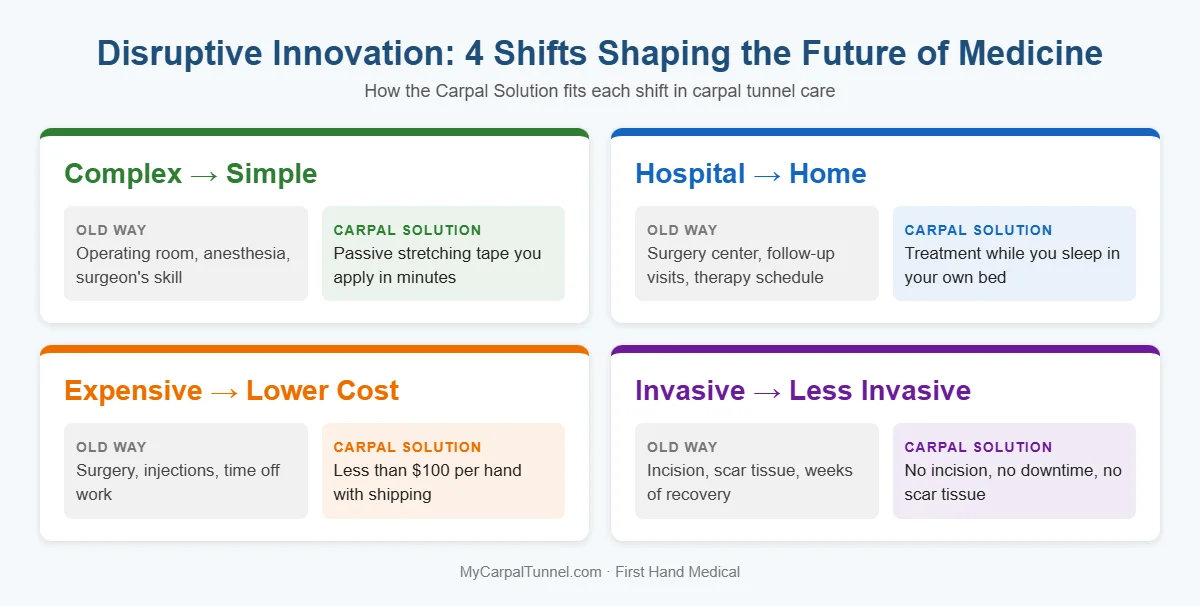
The founders saw four shifts shaping the future of healthcare, and each one matches how the Carpal Solution treats carpal tunnel syndrome.
1. From Complex to Simple
Christensen liked to say that when we simplify the problem, we simplify the solution. He pointed to LASIK eye surgery, where much of the skill moved from the surgeon’s hands into the machine. Dr. Gawande’s book Better tells a similar story about the Apgar score, a simple 0 to 10 rating anyone at the bedside can give a newborn in a minute. That one simple tool changed the practice of obstetrics.
The Carpal Solution simplifies carpal tunnel care by treating the root cause. Swelling and entrapped inflammation in the soft tissue in and around the carpal tunnel squeeze the median nerve and restrict blood flow and lymphatic fluid transport, so the nerve becomes irritated, short of oxygen and compressed.
The Carpal Solution’s targeted passive stretching restores flexibility to the injured soft tissue, relieves pressure on the median nerve, relieves restrictions on blood circulation and lets lymph fluid flow freely to clear out the swelling. It is your body that does the healing; the Carpal Solution just jump-starts the natural healing preempted by excess pressure from inflammation and swelling.
2. From the Hospital to the Home
In The Innovator’s Prescription, Christensen, Grossman and Hwang predicted that devices and diagnostic tools would decentralize medicine, moving care out of hospitals and into clinics and homes. The Carpal Solution is applied at home, at night, while you sleep. Over the six-week protocol, that adds up to more than 220 hours of targeted stretching, far more than any clinic schedule could deliver.
Home care also solves the waiting problem. The average wait for a new-patient appointment with a physician is about 31 days, and specialists often take longer. With a safe treatment at home, there is no reason to wait doing nothing. Read more in The Waiting in Healthcare.
3. From Expensive to Lower Cost
Surgery means surgeon fees, facility fees, anesthesia, follow-up visits and time off work. The Carpal Solution costs less than $100 per hand with shipping, it is billable to insurance under HCPCS code L3924, and you keep working while you treat. Our customers like it and often reorder for maintenance, because carpal tunnel syndrome is chronic and recurring.
4. From Invasive to Less Invasive
The Innovator’s Prescription describes how angioplasty improved to the point that fewer and fewer people needed bypass surgery. Less invasive care steadily took over work that once required the most invasive procedure. The Carpal Solution follows the same path: no incision, no anesthesia, no scar tissue and no downtime. It is conservative-first care that follows medicine’s oldest rule, “first, do no harm.” Learn how treatment options compare in Less Invasive to More Invasive Carpal Tunnel Treatment.
A New Treatment for Carpal Tunnel, by the Numbers
Medical breakthroughs are judged by results. Here is how a new treatment for carpal tunnel compares with surgery, measured by what patients report.
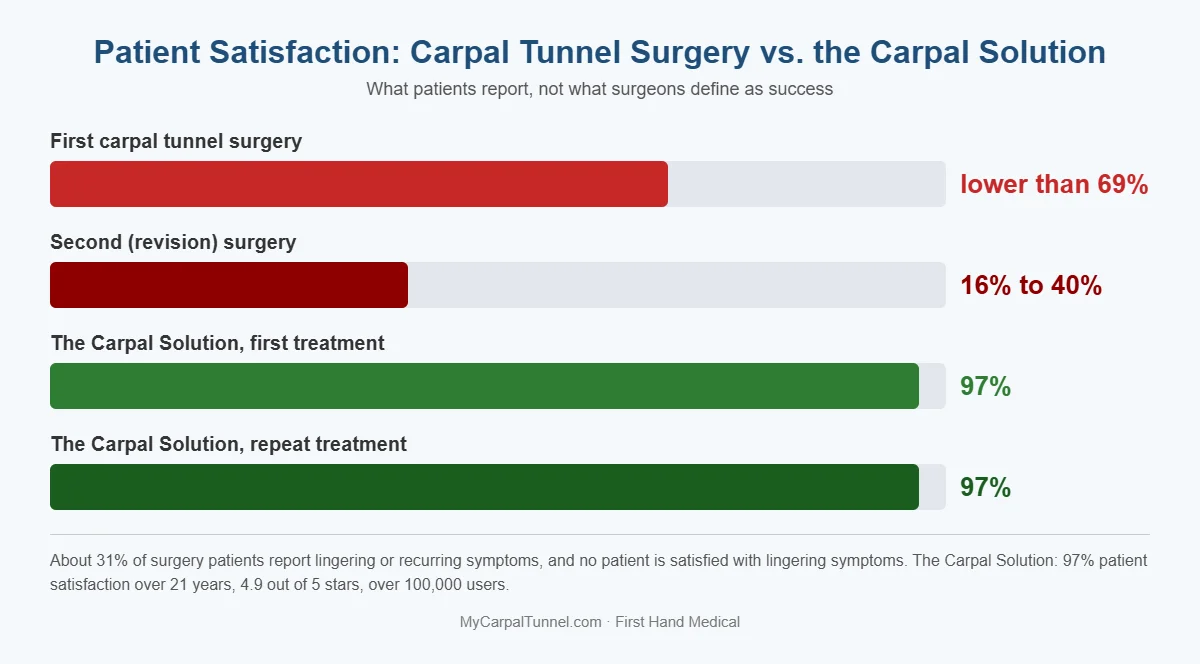
Surgery. Carpal tunnel surgery has a patient satisfaction rate lower than 69%. About 31% of patients report lingering or recurring symptoms, and no patient is satisfied with lingering symptoms. In one large study of 1,268 operations, patient-reported success was 69%, which the authors called a significant failure rate. Even after a successful surgery, symptoms often return: in one study, 57% of patients had at least some symptoms come back within 5.5 years. Read more about recurrence after surgery.
Second surgery. Because carpal tunnel syndrome recurs, many patients face another operation. Second carpal tunnel surgeries have a patient satisfaction rate between 16% and 40%.
The Carpal Solution. 97% patient satisfaction over 21 years, 4.9 out of 5 stars on independent review sites like Google Reviews, and over 100,000 people helped. Most people are better from their worst symptoms in two to three weeks. About 90% of people reach complete remission in 6 weeks; the other 10%, usually people with excess systemic inflammation, are 40% to 70% better at 6 weeks and reach full remission in 10 to 12 weeks.
Repeat treatment. This is where the difference is greatest. When symptoms return, a repeat round of the Carpal Solution keeps the same 97% patient satisfaction. Remission usually lasts 5 to 7 years for most people, though results vary with hand use and each person’s inflammation profile. For a chronic, recurring condition, a treatment that works just as well the second time is the disruptive innovation.
Examples of Disruptive Innovation in Medicine, and Where the Carpal Solution Fits
Not all medical breakthroughs are high-tech. Some of the best examples of disruptive innovation in medicine are simpler, safer ways to do what used to take a hospital:
- Angioplasty. A catheter procedure that reduced the need for open-heart bypass surgery for many patients.
- LASIK. Vision correction where the machine carries much of the skill that once depended on the surgeon.
- The Apgar score. A one-minute newborn rating that any trained person at the bedside can give.
- The Carpal Solution. Targeted passive stretching at home that relieves pressure on the median nerve and helps many people avoid carpal tunnel surgery.
Each one moves care to a simpler tool, a lower-cost setting or a less invasive approach. That is the pattern Christensen described, and it is the pattern the founders saw in 2005.
Win, Win, Win, Win: A Disruptive Innovation That Helps Everyone
The founders called the Carpal Solution a win for every party in healthcare. Here is why:
- Patients get a natural treatment at home with no incision, no downtime and 97% patient satisfaction, and they can start while they wait for appointments.
- Doctors get a conservative-first option to offer before injections or surgery, consistent with “first, do no harm,” and an effective tool for repeat flare-ups.
- Insurers pay far less for a home treatment than for surgery, revision surgery and the follow-up care that lingering symptoms require.
- The healthcare delivery system frees surgeons, operating rooms and specialist appointments for the patients who truly need them.
As Jeff Conley put it in 2005, “Simple Medicine is Smart Medicine.”
Innovation in Medicine Starts With the Patient’s Opinion
Real innovation in medicine starts with listening to patients. In medicine, the patient’s opinion rules. Researchers can call a surgery successful when patients do not agree, and carpal tunnel surgery is unusual in counting partial relief as success. Patients do not see it that way; they expect their symptoms to go away.
That is why this site reports patient satisfaction, not surgical success rates. The future of healthcare belongs to treatments that patients judge as better, safer and easier. For carpal tunnel syndrome, our doctors believe the Carpal Solution is that kind of treatment. If you have lingering symptoms after treatment, see our Persistent Symptoms Protocol.
When Healing Needs a Doctor’s Help and Professional Medical Evaluation
- Constant numbness that does not improve or loss of feeling in the fingertips that does not improve in 4 to 8 weeks.
- Extreme loss of the muscle at the base of the thumb, with loss of grip strength that does not improve over 6 to 8 weeks.
- Worsening symptoms over 6 to 8 weeks while using the best conservative treatments
- Symptoms that begin suddenly after hand or wrist trauma, a fracture or severe sprain from a fall or auto accident.
- Odd Symptoms that are not consistent with the Carpal Tunnel Symptoms listed on this website, that might be indicative of other nerve issues. A nerve conductivity study can clear up the confusion with minimal costs and not too much pain and no risk.
These signs may mean more advanced nerve involvement or a different condition and deserve professional medical evaluation and in person consultation. Home treatment can be used alongside professional in-person medical care while you wait for the healthcare delivery system to fit you into their schedule. There is no reason to wait doing nothing. You can start proven natural conservative treatment with good patient reviews while you wait for your appointments. If your symptoms start improving over 6 to 8 weeks, then you know you are on the right track and surgery is not necessary.
Frequently Asked Questions
What is disruptive innovation?
Disruptive innovation is Professor Clayton M. Christensen’s term for a simpler, more affordable and more convenient product or service that replaces a complex, expensive one and makes it available to many more people.
Is the Carpal Solution a disruptive innovation?
Yes. The founders of First Hand Medical, including Professor Christensen and Dr. Jerome H. Grossman, saw it as one in 2005. It moves carpal tunnel care from complex to simple, hospital to home, expensive to lower cost and invasive to less invasive.
Who founded First Hand Medical?
First Hand Medical was founded by Professor Clayton M. Christensen of Harvard Business School, Dr. Jerome H. Grossman, MD, and Jeffery C. Conley, who held the company’s first board meeting in June 2005.
What are examples of disruptive innovation in medicine?
Angioplasty reduced the need for bypass surgery, LASIK moved surgical skill into a machine, the Apgar score gave every delivery room a one-minute newborn check, and the Carpal Solution treats carpal tunnel syndrome at home without surgery.
Is there a new treatment for carpal tunnel without surgery?
Yes. The Carpal Solution is a natural, non-invasive treatment you use at home while you sleep. It has 97% patient satisfaction over 21 years and 4.9 out of 5 stars, and about 90% of people reach complete remission in 6 weeks.
How does carpal tunnel surgery compare?
Carpal tunnel surgery has a patient satisfaction rate lower than 69%, because about 31% of patients report lingering or recurring symptoms. Second surgeries have a patient satisfaction rate of only 16% to 40%.
Sources
- Christensen CM. The Innovator’s Dilemma: When New Technologies Cause Great Firms to Fail. Harvard Business School Press; 1997.
- Christensen CM, Grossman JH, Hwang J. The Innovator’s Prescription: A Disruptive Solution for Health Care. McGraw-Hill; 2009.
- Christensen CM, Bohmer R, Kenagy J. Will Disruptive Innovations Cure Health Care? Harvard Business Review. 2000.
- Gawande A. The Checklist Manifesto: How to Get Things Right. Metropolitan Books; 2009.
- Gawande A. Better: A Surgeon’s Notes on Performance. Metropolitan Books; 2007.
- Gawande A. The Cost Conundrum. The New Yorker. June 1, 2009.
- Bland JD. Do nerve conduction studies predict the outcome of carpal tunnel decompression? Muscle & Nerve. 2001.
- Louie D, Earp B, Blazar P. Long-term outcomes of carpal tunnel release: a critical review of the literature. Hand. 2012.
- AMN Healthcare. Survey of Physician Appointment Wait Times. 2025.

Developed by First Hand Medical’s Team of Doctors
The Carpal Solution Treatment Kit was developed by our expert team of medical doctors who have worked at and led some of the top medical institutions in the World – Including Harvard Medical, Tufts Medical, UCSD, UF Health, and The Ohio State University. We treat root causes with clinically proven conservative treatments. The results: Quick Natural Relief of All Your Carpal Tunnel Symptoms without complications.

Order Your Six Week Carpal Tunnel Treatment Now
The ONLY treatment for carpal tunnel that comes with a no questions asked 30-Day Satisfaction Window and in-house dedicated pain relief team.