 Created by renowned Harvard health care professionals.


Why Start Treating Carpal Tunnel with the Best Conservative Treatment First

Six reasons the safest effective option belongs at the front of the line, and why conservative treatment for carpal tunnel only works when it is also the best.
Key Takeaways
- Conservative-first care means starting with the least invasive treatment that works and escalating only when needed. It is rooted in medicine’s oldest principle: first, do no harm.
- Because carpal tunnel syndrome (CTS) recurs, the risks of invasive treatments compound every time they are repeated. A first treatment you can safely repeat is worth far more than one you can only use once or twice.
- For mild to moderate CTS there is usually time to try conservative care: many cases stay stable or improve, and permanent nerve damage is uncommon.
- Starting conservatively closes no doors. In a landmark trial, most patients who began with a splint never needed surgery, and those who did still had it.
- Not all conservative treatments are equal. The Carpal Solution, an overnight at-home stretching kit rated 4.9 out of 5 stars on Google, meets every test of a best-in-class first treatment.
What “Conservative First” Really Means
In medicine, “conservative” does not mean timid or second-rate. It means choosing the least invasive treatment that can do the job, giving it a fair trial, and moving to riskier options only if it falls short. Doctors call this the conservative hierarchy of treatment. Applied to conservative treatment for carpal tunnel syndrome, the ladder looks like this:
| Step | Treatment tier | Trade-offs |
|---|---|---|
| 1 | Lifestyle and ergonomic changes | Helpful habits, but rarely enough on their own; true rest is impractical for most people. |
| 2 | Non-invasive therapy aimed at the cause (targeted stretching such as The Carpal Solution, at-home therapy) | Lowest risk, repeatable, works with the body’s own healing. This is the tier to spend the most time in. |
| 3 | Splints and rigid braces | Modest short-term help; prolonged rigid bracing can contribute to stiffness and weakness. A splint holds the wrist in a neutral position, which can reduce pain from movement, but it does not promote healing from carpal tunnel syndrome. It causes muscle atrophy and stiffness, and its tight compression restricts blood circulation and lymphatic fluid exchange, which slows the dispersion of entrapped swelling, the root cause of carpal tunnel syndrome. Our medical team has observed that splints give some relief at first but aggravate symptoms in the long run. Immobilization is great for fractures and sprains, but not for carpal tunnel syndrome. |
| 4 | Steroid injections | Temporary relief that fades; invasive; limited number advised over a lifetime. |
| 5 | Medications (oral steroids, nerve-pain drugs) | Mask symptoms; side effects add up with repeated courses. |
| 6 | Surgery (carpal tunnel release) | Invasive, weeks of recovery, roughly one in three patients report lingering symptoms, and repeat operations fare worse. |
First Hand Medical’s doctors explain each rung in why conservative-first treatment matters. The rest of this article explains why the order matters so much for carpal tunnel, and why the first step should be the best conservative option available, not just any conservative option. To see how the options stack up against each other, read our ranked list of surgery alternatives.
Reason 1: “First, Do No Harm” Is Still the Rule
The Latin phrase primum non nocere, “first, do no harm,” is one of the foundations of medical ethics. Today it is known as non-maleficence, one of the four classic pillars alongside beneficence, autonomy and justice. In practice it means every treatment decision is a risk-benefit calculation, and every decision should ask one question:
Is there a less harmful way to get the same benefit?
For most people with carpal tunnel syndrome, the answer is yes. When non-surgical carpal tunnel treatment can relieve symptoms, accepting the risks of needles, drugs or an incision first makes little sense. Conservative-first is simply that question, answered honestly, in the right order.
Reason 2: Carpal Tunnel Comes Back, So Risks Compound
This is the reason that makes conservative treatment for carpal tunnel especially important. Carpal tunnel syndrome is a chronic, recurring condition. It is driven by a self-reinforcing cycle: pressure in the tunnel impairs blood flow and lymph drainage, fluid and inflammation become trapped, swelling increases, and pressure rises further. Whatever treatment you choose, there is a good chance you will need it again.
That turns every treatment choice, including non-surgical carpal tunnel treatment, into a long-term commitment:
- Steroid injections offer relief that fades, and the 2024 American Academy of Orthopaedic Surgeons (AAOS) guideline found strong evidence that they do not provide long-term improvement. Because of concerns about tissue and tendon changes with repeated exposure, the number of injections into one wrist is usually limited.
- Surgery relieves pressure by cutting the transverse carpal ligament, but it does not stop the swelling cycle from returning. When a second operation is needed, the most common findings are incomplete release of the ligament (54–62% of revision cases) and scar tethering of the nerve (23–35%), according to a review in SICOT-J. Scar tissue builds in the same confined space with each procedure, and outcomes after revision surgery are considerably worse than after the first.
- Medications such as oral steroids carry side effects, from blood sugar changes to bone density loss, that become harder to justify with every repeated course.
A treatment that is safe the first time but riskier the third time is a poor foundation for a condition that recurs. The ideal first treatment is one that is just as safe the tenth time as the first. We covered the compounding problem with repeat surgery in depth in Patients vs Surgeons: carpal tunnel surgery success rates and does carpal tunnel surgery cause scar tissue?
Reason 3: For Most People, There Is Time
Fear drives many people away from conservative treatment for carpal tunnel and toward surgery: the worry that waiting will cause permanent damage. For mild to moderate CTS, the evidence is reassuring. See Mild Carpal Tunnel Treatment: What to Do First.
- In a multicenter study in Neurology (Padua et al., 2001), 196 untreated patients followed for 10 to 15 months showed significant overall improvement in both symptoms and nerve-test measures.
- In a two-year study in Clinical Neurophysiology (Ortiz-Corredor et al., 2008), about 48% of 132 untreated patients improved clinically, 29% stayed stable and 23% worsened. The authors concluded that conservative treatment may be all that many patients need.
- Clinical pathways in the U.S. and U.K. reserve urgent surgical referral for severe signs, such as constant numbness, muscle wasting at the base of the thumb or weakness, and start mild to moderate cases with conservative care.
In other words, most people have the time to make a well-informed decision and to give conservative treatment for carpal tunnel a fair trial. Our article on permanent nerve damage from carpal tunnel explains why mild to moderate CTS should not be treated as an emergency.
Reason 4: Conservative Treatment for Carpal Tunnel Works for Many Patients
Conservative treatment for carpal tunnel is not a delay tactic; for a large share of patients, it is the solution. Two randomized trials show this clearly, even with fairly basic conservative care:
| Study | What patients received | What happened |
|---|---|---|
| Lewis et al., Journal of Physiotherapy, 2020 (105 patients already on a surgical waitlist) | One education session plus a home program of night splinting and nerve and tendon gliding exercises | Only 59% went on to surgery at 24 weeks, versus 80% of those who simply kept waiting. |
| Gerritsen et al., JAMA, 2002 (176 patients randomized to splinting or surgery) | A wrist splint as the first treatment | By 18 months, 59% of the splint group had never needed surgery. |
It is worth being clear about the Gerritsen trial: in a head-to-head comparison, surgery produced better results than splinting alone at 18 months (90% versus 75% reporting improvement). But a majority of the people who started with a simple splint, a treatment the Cochrane review rates as having only limited evidence, still avoided an operation entirely. Learn when carpal tunnel surgery is necessary.
That is the power of starting conservatively, and it raises an obvious question: what happens when the first conservative treatment is a better one? We return to that below.
Reason 5: Starting Conservatively Closes No Doors
Choosing surgery first is a one-way decision: once the ligament is cut and scar tissue forms, you cannot go back. Choosing non-surgical carpal tunnel treatment first keeps every option open.
In the Gerritsen trial, the 41% of splint patients who did not improve enough went on to have surgery during the study. Trying conservative care first did not take that option away. For patients with mild to moderate symptoms, a fair trial of conservative care costs you very little, and it may spare you an operation altogether. If you do eventually need surgery, you will make that decision with better information about how your hand responds to treatment.
Reason 6: Less Cost, Less Downtime, Less Disruption

Invasive treatment carries costs beyond the medical risk: specialist visits, nerve testing, surgical fees, deductibles, time off work, weeks of limited hand use, and help with everyday tasks during recovery. Patients often report pillar pain and scar tenderness at the base of the palm for months afterward. See costs of carpal tunnel surgery and carpal tunnel surgery recovery times.
Non-surgical carpal tunnel treatment done at home, at night, with no downtime keeps you working, driving, caring for family and sleeping through the night while you heal.
Why “Conservative” Isn’t Enough: It Has to Be the Best
Here is the catch. Conservative treatment for carpal tunnel only pays off if the first treatment actually works well enough to change the course of the condition. Many common conservative options fall short:
- Splints position the wrist but do not actively relieve the tissue around the nerve; Cochrane found only limited short-term evidence of benefit.
- Daytime exercises make sense, but few people can stretch for the hours needed each day, and consistency fades.
- NSAIDs and diuretics were no better than placebo in a Cochrane review, and vitamin B6 did not significantly help.
- Rest is unrealistic for most people and can increase stiffness.
When an underpowered non-surgical carpal tunnel treatment fails, patients often conclude that “conservative care doesn’t work” and move straight to injections or surgery. The real lesson is to start with the best conservative treatment for carpal tunnel, so the safest rung of the ladder has the strongest chance of being the last one you need. We compared every common option side by side in What Is the Best Carpal Tunnel Treatment to Start to Avoid Surgery?
The Best Conservative Treatment: The Carpal Solution

The Carpal Solution Treatment Kit was developed by First Hand Medical’s team of physicians, including co-founders Dr. Jerome H. Grossman, MD (former Harvard professor and president of New England Medical Center) and Dr. Joseph E. Scherger, MD, MPH, with musculoskeletal clinician Dr. Clyde E. Morgan, DC, and orthopedic hand surgeon Dr. Michael E. Ruff, MD. It was designed specifically to be the best conservative treatment for carpal tunnel: the strongest possible first rung on the conservative ladder.
| What a best-in-class first treatment needs | How The Carpal Solution delivers |
|---|---|
| Targets the cause | Gentle, targeted passive stretch on three areas around the carpal tunnel aims to restore soft-tissue flexibility, relieve pressure on the median nerve and reopen drainage of trapped fluid and inflammation. |
| Enough treatment to matter | Worn six to eight hours a night; over the six-week protocol, First Hand Medical calculates more than 220 hours of targeted stretching, far beyond any daytime routine. |
| Works when symptoms peak | Applied before bed, it works during sleep, when CTS symptoms are usually worst. |
| No harm | No needles, incisions, drugs or downtime. FDA registered; made in an FDA-registered facility certified to ISO 13485:2016, with Hypoallergenic (No Latex) materials. |
| Safely repeatable for life | If symptoms return, repeat the six-week protocol or use occasional preventive nights. |
| Doesn’t immobilize | Unlike a rigid splint, it allows natural hand movement. |
| Patient approval | Rated 4.9/5 on Google Reviews (69 reviews), 4.8/5 on Facebook (314) and Birdeye (271), and 4.6/5 on Trustpilot (41), as displayed on MyCarpalTunnel.com in November 2026. |
| Accessible | $99.95 for a six-week single-hand kit ($199.90 for both hands), a 30-Day Patient Satisfaction Guarantee, and possible insurance or Medicare reimbursement. |
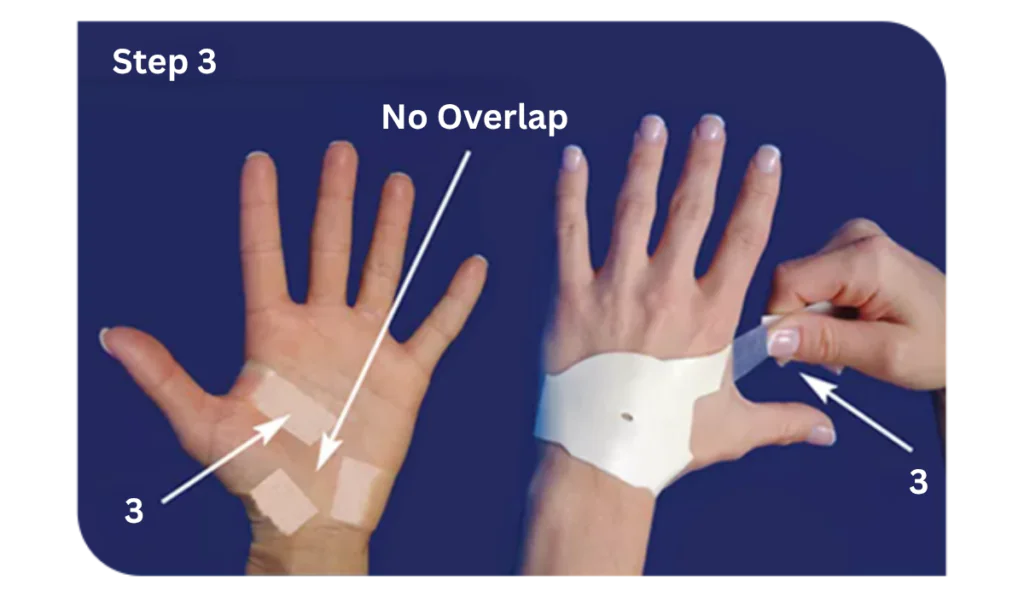
First Hand Medical reports that over 100,000 people have used the Carpal Solution over two decades to jump-start their body’s natural healing, with 97% patient satisfaction and 4.9 out of 5 stars from patients on independent review sites like Google Reviews, relief of the worst symptoms in two to three weeks for most patients, and complete remission in about six weeks.
The approach is also consistent with independent research on elastic therapeutic taping: meta-analyses in 2023 (13 trials) and 2025 (14 trials) found taping improved pain and function in mild to moderate CTS. Learn more in how The Carpal Solution works, the clinical documentation of The Carpal Solution and the Carpal Solution reviews page.
Your Conservative-First Plan
- Confirm what you are dealing with. Try the self test for carpal tunnel and talk with your doctor. The 2024 AAOS guideline supports clinical tools like the CTS-6 questionnaire for diagnosis in place of routine nerve testing.
- Start The Carpal Solution. Apply a stretching device every night for two weeks, then every other night for four weeks.
- Support it. Make ergonomic changes, avoid intense hand overuse and grip-strengthening exercises while healing, and follow the Persistent Symptoms Protocol if symptoms are stubborn.
- Give it a fair trial. First Hand Medical recommends at least three months with The Carpal Solution before moving on to more invasive options.
- Keep it in your toolkit. If symptoms return in the future, repeat the protocol rather than climbing the ladder.
- Escalate only if needed. If the best conservative treatment truly fails, you and your doctor can consider the next rung with confidence that you started in the right place.
Already had surgery? The Carpal Solution can also help with lingering post-surgical symptoms. First Hand Medical recommends waiting at least three months after surgery, so the surgically disturbed tissue can heal, before starting its stretching therapy. See are there symptoms after carpal tunnel surgery?
When Healing Needs a Doctor’s Help and Professional Medical Evaluation
- Constant numbness that does not improve or loss of feeling in the fingertips that does not improve in 4 to 8 weeks.
- Extreme loss of the muscle at the base of the thumb, with loss of grip strength that does not improve over 6 to 8 weeks.
- Worsening symptoms over 6 to 8 weeks while using the best conservative treatments
- Symptoms that begin suddenly after hand or wrist trauma, a fracture or severe sprain from a fall or auto accident.
- Odd Symptoms that are not consistent with the Carpal Tunnel Symptoms listed on this website, that might be indicative of other nerve issues. A nerve conductivity study can clear up the confusion with minimal costs and not too much pain and no risk.
These signs may mean more advanced nerve involvement or a different condition and deserve professional medical evaluation and in person consultation. Home treatment can be used alongside professional in-person medical care while you wait for the healthcare delivery system to fit you into their schedule. There is no reason to wait doing nothing. You can start proven natural conservative treatment with good patient reviews while you wait for your appointments. If your symptoms start improving over 6 to 8 weeks, then you know you are on the right track and surgery is not necessary.
Frequently Asked Questions
What does conservative-first treatment for carpal tunnel mean?
It means starting with the least invasive treatment that can relieve carpal tunnel syndrome, giving it a fair trial, and moving to riskier options such as injections or surgery only if it falls short. It follows the medical principle of first, do no harm.
Is it safe to try conservative treatment before carpal tunnel surgery?
For mild to moderate symptoms, usually yes. Studies of untreated patients show many stay stable or improve, and clinical pathways reserve urgent surgery for severe signs such as constant numbness, thumb muscle wasting or weakness.
Will trying conservative treatment first rule out surgery later?
No. In the Gerritsen trial, patients who did not improve enough with a splint went on to have surgery during the study. Starting conservatively keeps every option open, while surgery cannot be undone. Ready to start? Follow our 8-step plan to fix carpal tunnel without surgery.
What is the best conservative treatment for carpal tunnel?
The best conservative treatment targets the cause, delivers enough treatment to matter, carries no risk of harm and can be repeated safely. The Carpal Solution, an overnight at-home stretching kit rated 4.9 out of 5 stars on Google, is designed to meet all of those tests.
The Bottom Line on Conservative Treatment for Carpal Tunnel
Starting with conservative treatment for carpal tunnel is not settling for less. It is how good medicine works: do no harm, match the treatment to the problem, and keep invasive options in reserve. For carpal tunnel syndrome, a condition that tends to come back, that principle matters even more, because the risks of injections and surgery compound with every repetition while a safe, non-invasive treatment can be used again and again.
But the first step only works if it is a strong one with good customer reviews, a solid track record of customer satisfaction over many years and is backed by a strong medical team. Start with the best conservative treatment, The Carpal Solution: physician-developed, used at home while you sleep, safely repeatable for life, and rated 4.9 out of 5 stars by patients on Google. Give it a fair trial, and you may never need to climb any higher.
Order The Carpal Solution | Call (800) 798-5210
References
- American Academy of Orthopaedic Surgeons. Management of Carpal Tunnel Syndrome Evidence-Based Clinical Practice Guideline. May 18, 2024. aaos.org/cts2cpg
- Gerritsen AAM, de Vet HCW, Scholten RJPM, et al. Splinting vs surgery in the treatment of carpal tunnel syndrome: a randomized controlled trial. JAMA. 2002;288(10):1245–1251.
- Lewis KJ, Coppieters MW, Ross L, Hughes I, Vicenzino B, Schmid AB. Group education, night splinting and home exercises reduce conversion to surgery for carpal tunnel syndrome: a multicentre randomised trial. J Physiother. 2020;66(2):97–104. doi:10.1016/j.jphys.2020.03.007
- Padua L, Padua R, Aprile I, Pasqualetti P, Tonali P. Multiperspective follow-up of untreated carpal tunnel syndrome: a multicenter study. Neurology. 2001;56(11):1459–1466. doi:10.1212/WNL.56.11.1459
- Ortiz-Corredor F, Enríquez F, Díaz-Ruíz J, Calambas N. Natural evolution of carpal tunnel syndrome in untreated patients. Clin Neurophysiol. 2008;119(6):1373–1378.
- Page MJ, Massy-Westropp N, O’Connor D, Pitt V. Splinting for carpal tunnel syndrome. Cochrane Database Syst Rev. 2012;(7):CD010003. doi:10.1002/14651858.CD010003
- O’Connor D, Marshall S, Massy-Westropp N. Non-surgical treatment (other than steroid injection) for carpal tunnel syndrome. Cochrane Database Syst Rev. 2003;(1):CD003219. doi:10.1002/14651858.CD003219
- Role of pronator release in revision carpal tunnel surgery. SICOT-J. 2016. sicot-j.org
- Tomás-Escolar A, et al. Short-term effectiveness of kinesio taping in conservative treatment of carpal tunnel syndrome: a systematic review and meta-analysis. Physiother Res Int. 2023;28(3):e2026. doi:10.1002/pri.2026
- Li Z, Liu X, He S, Wu J, Zhu Z, Lu W. Kinesio taping can relieve symptoms and enhance functions in patients with mild-to-moderate carpal tunnel syndrome: a systematic review and meta-analysis. Physiother Theory Pract. 2025;41(9):1936–1951.
- First Hand Medical. Conservative-First Treatment; How The Carpal Solution Works; Clinical Documentation of The Carpal Solution. MyCarpalTunnel.com
This article is for educational purposes and does not replace personal medical advice. Consult your healthcare provider about your symptoms and treatment options. Results reported by First Hand Medical reflect the company’s clinical experience and patient reports; individual results vary. MyCarpalTunnel.com is the website for The Carpal Solution.


