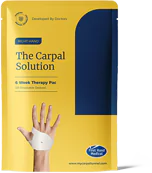
 Created by renowned Harvard health care professionals.



Carpal tunnel and rock climbing make a rough pair: numb fingertips and a fading grip are the last things you want on a wall. Gary, a climber, skier and mountain biker from Golden, Colorado, lost his grip, his sleep and his patience before he found a way back without surgery. Here is his story, what doctors know about carpal tunnel from rock climbing, and how climbers can treat it at home.
Table of Contents
Why Rock Climbing Leads to Carpal Tunnel
There is probably no sport or activity that is more demanding on your hands and wrists than Rock Climbing.
A secure grip is essential. Often the crevices in the rock are small and rough. Clinging to a rock face, supporting nearly all of a person’s weight with fingers clenched covered with chalk to such surfaces seems to defy physics. A fall can mean broken bones or at a minimum scrapes and road rash even when the climber is secured with belays, pitons and cams. Yet passion to climb and reach the pinnacle drives these enthusiasts beyond what most people can comprehend.
A rock climber’s hands and wrists take a beating. They often end an outing with aching fingers and wrists, but the satisfaction that they accomplished their goal, got better at their craft and became more fit.
This type of repetitive stress on the muscles, tendons, ligaments and joints of the hand and wrist often leads to Carpal Tunnel Syndrome. For a climber there is nothing worse than losing grip strength or losing the feeling in the tips of their fingers or hand numbness accompanied by clumsiness in their fingers.
Not surprisingly Rock Climbers experience a high incidence of this dreaded hand / wrist condition. The symptoms usually start with their hands waking them up in the middle of the night – numb and aching as if they had been sleeping on an arm and restricting blood circulation. This is one of the most common early symptoms of CTS.
It can be extremely dangerous for a Rock Climber to develop Carpal Tunnel Syndrome. When passion for climbing meets Carpal Tunnel Symptoms, like Loss of grip strength or loss of feeling in your fingertips – it could lead to a dangerous fall.
Doctors who treat climbers see this too. A 2026 review of climbing injuries in AAOS Now lists carpal tunnel syndrome among the common overuse injuries, more frequent in professional climbers and crack climbers, and names repetitive wrist flexion, swollen finger tendons and enlarged forearm muscles as contributors to median nerve compression.
That fits the anatomy. The muscles that bend your fingers and thumb live in your forearm, and their nine tendons run through the carpal tunnel beside the median nerve. Every crimp, pinch and hang loads those tendons, and when their linings swell, the tunnel gets crowded. That is why so many climbers with carpal tunnel feel a dull forearm ache along with numb fingers, and why rock climbing wrist pain with night numbness deserves a closer look.
Gary’s Story: “It Sneaks Up on You and Then Slams You Hard”
“I am an avid outdoor adventure guy. In the winter I ski, and in the summer I climb and mountain bike. In general, I love pushing my body to its limits. Or, at least I did, until I encountered Carpal Tunnel.
I have known a lot of injuries over the years, but never experienced anything like the symptoms of Carpal Tunnel. Most of my injuries have come from falls or crashes. You know exactly what caused it.
The symptoms of this condition are really strange and took me completely by surprise. It is really frustrating. At first you don’t know what’s happening. It sneaks up on you and then slams you hard.
For instance, my first symptom was when I would wake up at night with numb hands that had a kind of dull achiness. I thought I was sleeping on my arm cutting off circulation. So, I would change positions and try to go back to sleep, but the numbness would not go away. I hate being sleep deprived. My girlfriend says I get grumpy.
Then I started dropping things like coffee cups and tools. I work in a bike shop.
The last straw is I started losing my grip on simple training sessions while rock climbing. I could not figure out what was happening to me. I am too young and fit to lose grip strength.
I was afraid it was the first sign of some kind of weird disease that attacks the central nervous system.
Someone suggested that it might be Carpal Tunnel.
I jumped on the internet and looked up Carpal Tunnel Symptoms and found this great website written by Doctors called: MyCarpalTunnel.com.
The mystery was over. When I read the symptoms, I knew I had Carpal Tunnel. My symptoms were detailed as if someone were logging what was happening to me. I was relieved to know it was not something more serious.
I went to the Doctor, and he confirmed the diagnosis, and recommended wrist splints and a nerve test to determine how bad it was. It said I would probably have to have surgery. He also recommended taking a break from Rock Climbing and Mountain Biking. Both are hard on your CTS. Well, I didn’t care much for that advice.

The wrist splint helped a little at first, but then the dull ache in my forearm started getting worse and my overall symptoms took a turn for the worse.
I went back to the website MyCarpalTunnel.com and read more.
It turns out, that these Doctors have developed a simple stretching treatment that you wear at night. It is backed by a 30-Day Patient Satisfaction Guarantee and is reimbursed by health insurance. It is backed-up by clinical studies and claims 97% patient satisfaction and cost about $100 per hand for the treatment.
I also read more about surgery. Carpal Tunnel Surgery only gets a patient satisfaction rate lower than 69% (about 31% of patients report lingering or recurring symptoms after surgery, and no patient is satisfied with lingering symptoms) and comes back for up to 57% of people. Surgeons rarely follow patients long enough to know how often this happens; most studies stop at two years, and the longest published follow-up found that 57% of patients had at least some symptoms return within five and a half years, usually about two years after surgery (Nancollas et al., 1995).
“Are you kidding me?” I thought, there is no way I am going to risk a surgery with those kind of numbers.
Trying the Carpal Solution Treatment was a “no-brainer”. I ordered it online and got started within 3 days.
In the first week using the Carpal Solution, my sleep improved. After two weeks I was not dropping stuff. After three weeks, I decided to try my hands at rock climbing again. My grip was clearly stronger, but I did not want to overdo it. So, I did a couple of light sessions at the Climbing Gym on a tight belay tension to minimize the stress on my hands. I would rest a day in between each session for recovery time.
Each session my hands felt stronger. I was elated. The Carpal Solution Treatment was working and I was so excited to get back to full activity.
On the fifth week I started doing full work-outs at the climbing gym like normal. No problems! On the weekend I over did it and could feel it that evening. I eagerly put on the Carpal Solution that night early evening and slept through the night. The next day my hands and arms had some normal muscle soreness, but not the dull achiness associated with nerve pain.
In the Six Week Treatment, my grip strength is back to normal. I can climb like I never had Carpal Tunnel. I am so stoked!
I am “cured” of Carpal Tunnel without surgery. Yo!!!!
So, I write this to the skeptics who are unsure what action to take to treat Carpal Tunnel Syndrome. The Carpal Solution is the real deal. Get it!”
Gary
Rock Climber – Golden, Colorado
Watch: A Professional Climber Treats Carpal Tunnel on Expedition
Gary is not the only climber who has relied on the Carpal Solution. In this video from our YouTube channel, professional rock climber and mountaineer Yonca Duyan Preuss explains how she treated carpal tunnel from rock climbing with the Carpal Solution while she slept, during a climbing expedition in Spain, and avoided carpal tunnel surgery.
What Gary’s Story Shows: Forearm Ache and Splints
Gary’s doctor recommended wrist splints. He says they helped a little at first, then the dull ache in his forearm got worse and his symptoms took a turn for the worse. That matches what our medical team has observed for two decades: splints give some relief in the beginning but, in the long run, aggravate carpal tunnel symptoms.
A splint holds the wrist in a neutral position, which can reduce pain from movement, but it does not promote healing from carpal tunnel syndrome.
Immobilizing any limb leads to muscle atrophy over time (about 8% of muscle size and 23% of strength lost after 14 days in a cast; Wall and colleagues, Acta Physiologica, 2014), and a climber cannot afford to lose forearm strength. Forearm pain from climbing that gets worse in a splint is a sign the splint is not helping. A tight splint also compresses the hand, wrist and forearm, restricting blood circulation and lymphatic fluid exchange, which slows the dispersion of swelling. Pillows that keep your wrists neutral at night are a gentler way to protect your sleep posture. Read more about muscle atrophy and carpal tunnel and why you keep dropping things.
How Climbers Treat Carpal Tunnel at Night
 Swelling and entrapped inflammation in the soft tissue in and around the carpal tunnel squeeze the median nerve and restrict blood flow and lymphatic fluid transport, so the nerve becomes irritated, short of oxygen and compressed. The Carpal Solution’s targeted passive stretching, worn while you sleep, restores flexibility to the injured soft tissue, relieves pressure on the median nerve, relieves restrictions on blood circulation and lets lymph fluid flow freely to clear out the swelling. It is your body that does the healing; the Carpal Solution just jump-starts the natural healing preempted by excess pressure from inflammation and swelling.
The six-week protocol gives over 220 hours of targeted stretching without taking a single day off the wall. Most people are better from their worst symptoms in two to three weeks, and over 90% resolve in six weeks; about 10%, with excess systemic inflammation, need 8 to 12 weeks and are usually 50 to 70% better at six weeks.
Gary’s timeline followed that pattern: better sleep in the first week, no more dropped tools by week two, light sessions on a tight belay in week three, full workouts by week five and normal grip strength by the end of six weeks. Over 100,000 people have used the Carpal Solution over two decades, with 97% patient satisfaction over 21 years and 4.9 out of 5 stars on independent review sites like Google Reviews.
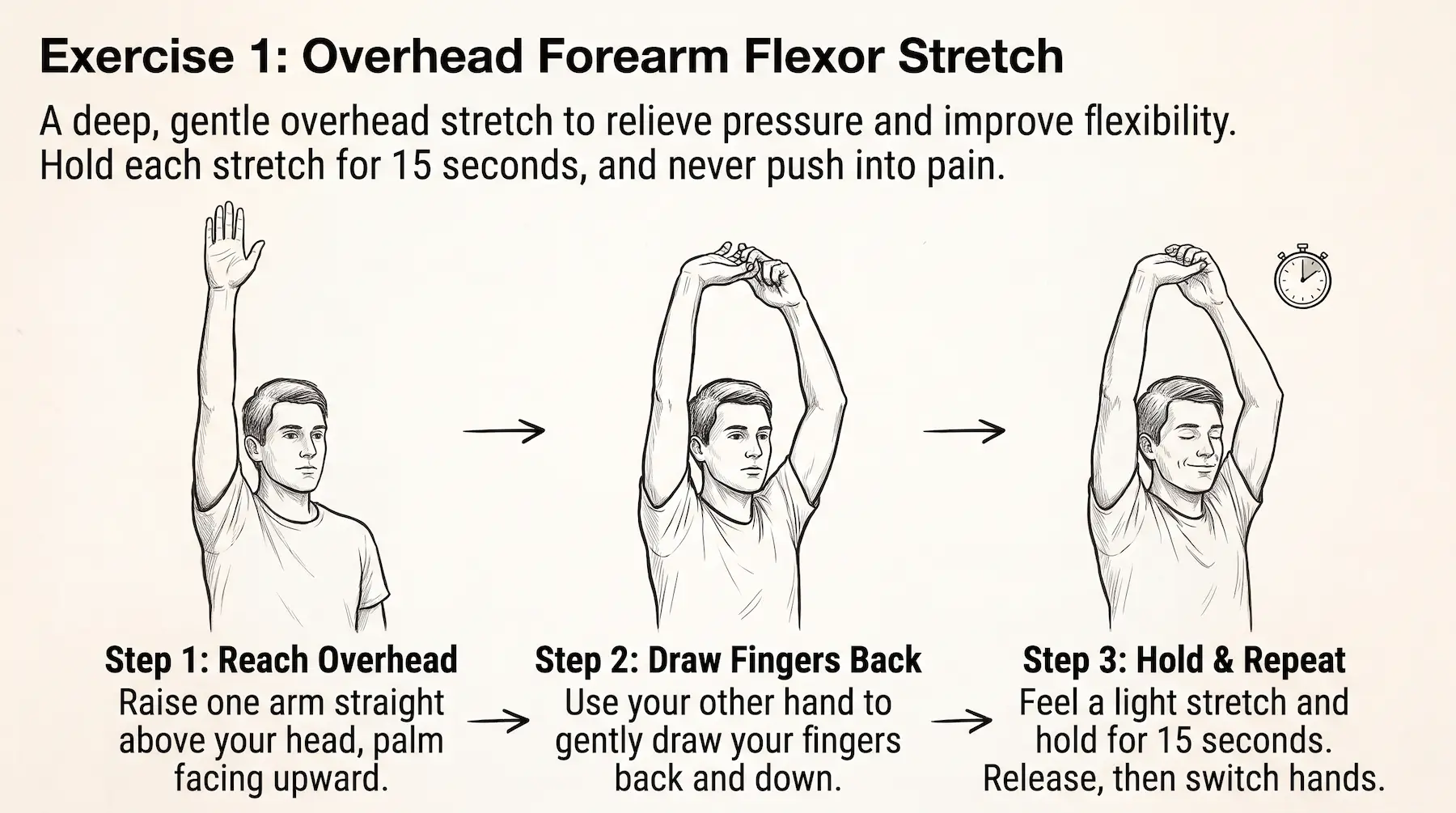 A few tips for climbers while you heal. Ease back the way Gary did, with lighter sessions and rest days between them. Hold off on grip trainers, putty and heavy hangboard sessions until symptoms settle; grip comes back with normal hand use once the pressure is off the nerve. Gentle daytime stretches, like the forearm flexor stretch, are a bonus if they fit your day (up to 6 sets of 10, holding each for 15 seconds with 30 seconds of rest). The Carpal Solution is thin, flexible and Hypoallergenic (No Latex), so it packs easily for road trips and climbing weekends.
Mountain Biking and Carpal Tunnel: Easing Handlebar Pressure
Gary also mountain bikes, and the handlebars add their own pressure. In a study of riders on a six-day, 420-mile bike tour, carpal tunnel symptoms and nerve tests got worse in 3 hands, with carpal tunnel beginning in 1 hand after the ride (Akuthota and colleagues, American Journal of Sports Medicine, 2005). The American Society for Surgery of the Hand notes that riding in the drops bends the wrist back further, which raises pressure in the carpal tunnel.
Padded gloves, changing hand positions often and keeping your wrists level with the bars all help, and a night with the Carpal Solution after a long ride helps clear the swelling. Riders of other kinds can read the motorcycle rider’s carpal tunnel review, and skiers can read our skier’s story.
Staying in Remission as a Climber
 Carpal tunnel syndrome is a chronic, recurring condition. Remission after the Carpal Solution usually lasts 5 to 7 years for most people, but everyone is different based on hand use and their personal systemic inflammation profile; people have gone as long as 17 years and as little as 1 year between treatments. The harder you use your hands, the sooner it tends to come back, and few people use their hands harder than climbers. Prevention nights range from once a week to once every six months, and after a big weekend, a night with the Carpal Solution is a smart habit; Gary did exactly that and slept through the night.
Surgery, Downtime and the Waiting
Gary’s doctor said he would probably need surgery. A 2026 AAOS Now review says climbers who have carpal tunnel release can often return to climbing within six to eight weeks. Downtime is only part of the story. Carpal tunnel surgery has a patient satisfaction rate lower than 69%, because about 31% of patients report lingering or recurring symptoms, and no patient is satisfied with lingering symptoms (Bland, Muscle & Nerve, 2001).
Even after a successful surgery, symptoms often return: 57% had at least some symptoms come back within 5.5 years in one study (Nancollas, 1995, reviewed by Louie, Earp and Blazar, HAND, 2012). Our doctors estimate 80 to 90% within 10 years from two decades of clinical experience; that has not been statistically researched and is their best estimate until long-term studies are done. Second surgeries have a patient satisfaction rate between 16% and 40%. See recurrence after carpal tunnel surgery and carpal tunnel surgery myths.
There is also the waiting. The average wait for a new-patient physician appointment is 31 days (AMN Healthcare, 2025), and specialists, nerve tests and surgery schedules add more. You do not have to sit out the season doing nothing; you can start safe, natural treatment at home while you wait for your appointments. Read more about waiting for carpal tunnel treatment.
Carpal Tunnel From Rock Climbing: Frequently Asked Questions
Can climbing cause carpal tunnel?
It can contribute. Repeated wrist flexion, hard gripping and swollen finger tendons crowd the carpal tunnel, and doctors report carpal tunnel more often in professional and crack climbers.
Is it carpal tunnel or a climbing injury?
Climbers also get pulley injuries and other hand strains, which usually hurt at a specific spot after a hard move. Carpal tunnel brings numbness, tingling and weakness in the thumb, index, middle and part of the ring finger, often waking you at night. Our doctors’ experience over two decades is that people with three or more of the carpal tunnel symptoms listed on this site can be about 95% confident they have carpal tunnel (clinical experience, not a published statistic). Still get an in-person evaluation and formal diagnosis, and start natural treatment while you wait. See a doctor promptly for constant numbness, weakness or thinning of the thumb muscles.
Do I have to stop climbing?
Gary’s doctor suggested a break. Gary kept climbing lightly, on a tight belay with rest days, while he treated his hands at night, and built back up as his grip returned. Ask your doctor what fits your symptoms, and back off if numbness or weakness gets worse.
How long until I can climb hard again?
Most people are better from their worst symptoms in two to three weeks, and over 90% resolve in six weeks. Gary was back to full workouts in week five.
Does mountain biking make carpal tunnel worse?
Long rides with weight on the hands can. Use padded gloves, change hand positions and keep your wrists level with the bars.
Sources
- AAOS Now. Clinical review of climbing injuries (member access). March 2026.
- Akuthota V, et al. The effect of long-distance bicycling on ulnar and median nerves: an electrophysiologic evaluation of cyclist palsy. American Journal of Sports Medicine. 2005;33(8).
- American Society for Surgery of the Hand. Cyclist’s palsy.
- Wall BT, et al. Acta Physiologica. 2014: muscle size and strength loss after cast immobilization (doi:10.1111/apha.12190).
- Bland JD. Muscle & Nerve. 2001: patient-reported outcomes of 1,268 carpal tunnel operations (PubMed 11410921).
- Louie D, Earp B, Blazar P. Long-term outcomes of carpal tunnel release: a critical review of the literature. HAND. 2012.
- AMN Healthcare. The growing challenges with physician appointment wait times. 2025.
- NINDS carpal tunnel syndrome fact sheet.
There is hope for you. You do not need to undergo surgery.
Neurologists are experts on the central nervous system.
Neurologists, including Dr. James S. Zu, MD, PhD, of Edison, New Jersey, call the Carpal Solution a better first line of defense for Carpal Tunnel Syndrome, and many patients call it a Carpal Tunnel “Cure”.
The Carpal Solution has been used by over 100,000 people in over 30 countries, with 97% patient satisfaction over 21 years and 4.9 out of 5 stars on independent review sites like Google Reviews.
The Carpal Solution has 97% patient satisfaction over 21 years among people with Carpal Tunnel Symptoms. It will likely work for you too.
It is the only treatment for Carpal Tunnel that comes with a 30-Day Patient Satisfaction Guarantee and many people are reimbursed 70 to 80% by health insurance.
Not only are there no risks of complications with the Carpal Solution Therapy, as you find with carpal tunnel surgery, but First Hand Medical has also eliminated any financial risk of trying the Carpal Solution.
Learn more about health insurance reimbursement for The Carpal Solution
When Healing Needs a Doctor’s Help and Professional Medical Evaluation
- Constant numbness that does not improve or loss of feeling in the fingertips that does not improve in 4 to 8 weeks.
- Extreme loss of the muscle at the base of the thumb, with loss of grip strength that does not improve over 6 to 8 weeks.
- Worsening symptoms over 6 to 8 weeks while using the best conservative treatments
- Symptoms that begin suddenly after hand or wrist trauma, a fracture or severe sprain from a fall or auto accident.
- Odd Symptoms that are not consistent with the Carpal Tunnel Symptoms listed on this website, that might be indicative of other nerve issues. A nerve conductivity study can clear up the confusion with minimal costs and not too much pain and no risk.
These signs may mean more advanced nerve involvement or a different condition and deserve professional medical evaluation and in person consultation. Home treatment can be used alongside professional in-person medical care while you wait for the healthcare delivery system to fit you into their schedule. There is no reason to wait doing nothing. You can start proven natural conservative treatment with good patient reviews while you wait for your appointments. If your symptoms start improving over 6 to 8 weeks, then you know you are on the right track and surgery is not necessary.

About the word “cure”: Many patients tell us the Carpal Solution “cured” their carpal tunnel, and “carpal tunnel cure” is one of the most searched phrases in this field. Our position is that carpal tunnel syndrome is a chronic, recurring condition that cannot be “cured”. The Carpal Solution is the next best thing: it lets you control symptoms conveniently at home, without downtime, surgical risks, scar tissue or complications. That is what patients are looking for when they search for a “carpal tunnel cure” or carpal tunnel relief without surgery, and it is why more than 100,000 people have used it over two decades, with 97% patient satisfaction and 4.9 out of 5 stars in independent reviews on sites like Google Reviews. Read more in Carpal Tunnel “Cure”: The Honest Truth and a Plan for Life.