 Created by renowned Harvard health care professionals.


Health Insurers Should Care the Most About Carpal Tunnel Treatment: $2 Billion a Year, and Little Value
Health insurers pay over $2 billion a year for carpal tunnel surgery, yet patient satisfaction is lower than 69% and symptoms often return. Our doctors show what insurers pay, what they get, and how step therapy and conservative-first care deliver high value care at a fraction of the cost.

Health Insurers Should Care the Most About Carpal Tunnel Treatment
Written by Jeff Conley, President, First Hand Medical · Medically reviewed by Dr. Joseph E. Scherger, MD, MPH, family physician, clinical professor, UC San Diego School of Medicine · Last reviewed: November 2026
Health insurers pay most of the bill for carpal tunnel treatment, so they should care the most about how well it works, and it is one of the clearest opportunities for cost containment in healthcare. More than 500,000 carpal tunnel releases are performed in the United States each year, costing over $2 billion. For that money, health insurers buy an operation with a patient satisfaction rate lower than 69%, symptoms that often come back, and second surgeries that satisfy even fewer patients.
This article lays out what health insurers pay, what they get, and how the tools they already use, from prior authorization to step therapy, could turn carpal tunnel care into high value care: conservative first, at a fraction of the cost.
On This Page
Key points
- Over $2 billion a year goes to carpal tunnel surgery in the U.S., and surgery first is the costliest strategy at $2,149 to $9,927 per patient.
- Patient satisfaction with the surgery is lower than 69%, and in the best-known long-term study only 46% of all patients were confirmed satisfied 13 years later.
- Carpal tunnel cases keep people off work a median of 28 days, among the longest of any workplace condition.
- The Carpal Solution costs less than $100 per hand, carries 97% patient satisfaction over 21 years and is worn at night with no time off work.
- Requiring a 12-week trial of high-satisfaction conservative care before surgery is the simplest cost containment step available.
- Under conservative assumptions, conservative-first care pays for itself if it avoids 1 in 16 surgeries, and is worth several billion dollars to more than $10 billion to health insurers over 10 years.
What Our Founders Saw: Dr. Grossman and Professor Christensen on Carpal Tunnel
Health insurers are not the first to see this. In June 2005, the founders of First Hand Medical, Professor Clayton M. Christensen of Harvard Business School, the author of the theory of disruptive innovation, and Dr. Jerome H. Grossman, MD, a national leader in health care delivery, described carpal tunnel care in words that read like a message to every health plan:
“No area of medicine is more primed for disruption than the diagnosis and treatment of carpal tunnel syndrome (CTS). The patient satisfaction rate with surgery, steroid injections and splinting is low, with lots of complications, and CTS is a chronic recurring condition caused by entrapped lymph fluid and inflammation. There must be a simpler and better way to jump-start the body’s natural healing to disperse the entrapped inflammation.”
— Dr. Jerome H. Grossman, MD, former CEO of New England Medical Center and Director of the Health Care Delivery Policy Program at Harvard’s Kennedy School
“Every once in a while, a new, simpler innovation comes along that solves a problem much more elegantly than the big, complex machinery that solved the problem historically… This type of innovation can also relieve some of the burden imposed on the healthcare delivery system. Eliminating unnecessary surgical procedures can free up limited resources and funding for other sectors of medicine that are screaming for attention.”
— Professor Clayton M. Christensen, Harvard Business School
Professor Christensen named exactly what health insurers stand to gain: eliminating unnecessary surgical procedures frees up limited resources and funding. Dr. Grossman named why it matters: low patient satisfaction, frequent complications and a chronic, recurring condition. Years earlier, he told an Institute of Medicine conference that “investment in quality is the lowest cost way of achieving improved health status outcomes.” For carpal tunnel, quality and lower cost point the same way.
In their book The Innovator’s Prescription, Christensen, Grossman and Dr. Jason Hwang wrote that today’s health-care industry “screams for disruption.” Read the full story in disruptive innovation in medicine and carpal tunnel syndrome: ripe for disruptive innovation.
What Health Insurers Pay for Carpal Tunnel
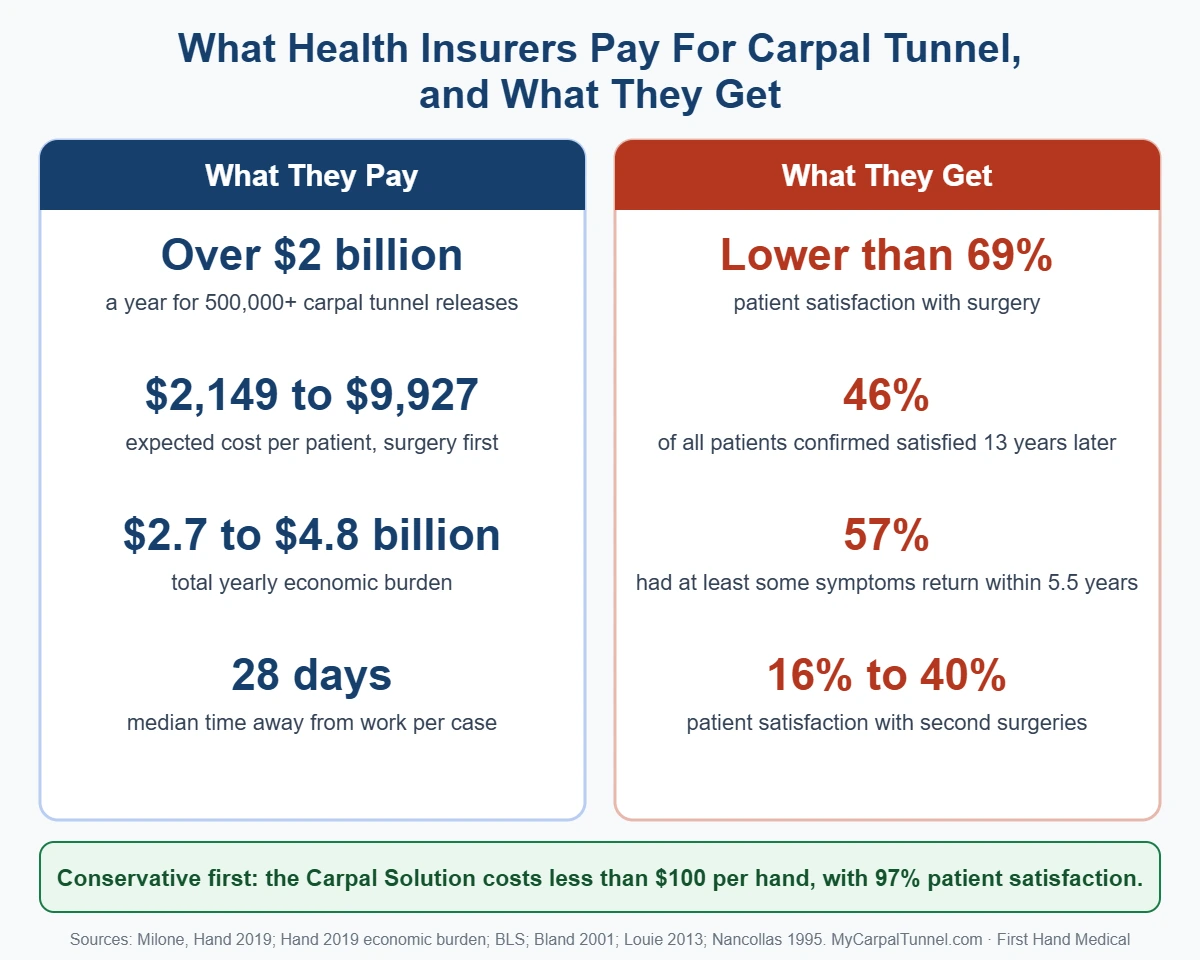
- Surgery: more than 500,000 carpal tunnel releases a year, costing over $2 billion, according to a cost analysis published in the journal Hand.
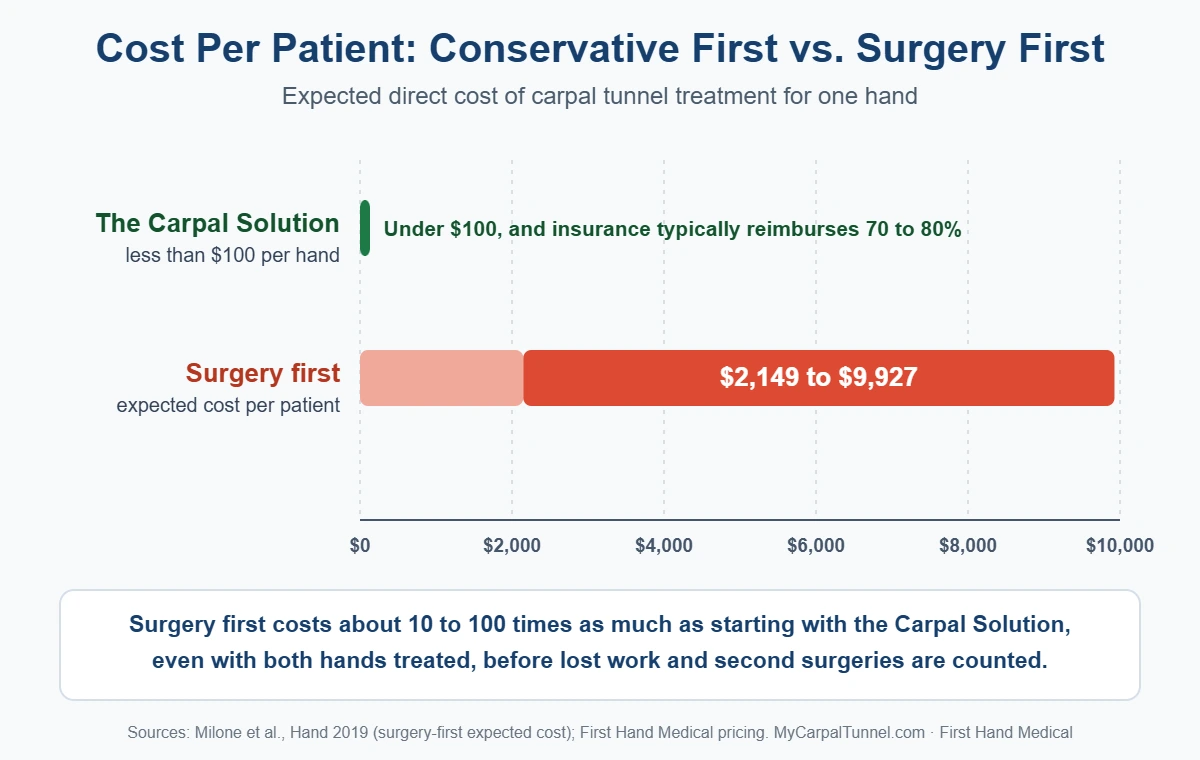
- Per patient: the same analysis found that going straight to surgery is the costliest strategy, with an expected cost of $2,149 to $9,927 per patient. Medicare alone pays roughly $1,300 to $1,650 per release.
- The whole burden: counting disability as well as treatment, a separate economic analysis put the total burden of carpal tunnel syndrome at $2.7 to $4.8 billion a year.
- Lost work: the U.S. Bureau of Labor Statistics has found that carpal tunnel cases keep workers away from their jobs a median of 28 days, among the longest of any workplace injury or illness.
- Everything around it: office visits, nerve studies, steroid injections, splints, therapy, follow-up visits and, when symptoms return, a second round of all of it.
What Health Insurers Get for the Money
- Patient satisfaction lower than 69%: about 31% of patients report lingering or recurring symptoms, and no patient is satisfied with lingering symptoms.
- 46% of all patients, not 88%: in the best-known long-term study, only 97 of 211 patients were confirmed completely or very satisfied 13 years later. See continuity of care for every number in that study.
- Symptoms come back: in one study, 57% had at least some symptoms return within 5.5 years.
- Second surgeries: patient satisfaction between 16% and 40%.
- Steroid injections: temporary relief for most, real risks, and research linking injections before surgery to worse long-term surgical results.
That is not what anyone would choose to buy at full price. It is what the system buys by default.
Low Value Care at a High Price
Health policy experts use the term low value care for services whose cost or risk is high compared with the benefit patients actually get. By the numbers above, surgery first for carpal tunnel fits that description. A treatment that leaves roughly a third of patients with lingering or recurring symptoms, and often has to be repeated, is low value care no matter how routine it has become.
Even the surgeons’ own cost analysis found that immediate surgery was the most expensive way to treat carpal tunnel. It recommended trying steroid injections first to save money. Our doctors agree with the principle of trying something less invasive first, but they would not stop at injections, which give only temporary relief. A conservative treatment that addresses the root cause should come first.
Why Is Health Insurance So Expensive? Paying Twice for the Same Hands
Many things drive health insurance premiums, from hospital prices to new drugs. But one quiet driver is paying again and again for the same problem. When a carpal tunnel surgery leaves lingering symptoms, the patient returns for visits, nerve studies, injections, therapy and sometimes a second operation. The insurer pays each time, and those costs flow into the premiums employers and families pay the next year.
Ask why health insurance is so expensive, and part of the answer is that the system rarely asks whether the first treatment worked years later. Carpal tunnel is a clear example of where better value is sitting in plain sight.
Self-Funded Health Plans and Employer Health Care Costs
Two-thirds of covered workers in the United States, and 80% at larger firms, are in self funded health plans, according to KFF’s 2025 Employer Health Benefits Survey. In these plans the employer, not an insurance company, pays the claims. For them, carpal tunnel is a double cost: the medical bills, plus a median of 28 days away from work per case and weeks of reduced hand use after surgery.
Employer health care costs fall when employees get better without losing work time. A treatment worn at night, while the patient sleeps, lets people keep working through recovery. That is why self-funded employers and their benefits advisors should look closely at a conservative-first rule for carpal tunnel.
Prior Authorization, Step Therapy and Utilization Review: Tools Insurers Already Have
Health insurers already use utilization management to make sure care is appropriate before they pay for it. Utilization review teams apply the medical necessity criteria written into each plan’s medical policy for carpal tunnel release, and those criteria are the natural place to require conservative care first. Two of its tools fit carpal tunnel perfectly:
- Step therapy: patients start with a safer, lower-cost treatment and move to the next step only if it does not work. For carpal tunnel, step one should be a well-reviewed conservative treatment for at least 12 weeks.
- Prior authorization: before approving carpal tunnel release, require documentation that a high-satisfaction conservative treatment was tried and did not work, except when there are urgent signs such as constant numbness or thumb muscle loss.
This is not about denying care. It is conservative-first care that follows medicine’s “Do No Harm” principle, applied through the payment system. Patients who need surgery still get it; patients who don’t are spared the risks, the time off work and the cost.
Why Don’t Health Insurers Require the Carpal Solution First?
It begs the question: if the math is this compelling, why don’t health insurers require every patient to try the Carpal Solution for at least three months before scheduling surgery?
They Already Require Conservative Care, Just the Wrong Kind
Many health insurers already require conservative care before they approve carpal tunnel release. The trouble is what they count as conservative care. One plan’s medical policy, for example, accepts oral medications, a steroid injection or splinting; another asks for a splint for six weeks; some U.K. health systems ask for an injection or night splinting for 8 to 12 weeks. Those are the very treatments our doctors say give temporary relief at best: splints rest the wrist but do not heal the soft tissue, and steroid injections wear off. A rule that requires a low-value treatment before surgery mostly delays the surgery. A rule that requires a high-satisfaction treatment that addresses the root cause can replace it.
Why the Carpal Solution Is Not on the List Yet
- Policies follow guidelines: insurers’ medical policies are written from specialty-society guidelines and published trials, which name categories such as splinting and injections, not newer conservative options.
- Insurers rarely name a brand: policies describe a type of treatment. Targeted passive stretching, billed under HCPCS L3924, has not yet been written into most carpal tunnel policies as its own category.
- Members change plans: people often switch insurers every few years, so the insurer that pays for prevention may not be the one that saves on the surgery avoided. That weakens the incentive to invest in conservative care.
- Habit and friction: surgery is the familiar path, prior authorization draws pushback from providers and patients, and a $200 device is too small a line item to get attention in a medical-policy review.
- No one measures the long run: without long-term outcome data, the cost of recurrence and repeat care stays invisible.
What It Would Take
- Add targeted passive stretching (HCPCS L3924) to the medical necessity criteria for carpal tunnel release, as a conservative treatment that satisfies the medical policy.
- Pay 100% of the Carpal Solution for the three-month trial, so cost never stands between a patient and the highest-value first step.
- Lengthen the required trial to 12 weeks, the window our doctors recommend, with exceptions for urgent signs.
- Start with a pilot: a self-funded employer or a single health plan offering the Carpal Solution first and tracking surgeries, claims and work days for a year.
- Measure satisfaction and total cost at 1, 5 and 10 years, so the savings show up where decisions are made.
The Payback: Pay for It in Full and Still Come Out Far Ahead
Suppose an insurer pays the entire cost of the Carpal Solution, both hands, for every surgical candidate: about $200 a patient, or $20,000 for every 100 patients. If half of those patients avoid surgery at about $4,000 each, the insurer saves about $200,000, or about $160,000 after allowing for 1 in 5 of them to have surgery later anyway. That is roughly $8 to $10 back for every $1 spent. And because the trial lasts three months and surgery is usually scheduled within months, the payback comes within the same year. Few investments a health plan can make pay back that fast.
None of these steps denies anyone surgery. They simply put the highest-value treatment first, which is what both good medicine and good business call for.
High Value Care: What Conservative First Looks Like
High value care delivers better results for the money. Swelling and entrapped inflammation in the soft tissue in and around the carpal tunnel squeeze the median nerve and restrict blood flow and lymphatic fluid transport. The Carpal Solution’s targeted passive stretching restores flexibility to the injured soft tissue, relieves pressure on the median nerve, relieves restrictions on blood circulation and lets lymph fluid flow freely to clear out the swelling. It is the body that does the healing; the Carpal Solution just jump-starts it.
- Cost: less than $100 per hand with shipping; health insurance typically reimburses 70 to 80% under HCPCS code L3924.
- Results: most people are better from their worst symptoms in two to three weeks, and about 90% reach complete remission in six weeks.
- Satisfaction: 97% patient satisfaction over 21 years, 4.9 out of 5 stars on independent review sites, over 100,000 users.
- No lost work: worn at night while the patient sleeps; no downtime, no scar tissue, no anesthesia.
- For life: carpal tunnel is chronic and recurring, so patients keep it in remission at home with occasional preventive nights.
Learn more about health insurance reimbursement for the Carpal Solution.
Cost Containment in Healthcare: A Rigorous Financial Analysis From Six Perspectives
Cost containment in healthcare usually means hard trade-offs. Here it does not. We modeled a conservative-first rule for carpal tunnel from six perspectives, using assumptions chosen to understate the savings rather than overstate them.
Conservative Assumptions
- 450,000 surgical candidates a year, below the published figure of more than 500,000.
- Everyone tries the Carpal Solution first, both hands, at full price ($200 per patient), with the payer covering all of it, even though insurers typically reimburse 70 to 80%.
- Patients who still need surgery get it, so the Carpal Solution cost for them is counted with no offsetting savings.
- 20% of avoided surgeries happen anyway three years later, a deliberate haircut.
- Every patient who avoids surgery buys another kit every three years, more often than the 5 to 7 years of remission most people see.
- Only the operation itself is counted: no savings for injections, nerve studies, therapy, second surgeries or complications.
- Three surgery costs: $1,500 (about what Medicare pays per release), $4,000 (the $2 billion national total divided by 500,000 operations) and $6,000 (within the published $2,149 to $9,927 expected cost per patient).
- Ten yearly groups of patients, with nothing counted after year 10, discounted at 3%, 8% and 10%.
1. All U.S. Health Insurers Combined
The full net present value tables, at three surgery costs and three discount rates, are in the next section. In the base case, at $4,000 per surgery and half of surgeries avoided, the 10-year value is about $4.6 billion at an 8% discount rate.
2. Break-Even: How Few Surgeries Must Be Avoided
| Surgery cost | Break-even share of surgeries avoided |
|---|---|
| $1,300 (Medicare open release) | 19% |
| $1,500 | 17% |
| $4,000 (national average) | 6% (about 1 in 16) |
| $6,000 | 4% (about 1 in 24) |
These break-even points already include the 20% haircut. With about 90% of people reaching complete remission in six weeks, the margin of safety is wide.
3. A Health Plan With 1 Million Members
About 1,340 members a year become carpal tunnel surgical candidates, if surgery rates match the national average. At $4,000 per surgery, a conservative-first rule saves about $1.1 million a year at 25% avoided and $2.4 million at 50%, worth about $6 million to $14 million over 10 years. At $1,500 per surgery, the 10-year value is about $0.8 million to $3.5 million.
4. A Self-Funded Employer With 10,000 Employees
About 13 employees a year become surgical candidates. Counting both claims and lost work (14 days per avoided surgery at $200 a day, about half the BLS median absence and well below the average private wage of roughly $38 an hour), the employer saves about $20,000 a year at 25% avoided and $43,000 at 50%, worth about $117,000 to $252,000 over 10 years. Claims alone account for about half of that.
5. Medicare
Medicare pays far less per release, about $1,300 to $1,650, so its margin is thinner but still positive. For every 1,000 beneficiaries who are surgical candidates, a conservative-first rule saves about $125,000 a year at 25% avoided and $450,000 at 50%, worth about $0.3 million to $2 million over 10 years. Medicare breaks even at about 19% avoided.
6. Society and Patients
Adding lost work to direct costs and using a 3% social discount rate, the 10-year value to the country is about $4.8 billion at 25% avoided, $10.3 billion at 50% and $19.2 billion at 90%. For patients, the Carpal Solution typically costs $40 to $60 out of pocket for both hands after 70 to 80% insurance reimbursement, compared with surgery deductibles plus a median 28 days away from work per case and weeks of limited hand use.
The Bottom Line
Under conservative assumptions, conservative-first care pays for itself if it avoids as few as 1 in 16 surgeries at average cost. At realistic success rates, the value to health insurers runs from several billion dollars to more than $10 billion over 10 years, and to society from $10 billion to nearly $20 billion. This is what Professor Christensen meant by freeing up limited resources and funding for other sectors of medicine.
Method: a cohort model of 10 yearly groups of surgical candidates, with costs and savings discounted from mid-year. Results for any one health plan will vary with its members, prices and contracts. Figures are rounded.
Here Is the Opportunity for Health Insurance Administrators to Consider
Health insurance administrators weigh every new policy against its cost, its risk and its return. The tables below frame the opportunity: the net present value (NPV) of requiring a three-month trial of the Carpal Solution, paid in full by the insurer, before carpal tunnel surgery is scheduled. Each figure is the value today of 10 years of the policy, net of paying for the Carpal Solution for every surgical candidate.
All figures use the conservative assumptions in the financial analysis above: 450,000 surgical candidates a year, $200 per patient for both hands paid in full, 20% of avoided surgeries happening three years later anyway, a new kit every three years for every patient who avoids surgery, and only the cost of the operation counted. Nothing after year 10 is included.
Five Cases, From Most Conservative to Most Aggressive
Each case changes all of the key assumptions together: what a surgery costs, the share of surgeries avoided, how many avoided surgeries happen later anyway, and the discount rate. Every case still pays $200 per patient for the Carpal Solution, buys a new kit every three years for every patient who avoids surgery, and counts only the cost of the operation.
| Assumption | 1. Most conservative | 2. Conservative | 3. Moderate | 4. Optimistic | 5. Most aggressive |
|---|---|---|---|---|---|
| Cost per surgery | $1,500 | $2,500 | $4,000 | $5,000 | $6,000 |
| Surgeries avoided | 25% | 40% | 50% | 70% | 90% |
| Avoided surgeries that happen later anyway | 40% | 30% | 20% | 15% | 10% |
| Discount rate | 10% | 8% | 8% | 8% | 3% |
| 10-year NPV, all U.S. insurers | $0.2B | $1.8B | $4.6B | $9.0B | $18.1B |
| First-year net savings | $0.08B | $0.36B | $0.81B | $1.49B | $2.34B |
| Return per $1 spent | $1.25 | $3.19 | $6.27 | $9.97 | $13.21 |
| 10-year NPV, one plan with 1 million members | $0.5M | $5.2M | $13.8M | $26.8M | $54.2M |
The economic impact is somewhere in this range: about $0.2 billion to $18 billion in net present value for U.S. health insurers, with the middle three cases at $1.8 billion to $9 billion. Even the most conservative case comes out ahead. The question is not whether the policy pays, but how much, and a well-run trial can answer that.
Detailed NPV Tables
The tables below hold the other assumptions at their moderate values and show how the value moves with surgery cost, success rate and discount rate.
NPV for All U.S. Health Insurers Combined
10-year NPV by share of surgeries avoided and discount rate. *90% matches the Carpal Solution’s complete remission rate. Return per $1 is at an 8% discount rate.
| Surgeries avoided | 3% | 8% | 10% | Return per $1 |
|---|---|---|---|---|
| 25% | $0.3B | $0.3B | $0.3B | $1.40 |
| 50% | $1.4B | $1.2B | $1.1B | $2.40 |
| 75% | $2.5B | $2.1B | $2.0B | $3.10 |
| 90%* | $3.1B | $2.6B | $2.5B | $3.40 |
| Surgeries avoided | 3% | 8% | 10% | Return per $1 |
|---|---|---|---|---|
| 25% | $2.4B | $2.0B | $1.9B | $3.70 |
| 50% | $5.6B | $4.6B | $4.3B | $6.30 |
| 75% | $8.8B | $7.3B | $6.8B | $8.20 |
| 90%* | $10.7B | $8.8B | $8.2B | $9.20 |
| Surgeries avoided | 3% | 8% | 10% | Return per $1 |
|---|---|---|---|---|
| 25% | $4.1B | $3.4B | $3.1B | $5.50 |
| 50% | $9.0B | $7.4B | $6.9B | $9.40 |
| 75% | $13.9B | $11.4B | $10.6B | $12.30 |
| 90%* | $16.8B | $13.8B | $12.8B | $13.80 |
NPV for a Single Health Plan With 1 Million Members
About 1,340 members a year become carpal tunnel surgical candidates, if surgery rates match the national average. Ten-year NPV at an 8% discount rate, by surgery cost:
| Surgeries avoided | $1,500 | $4,000 | $6,000 |
|---|---|---|---|
| 25% | $0.8M | $6.0M | $10.1M |
| 50% | $3.5M | $13.8M | $22.0M |
| 75% | $6.2M | $21.6M | $34.0M |
| 90%* | $7.9M | $26.3M | $41.1M |
The Opportunity Impact
- Range: about $0.2 billion in the most conservative case to $18 billion in the most aggressive, with the middle cases at $1.8 to $9 billion.
- Base case for the industry: at $4,000 per surgery and half of surgeries avoided, the policy is worth about $4.6 billion over 10 years at an 8% discount rate, returning about $6.30 for every $1 spent on the Carpal Solution.
- At the 90% remission rate: about $8.8 billion at 8%, $10.7 billion at 3%, and up to $13.8 billion at higher surgery costs.
- For one health plan: a plan with 1 million members gains about $13.8 million in the base case and up to $41 million at higher surgery costs and success rates.
- Low risk: the policy breaks even if it avoids just 1 surgery in 16 at average cost, or about 1 in 5 at Medicare’s lower payment, and it is positive in every case in these tables.
- Fast payback: the trial lasts three months, so the savings arrive within the same year as the spending.
- Not counted, all upside: lost work days, steroid injections, nerve studies, therapy, second surgeries and complications.
Few decisions available to a health insurance administrator combine better patient outcomes, lower risk and a return this large. This is the simpler, better way our founders described in 2005, and the numbers now make the case on their own.
Figures are rounded; results for any one health plan will vary with its members, prices and contracts.
The Opportunity for One Large Health Insurer: A Hypothetical Case
National totals are useful, but every health insurer decides for itself. Here is a hypothetical analysis for one large national health insurer, the size of the biggest companies in the industry. The company and its numbers are illustrative; they do not describe any real insurer.
The Hypothetical Insurer
- Members: 25 million people with medical coverage.
- Carpal tunnel surgical candidates: about 33,600 members a year, if surgery rates match the national average.
- The policy: before carpal tunnel surgery is scheduled, members try the Carpal Solution for three months, paid in full by the insurer at $200 per patient.
- Program cost: about $6.7 million a year.
- What is counted: only the cost of the operation, the cost of the Carpal Solution, a new kit every three years for every member who avoids surgery, and avoided surgeries that happen later anyway. Nothing after year 10 is included.
Three Cases, Plus the Expected Case, for One Large Insurer
| Conservative | Moderate | Aggressive | Expected* | |
|---|---|---|---|---|
| Cost per surgery | $2,500 | $4,000 | $5,000 | $4,000 |
| Surgeries avoided | 40% | 50% | 70% | 90% |
| Avoided surgeries that happen later anyway | 30% | 20% | 15% | 20% |
| Discount rate | 10% | 8% | 8% | 8% |
| Surgeries avoided in year one | About 13,400 | About 16,800 | About 23,500 | About 30,200 |
| Spent on the Carpal Solution each year | $6.7 million | $6.7 million | $6.7 million | $6.7 million |
| Surgery costs avoided in year one | $33.6 million | $67.2 million | $117.5 million | $120.9 million |
| First-year net savings | $26.9 million | $60.4 million | $110.8 million | $114.2 million |
| 10-year NPV | $123 million | $345 million | $669 million | $659 million |
| Return per $1 spent | $3.24 | $6.27 | $9.97 | $9.19 |
*Expected: what the policy would return if results match what our doctors have seen over 21 years, with about 90% of patients in complete remission in 6 weeks. To stay careful, it uses the moderate surgery cost and assumes 1 in 5 of those patients still has surgery within three years.
Per Member Analysis
Health insurance administrators measure costs per member per month (PMPM). Spread across all 25 million members, here is what the policy costs and returns:
| Conservative | Moderate | Aggressive | Expected* | |
|---|---|---|---|---|
| Program cost PMPM | 2 cents | 2 cents | 2 cents | 2 cents |
| First-year net savings PMPM | 9 cents | 20 cents | 37 cents | 38 cents |
| First-year net savings per member per year | $1.07 | $2.42 | $4.43 | $4.57 |
| Average net savings PMPM over 10 years | 6 cents | 17 cents | 32 cents | 32 cents |
| 10-year NPV per member | $4.92 | $13.81 | $26.77 | $26.35 |
| First-year net savings per patient treated | $800 | $1,800 | $3,300 | $3,400 |
| Return per $1 spent | $3.24 | $6.27 | $9.97 | $9.19 |
If it plays out the way 21 years of results suggest: the insurer spends about 2 cents per member per month and saves about 38 cents net, about 17 times the program cost in the first year. Every member who is treated saves the plan about $3,400 net in the first year, and every $1 spent on the Carpal Solution returns about $9.19 over 10 years. For the whole insurer, that is about $114 million in first-year net savings and $659 million in 10-year value.
The savings per member look small because carpal tunnel is one condition among thousands. That is the point: a 2-cent program that returns 9 to 38 cents, from one policy change, is the kind of result cost containment in healthcare rarely finds.
What This Means for a Large Insurer
- A range of about $123 million to $669 million in 10-year net present value, with about $345 million in the moderate case and $659 million if results match 21 years of experience, from one change in medical policy for one condition.
- Low cost to try: the program costs about $6.7 million a year, and savings in the conservative case are about four times that in the first year.
- Savings arrive fast: the trial lasts three months, so most savings come in the same year as the spending. Members who later switch to another insurer do not erase the value, because it is mostly captured before they leave.
- Easy to run: it fits the tools insurers already use, including prior authorization, step therapy and medical policy, and the Carpal Solution is used at home with no visits.
- Better for members: most patients avoid surgery, recovery time and the risk of complications, which supports member satisfaction and quality ratings.
- Not counted, all upside: steroid injections, nerve studies, therapy, second surgeries, complications, and for employer clients, lost work days.
For a large insurer, the policy could be tested in one region or one product line first. The independent trial below is designed to give it the evidence to decide.
Hypothetical example for illustration. Results for any real insurer will vary with its members, prices, contracts and surgery rates.
Let’s Prove It: An Independent 1,000-Patient Trial in 9 Months
The numbers make a strong case, and the right next step is to prove it. We propose an independent trial of 1,000 patients, with results in 9 months, funded by the health insurers who stand to gain the most. For a large insurer, the full cost is less than one week of the expected savings. First Hand Medical will supply the Carpal Solution treatment kits at cost.
The Trial Design
- Who: 1,000 adults whose carpal tunnel syndrome has been confirmed by a physician and who are candidates for surgery.
- Safety first: patients with muscle wasting at the base of the thumb, constant numbness or rapidly worsening symptoms are referred straight to their doctor and not enrolled. Surgery stays available to every patient at any time.
- What: three months of the Carpal Solution, paid in full, used at home as directed.
- Main result: the share of all 1,000 patients who have not had surgery and no longer need it at three months. Every patient who drops out, cannot be reached or chooses surgery counts against the result. Results are reported as a percent of everyone enrolled, not just those who answer.
- Other results: symptom and hand-function scores on the Boston Carpal Tunnel Questionnaire at the start, 3 weeks, 6 weeks and 3 months; sleep; missed work; and total costs. Patients are followed for 12 months, and later results are published too.
- Comparison: partner insurers compare enrolled patients with similar members from their own claims history to measure surgeries avoided and dollars saved.
Independent From Start to Finish
The trial must be trustworthy to people who doubt it. It cannot be monitored by a hand surgeon or by anyone with a financial interest in hand surgery. The same rule applies to everyone with a stake: neither the insurers who fund it nor First Hand Medical runs it, analyzes it or controls the data.
- The protocol and main result are registered publicly on ClinicalTrials.gov before the first patient enrolls, and approved by an independent ethics board.
- An independent research organization runs the trial, and an independent biostatistician analyzes it.
- A data and safety monitoring board with no ties to hand surgery or to First Hand Medical oversees patient safety.
- All results are published, whatever they show.
The 9-Month Timeline
| Months | Step |
|---|---|
| 1 | Protocol, ethics approval, public registration |
| 2 to 3 | Enroll 1,000 patients nationwide, from home, through physicians and partner insurers |
| 3 to 6 | Three months of treatment for each patient |
| 7 to 8 | Three-month results collected and independently analyzed |
| 9 | Results posted publicly and submitted for peer-reviewed publication |
Peer review adds time before a journal prints a study, so the 9-month goal is for the full results to be public and submitted. The full trial costs a small fraction of the value at stake, and First Hand Medical supplies the Carpal Solution kits at cost.
What the Trial Will Settle
The policy breaks even if about 1 in 16 surgeries is avoided at average cost. The trial measures the real share directly, which tells health insurance administrators which of the five cases above is closest to the truth. If the results match what our doctors have seen for 21 years, the case for a three-month Carpal Solution trial before surgery will rest on independent evidence, not on our word.
Measure the Long Run, Not the Six-Week Visit
Health insurers cannot manage what they never measure. Hip and knee replacement patients are followed for 20 to 25 years in national registries, and Medicare requires patient-reported outcomes for those operations. Carpal tunnel surgery is usually studied for about two years. That gap hides the true cost of recurrence and repeat care from the people paying for it.
Insurers can close it by asking for patient-reported satisfaction at 1, 5 and 10 years and by tracking the total cost of care for each patient over time. Read our doctors’ case in continuity of care and value based care.
What Health Insurers Should Do Now
- Make a 12-week trial of a well-reviewed conservative treatment the first step for carpal tunnel, through step therapy and prior authorization, with exceptions for urgent signs.
- Cover conservative treatments with strong patient satisfaction records, such as the Carpal Solution (HCPCS L3924), so patients can start right away.
- Track patient-reported satisfaction and total cost of care for carpal tunnel at 1, 5 and 10 years.
- In value based purchasing and value based contracting with surgeons and health systems, tie payment for carpal tunnel release to patient-reported results at 1, 5 and 10 years, not just to the procedure.
- Report results as a percent of all patients treated, not just those who answer a survey.
- Work with self-funded employers to count lost work days alongside medical claims.
Health insurers are spending more than $2 billion a year and not getting the value they should. They have the most to gain from a better way forward, and the tools to make it happen. Our founders saw it in 2005: a simpler, better way that patients prefer and that costs a fraction as much. Two decades later, the disruptive innovation they described is ready, and health insurers are the ones who can make it the standard.
When Healing Needs a Doctor’s Help and Professional Medical Evaluation
- Constant numbness that does not improve or loss of feeling in the fingertips that does not improve in 4 to 8 weeks.
- Extreme loss of the muscle at the base of the thumb, with loss of grip strength that does not improve over 6 to 8 weeks.
- Worsening symptoms over 6 to 8 weeks while using the best conservative treatments
- Symptoms that begin suddenly after hand or wrist trauma, a fracture or severe sprain from a fall or auto accident.
- Odd Symptoms that are not consistent with the Carpal Tunnel Symptoms listed on this website, that might be indicative of other nerve issues. A nerve conductivity study can clear up the confusion with minimal costs and not too much pain and no risk.
These signs may mean more advanced nerve involvement or a different condition and deserve professional medical evaluation and in person consultation. Home treatment can be used alongside professional in-person medical care while you wait for the healthcare delivery system to fit you into their schedule. There is no reason to wait doing nothing. You can start proven natural conservative treatment with good patient reviews while you wait for your appointments. If your symptoms start improving over 6 to 8 weeks, then you know you are on the right track and surgery is not necessary.
Frequently Asked Questions About Health Insurers and Carpal Tunnel
How much do health insurers spend on carpal tunnel surgery?
More than 500,000 carpal tunnel releases are performed each year in the United States, costing over $2 billion. Going straight to surgery has an expected cost of $2,149 to $9,927 per patient, the most expensive strategy.
Are health insurers getting value from carpal tunnel surgery?
Our doctors say no. Patient satisfaction with the surgery is lower than 69%, symptoms often return, second surgeries satisfy only 16% to 40% of patients, and in the best-known long-term study only 46% of all patients were confirmed satisfied 13 years later.
What is step therapy for carpal tunnel?
Step therapy means starting with a safer, lower-cost treatment and moving to surgery only if it does not work. For carpal tunnel, our doctors recommend a well-reviewed conservative treatment for at least 12 weeks first, unless there are urgent signs such as constant numbness or thumb muscle loss.
Does insurance cover the Carpal Solution?
Health insurance typically reimburses 70 to 80% of the Carpal Solution under HCPCS code L3924. It costs less than $100 per hand with shipping.
Why should self-funded employers care about carpal tunnel?
Self-funded employers pay the claims directly and also lose work time: carpal tunnel cases keep workers off the job a median of 28 days. A treatment worn at night lets employees keep working while they recover.
How can health insurers lower carpal tunnel costs without denying care?
Require a trial of high-satisfaction conservative care before surgery through step therapy and prior authorization, cover conservative treatments like the Carpal Solution, and track patient satisfaction and total cost of care over 1, 5 and 10 years.
Sources
- Milone MT, et al. Analysis of expected costs of carpal tunnel syndrome treatment strategies. Hand (N Y). 2019;14(3):317-323. Link
- Economic burden and benefit of carpal tunnel release in the United States (disability-adjusted life years and Medicare reimbursement). PubMed Central. 2019. Link
- U.S. Bureau of Labor Statistics. Carpal tunnel syndrome and fractures had the highest median days away from work (28 days). Link
- KFF. 2025 Employer Health Benefits Survey (self-funded plans). Link
- Bland JD. Do nerve conduction studies predict the outcome of carpal tunnel decompression? Muscle & Nerve. 2001 (patient-reported success 69%). Link
- Louie DL, et al. Outcomes of open carpal tunnel release at a minimum of ten years. J Bone Joint Surg Am. 2013 (211 patients; 97 completely or very satisfied). Link
- Louie D, Earp B, Blazar P. Long-term outcomes of carpal tunnel release: a critical review of the literature (includes Nancollas 1995, 57% symptom return). Hand. 2012. Link
- Evers S, et al. Corticosteroid injections for carpal tunnel syndrome: long-term follow-up. Plastic and Reconstructive Surgery. 2017. Link
- Preoperative corticosteroid injections are associated with worse long-term outcome of surgical carpal tunnel release. Acta Orthopaedica. 2014. Link
- Christensen CM, Grossman JH, Hwang J. The Innovator’s Prescription: A Disruptive Solution for Health Care (book excerpt). Harvard Business School Working Knowledge. 2009. Link
- Grossman JH. Where Do We Go From Here? Medicare: New Directions in Quality Assurance. Institute of Medicine. 1991. Link
- Highmark Wholecare. Clinical Medical Policy MP-031: Carpal Tunnel Surgery (conservative treatment: oral medications, glucocorticoid injection or splinting). Link
- Anthem. Clinical UM Guideline: Carpal Tunnel Decompression Surgery (splint for 6 weeks). Link
- NHS Bristol, North Somerset and South Gloucestershire. Carpal Tunnel Syndrome Surgery Criteria Based Access Policy (injection or night splinting for 12 weeks). Link

Developed by First Hand Medical’s Team of Doctors and Medical Professionals
The Carpal Solution Treatment Kit was developed by our expert team of medical doctors who have worked at and led some of the top medical institutions in the World – Including Harvard Medical, Tufts Medical, UCSD Medical School, Florida State Medical School, and The Ohio State University Medical School. We treat root causes with clinically proven conservative treatments. The results: Quick Natural Relief of All Your Carpal Tunnel Symptoms without complications. Meet The Medical Team Backing The Carpal Solution at First Hand Medical

Order Your Six Week Carpal Tunnel Treatment Now
The ONLY treatment for carpal tunnel that comes with a no questions asked 30-Day Satisfaction Window and in-house dedicated pain relief team.

