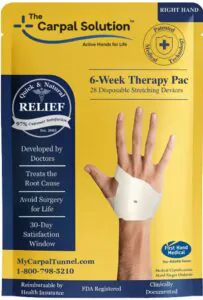
Created by renowned Harvard health care professionals.


Hand Strengthening Exercises: Heal First, Then Build Hand Strength Safely
Hand strengthening exercises rebuild grip and hand strength, but timing matters. Our doctors explain why to heal first with the Carpal Solution, then restart hand strength exercises with less resistance, and how to build hand strength safely.

Hand Strengthening Exercises: What Our Doctors Want You to Know
Written by Julie Sunberg, Director of Marketing and Customer Service, First Hand Medical · Clinically reviewed by Mr. Alan Ward, MOT, OTR, Master Occupational Therapist, VP of Precision Rehabilitation · Last reviewed: November 2026
Hand strengthening exercises help you grip, lift, open jars and carry groceries with confidence. Strong hands matter at every age. But our doctors have one firm rule when carpal tunnel is involved: heal first, then strengthen. Squeezing a ball or a gripper while the median nerve is still compressed adds pressure where you need less of it.
The good news is that grip strength usually comes back on its own with normal hand use once the pressure is off the nerve. When you are healed, light hand strength exercises can rebuild what you lost. This guide shows the 8 hand strengthening exercises our doctors like, how to use a hand exercise ball or therapy putty safely, and how to build hand strength step by step without a setback.
On This Page
Key points
- Heal first with the Carpal Solution; skip squeeze balls, putty and grippers while symptoms are active.
- When pain and numbness are gone, restart with less resistance and less weight than before.
- Add repetitions before resistance, and stop if numbness or tingling returns.
- Grip strength usually returns with normal hand use once the pressure on the median nerve is relieved.
- Conservative-first care that follows medicine’s “Do No Harm” principle comes first; surgery is the last resort.
Why Our Doctors Say Heal First, Then Strengthen
Carpal tunnel is a pressure problem. Swelling and entrapped inflammation in the carpal tunnel squeeze the median nerve. The Carpal Tunnel is not in the wrist, it is at the base of the palm between the two major muscles of the hand. The nine tendons that bend your fingers and thumb run through that same tunnel, beside the nerve.
When you grip, pinch or squeeze, those tendons tighten and the pressure inside the tunnel rises. Laboratory studies by Rempel and Keir measured it: fingertip loading raised carpal tunnel pressure, and pinching raised it more than pressing. That is why our doctors say no squeeze balls, putty or grip strengtheners while you are healing. People often ask, do grip strengtheners help carpal tunnel? Not while it is active. They add load to the very tunnel you are trying to calm.
Weakness from carpal tunnel is mostly a nerve problem, not a muscle problem. Relieve the pressure and the signal returns. Most people find their grip comes back with everyday use. If your thumb base looks flat or your grip keeps fading, read about muscle atrophy and carpal tunnel and see your doctor.
8 Hand Strengthening Exercises for After You Heal
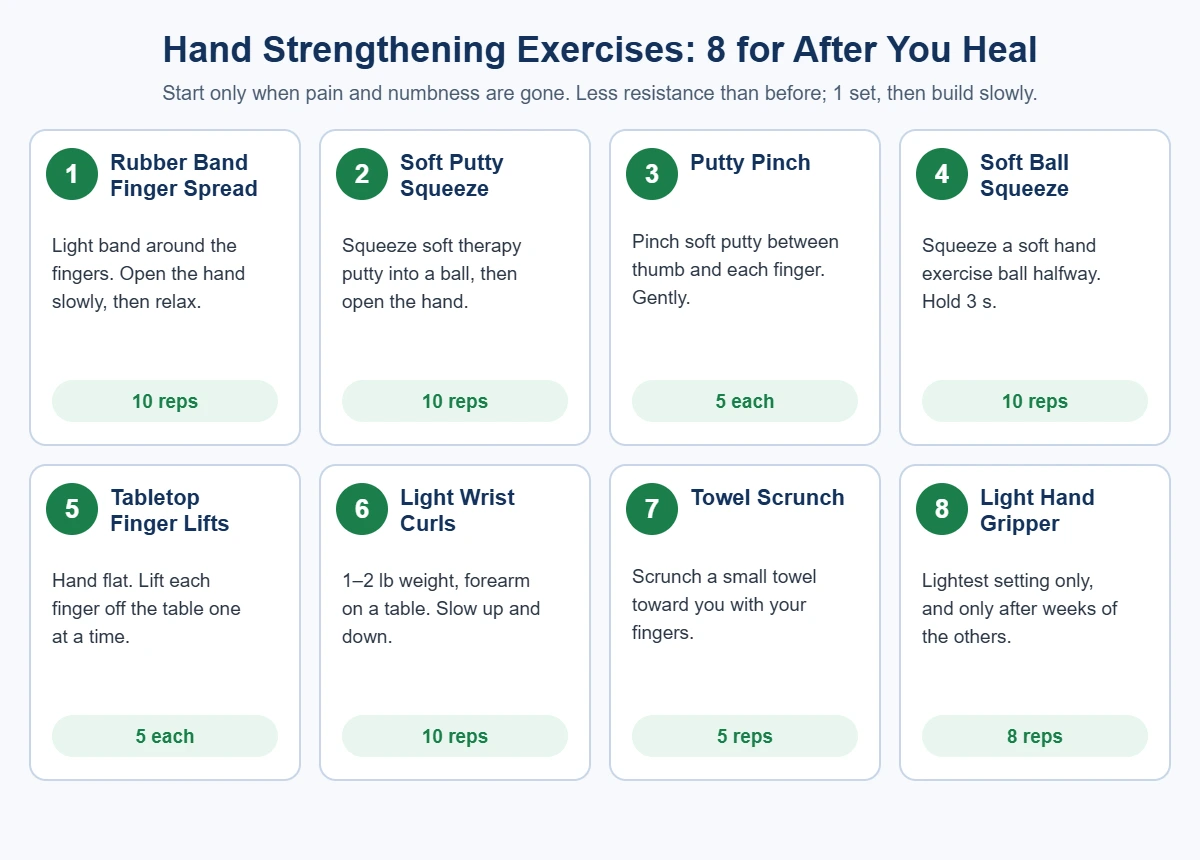
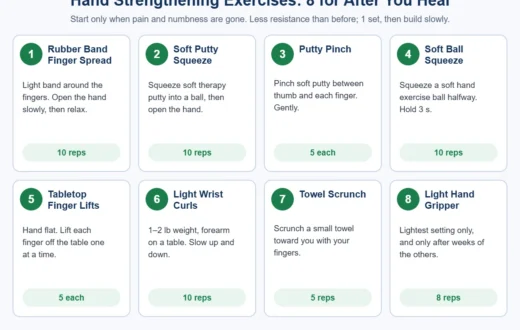
Start these hand strength exercises only when pain and numbness are gone. Do one set every other day at first, slowly, with less resistance than you used before.
1. Rubber Band Hand Exercises: The Finger Spread
Loop a light rubber band around your fingers and thumb. Open your hand slowly against the band, then relax. This works the extensor muscles that balance all the gripping you do. Rubber band hand exercises are a gentle place to start because the resistance is light.
2. Soft Putty Squeeze
Roll soft therapy putty into a ball and squeeze it gently, then open your hand fully.
3. Putty Pinch
Pinch the putty between your thumb and each finger in turn. Keep it gentle; pinching loads the carpal tunnel more than any other move.
4. Soft Ball Squeeze
Squeeze a soft hand exercise ball about halfway and hold three seconds.
5. Tabletop Finger Lifts
With your hand flat on a table, lift one finger at a time a little way off the surface.
6. Light Wrist Curls
With your forearm on a table, curl a 1 to 2 pound weight up and down slowly. See weak wrists for more wrist work.
7. Towel Scrunch
Lay a small towel flat and scrunch it toward you with your fingers.
8. Light Hand Gripper
Hand strengthener exercises with a gripper come last, on the lightest setting, and only after several weeks of the others without symptoms.
Hand Grip Exercises and How to Build Hand Strength
Hand grip exercises build the strength you use to carry, twist and hold. Grip strength is also one of the simplest signs of overall health; research links stronger grip to longer, healthier lives, as we explain in tendons in the wrist.
How to build hand strength without a setback:
- Reps before resistance. Go from 5 to 10 to 15 repetitions before you move to firmer putty or a stiffer ball.
- Every other day. Muscles and tendons get stronger during rest.
- Balance the hand. Pair every squeeze with an opening exercise, like the rubber band spread.
- Watch the signals. Numbness, tingling or night symptoms mean back off to stretches for a week.
Everyday tasks count too. Carrying light grocery bags, gardening and kneading dough are natural ways to strengthen hands once you have healed. The key to how to strengthen hands safely is patience.
Finger Strengthening Exercises
Finger strengthening exercises target each finger on its own, which helps with typing, music, crafts and fine work. Tabletop finger lifts, the putty pinch and rubber band finger spreads all count. Musicians and guitar players often work the pinky separately with gentle lifts and spreads.
Do these after your finger exercises and stretches, not instead of them. For the thumb, see our thumb exercises, which follow the same heal-first rule.
Hand Exercise Ball, Therapy Putty and Grippers: How to Use Them Safely
Hand strengthening tools are not bad. They are just poorly timed for someone who is still healing. Here is how to use them well once you are ready.
- Hand exercise ball: choose a soft one. Squeeze halfway, not to a full fist, and hold a few seconds.
- Therapy putty exercises: putty comes in resistance levels by color. Start with the softest. Squeeze, pinch, roll and pull it apart gently.
- Rubber bands: the cheapest tool and the best for opening the hand.
- Grippers: the heaviest load. Save them for last and use the lightest setting.
Products vary, so read the instructions and do your own research. Whatever you use, less resistance and more patience win.
Hand Strengthening Exercises in Occupational Therapy

The hand strengthening exercises occupational therapy programs use are built around the tasks you need to do: buttoning, writing, cooking, using tools or getting back to work. An occupational therapist or hand therapist measures your grip, picks the right resistance and watches your form.
Our clinical reviewer, Mr. Alan Ward, MOT, OTR, follows the same order our doctors do: calm the symptoms first, then rebuild strength gradually. See also physical therapy for carpal tunnel, which explains the one thing to skip.
One caution: after a period in a splint or cast, the hand will have lost strength from disuse. That is muscle atrophy from not using the muscles, and it is one reason our doctors do not favor long-term splinting for chronic conditions. A splint also restricts blood circulation and lymph flow, which slows soft-tissue healing. Rebuilding takes time either way, so go slowly.
How to Build Hand Strength Safely: A 3-Stage Plan
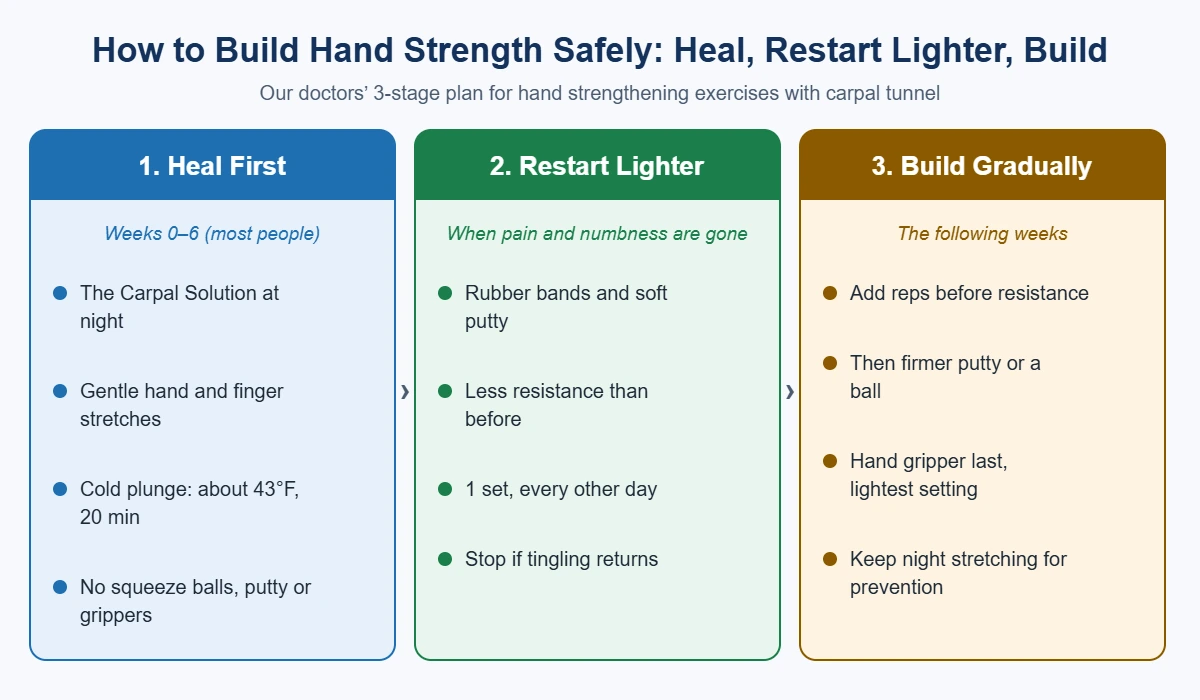
- Stage 1, Heal first: the Carpal Solution at night, gentle stretches by day, and a cold plunge for hands and forearms at about 43°F for 20 minutes to calm new inflammation. No squeezing.
- Stage 2, Restart lighter: once pain and numbness are gone, start rubber bands and soft putty with less resistance and less weight than before, one set every other day.
- Stage 3, Build gradually: add repetitions first, then a little more resistance. A hand gripper comes last.
Keep using the Carpal Solution now and then for prevention, from once a week to once every six months, especially during busy seasons of heavy hand use.
Our Doctors’ Plan: Heal at Night, Strengthen Later
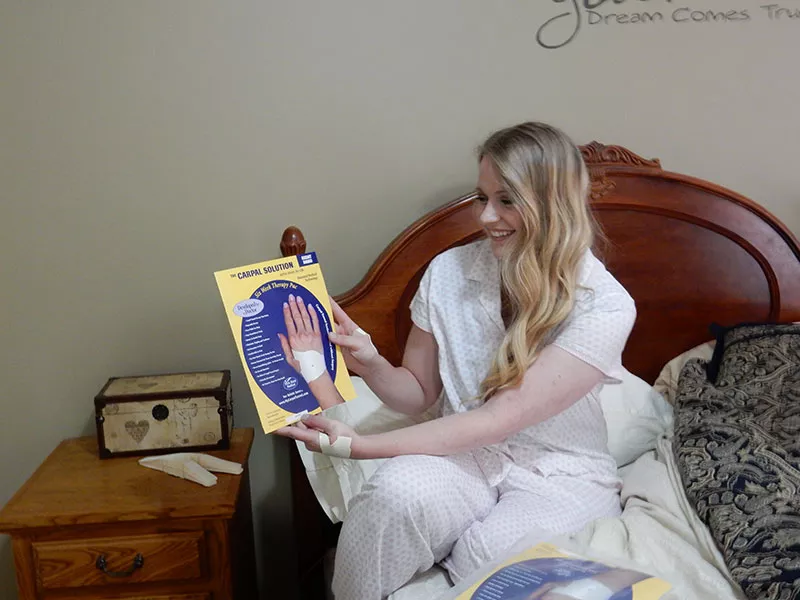
Swelling and entrapped inflammation in the soft tissue in and around the carpal tunnel squeeze the median nerve and restrict blood flow and lymphatic fluid transport. The nerve becomes irritated, short of oxygen and compressed, and the hand loses feeling and strength.
The Carpal Solution’s targeted passive stretching restores flexibility to the injured soft tissue, relieves pressure on the median nerve, relieves restrictions on blood circulation and lets lymph fluid flow freely to clear out the swelling. It is your body that does the healing; the Carpal Solution just jump-starts the natural healing that excess pressure from inflammation and swelling has held back.
The six-week protocol delivers over 220 hours of targeted stretching while you sleep. Most people are better from their worst symptoms in two to three weeks, and about 90% reach complete remission in six weeks. The Carpal Solution has 97% patient satisfaction over 21 years, 4.9 out of 5 stars on independent review sites, and over 100,000 users. Carpal tunnel surgery, by contrast, has a patient satisfaction rate lower than 69%, because about 31% of patients report lingering or recurring symptoms, and no patient is satisfied with lingering symptoms.
When Healing Needs a Doctor’s Help and Professional Medical Evaluation
- Constant numbness that does not improve or loss of feeling in the fingertips that does not improve in 4 to 8 weeks.
- Extreme loss of the muscle at the base of the thumb, with loss of grip strength that does not improve over 6 to 8 weeks.
- Worsening symptoms over 6 to 8 weeks while using the best conservative treatments
- Symptoms that begin suddenly after hand or wrist trauma, a fracture or severe sprain from a fall or auto accident.
- Odd Symptoms that are not consistent with the Carpal Tunnel Symptoms listed on this website, that might be indicative of other nerve issues. A nerve conductivity study can clear up the confusion with minimal costs and not too much pain and no risk.
These signs may mean more advanced nerve involvement or a different condition and deserve professional medical evaluation and in person consultation. Home treatment can be used alongside professional in-person medical care while you wait for the healthcare delivery system to fit you into their schedule. There is no reason to wait doing nothing. You can start proven natural conservative treatment with good patient reviews while you wait for your appointments. If your symptoms start improving over 6 to 8 weeks, then you know you are on the right track and surgery is not necessary.
Frequently Asked Questions About Hand Strengthening Exercises
What are the best hand strengthening exercises?
After you heal: rubber band finger spreads, soft putty squeezes and pinches, a soft ball squeeze, tabletop finger lifts, light wrist curls and towel scrunches. Start light, one set every other day, and add repetitions before resistance.
Do grip strengtheners help carpal tunnel?
Not while symptoms are active. Gripping and pinching raise pressure in the carpal tunnel. Our doctors say to heal first with the Carpal Solution, then use grippers last, on the lightest setting.
How can I build hand strength after carpal tunnel?
Relieve the pressure on the median nerve first. Grip strength usually returns with normal hand use. Then restart hand strength exercises with less resistance than before and build gradually.
Is a stress ball good for my hands?
A soft ball is fine for healthy hands and after you heal. While carpal tunnel symptoms are active, skip squeeze balls and use gentle stretches instead.
How often should I do hand strength exercises?
Every other day is enough at first. Muscles and tendons get stronger during rest, and it lowers the risk of a flare-up.
When should I see a doctor about hand weakness?
See a doctor promptly for constant numbness, weakness, thinning of the thumb muscles, sudden weakness or weakness after an injury.
Sources
- Rempel D et al. Effects of static fingertip loading on carpal tunnel pressure. Journal of Orthopaedic Research, 1997
- Keir PJ, Bach JM, Rempel DM. Fingertip loading and carpal tunnel pressure: differences between a pinching and a pressing task. Journal of Orthopaedic Research, 1998
- Page MJ et al. Exercise and mobilisation interventions for carpal tunnel syndrome. Cochrane Database of Systematic Reviews, 2012
- Journal of Ultrasound (2012): the nine flexor tendons and the median nerve in the carpal tunnel
- Wall BT et al. Short-term muscle disuse leads to substantial losses in muscle size and strength. Acta Physiologica, 2014
- Bland, Muscle & Nerve (2001): patient-reported outcome of carpal tunnel surgery in 1,268 operations
- Leong DP et al. Prognostic value of grip strength: findings from the PURE study. The Lancet, 2015

Developed by First Hand Medical’s Team of Doctors and Medical Professionals
The Carpal Solution Treatment Kit was developed by our expert team of medical doctors who have worked at and led some of the top medical institutions in the World – Including Harvard Medical, Tufts Medical, UCSD Medical School, Florida State Medical School, and The Ohio State University Medical School. We treat root causes with clinically proven conservative treatments. The results: Quick Natural Relief of All Your Carpal Tunnel Symptoms without complications. Meet The Medical Team Backing The Carpal Solution at First Hand Medical

Order Your Six Week Carpal Tunnel Treatment Now
The ONLY treatment for carpal tunnel that comes with a no questions asked 30-Day Satisfaction Window and in-house dedicated pain relief team.