Created by renowned Harvard health care professionals.


Tendons in Wrist and Hand: How 9 Tendons Give You Remarkable Dexterity
Nine tendons run from muscles in your forearm, through the wrist and the narrow carpal tunnel, to the bones of your fingers and thumb, giving you remarkable strength, dexterity and control. Here is how this system works, why swelling in the tunnel causes carpal tunnel symptoms, why healthy hands matter for an independent life, and why healthy tendons are a golfer’s quiet advantage.


Tendons in Wrist and Hand: Our Doctors’ View
Written by Edward A. Palank, MD, FACC, cardiologist and author of The Golf Doc, with Julie Sunberg, Director of Marketing and Customer Service at First Hand Medical · Medically reviewed by Clyde E. Morgan, DC, musculoskeletal expert, co-founder of First Hand Medical and inventor of the Carpal Solution · Last reviewed: November 2026
The tendons in wrist and hand are one of the most remarkable systems in the human body. Nine flexor tendons start at muscles in your forearm, run through the wrist, squeeze through the narrow carpal tunnel and attach to the bones of your fingers and thumb. From a mechanical point of view, the precision this system delivers would seem impossible to build. Yet we all take it for granted and simply expect it to work flawlessly every day.
When it doesn’t, it really throws us off our game. Buttons, keys, a coffee cup, a pen, a phone: trying to function in this world without healthy hands is a real challenge. That is why our doctors treat hand health as whole-life health, and why they work so hard to keep the carpal tunnel free of the swelling that crowds these tendons and the nerve beside them.
On This Page
- Nine tendons, one tunnel. Four superficialis, four profundus and one flexor pollicis longus tendon share the carpal tunnel with the median nerve.
- The power is in the forearm. The muscles that bend your fingers and thumb sit in the forearm and pull their tendons like cables.
- The tunnel cannot expand. When tendon linings swell, the pressure lands on the median nerve, and carpal tunnel symptoms begin.
- Healthy hands, longer independence. Research on aging links stronger, healthier hands with staying independent longer.
- Better golf starts in the forearm. Healthy tendons give golfers the grip, wrist hinge and feel behind a repeatable swing and a lower handicap.
- Conservative first. Keep tendons gliding, calm the inflammation, and restore circulation before thinking about surgery.
A Mechanical Marvel: How the Tendons in Hand and Wrist Work
Think about what your hand can do in a single morning. It can thread a needle, grip a heavy pan, type a message, button a shirt and feel the difference between a dime and a nickel in your pocket. Engineers who build robotic hands still struggle to match that mix of strength, speed and fine control.
Part of the secret is where the muscles are. If all the muscles that bend your fingers were inside the hand, your fingers would be thick and clumsy. Instead, the big muscles sit in the forearm, and long, strong tendons carry their pull down through the wrist to the fingers, like the strings of a marionette or the brake cables on a bicycle. That keeps the fingers slim and nimble while the forearm does the heavy work.
The tendons in hand and wrist must also turn a corner at the wrist, glide back and forth thousands of times a day, and do it all inside a passage about the width of your thumb. Slippery linings called synovial sheaths wrap the tendons so they glide without grinding. It is an extraordinary design, and it usually works so smoothly that we never give it a thought.
The 9 Flexor Tendons: From Forearm Muscle to Fingertip
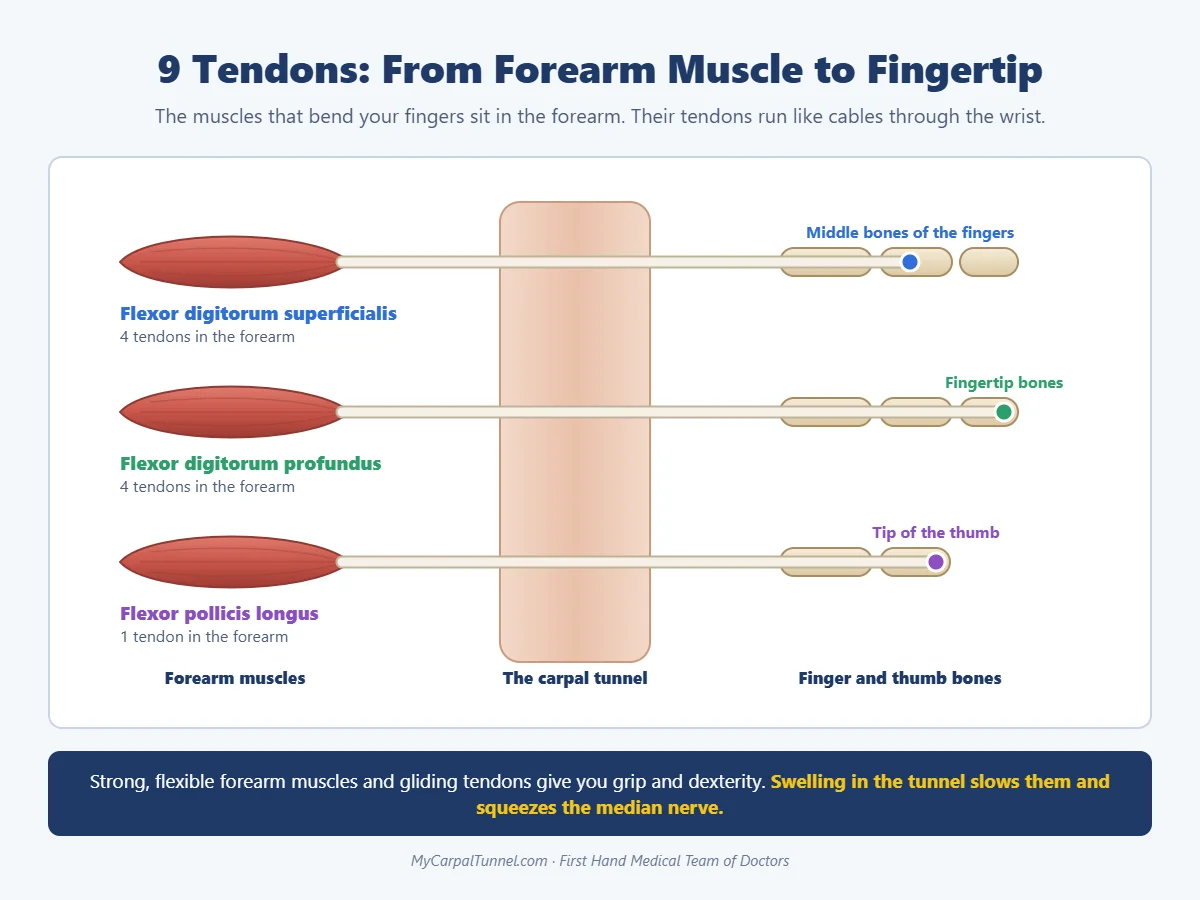
Flexor tendons are the tendons that bend (flex) the fingers and thumb. Nine of them run through the carpal tunnel, and they come from three forearm muscles.
Flexor Digitorum Superficialis: 4 Tendons
The flexor digitorum superficialis sits in the forearm and sends four tendons, one to each finger. They attach to the middle bones of the fingers and bend the middle knuckles. This muscle can bend each finger fairly independently, which is part of what lets a pianist or a typist move one finger at a time.
Flexor Digitorum Profundus: 4 Tendons to the Fingertips
The flexor digitorum profundus lies deeper in the forearm. Its four tendons travel all the way to the fingertip bones. In the finger, each profundus tendon passes through a split in the superficialis tendon on its way to the tip, an elegant bit of engineering. The profundus is the power-grip muscle. The parts that serve the middle, ring and little fingers share a common muscle belly, which is why it is hard to bend your ring finger without its neighbors following.
Flexor Pollicis Longus: 1 Tendon to the Thumb
The flexor pollicis longus runs from the forearm to the tip of the thumb and bends the thumb’s last joint. Pinching, writing and holding small objects all depend on it.
Finger Tendons Beyond the Wrist
Once the finger tendons leave the carpal tunnel, they fan out across the palm and enter tunnels of their own along each finger. Small muscles called lumbricals start on the profundus tendons in the palm and help fine-tune finger movement. Every link in this chain, from forearm to fingertip, has to work for your hand to feel normal.
Carpal Tunnel Tendons: Ten Structures in a Space That Cannot Expand
The carpal tunnel is a narrow passage at the base of the palm. Its floor and walls are the small carpal bones, and its roof is a tough band called the transverse carpal ligament. Ten structures pass through it: the nine carpal tunnel tendons and the median nerve, which lies just under the ligament. See our full guide to carpal tunnel anatomy.
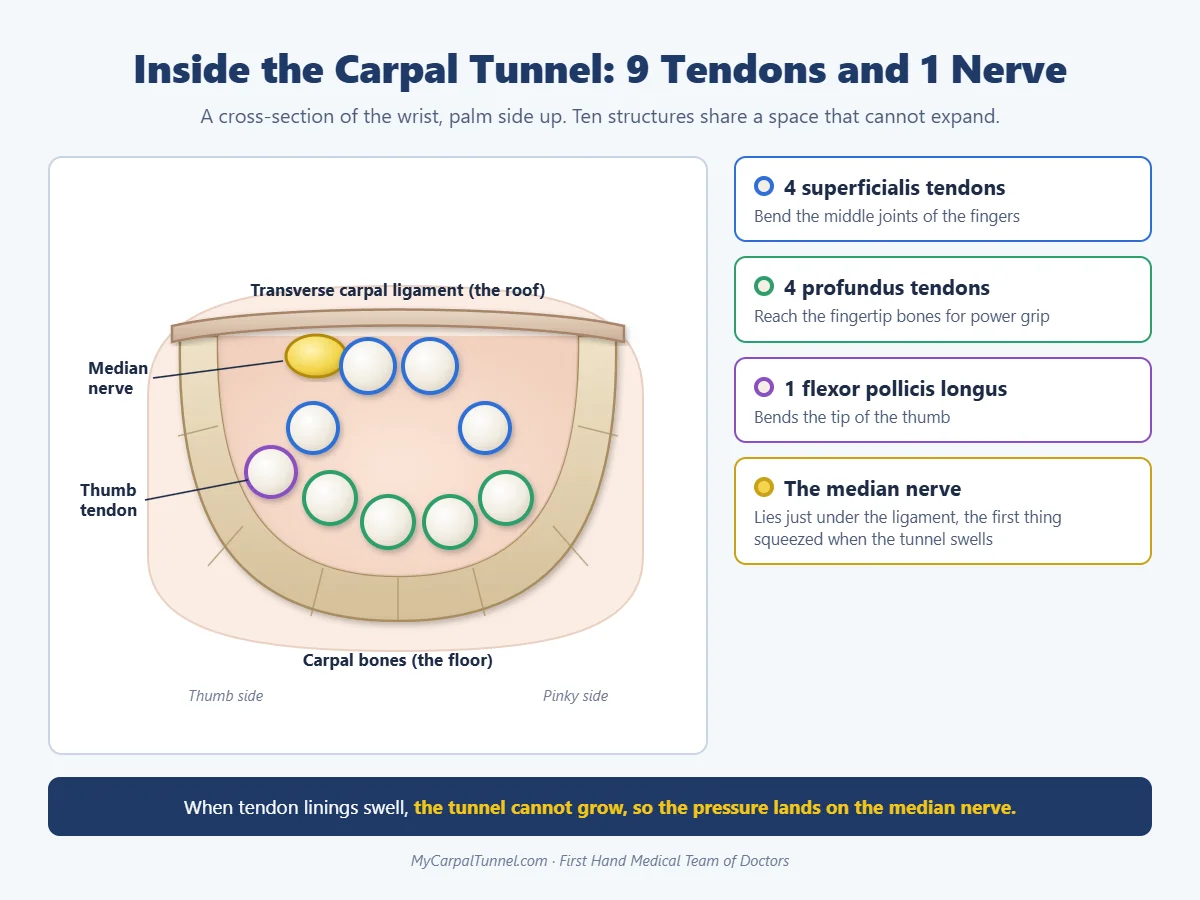
Because bone and ligament surround the tunnel, it cannot expand. When the tendon linings swell from hours of gripping, typing or tool use, or from inflammation in the body, the extra volume has nowhere to go. The tendons are tough, but the median nerve is soft, so it takes the pressure first. That is carpal tunnel syndrome: numbness, tingling, pain and weakness in the thumb, index, middle and half of the ring finger.
Our doctors explain it this way. Swelling and entrapped inflammation in the soft tissue in and around the carpal tunnel squeeze the median nerve and restrict blood flow and lymphatic fluid transport. The nerve becomes irritated, short of oxygen and compressed, and the tendons and forearm muscles feel it too: forearm aching, fatigue, a weaker grip and dropping things.
Some people are simply built with less room to spare. Occupational therapist Alan Ward, MOT, OTR, puts it plainly: “Some people just come pre-built with a little bit shorter tendon here, or the bones are shaped or arranged a little bit more tight, a little more compact fashion, so everybody’s probably gonna present a little bit different.”
Hand Tendons Anatomy: Flexors, Extensors and the Sheaths That Help Them Glide
Hand tendons anatomy has two main teams. The flexor tendons on the palm side bend the fingers and thumb. The extensor tendons on the back of the hand straighten them. The extensors cross the back of the wrist in their own compartments, so they do not pass through the carpal tunnel, but they balance every move the flexors make.
Flexor Tendon Sheaths
Inside the carpal tunnel, the eight finger tendons share a large lubricated sleeve, and the thumb tendon has its own. These synovial sheaths let the tendons glide smoothly. When they become irritated and thickened (tenosynovitis), they take up more room in the tunnel. That is one way repetitive work and wrist tendonitis can lead to carpal tunnel symptoms; see tendonitis vs carpal tunnel.
The Forearm Muscles Behind the Tendons
Because the muscles that bend the fingers live in the forearm, carpal tunnel trouble rarely stays in the hand. Our doctors never leave the forearm out of the picture: forearm aching, fatigue and weakness are part of carpal tunnel syndrome for many people, and the strength and dexterity of the forearm, thumb and fingers can fade if the problem is ignored. See forearm pain and muscle atrophy.
The Thumb’s Own Muscles
The small thenar muscles at the base of the thumb get their nerve supply from the median nerve after it leaves the carpal tunnel. When the tunnel is crowded, a weak pinch and a thinning thumb pad can follow; see thenar eminence pain.
Hand Dexterity: The Gift We All Take for Granted
Hand dexterity is the ability to make quick, precise, coordinated movements with the fingers and thumb. It depends on every part of the system: healthy nerves that carry feeling and commands, strong forearm muscles, gliding tendons and the small muscles in the hand that fine-tune each move.
Most of us never think about it until something goes wrong. Then the simple things become hard:
- Buttoning a shirt, fastening jewelry or tying shoelaces
- Typing, texting and using a mouse
- Opening jars, turning keys and carrying groceries
- Writing, cooking, playing an instrument or holding a grandchild
- Sleeping through the night without numb, aching hands
That loss of dexterity is what throws people off their game. It affects work, hobbies, confidence and mood. Diane, a Los Angeles music director, described how carpal tunnel left her dropping things and unable to play with the articulation she needed, before the Carpal Solution helped her return to full-time playing; read Diane’s Patient Experience.
Grip Strength and Longevity: Healthy Hands, Longer Independence
Gerontologists, the scientists who study aging, have found that hand health is closely tied to how long people stay independent. Hand function is critical for older adults to manage the activities of daily living on their own: dressing, bathing, cooking, eating and handling money and medicines.
Grip strength is one of the simplest measures of hand health, and research on grip strength and longevity is striking. In a U.S. study that followed 17,747 older adults for 8 years, lower handgrip strength was linked to higher odds of disability in each activity of daily living, and those disabilities were in turn linked to a higher risk of death. Other studies have found that low grip strength predicts later disability and loss of independence.
Independence matters for happiness too. Losing it often means relying on caregivers, and researchers note that it frequently leads to social withdrawal and lower wellbeing and quality of life. In short, people with healthy hands tend to live independently longer, and that independence supports a happier life. Your hand function can also be measured and documented; see how hand function is documented.
Tendons in Wrist and Your Golf Swing: The Golf Doc on Grip, Hinge and Handicap
As a cardiologist and lifelong golfer, I have spent years helping golfers stay healthy enough to keep playing the game they love. In The Golf Doc I wrote that “there are many myths and half-truths about golf and health.” One of the biggest is that the golf swing is all about big muscles. The truth is that every shot you hit travels through the tendons in your wrist and hand.
Golf Grip Strength Starts in the Forearm
Good players hold the club in the fingers, not the palm, and most of the pressure sits in the last three fingers of the lead hand. Those fingers are powered by the profundus tendons running from your forearm through the carpal tunnel. Golf grip strength is not about squeezing harder. It is about steady, light pressure you can hold for 18 holes without tension creeping up your forearms. Healthy, gliding tendons make that possible.
The Golf Wrist Hinge and Release
The golf wrist hinge, the way your wrists cock on the backswing and release through impact, is where much of your clubhead speed and clubface control come from. That move depends on flexor and extensor tendons sliding smoothly through the wrist hundreds of times a round, and many more on the practice range. When the tendon linings are swollen or the median nerve is irritated, the hinge gets stiff and the release comes too late or too early, and the ball goes where you did not intend.
Healthy Tendons and a Lower Handicap
Ask any good player how to lower your golf handicap and you will hear the same answer: consistent contact and a sharp short game. Both live in your hands. Putting, chipping and pitching depend on fingertip feel and tiny, precise adjustments, the very dexterity that the median nerve and the nine flexor tendons provide. Golfers with numb fingers or aching wrists lose that touch first, then they start squeezing the club to feel it, and the tension spreads into the swing. Healthy tendons are a quiet advantage that shows up on the scorecard.
The Golf Doc’s Advice for Your Hands
- Warm up the wrists and forearms before you hit a ball: gentle stretches, wrist circles and easy half swings.
- Keep grip pressure light and check that your grips are the right size and not worn slick.
- Walk the course when you can. Walking improves circulation and fitness, which helps healthy tissue recover.
- Limit hard practice sessions off mats, which jar the wrists, and rest between buckets.
- Treat hand numbness and tingling early. Don’t play through it for a season.
My goal has always been to help golfers “improve your game and your life by staying healthy,” as the cover of The Golf Doc puts it. For golfers with carpal tunnel symptoms, I recommend the Carpal Solution at night as the first line of treatment, so you can keep playing while your hands heal. Read more about golf and carpal tunnel, hand pain from golf and how a golfer conquered carpal tunnel, or meet Dr. Palank.

Caring for the Tendons in Your Wrist: Conservative First
Conservative-first care follows medicine’s oldest rule: first, do no harm. Healthy tendons need movement, circulation and rest breaks, not immobilization or force.
Daily Habits That Keep Tendons Gliding
- Take a break every 20 to 30 minutes from typing, phones, tools and gripping. Open the hands and shake them out.
- Stretch gently: up to 6 sets of 10 hand, wrist and forearm stretches, holding each for 15 seconds with 30 seconds of rest. See our forearm stretches and tendon and nerve glides.
- Use a lighter grip and wider handles, and keep the wrists straight while you work and sleep.
- Eat to calm inflammation with the Carpal Solution Diet, and stay well hydrated.
- Skip squeeze balls and putty while you heal. Irritated tendons and a crowded tunnel need circulation, not more hard gripping.
Why Our Doctors Avoid Long-Term Splints
A splint can shield the wrist from painful movement, but it carries two separate costs. Unused muscles weaken, leading to muscle atrophy. Splints also restrict blood circulation and lymph fluid flow, which slows soft-tissue healing. Splints are necessary for fractures and sprains, but they are a poor choice for chronic tendon and nerve problems; use one only for temporary relief, never long term. See braces for carpal tunnel.
The Carpal Solution: Making Room in the Tunnel
Our doctors developed the Carpal Solution to take the pressure off the median nerve at its root. Its targeted passive stretching restores flexibility to the injured soft tissue, relieves pressure on the median nerve, relieves restrictions on blood circulation and lets lymph fluid flow freely to clear out the swelling. It is your body that does the healing; the Carpal Solution just jump-starts the natural healing preempted by excess pressure from inflammation and swelling.

- Over 220 hours of targeted stretching in the six-week protocol, while you sleep.
- Most people are better from their worst symptoms in two to three weeks.
- About 90% get complete remission in 6 weeks; the other 10%, usually people with excess systemic inflammation, are 40 to 70% better at six weeks and reach full remission in 10 to 12 weeks.
- 97% patient satisfaction over 21 years and 4.9 out of 5 stars on independent review sites like Google Reviews. Over 100,000 people have used it.
See how the Carpal Solution hand orthosis works, and if symptoms linger, follow our Persistent Symptoms Protocol.
Before You Consider Surgery
Surgery is the last resort. Carpal tunnel surgery has a patient satisfaction rate lower than 69%, because about 31% of patients report lingering or recurring symptoms after surgery, and no patient is satisfied with lingering symptoms. See recurrence after surgery. In our doctors’ clinical experience, some patients also report a permanent loss of grip strength after surgery, a high price for hands that need to last a lifetime. Try a well-reviewed conservative treatment for at least 12 weeks first, and start while you wait for carpal tunnel treatment.
When Healing Needs a Doctor’s Help and Professional Medical Evaluation
- Constant numbness that does not improve or loss of feeling in the fingertips that does not improve in 4 to 8 weeks.
- Extreme loss of the muscle at the base of the thumb, with loss of grip strength that does not improve over 6 to 8 weeks.
- Worsening symptoms over 6 to 8 weeks while using the best conservative treatments
- Symptoms that begin suddenly after hand or wrist trauma, a fracture or severe sprain from a fall or auto accident.
- Odd Symptoms that are not consistent with the Carpal Tunnel Symptoms listed on this website, that might be indicative of other nerve issues. A nerve conductivity study can clear up the confusion with minimal costs and not too much pain and no risk.
These signs may mean more advanced nerve involvement or a different condition and deserve professional medical evaluation and in person consultation. Home treatment can be used alongside professional in-person medical care while you wait for the healthcare delivery system to fit you into their schedule. There is no reason to wait doing nothing. You can start proven natural conservative treatment with good patient reviews while you wait for your appointments. If your symptoms start improving over 6 to 8 weeks, then you know you are on the right track and surgery is not necessary.
Frequently Asked Questions About Tendons in Wrist and Hand
How many tendons are in the wrist?
Nine flexor tendons pass through the carpal tunnel on the palm side of the wrist: four flexor digitorum superficialis, four flexor digitorum profundus and one flexor pollicis longus. The extensor tendons cross the back of the wrist in separate compartments.
What do the tendons in the carpal tunnel do?
They connect the forearm muscles to the bones of the fingers and thumb. The superficialis tendons bend the middle knuckles, the profundus tendons bend the fingertips and give power grip, and the flexor pollicis longus bends the tip of the thumb.
Can swollen tendons cause carpal tunnel syndrome?
Yes. When the tendon linings swell, the carpal tunnel cannot expand, so the extra volume squeezes the median nerve and restricts blood flow and lymph transport. That pressure causes numbness, tingling, pain and weakness.
Why is it hard to move my ring finger by itself?
The profundus tendons to the middle, ring and little fingers come from a shared muscle belly in the forearm, so those fingers tend to move together.
Is grip strength linked to longevity?
Studies of older adults link lower grip strength with more difficulty in daily activities, loss of independence and a higher risk of death. Keeping your hands healthy helps you stay independent longer.
How can I keep the tendons in my wrist healthy?
Take frequent breaks, stretch gently, use a lighter grip, keep your wrists straight, eat to calm inflammation and avoid long-term splints. If carpal tunnel symptoms start, treat them early and conservatively.
Do healthy tendons help your golf swing?
Yes. Your grip, wrist hinge and release all run through the tendons in your wrist and hand. Healthy, gliding tendons let you keep light grip pressure, hinge freely and feel the club, which leads to more consistent contact, a better short game and a lower handicap.
Sources
- Carpal tunnel anatomy: the median nerve and nine flexor tendons. Journal of Ultrasound, 2012.
- Forearm and hand flexor muscle anatomy. StatPearls, NCBI Bookshelf.
- Anatomy, Shoulder and Upper Limb, Hand Flexor Digitorum Superficialis Muscle. StatPearls, NCBI Bookshelf.
- Anatomy, Shoulder and Upper Limb, Hand Flexor Digitorum Profundus Muscle. StatPearls.
- Handgrip strength, ADL disability and mortality in older adults. Health and Retirement Study, 17,747 participants, 8-year follow-up.
- Handgrip strength in old and oldest old Swiss adults. Cross-sectional study.
- Bidirectional association between handgrip strength and ADL disability. Frontiers in Public Health, 2023.
- Predicting hand function in older adults. Aging Clinical and Experimental Research, 2016.
- Wall BT et al. Acta Physiologica, 2014 (doi 10.1111/apha.12190): about 8% loss of muscle size and 23% loss of strength after 14 days of immobilization.
- Bland JD. Patient-reported outcomes of 1,268 carpal tunnel operations. Muscle & Nerve, 2001 (PubMed 11410921).

Developed by First Hand Medical’s Team of Doctors
The Carpal Solution Treatment Kit was developed by our expert team of medical doctors who have worked at and led some of the top medical institutions in the World – Including Harvard Medical, Tufts Medical, UCSD, UF Health, and The Ohio State University. We treat root causes with clinically proven conservative treatments. The results: Quick Natural Relief of All Your Carpal Tunnel Symptoms without complications.

Order Your Six Week Carpal Tunnel Treatment Now
The ONLY treatment for carpal tunnel that comes with a no questions asked 30-Day Satisfaction Window and in-house dedicated pain relief team.