Created by renowned Harvard health care professionals.


Thumb Joint Pain: Pain at the Base of the Thumb, Thumb Arthritis and Carpal Tunnel
Thumb joint pain at the base of the thumb is usually arthritis in the CMC joint, carpal tunnel, or both. Our doctors see them feed each other: arthritis inflammation crowds the carpal tunnel, and carpal tunnel slows the circulation arthritic joints need. That is why they say no one with arthritis should get carpal tunnel surgery.

Thumb Joint Pain: Our Doctors’ Short Answer
Written by Jeff Conley, President of First Hand Medical · Medically reviewed by Benjamin E. Bierbaum, MD, orthopedic surgeon and hand specialist, clinical professor of orthopedic surgery, Harvard Medical School · Last reviewed: November 2026
Thumb joint pain at the base of the thumb usually comes from one of two places: arthritis in the joint where the thumb meets the wrist, or carpal tunnel syndrome pinching the median nerve just next door. Very often it is both. Our doctors see the two conditions feed each other every day. Arthritis adds inflammation and swelling that crowd the carpal tunnel, and carpal tunnel restricts the blood flow and lymph transport that arthritic joints need to calm down. That two-way street is why our doctors routinely say no one with arthritis should get carpal tunnel surgery, and why they treat both conditions by calming inflammation and restoring circulation.
On This Page
- Two neighbors, one ache. The thumb’s base joint and the carpal tunnel share a bone, so trouble in one spills into the other.
- Arthritis feeds carpal tunnel. Inflamed joint linings and tendons add swelling inside the tunnel.
- Carpal tunnel feeds arthritis. A squeezed tunnel slows circulation, so inflammation stays trapped and joints stay sore.
- No carpal tunnel surgery with arthritis. Arthritic tissue forms far more scar tissue when it is cut.
- Relief starts at home. Rest from pinching, a cold water plunge, gentle motion, an anti-inflammatory diet and passive stretching at night.
The CMC Joint: Where Pain at the Base of the Thumb Starts
The CMC joint (carpometacarpal joint) is where the long bone of the thumb meets the trapezium, one of the eight small carpal bones of the wrist. It is a saddle-shaped joint that lets the thumb swing across the palm to pinch, grip and turn. Because the thumb does so much work, the CMC joint carries heavy loads every day, and it is one of the most common places in the hand for arthritis to start.
The trapezium has a second job. It is one of the anchor points for the transverse carpal ligament, the roof of the carpal tunnel. So the thumb’s base joint and the carpal tunnel sit side by side, sharing a bone and the soft tissue around it. Inflammation in one does not stay put.
Pain at base of thumb palm side can also come from the thenar muscles in the thumb pad, which are powered by the median nerve. See our guide to thenar eminence pain. For thumb pain from texting, gripping and bending, see thumb pain.
Thumb Arthritis Symptoms: Basal Joint Arthritis and CMC Arthritis
Thumb arthritis at the base of the thumb is called basal joint arthritis or CMC arthritis. Basal thumb pain from arthritis usually feels like:
- A deep ache where the thumb meets the wrist, worse after pinching, writing, opening jars, turning keys or twisting door handles
- A sore thumb joint that is tender when pressed
- Stiffness and swelling, often worse in the morning or in cold weather
- A bony bump at the base of the thumb as the joint changes shape
- Grinding or catching when the thumb moves, and a weaker pinch because it hurts
Two kinds of thumb arthritis matter most. Osteoarthritis is wear and tear from years of repeated loading, usually after age 50, and it still inflames the joint lining. Rheumatoid arthritis is an autoimmune condition: the immune system attacks the joint linings and tendon sheaths, driving inflammation throughout the body. Thumb arthritis is more common in women and after age 50, and in people whose hands pinch and grip all day: hairstylists, dental hygienists, musicians, knitters, mechanics and anyone who types or texts for hours. Those same jobs load the carpal tunnel, which is one reason the two conditions so often show up together. See who is at risk for carpal tunnel for your profession.
Doctors grade basal joint arthritis in four stages on X-ray, from mild joint narrowing to a worn-out joint.
Thumb Arthritis or Carpal Tunnel? How to Tell
Arthritis hurts. Carpal tunnel numbs, tingles and burns. When you have pain at the base of the thumb plus numbness or tingling in the thumb, index and middle fingers, suspect both.
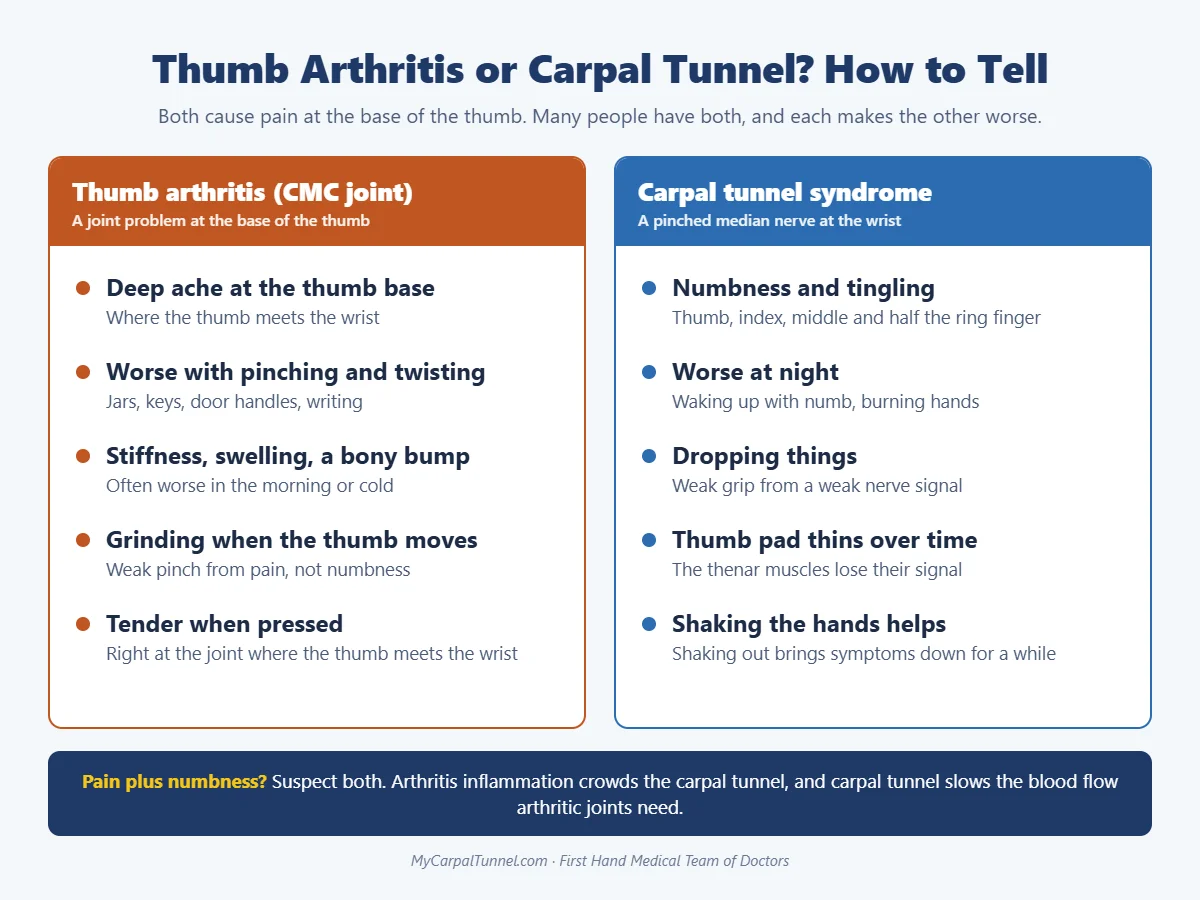
Many people live with both at the same time. Court reporter Rita from Staten Island lives with carpal tunnel and arthritis in two fingers; read her experience in carpal tunnel vs arthritis. Tendon flare-ups along the thumb side of the wrist can also cause basal thumb pain, so a doctor’s evaluation matters when the cause is unclear.
Our Doctors’ Position: Arthritis and Carpal Tunnel Make Each Other Worse
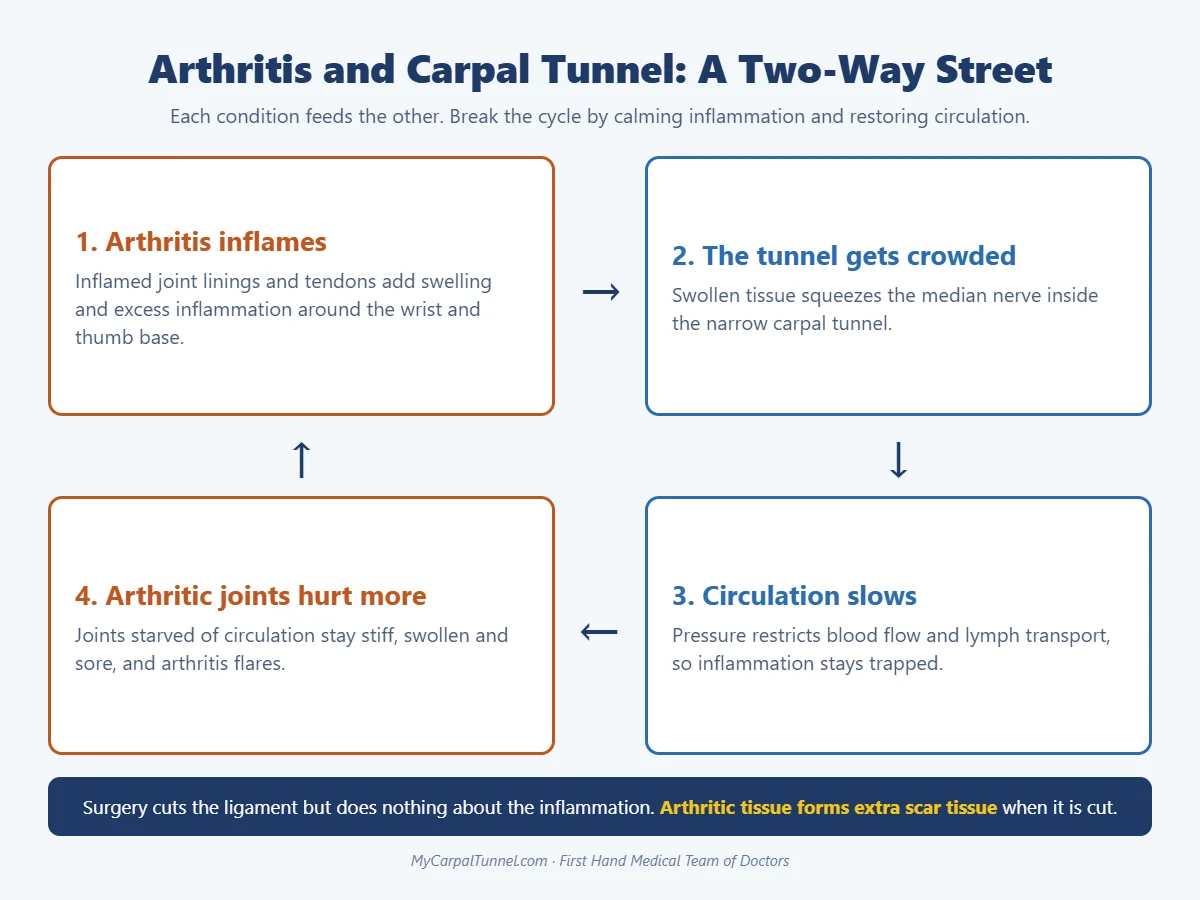
Our doctors’ position is simple: carpal tunnel makes arthritis worse, and arthritis makes carpal tunnel worse. Carpal tunnel syndrome is a chronic, recurring condition brought on by excess inflammation, and arthritis is one of the biggest sources of excess inflammation in the hands.
How Arthritis Makes Carpal Tunnel Worse
Rheumatoid arthritis is an autoimmune condition that keeps generating inflammation throughout the body. It inflames the linings around the flexor tendons in the wrist, and that swelling crowds the median nerve inside the tunnel. Osteoarthritis at the thumb base and wrist also inflames the joint lining and can add bony changes that narrow the space. Either way, more swelling is trapped in a tunnel that has no room to spare. Arthritis is one of more than 27 possible contributing factors to carpal tunnel syndrome, and one of the most stubborn.
How Carpal Tunnel Makes Arthritis Worse
Swelling and entrapped inflammation in the soft tissue in and around the carpal tunnel squeeze the median nerve and restrict blood flow and lymphatic fluid transport. Arthritic joints depend on that circulation to bring in nutrients and carry inflammation away. When it slows, the joints at the base of the thumb and in the fingers stay stiff, swollen and sore, and arthritis flares.
“If my carpal tunnel acts up, my arthritis flares up terribly… my fingers over here aren’t so swollen, and it really, really does subside the inflammation for the arthritis.”
— Rita, court reporter for 31 years, Staten Island, New York, on using the Carpal Solution
Read more in our doctors’ guide to carpal tunnel and arthritis and in thumb arthritis and carpal tunnel with autoimmune disease.
Why Our Doctors Say No Carpal Tunnel Surgery With Arthritis
Our doctors routinely tell patients:
“No one with arthritis should get carpal tunnel surgery. The risk of excessive scar tissue is off the charts.”
— First Hand Medical Team of Doctors
Here is why. Carpal tunnel surgery cuts the ligament over the tunnel to make room for the nerve. It does nothing about the inflammation. In our doctors’ clinical experience, arthritic soft tissue that is cut generates far more scar tissue than normal tissue. In a space that is already tight, excess scar tissue constricts the carpal tunnel further and adds new pressure on the median nerve, so many patients with arthritis end up with worse symptoms after surgery than before. And because arthritis keeps producing inflammation, symptoms come back faster.
The research points the same way: in a study of 7,464 patients, rheumatoid arthritis was independently associated with needing a second carpal tunnel release. For everyone, carpal tunnel surgery has a patient satisfaction rate lower than 69%, because about 31% of patients report lingering or recurring symptoms after surgery, and no patient is satisfied with lingering symptoms. Second surgeries fare worse, with a patient satisfaction rate between 16% and 40%. Read who should avoid carpal tunnel surgery and our page on recurrence after carpal tunnel surgery.
Our doctors recommend everyone try a well-reviewed conservative treatment for at least 12 weeks before considering any operation, and for people with arthritis, conservative care is essential. The same conservative-first rule applies to surgery on the thumb joint itself.
How to Relieve Thumb Joint Pain at Home
Conservative-first care follows medicine’s oldest rule: first, do no harm. To relieve thumb joint pain at the base of the thumb, calm the inflammation and restore circulation for both the joint and the carpal tunnel:
- Rest the thumb from pinching and twisting. Use jar openers, key turners, wider pens and tools with bigger handles, and switch hands when you can.
- Use a cold water plunge to calm new inflammation: hands and forearms in water at about 43°F for 20 minutes, never colder than 41°F. People with Raynaud’s, diabetic nerve issues or poor circulation should use 44 to 48°F and be more careful.
- Keep the thumb moving gently. Slow thumb circles and gentle hand and wrist stretches keep the joint from stiffening. Skip squeeze balls and putty, which load the sore joint and crowd the carpal tunnel.
- Wear compression gloves by day. They can increase blood circulation and cushion the hand from everyday bumps.
- Fight inflammation from the inside. Follow the Carpal Solution Diet, stay active with aerobic exercise, and if you suspect rheumatoid arthritis, see a rheumatologist to get it under control.
- Stretch passively at night with the Carpal Solution.
Thumb Braces: For Tasks, Not All Day
Splints are the right tool for fractures and sprains, where holding a joint still lets it heal. For thumb arthritis and carpal tunnel, a brace mostly shields the joint from painful movement, at two separate costs: unused muscles weaken (muscle atrophy), and restricted blood circulation and lymph flow reduce the nutrients needed for healing and slow the clearing of inflammation, so soft tissue heals more slowly. Wear a thumb brace for arthritis only for a painful task or for temporary relief, not long term.
The Carpal Solution: Treating the Root Cause While You Sleep
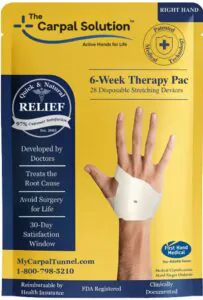
Our doctors developed the Carpal Solution to take the pressure off the median nerve. Its targeted passive stretching restores flexibility to the injured soft tissue, relieves pressure on the median nerve, relieves restrictions on blood circulation and lets lymph fluid flow freely to clear out the swelling. Full circulation is good for arthritic tissue too. It is your body that does the healing; the Carpal Solution just jump-starts the natural healing preempted by excess pressure from inflammation and swelling.

- Over 220 hours of targeted stretching in the six-week protocol, while you sleep.
- Most people are better from their worst symptoms in two to three weeks.
- About 90% get complete remission in 6 weeks; the other 10%, usually people with excess systemic inflammation such as arthritis, are 40 to 70% better at six weeks and reach full remission in 10 to 12 weeks.
- 97% patient satisfaction over 21 years and 4.9 out of 5 stars on independent review sites like Google Reviews. Over 100,000 people have used it.
With arthritis, carpal tunnel tends to come back, so our doctors recommend preventive Carpal Solution nights, from once a week to once every six months, to keep it in remission. If symptoms linger, follow our Persistent Symptoms Protocol.
When Healing Needs a Doctor’s Help and Professional Medical Evaluation
- Constant numbness that does not improve or loss of feeling in the fingertips that does not improve in 4 to 8 weeks.
- Extreme loss of the muscle at the base of the thumb, with loss of grip strength that does not improve over 6 to 8 weeks.
- Worsening symptoms over 6 to 8 weeks while using the best conservative treatments
- Symptoms that begin suddenly after hand or wrist trauma, a fracture or severe sprain from a fall or auto accident.
- Odd Symptoms that are not consistent with the Carpal Tunnel Symptoms listed on this website, that might be indicative of other nerve issues. A nerve conductivity study can clear up the confusion with minimal costs and not too much pain and no risk.
These signs may mean more advanced nerve involvement or a different condition and deserve professional medical evaluation and in person consultation. Home treatment can be used alongside professional in-person medical care while you wait for the healthcare delivery system to fit you into their schedule. There is no reason to wait doing nothing. You can start proven natural conservative treatment with good patient reviews while you wait for your appointments. If your symptoms start improving over 6 to 8 weeks, then you know you are on the right track and surgery is not necessary.
Frequently Asked Questions About Thumb Joint Pain
What causes pain at the base of the thumb?
The most common causes are arthritis in the CMC joint where the thumb meets the wrist and carpal tunnel syndrome, and many people have both. Overuse, tendon flare-ups along the thumb side of the wrist and injuries are other causes.
What are the first signs of thumb arthritis?
A deep ache at the base of the thumb after pinching, writing or opening jars, a sore thumb joint that is tender when pressed, and stiffness in the morning. Later, a bony bump and a weaker pinch can appear.
How do I relieve thumb joint pain?
Rest the thumb from pinching and twisting, use a cold water plunge at about 43°F for 20 minutes, keep the thumb moving gently, wear compression gloves by day, follow an anti-inflammatory diet, and use passive stretching at night to restore circulation.
Can carpal tunnel cause thumb joint pain?
Yes. Carpal tunnel restricts blood flow and lymph transport in the hand, so inflammation stays trapped and arthritic thumb joints hurt more. Numbness or tingling in the thumb, index and middle fingers points to carpal tunnel.
Should I have carpal tunnel surgery if I have arthritis?
Our doctors say no one with arthritis should get carpal tunnel surgery, because arthritic tissue forms excessive scar tissue when it is cut, and arthritis keeps bringing the inflammation back. Try a well-reviewed conservative treatment first.
Is a thumb brace good for thumb arthritis?
Only for a painful task or temporary relief. Worn all day, a brace weakens unused muscles (muscle atrophy) and, separately, restricts the blood and lymph flow soft tissue needs to heal.
Sources
- Carpal tunnel anatomy: the median nerve and nine flexor tendons. Journal of Ultrasound, 2012.
- Eaton RG, Littler JW. Ligament reconstruction for the painful thumb carpometacarpal joint. Journal of Bone and Joint Surgery, 1973 (staging of basal joint arthritis).
- Westenberg RF, et al. Plastic and Reconstructive Surgery, 2020: in 7,464 patients, smoking and rheumatoid arthritis were independently associated with revision carpal tunnel release.
- Bland JD. Patient-reported outcomes of 1,268 carpal tunnel operations. Muscle & Nerve, 2001 (PubMed 11410921).
- Louie D, Earp B, Blazar P. Long-term outcomes of carpal tunnel release: a critical review of the literature. Hand, 2012.
- Wall BT, et al. Short-term muscle disuse leads to substantial losses in muscle size and strength. Acta Physiologica, 2014.

Developed by First Hand Medical’s Team of Doctors
The Carpal Solution Treatment Kit was developed by our expert team of medical doctors who have worked at and led some of the top medical institutions in the World – Including Harvard Medical, Tufts Medical, UCSD, UF Health, and The Ohio State University. We treat root causes with clinically proven conservative treatments. The results: Quick Natural Relief of All Your Carpal Tunnel Symptoms without complications.

Order Your Six Week Carpal Tunnel Treatment Now
The ONLY treatment for carpal tunnel that comes with a no questions asked 30-Day Satisfaction Window and in-house dedicated pain relief team.