Created by renowned Harvard health care professionals.



Written by Jeff Conley, President, First Hand Medical · Medically reviewed by Joseph E. Scherger, MD, MPH, family physician, clinical professor at UC San Diego School of Medicine and co-chair of the First Hand Medical advisory board · Last reviewed: November 2026
A repetitive strain injury (RSI) often takes people by surprise. One day the hand, wrist, fingers or thumb start to hurt, go numb or stop working the way they should, and there was no fall, no collision and no obvious cause. That confusion is part of what makes a repetitive strain injury so frustrating. It takes time to understand what caused it, and more time to work out what can be done.
This guide explains what a repetitive strain injury is, why it gives so little warning, the most common types, and the repetitive strain injury treatment our doctors recommend first for the most common one of all: carpal tunnel syndrome.
Table of Contents
What Is a Repetitive Strain Injury?
A repetitive strain injury, also called a repetitive stress injury or cumulative trauma disorder, is damage to tendons, tendon sheaths, nerves, muscles, ligaments or fascia caused by doing the same motion over and over. Typing, using a mouse, gripping tools, playing an instrument, cutting hair, cleaning teeth, scanning groceries and assembly-line work are classic examples. Each movement is harmless on its own; the injury comes from thousands of them adding up over months and years.
From early childhood we are programmed to react to pain. When something hurts, we stop doing it until the pain stops. That is the body’s way of training us to protect ourselves, and it becomes so instinctive that we do not even think about it. We also learn early that injuries come from sudden impact, such as a fall, a collision, or being struck by a ball, a bat or a car, and we learn to avoid those accidents through safety and prevention.
A repetitive strain injury breaks both of those rules. It does not come from a single impact, and in its early stages it usually does not hurt enough to make us stop.
Why a Repetitive Strain Injury Gives No Warning
The insidious part of a repetitive strain injury is that the subtle wear and tear of the daily grind accumulates without any signal of what is coming. You can type at a keyboard or work a mouse for years, even decades, with seemingly minimal impact on your tendons, fascia, ligaments, tendon sheaths and joints. There is no pain response, no warning to stop the activity or improve your ergonomics, and no sign that any damage is happening at all.
Then one day you wake up with pain, numbness or weakness in a finger, thumb, wrist or joint. Or you are awakened in the night by an intense numb, tingling sensation in your hands. People first wonder: What have I done? What has happened to me? Why am I falling apart? The answer is the cumulative effect of many years of seemingly insignificant physical stress, which finally triggers inflammation and nerve symptoms.
Metabolic conditions such as diabetes, thyroid disease and the fluid shifts of pregnancy can also contribute to a repetitive strain injury and complicate diagnosis and treatment, because they make tissue swell more easily under the same workload.

Who is most at risk?
Anyone who repeats the same hand motions for hours a day is at risk of a repetitive strain injury. That includes office and computer workers, programmers, writers, cashiers, assembly and warehouse workers, mechanics, carpenters, hairdressers, dental professionals, surgeons, musicians, gamers and athletes in grip sports.
Risk rises with forceful gripping, awkward wrist angles, vibrating tools, cold work environments, too few breaks, and conditions that promote swelling, such as diabetes, thyroid disease and pregnancy. Age matters too: tissue becomes less forgiving over time, which is one reason symptoms often appear in the forties and fifties after years of the same work.
Common Types of Repetitive Strain Injury in the Hand and Arm
Repetitive strain injury is an umbrella term. The most common types in the upper body include:
- Carpal tunnel syndrome: swelling inside the carpal tunnel compresses the median nerve, causing numbness, tingling and weakness in the thumb, index, middle and part of the ring finger.
- Tendinitis and tenosynovitis: inflammation of a tendon or its sheath, often in the wrist or forearm.
- De Quervain’s tenosynovitis: pain along the thumb side of the wrist, common in new parents and heavy phone users.
- Trigger finger: a finger or thumb that catches or locks when it bends.
- Tennis elbow and golfer’s elbow: pain on the outside or inside of the elbow from gripping and wrist motion.
- Cubital tunnel syndrome: pressure on the ulnar nerve at the elbow, with numbness in the ring and little fingers.
Because several of these can overlap or mimic each other, an in-person evaluation from a doctor is important. Carpal tunnel syndrome is by far the most common repetitive strain injury of the hand, so it is where we focus below.
How Can I Find Relief From RSI Pain?
Carpal Tunnel: The Most Common Repetitive Strain Injury of the Hand
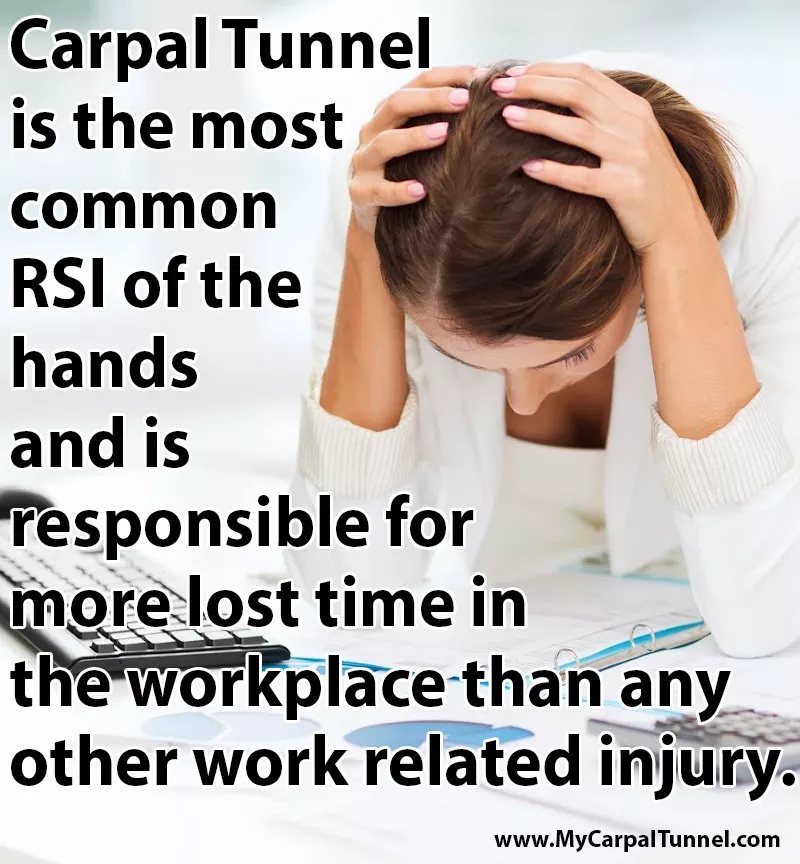
Carpal tunnel syndrome is the most common repetitive strain injury of the hand, and it has long been one of the work injuries that keeps people off the job the longest. The carpal tunnel is a narrow passage at the base of the palm. Nine tendons from the forearm muscles (four flexor digitorum superficialis, four flexor digitorum profundus and the flexor pollicis longus) pass through it beside the median nerve.
Repeated gripping, typing and wrist motion inflame the tissue around those tendons. When that swelling becomes trapped inside the tunnel, it squeezes the median nerve and restricts circulation, which slows healing and keeps the cycle going. The result is finger numbness and pain, tingling that wakes you at night, a weaker grip and dropped objects. Forearm muscle weakness and thinning of the muscle at the base of the thumb can follow if the cycle runs long enough.

If you have three or more of the common carpal tunnel symptoms, our doctors’ two decades of clinical experience (not a published statistic) suggest you can be about 95% confident it is carpal tunnel. You should still get an in-person evaluation and formal diagnosis from a doctor. With that confidence, though, you can start a natural, non-invasive treatment while you wait; the average wait for a new-patient physician appointment is 31 days (AMN Healthcare, 2025). Read more about waiting for carpal tunnel treatment.
What about a wrist splint? A splint holds the wrist in a neutral position, which can reduce pain from movement, but it does not promote healing from carpal tunnel syndrome. It causes muscle atrophy and stiffness, and its tight compression restricts blood circulation and lymphatic fluid exchange, which slows the dispersion of entrapped swelling, the root cause of carpal tunnel syndrome.
Our medical team has observed that splints give some relief at first but aggravate symptoms in the long run. Immobilization is great for fractures and sprains, but not for carpal tunnel syndrome.
How Does The Carpal Solution Work?
Repetitive Strain Injury Treatment: How the Carpal Solution Works
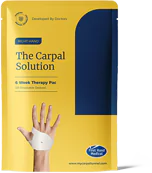
For carpal tunnel syndrome caused by repetitive strain, our doctors recommend conservative care first, with the Carpal Solution as the anchor treatment. It is not a rigid immobilizing wrist brace. Worn during sleep, it is a soft, Hypoallergenic (No Latex) device that gently tugs at three key points on the palm around the carpal tunnel. That consistent stretch, applied for 6 to 8 hours while the hand is relaxed, decompresses and reshapes the soft tissue and relieves pressure on the median nerve.
Carpal Solution therapy combines this gentle soft tissue reshaping during sleep with normal, active use of the hand during the day. That rhythm relieves symptoms with no muscle atrophy or downtime, and the hand rehabilitates through normal use once pain is relieved. Over the six-week protocol, it adds up to over 220 hours of targeted stretching. Dr. Clyde E. Morgan, its inventor, explains that better circulation of nutrient- and oxygen-rich blood helps disperse lymphatic fluid and supports recovery of injured tissue.
| Stage | Schedule | What most people notice |
|---|---|---|
| Weeks 1–2 | Every night | Most people are better from their worst symptoms in two to three weeks. |
| Weeks 3–6 | Every other night | Over 90% of people reach remission by 6 weeks. |
| Higher inflammation | 8 to 12 weeks | About 10% of people, usually with excess systemic inflammation, are 50–70% better at 6 weeks and need 8 to 12 weeks. |
| After remission | Once a week to once every six months | Prevention nights if repetitive work continues. |
The Carpal Solution has 97% patient satisfaction over 21 years and 4.9 out of 5 stars on independent review sites like Google Reviews, and over 100,000 people have used it over two decades. Neurologists, including Dr. James S. Zu, MD, PhD, of Edison, New Jersey, call the Carpal Solution a better first line of defense for carpal tunnel syndrome.

Compare it with the alternatives. Steroid injections and carpal tunnel release surgery are invasive. Oral anti-inflammatory pain medicines carry gastrointestinal and heart risks with long-term use. Rigid splints and cock-up night splints hold the hand in one position with no therapeutic action, interrupt sleep and annoy bed partners. The Carpal Solution is a comfortable, flexible alternative you can depend on. See how the Carpal Solution works.
Preventing a Repetitive Strain Injury From Coming Back
Most people cannot give up the work that caused their repetitive strain injury, so prevention matters. Remission after the Carpal Solution usually lasts 5 to 7 years for most people, but everyone is different. Hand-use patterns and each person’s systemic inflammation profile matter; people have gone as long as 17 years and as little as 1 year between treatments. Prevention nights, from once a week to once every six months, help keep symptoms from returning.
Ergonomics helps too. Keep your wrists close to neutral at the keyboard, use a mouse that fits your hand, take short breaks every half hour or so, and loosen your grip on tools and pens. Gentle daytime stretches (up to 6 sets of 10, holding each for 15 seconds with 30 seconds of rest) are a bonus. Avoid grip, squeeze-ball and putty exercises while healing; save aerobic conditioning for after remission.

Unchecked, repetitive stress induced carpal tunnel syndrome can wear on your overall health through chronic sleep loss, strain your standing at work and test your relationships through unexplained irritability. Be proactive about your hand health. If symptoms return after a year or two, you have a reliable, natural treatment to manage this persistent condition with the least interruption to your life and your earning power.
RIGHT HAND INSTRUCTIONS:
Apply the Carpal Solution before Retiring to Bed in 3 Easy Steps
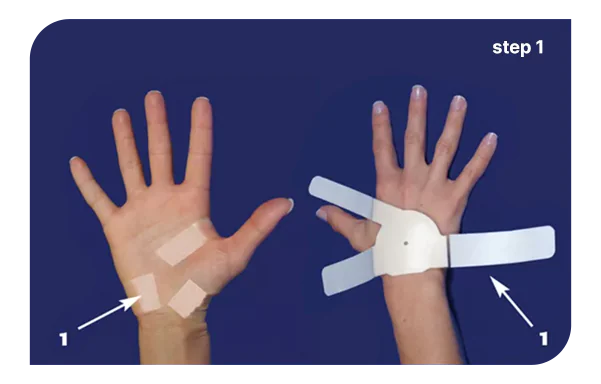
STEP 1: Place the Carpal Solution on the Back of the hand as shown with adhesive side down. Attach 1st strap below little finger securing it on the palm. Tear away excess tape to prevent overlap of straps on palm.
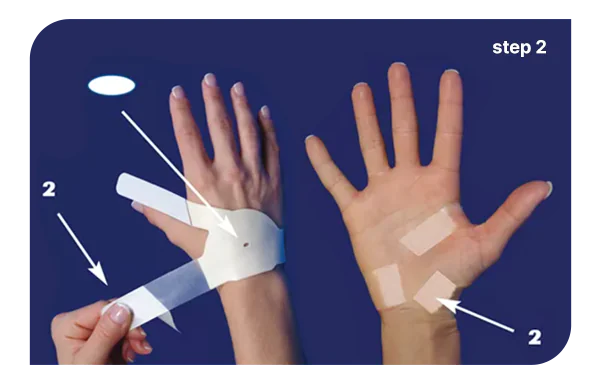
STEP 2: Self apply the appropriate tension to the Carpal Solution with 2nd strap below the thumb and attached on palm side of hand as shown. Adjust tension by stretching circular hole on back of hand in the elastic centerpiece to an oval shape. The diameter should be at least 1.5 times the original.
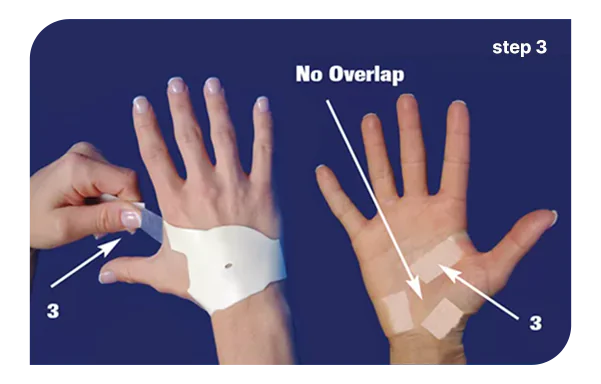
STEP 3: Self apply the appropriate tension to the Carpal Solution with 3rd strap above the thumb. Tear-away straps should be aligned so there is no overlap of straps on palm side of hand. The Carpal Solution begins to relieve symptoms usually within twenty minutes of placement.
Start with a safe, conservative treatment for RSI pain, backed by a 30-Day Patient Satisfaction Guarantee, before you consider surgery.
Where Surgery Fits
Surgery is the last resort, not the first answer to a repetitive strain injury. Carpal tunnel surgery has a patient satisfaction rate lower than 69%: about 31% of patients report lingering or recurring symptoms, and no patient is satisfied with lingering symptoms (see the 31% Problem). About 8% say their condition is worse after surgery, and second surgeries have a patient satisfaction rate of only 16% to 40%.
Surgery also does nothing about the repetitive work that caused the problem. Even after a successful surgery, symptoms often return: 57% had at least some symptoms return within 5.5 years in one study (Nancollas, 1995). Our doctors estimate 80 to 90% within 10 years from two decades of clinical experience; that is their best estimate, not a statistically researched figure. Read more about recurrence after surgery.
The Carpal Solution comes with a 30-Day Patient Satisfaction Guarantee and is billed under HCPCS code L3924; many health insurance plans reimburse 70 to 80%. For general background, see the NINDS carpal tunnel syndrome fact sheet, and ask your doctor about repetitive strain injury treatment in your case.
When Healing Needs a Doctor’s Help and Professional Medical Evaluation
- Constant numbness that does not improve or loss of feeling in the fingertips that does not improve in 4 to 8 weeks.
- Extreme loss of the muscle at the base of the thumb, with loss of grip strength that does not improve over 6 to 8 weeks.
- Worsening symptoms over 6 to 8 weeks while using the best conservative treatments
- Symptoms that begin suddenly after hand or wrist trauma, a fracture or severe sprain from a fall or auto accident.
- Odd Symptoms that are not consistent with the Carpal Tunnel Symptoms listed on this website, that might be indicative of other nerve issues. A nerve conductivity study can clear up the confusion with minimal costs and not too much pain and no risk.
These signs may mean more advanced nerve involvement or a different condition and deserve professional medical evaluation and in person consultation. Home treatment can be used alongside professional in-person medical care while you wait for the healthcare delivery system to fit you into their schedule. There is no reason to wait doing nothing. You can start proven natural conservative treatment with good patient reviews while you wait for your appointments. If your symptoms start improving over 6 to 8 weeks, then you know you are on the right track and surgery is not necessary.
Repetitive Strain Injury FAQ
What is the most common repetitive strain injury?
Carpal tunnel syndrome is the most common repetitive strain injury of the hand. Tendinitis, De Quervain’s tenosynovitis, trigger finger and tennis elbow are other common types.
Is RSI the same as carpal tunnel syndrome?
No. RSI is an umbrella term for injuries caused by repeated motion. Carpal tunnel syndrome is one specific RSI, in which swelling compresses the median nerve at the wrist.
What is the best repetitive strain injury treatment for carpal tunnel?
Our doctors recommend conservative care first, anchored by nighttime passive stretching with the Carpal Solution. Most people are better from their worst symptoms in two to three weeks, and over 90% reach remission by 6 weeks.
Can a repetitive strain injury heal on its own?
Mild strain may ease with rest, but most people cannot stop the work that caused it. Carpal tunnel syndrome is cyclical, and trapped swelling tends to keep the symptoms going until the cycle is broken.
Should I wear a wrist splint for RSI?
For carpal tunnel syndrome, our doctors do not recommend rigid splints long term. A splint can reduce pain from movement but does not promote healing, and immobilization causes muscle atrophy.
How do I prevent a repetitive strain injury?
Use sound ergonomics, take regular breaks, loosen your grip, and after carpal tunnel treatment use prevention nights with the Carpal Solution from once a week to once every six months.
Sources
- National Institute of Neurological Disorders and Stroke. Carpal Tunnel Syndrome fact sheet.
- Journal of Ultrasound, 2012: anatomy of the carpal tunnel. PMC3558235.
- Bland JDP. Patient-reported outcome of 1,268 carpal tunnel operations. Muscle & Nerve, 2001. PubMed 11410921.
- Bland JDP. Review of 209 studies (32,936 operations) of carpal tunnel surgery outcomes. Muscle & Nerve, 2007.
- Louie D, Earp B, Blazar P. Long-term outcomes of carpal tunnel release: a critical review of the literature. Hand, 2012 (reviews Nancollas 1995). PMC3418353.
- AMN Healthcare. 2025 Survey of Physician Appointment Wait Times.
Watch videos of people who “Cured” their Carpal Tunnel Naturally and Avoided the Risks of Carpal Tunnel Surgery!