 Created by renowned Harvard health care professionals.


Self Test for Carpal Tunnel: Two Simple Checks
Often a family Doctor, Personal Healthcare Provider, or Emergency Room Doctor will have you perform simple non-invasive tests that will provide a strong indication of whether or not you are experiencing Carpal Tunnel Syndrome (CTS). If you would prefer to learn the two common tests performed by Doctors then read below:
Self Test for Carpal Tunnel, Test 1: Phalen’s Maneuver
This self test for carpal tunnel takes about two minutes and works like a simple carpal tunnel home test or quiz: two checks doctors use in the office, which you can try at home before your appointment. A positive result is not a diagnosis, but together with your symptoms it tells you a lot.
Table of Contents
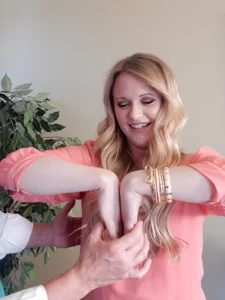 In Phalen’s Maneuver, the wrists are touched together in force flexion with the elbows extended and the hands pointing down toward the ground parallel to each other as in the photograph above.
A patient is asked to hold this position for sixty seconds. If a state of Paresthesias is produced during this time in the area of the hand that is controlled by the Median Nerve, then it is concluded that the patient likely has Carpal Tunnel Syndrome.
Paresthesia is a medical term which basically means a tingling sensation or the familiar “pins and needles” sensation a person feels when a limb is “falling asleep”. Another common sensation where Paresthesias is encountered is when someone strikes their elbow on an edge of a counter or desk and the say they hit their “funny bone”.
Some people describe it as a tickling or prickling sensation or even sometimes as a burning sensation.
Phalen’s Maneuver could easily be performed as a Self-Test for Carpal Tunnel at home to get an indication confirming that you likely have Carpal Tunnel Syndrome or you likely do not have this chronic condition of the hand and wrist.
The Median Nerve
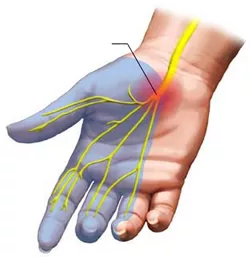
The area of the body affected and controlled by the Median Nerve runs from the cortex of the brain through the neck, shoulder, elbow, forearm, wrist, then through the Carpal Tunnel at the base of the hand and out to the thumb, index finger, middle finger and part of the ring finger.
How to Test for Carpal Tunnel at Home: Step by Step
How to Test for Carpal Tunnel Syndrome at Home
If you are wondering how to test for carpal tunnel syndrome without waiting for an appointment, start with three steps: take the do I have carpal tunnel quiz below, try the two hand checks on this page, and note which fingers are involved. Our doctors’ two decades of clinical experience is that people with three or more of the classic symptoms can be about 95% confident it is carpal tunnel (clinical experience, not a published statistic). A doctor should still confirm it.
How Do You Test for Carpal Tunnel Syndrome? Step by Step
- Step 1: Map your fingers. Numbness or tingling in the thumb, index, middle and half of the ring finger fits carpal tunnel; the little finger usually does not.
- Step 2: Hold Phalen’s position (backs of the hands together, wrists bent down) for 60 seconds and note any tingling.
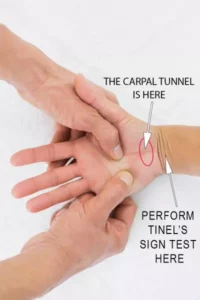
- Step 3: Tap gently over the palm side of the wrist crease (Tinel’s sign) and note any electric tingling into the fingers.
- Step 4: Count your symptoms with the quiz and write down your results for your doctor.

Optional: the reverse Phalen test holds the palms together in a prayer position with the wrists bent back for 60 seconds. Tingling in the thumb, index or middle finger counts as positive.
Carpal Tunnel Home Test vs. a Doctor’s Exam
A carpal tunnel home test uses the same quick checks doctors use in the office, so it is a good first step. A doctor adds a hand exam, strength testing and, when needed, a nerve conduction study. Testing for carpal tunnel at home works best when you do it at the end of the day, when symptoms are strongest, and repeat it on a second day.
Home Test for Carpal Tunnel Syndrome: What a Positive Result Means
A positive home test for carpal tunnel syndrome means your median nerve is likely irritated. A negative result does not rule it out, especially early on. Either way, tell your doctor’s office about constant numbness, weakness or thinning at the base of the thumb so they can see you sooner.
Carpal Tunnel Syndrome Test at Home: What to Do Next
If your carpal tunnel syndrome test at home points to carpal tunnel, you can start a natural, non-invasive treatment developed by doctors while you wait for your appointment. Most people are better from their worst symptoms in two to three weeks with the Carpal Solution. Carpal tunnel surgery has a patient satisfaction rate lower than 69%, so conservative care first makes sense.
Your Carpal Tunnel Self Test Checklist
Use this carpal tunnel self test checklist each time: which fingers, worse at night or not, Phalen’s result, Tinel’s result and your quiz score. For more on how to test for carpal tunnel at home with Phalen’s and Tinel’s checks, see Phalen test and Tinel sign explained and our main carpal tunnel symptoms page.
Self Test for Carpal Tunnel, Test 2: Tinel’s Sign
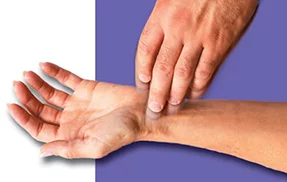 The test known in the medical community as Tinel’s Sign involves holding the hand and wrist flat on a table or padded surface or supported by the physician’s hand, then lightly tapping on the Median Nerve just behind the Carpal Tunnel.
The Carpal Tunnel is located at the base of the hand between the two muscular areas of the hand. So, the light percussion or tapping is done at the underside of the wrist just behind the Carpal Tunnel itself. If the light tapping produces paresthesia, the tingling sensation, along the nerve path in either direction in the nerve distribution path, then this is a positive sign of Carpal Tunnel Syndrome and likely means the patient is experiencing CTS.
Tinel’s Sign is also a test that can be performed as a Self-Test for Carpal Tunnel Syndrome.
There is no need for specialized medical equipment and the diagnosis is confirmed by what the patient is feeling when the tapping goes on.
It is important that the tapping is not too rigorous, because this type of tapping can produce the tingling sensation even when Carpal Tunnel is not present if overdone.
Where to perform Tinel’s Sign Test
The Carpal Tunnel is located at the base of the hand, just above the wrist between the two largest muscles of the hand.
Often people mistakenly think that the Tunnel is located in the wrist, because when people feel pain and discomfort from Carpal Tunnel Syndrome, it is often concentrated in the joint closest to the Tunnel.
However, the narrow passage, known as the Carpal Tunnel, is not in the wrist, it is at the base of the hand next to the wrist.
To perform the Tinel’s Sign self test for Carpal Tunnel, lightly tap just behind the Carpal Tunnel.
Do I Have Carpal Tunnel Quiz: Count Your Symptoms
Phalen’s Maneuver and Tinel’s Sign check your median nerve. This short carpal tunnel quiz checks your symptoms. Use it together with your self test for carpal tunnel. Count how many of these you have had in the last month:
- Numbness in your thumb, index, middle or ring finger
- Tingling or “pins and needles” in your fingers
- Symptoms that wake you at night or are worst in the morning
- Dropping things, or a weaker grip
- Clumsy fingers when buttoning, tying shoes or picking up coins
- Burning or electric-like shocks in your hand
- Pain at the base of your thumb or in your wrist
- Pain or aching that runs up your forearm
- Trouble using a computer mouse, phone or tools for long
- Hands that feel cold, stiff or like sandpaper
What Your Carpal Tunnel Quiz Score Means
In our doctors’ two decades of clinical experience (not a published statistic), people with one of these carpal tunnel symptoms have about a 70 to 80% chance of having carpal tunnel syndrome, and people with two have about 80 to 90%. People with three or more can be about 95% confident. If your self test for carpal tunnel was also positive, the picture is even clearer. A negative self test for carpal tunnel with three or more symptoms still deserves a doctor’s visit.
This carpal tunnel symptom checker is not a diagnosis. Get an in-person evaluation and a formal diagnosis from your doctor, and see a doctor promptly for constant numbness, weakness or thinning of the thumb muscle. With that confidence, you can start a natural, non-invasive treatment developed by doctors, like the Carpal Solution, while you wait for your appointment. It has 97% patient satisfaction over 21 years and 4.9 out of 5 stars on Google. See the full list of carpal tunnel symptoms.
Other Carpal Tunnel Symptoms Test Options Doctors Use
Your self test for carpal tunnel at home uses the same two checks many doctors start with. At your appointment, your doctor may add one or more of these, depending on your symptoms.
Carpal Compression Test (Durkan’s Test)
The doctor presses both thumbs firmly over the carpal tunnel at the base of your palm for about 30 seconds. If numbness or tingling shows up in your fingers, the test is positive. It is quick and painless, and it checks the same median nerve as Phalen’s and Tinel’s.
Two-Point Discrimination and Sensation Checks
The doctor lightly touches your fingertips with one or two points to see how well you can tell them apart, or checks how well you feel light touch. Reduced feeling in the thumb, index and middle fingers points toward the median nerve.
Grip and Pinch Strength
This one also works as a simple self test for carpal tunnel: notice whether pinching small objects feels harder than it used to. Weakness when you pinch or grip, or thinning of the muscle at the base of your thumb, tells the doctor how much the nerve is affected. See our signs of carpal tunnel for what to watch for.
Nerve Conduction Study and EMG
If your symptoms are unusual or your doctor wants to measure the nerve directly, a nerve conduction study can clear up the confusion with minimal cost, not too much pain and no risk. It measures how fast signals travel through the median nerve. Learn more about nerve conduction testing.
Ultrasound
Some clinics use ultrasound to look at the median nerve and the swelling around it inside the carpal tunnel.
None of these tests treat carpal tunnel syndrome, and neither does a self test for carpal tunnel; they only tell you what is going on. While you wait for appointments and test results, conservative-first care that follows medicine’s “Do No Harm” principle lets you start relieving symptoms at home tonight.
Do you have Two or More of the Common Symptoms of Carpal Tunnel?
Even though you can accurately self-diagnose CTS, it is important to see your doctor and get a formal diagnosis as soon as you can.
While you are waiting to see your doctor for his formal medical diagnosis, you can begin treatment with non-invasive therapy like the Carpal Solution Therapy.
This unique and affordable device is designed to be worn at night during sleep when the hand is relaxed. It is so convenient and easy to use. If your results suggest mild symptoms, read Mild Carpal Tunnel Treatment: What to Do First.
If you have two or more of the symptoms describe on our Carpal Tunnel Symptoms page, you can safely conclude that you likely have Carpal Tunnel Syndrome and begin to take corrective action with the Carpal Solution Therapy.
 While you are at your doctor you should also pick up a prescription for health insurance reimbursement.
The prescription should read: Hand Finger Orthosis for Carpal Tunnel Syndrome
Read More on Health Insurance Reimbursement for The Carpal Solution
After Your Self Test for Carpal Tunnel
If either check brings on tingling or numbness in your thumb, index or middle finger, treat this self test for carpal tunnel as positive and book a visit with your doctor. You do not have to wait to start feeling better: a natural, conservative treatment with strong patient reviews is safe to begin while you wait, and the average new-patient appointment takes 31 days (The Waiting in Healthcare). For more tests, see Tinel and Phalen tests.
If surgery comes up later, know that carpal tunnel surgery has a patient satisfaction rate lower than 69%, because about 31% of patients report lingering or recurring symptoms, and no patient is satisfied with lingering symptoms (Bland, Muscle & Nerve, 2001).
Other Signs to Check Along With Your Self Test
The two checks above work best alongside your everyday symptoms. Note which of these you have had in the last month:
- Numbness or tingling in the thumb, index, middle or half of the ring finger
- Waking at night with numb hands, then shaking them out
- Dropping things, or trouble with buttons, keys or jar lids
- Aching that runs from the wrist up into the forearm
- Weakness or thinning of the muscle at the base of the thumb
Our doctors’ two decades of clinical experience is that three or more of these, plus a positive self test for carpal tunnel, point strongly to carpal tunnel syndrome. See the full carpal tunnel symptoms list.
Self Test for Carpal Tunnel: FAQ
How accurate is a carpal tunnel home test?
Phalen’s maneuver and Tinel’s sign are quick screening checks, not a diagnosis. A doctor’s exam, and sometimes a nerve conduction study, confirms it.
What if my self test is negative but I still have symptoms?
A negative test does not rule out carpal tunnel. If your symptoms match, see your doctor.
Can I start treatment before I see a doctor?
Yes. A safe, natural treatment can relieve sleep loss, numbness and pain while you wait for your appointment.
When Healing Needs a Doctor’s Help and Professional Medical Evaluation
- Constant numbness that does not improve or loss of feeling in the fingertips that does not improve in 4 to 8 weeks.
- Extreme loss of the muscle at the base of the thumb, with loss of grip strength that does not improve over 6 to 8 weeks.
- Worsening symptoms over 6 to 8 weeks while using the best conservative treatments
- Symptoms that begin suddenly after hand or wrist trauma, a fracture or severe sprain from a fall or auto accident.
- Odd Symptoms that are not consistent with the Carpal Tunnel Symptoms listed on this website, that might be indicative of other nerve issues. A nerve conductivity study can clear up the confusion with minimal costs and not too much pain and no risk.
These signs may mean more advanced nerve involvement or a different condition and deserve professional medical evaluation and in person consultation. Home treatment can be used alongside professional in-person medical care while you wait for the healthcare delivery system to fit you into their schedule. There is no reason to wait doing nothing. You can start proven natural conservative treatment with good patient reviews while you wait for your appointments. If your symptoms start improving over 6 to 8 weeks, then you know you are on the right track and surgery is not necessary.
Our doctors’ experience: Over two decades, our doctors have found that people with three or more of the carpal tunnel symptoms listed on this website can be about 95% confident they have carpal tunnel syndrome. This is clinical experience, not a published statistic.
You should still get an in-person evaluation and a formal diagnosis from a doctor, and see one promptly if you have constant numbness, weakness or thinning at the base of the thumb.
With that level of confidence, many people start a natural, non-invasive treatment developed by doctors, like the Carpal Solution, with 97% patient satisfaction and 4.9 out of 5 stars on independent review sites like Google Reviews, while they wait for their appointment. The wait is real: a new-patient appointment with a doctor now takes an average of 31 days (AMN Healthcare, 2025), and seeing a neurologist or hand surgeon can mean more waiting.

Order Your Six Week Carpal Tunnel Treatment Now
The ONLY treatment for carpal tunnel that comes with a no questions asked 30-Day Satisfaction Window and in-house dedicated pain relief team.
