 Created by renowned Harvard health care professionals.


Continuity of Care: Why Hand Surgery Falls Short of Hips and Knees, and Why Carpal Tunnel Care Is Ripe for Disruption
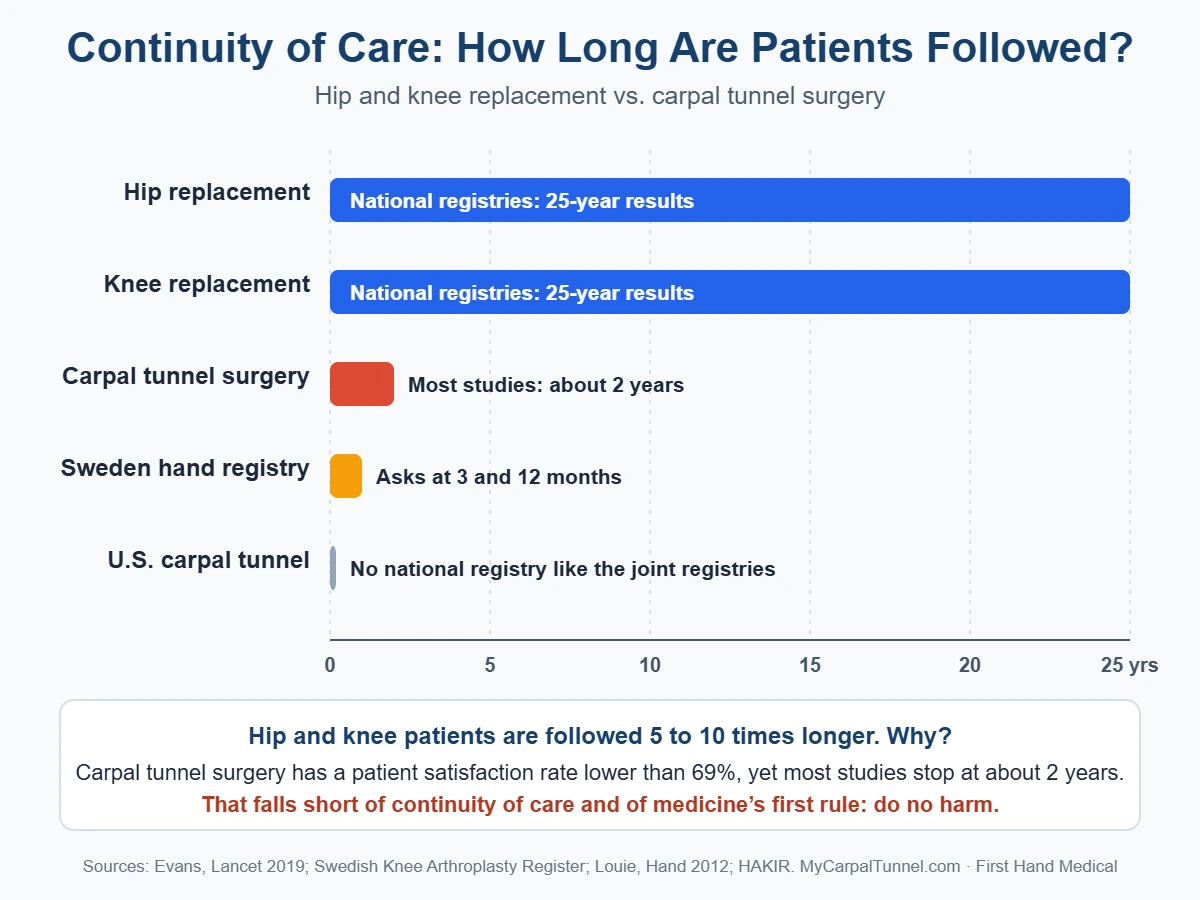
Continuity of care is a founding principle of medicine: outcomes are judged over the years after treatment. Hip and knee patients are followed 5 to 10 times longer than carpal tunnel surgery patients. Our doctors explain why that falls short of do no harm, and why carpal tunnel care is ripe for disruption.

Continuity of Care: A Founding Principle of Medicine
Written by Dr. Benjamin E. Bierbaum, MD, orthopedic surgeon and international expert in hip and knee replacement, clinical professor of orthopedic surgery at Harvard Medical School for more than 25 years, and Jeff Conley, President, First Hand Medical · Medically reviewed by Dr. Joseph E. Scherger, MD, MPH, family physician, clinical professor, UC San Diego School of Medicine · Last reviewed: November 2026
Continuity of care is one of medicine’s founding principles: a patient’s outcome is judged across the years that follow treatment, not at the final post-op visit. Hip and knee surgeons have built their specialty around it. National registries follow joint replacement patients for 20 to 25 years and ask them, again and again, how satisfied they are.
Hand surgery has not held itself to that standard. Carpal tunnel release is one of the most common operations in the country, yet most of its outcome studies stop at about two years. Our hands matter to quality of life as much as our hips and knees. This article explains what continuity of care means, how far hand surgery falls short, why that also falls short of “do no harm,” and why carpal tunnel treatment is ripe for a better way forward.
On This Page
Key points
- Continuity of care means following patients over time, keeping their care connected and holding treatment accountable for long-term results.
- Hip and knee registries follow patients for 25 years; Sweden’s knee registry has asked patients about satisfaction since 1975.
- Hip and knee patients are followed 5 to 10 times longer than carpal tunnel surgery patients, and there is no good medical reason for the gap.
- Carpal tunnel surgery has a patient satisfaction rate lower than 69%, yet most studies stop at about two years.
- A treatment can’t be called safe and effective when its long-term results are largely unknown. That falls short of “do no harm.”
- Carpal tunnel care is screaming for a better way: conservative first, followed for life.
Continuity of Care Definition: What Does Continuity of Care Mean?
What is continuity of care? The simplest continuity of care definition: following a patient’s treatment and results over time, rather than treating one episode and moving on. A landmark review of 583 documents across medicine, published in the BMJ in 2003, found three types of continuity recognized in every discipline:
- Informational continuity: what is learned about a patient is carried forward, so each visit builds on the last.
- Management continuity: care stays consistent and connected across doctors and settings, so nothing falls through the cracks.
- Relational continuity: an ongoing relationship between the patient and the clinicians who know them.
Our doctors add a fourth that surgery depends on: long-term accountability. Outcomes are measured over the long run, so problems that show up later are caught and counted. In one line, continuity of care means a patient’s outcome is judged across the years that follow, not at the final post-op visit.
Why Is Continuity of Care Important?
Continuity is not a nicety. A 2018 systematic review in BMJ Open looked at every study it could find on continuity of care with doctors and death rates. Of the 22 studies that qualified, 18 found that patients who saw the same doctors over time had significantly lower mortality, with both generalists and specialists. The authors also noted its links to higher patient satisfaction, better adherence to medical advice and fewer hospital visits.
For surgery, continuity answers the question patients care about most: will this still be working for me in 10 or 20 years? Without long-term follow-up, nobody can answer it honestly, and better patient outcomes depend on knowing that answer.
Continuity of Care Examples: How Hip and Knee Surgeons Set the Standard
Hip and knee replacement offers the clearest continuity of care examples in surgery. The specialty treats every operation as something to be watched for the rest of the patient’s life.
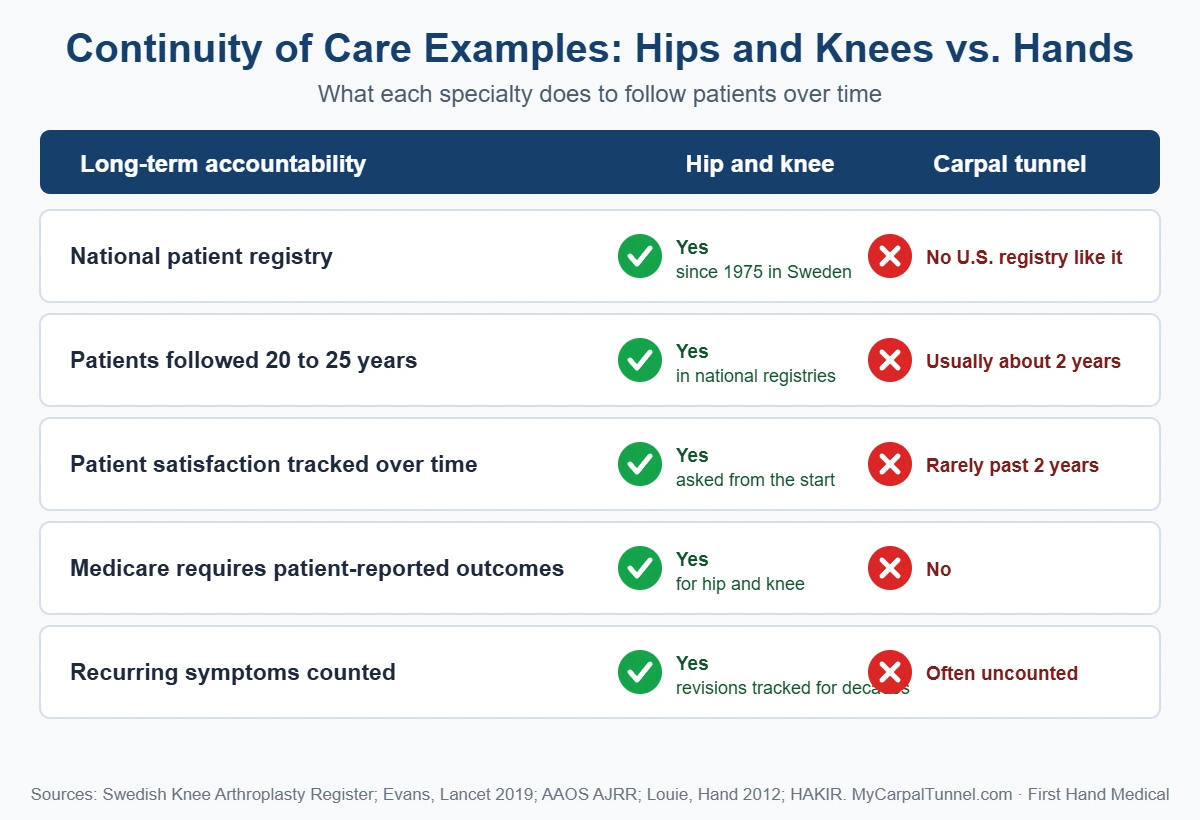
- Sweden, 1975: the Swedish Knee Arthroplasty Register became the world’s first national joint registry. It asked patients about their satisfaction from the start, and in 1997 it surveyed every living patient operated on since 1975.
- National joint registry data, 25 years out: pooled registry results published in The Lancet in 2019 showed about 58% of hip replacements and about 82% of total knee replacements still working at 25 years. Surgeons can tell patients what to expect because someone kept counting.
- The American Joint Replacement Registry: the AAOS registry now holds data on more than 5 million hip and knee procedures from all 50 states and collects patient-reported outcomes.
- Medicare: hospitals report patient-reported outcomes for hip and knee replacement under a mandatory Medicare measure.
This is a patient registry culture: follow everyone, ask patients how they are doing, publish the results and change practice when something isn’t holding up.
Hands Matter as Much as Hips and Knees
We walk on our hips and knees, but we live through our hands. Hands dress us, feed us, earn our living, hold our grandchildren and let us write, play music and care for others. Loss of feeling, grip or dexterity can end a career as surely as a worn-out knee.
Carpal tunnel surgery is also big business. More than 500,000 carpal tunnel releases are performed each year in the United States, at a cost of over $2 billion. An operation done that often, on a body part that important, deserves at least the same long-term scrutiny as a hip or a knee.
Where Hand Surgery Falls Short of Continuity of Care
Followed 5 to 10 Times Longer: Hips and Knees vs. Hands
Put the numbers side by side. Hip and knee replacement results are routinely tracked for 20 to 25 years. Carpal tunnel surgery is usually studied for about 2 years, and only rarely for 4 to 7. That is a 5 to 10 times difference in how long patients are followed, and for most carpal tunnel studies the gap is even wider.
Hand surgery has not held itself to the same standard:
- Short studies: a 2012 review of the carpal tunnel release literature found that so-called long-term studies have rarely gone beyond two years, which the reviewers warned may be too short for a chronic condition that can come back.
- Short registries: Sweden’s national hand surgery registry, started in 2010, asks patients about their results only at 3 and 12 months, and in one analysis only about 25% answered at 12 months.
- No U.S. registry like the joint registries: there is no national system that follows carpal tunnel surgery patients the way hip and knee patients are followed.
- A handful of small long-term studies: each from a single center and a few hundred patients at most, like the Boston study below.
The Real Numbers: Every Result as a Percent of All Patients
The best-known long-term carpal tunnel study, published in the Journal of Bone and Joint Surgery in 2013, followed the 211 patients one fellowship-trained surgeon at a Boston hospital operated on between 1996 and 2000. Its headline result, repeated in news coverage, is that 88% of patients were completely or very satisfied an average of 13 years later.
That 88% is a percent of the 113 patients who answered the questionnaire, not of the 211 who had the operation. Here is every number in the study restated as a percent of all patients:
| What the study counted | Patients | Percent of all 211 | Percent as reported (of 113 who answered) |
|---|---|---|---|
| All patients operated on (1996 to 2000) | 211 | 100% | — |
| Located 11 to 17 years later | 194 | 92% | — |
| Had died | 54 | 26% | — |
| Could not be located | 17 | 8% | — |
| Alive but did not answer | 27 | 13% | — |
| Answered the questionnaire | 113 | 54% | 100% (the base used) |
| Completely or very satisfied | 97 | 46% | 88% |
| Somewhat satisfied | 4 | 2% | 4% |
| Somewhat or very dissatisfied | 9 | 4% | 8% |
| Symptoms completely resolved | about 84 | about 40% | 74% |
| Repeat surgery reported | 2 | 1% | 1.8% |
Measured against everyone who had the operation, 46% can be confirmed as completely or very satisfied and about 40% as free of symptoms. Even counting only the 140 patients still alive, 69% confirmed being satisfied. The outcomes of 98 patients, 46% of the total, were never measured: 54 had died, 17 could not be found and 27 did not answer. Repeat surgery was counted only among the 113 who answered, so any repeat operations among the other 98 are unknown.
The study’s authors printed these counts in their abstract. But the number carried forward, and the one most patients will ever hear, is 88%. Choosing the respondents as the base produces the most favorable result. Patients who have died cannot answer, and patients unhappy with their outcome are the least likely to answer a survey from the surgeon’s own team, so counting only the people who write back pushes the number up.
Why the Framing Matters in Medicine
Putting the best number forward happens everywhere in business when people can get away with it. Medicine is held to a higher standard. Doctors take the Hippocratic Oath to do no harm, and good practice calls for conservative care first and continuity of care for every patient. When a patient is deciding whether to have an operation that can change their hands for life, they deserve the number that counts everyone, not just the people who answered. The fact is simple: in the best-known long-term study of carpal tunnel surgery, fewer than half of all patients were confirmed satisfied 13 years later.
Meanwhile, what we do know is sobering. Carpal tunnel surgery has a patient satisfaction rate lower than 69%, because about 31% of patients report lingering or recurring symptoms. In one study, 57% had at least some symptoms return within 5.5 years. Our doctors’ best estimate from two decades of clinical experience, not yet statistically researched, is that 80 to 90% see symptoms return within 10 years. Second surgeries have a patient satisfaction rate between 16% and 40%. See recurrence after carpal tunnel surgery for the full references.
Returning symptoms, lingering numbness, pillar pain and revision surgeries often go uncounted once the patient leaves the surgeon’s care. That falls well short of continuity of care.
Falling Short of Do No Harm and Accountability in Healthcare
Medicine’s oldest rule is “first, do no harm.” It asks more than avoiding mistakes in the operating room. It asks doctors to know, as far as they can, that a treatment helps more than it hurts over the patient’s life.
A procedure can’t be judged truly safe and effective when its long-term results are largely unknown. That is the heart of accountability in healthcare: you measure what happens to patients after they leave, and you let those patient outcomes change what you do. When an operation with a patient satisfaction rate lower than 69% is not followed past two years, the harms that come later stay invisible, and so does the case for safer options. Read more about conservative-first care and the do no harm principle.
The 5 to 10 Times Gap Begs the Question: Why?
Why would one branch of orthopedics follow its patients 5 to 10 times longer than another? Both operate on bones, joints and soft tissue. Both treat conditions that affect how people live and work. Both have the same tools for registries and surveys. Our doctors see no good medical reason for the gap. When a specialty performs more than 500,000 of an operation every year and still does not look past two years, it is hard to avoid the conclusion that it does not want to know.
The way the system works makes not knowing easy:
- Paid per episode: the system pays for the operation and a short recovery window, not for how the hand works ten years later.
- A short follow-up visit: once the stitches are out and the patient is “improved,” the surgeon’s formal follow-up usually ends.
- Success defined by surgeons, not patients: partial relief is often counted as success, while patients living with lingering symptoms are not satisfied.
- Patients scatter: when symptoms return, many people see a different doctor, try injections or splints, or simply live with it, and nobody adds them back to the count.
- No mandate: nothing requires long-term reporting for carpal tunnel surgery the way registries and Medicare do for hips and knees.
None of these is a good reason. Hip and knee surgeons face the same pressures and chose to look anyway. The result for carpal tunnel patients is a blind spot exactly where they need the most clarity.
Ripe for Disruption: A Better Way Forward
Our co-founder Dr. Jerome Grossman said no area of medicine was more primed for disruption than carpal tunnel care, and Professor Clayton Christensen called for simpler innovations that free up limited resources. Two decades later, the continuity gap makes their case stronger. Read the full story in disruptive innovation in medicine and value based care.
A better way forward starts with conservative first, then follows the patient for life. Swelling and entrapped inflammation in the soft tissue in and around the carpal tunnel squeeze the median nerve and restrict blood flow and lymphatic fluid transport. The Carpal Solution’s targeted passive stretching restores flexibility to the injured soft tissue, relieves pressure on the median nerve, relieves restrictions on blood circulation and lets lymph fluid flow freely to clear out the swelling. It is your body that does the healing; the Carpal Solution just jump-starts it.

- Measured over two decades: 97% patient satisfaction over 21 years, 4.9 out of 5 stars on independent review sites, and over 100,000 users.
- Results patients feel: most people are better from their worst symptoms in two to three weeks, and about 90% reach complete remission in six weeks.
- Built for the long run: carpal tunnel is chronic and recurring, so patients keep it in remission at home with preventive nights, from once a week to once every six months, and repeat the protocol if symptoms return.
- No downtime, no scar tissue: it is worn at night, costs less than $100 per hand with shipping, and health insurance typically reimburses 70 to 80% (HCPCS L3924).
That is continuity of care the patient can own: a safe treatment, a plan for life and a satisfaction record measured over decades.
What Patients, Insurers and Surgeons Can Do
- Patients: ask any surgeon how their patients are doing 5 and 10 years later, not just at the six-week visit. Try a well-reviewed conservative treatment for at least 12 weeks first.
- Insurers and health systems: require a trial of high-satisfaction conservative care before surgery, and fund long-term outcome tracking for the procedures you pay for.
- Hand surgeons: build a national carpal tunnel patient registry with patient-reported satisfaction at 1, 5, 10 and 20 years, as your hip and knee colleagues have done.
- Medical schools and researchers: run the 10- and 20-year studies that a procedure this common deserves.
Hip and knee surgeons have shown what continuity of care looks like. Patients’ hands deserve nothing less.
When Healing Needs a Doctor’s Help and Professional Medical Evaluation
- Constant numbness that does not improve or loss of feeling in the fingertips that does not improve in 4 to 8 weeks.
- Extreme loss of the muscle at the base of the thumb, with loss of grip strength that does not improve over 6 to 8 weeks.
- Worsening symptoms over 6 to 8 weeks while using the best conservative treatments
- Symptoms that begin suddenly after hand or wrist trauma, a fracture or severe sprain from a fall or auto accident.
- Odd Symptoms that are not consistent with the Carpal Tunnel Symptoms listed on this website, that might be indicative of other nerve issues. A nerve conductivity study can clear up the confusion with minimal costs and not too much pain and no risk.
These signs may mean more advanced nerve involvement or a different condition and deserve professional medical evaluation and in person consultation. Home treatment can be used alongside professional in-person medical care while you wait for the healthcare delivery system to fit you into their schedule. There is no reason to wait doing nothing. You can start proven natural conservative treatment with good patient reviews while you wait for your appointments. If your symptoms start improving over 6 to 8 weeks, then you know you are on the right track and surgery is not necessary.
Frequently Asked Questions About Continuity of Care
What is continuity of care?
Continuity of care means following a patient’s treatment and results over time, keeping care connected across doctors and holding treatment accountable for long-term results, rather than treating one episode and moving on.
Why is continuity of care important?
A 2018 systematic review found that 18 of 22 studies linked continuity of care with doctors to lower death rates, and continuity is also tied to higher patient satisfaction and better adherence to medical advice. In surgery, it is the only way to know whether a treatment still works years later.
How long are hip and knee replacement patients followed?
National joint registries report results 20 to 25 years after surgery. Sweden’s knee registry has followed patients and asked about their satisfaction since 1975, and the American Joint Replacement Registry holds data on more than 5 million procedures.
How long are carpal tunnel surgery patients followed?
Most carpal tunnel release studies stop at about two years, and only a handful of small studies go past 10. That is 5 to 10 times shorter than hip and knee replacement tracking.
Why is carpal tunnel surgery not followed longer?
Our doctors see no good medical reason. The system pays per episode, formal follow-up ends early, partial relief is counted as success and nothing requires long-term reporting. Hip and knee surgeons face the same pressures and track their patients anyway.
What can patients do?
Ask any surgeon how their patients are doing 5 and 10 years later, and try a well-reviewed conservative treatment such as the Carpal Solution for at least 12 weeks before considering surgery.
Sources
- Haggerty JL, et al. Continuity of care: a multidisciplinary review. BMJ. 2003;327:1219-1221. Link
- Pereira Gray DJ, et al. Continuity of care with doctors: a matter of life and death? A systematic review of continuity of care and mortality. BMJ Open. 2018;8:e021161. Link
- Robertsson O, et al. The Swedish Knee Arthroplasty Register: a review. Bone & Joint Research. 2014. Link
- Knutson K, Robertsson O. The Swedish Knee Arthroplasty Register: the inside story. Acta Orthopaedica. 2010. Link
- Evans JT, et al. How long does a hip replacement last? Lancet. 2019;393:647-654. Link
- Evans JT, et al. How long does a knee replacement last? Lancet. 2019. Link
- American Academy of Orthopaedic Surgeons. American Joint Replacement Registry. Link
- Louie D, Earp B, Blazar P. Long-term outcomes of carpal tunnel release: a critical review of the literature. Hand. 2012. Link
- Louie DL, et al. Outcomes of open carpal tunnel release at a minimum of ten years. J Bone Joint Surg Am. 2013;95(12):1067-1073 (211 patients; 54 died; 113 responded; 97 completely or very satisfied). Link
- Zimmerman M, et al. Cold sensitivity in carpal tunnel syndrome and outcome after open carpal tunnel release (Swedish hand surgery registry, HAKIR, response rates). 2020. Link
- Zimmerman M, et al. Open carpal tunnel release and diabetes: a retrospective study using PROMs and national quality registries (HAKIR asks at 3 and 12 months). BMJ Open. 2019. Link
- Bland JD. Do nerve conduction studies predict the outcome of carpal tunnel decompression? Muscle & Nerve. 2001 (patient-reported success 69%). Link
- Milone MT, et al. Analysis of expected costs of carpal tunnel syndrome treatment strategies. Hand (N Y). 2019. Link

Developed by First Hand Medical’s Team of Doctors and Medical Professionals
The Carpal Solution Treatment Kit was developed by our expert team of medical doctors who have worked at and led some of the top medical institutions in the World – Including Harvard Medical, Tufts Medical, UCSD Medical School, Florida State Medical School, and The Ohio State University Medical School. We treat root causes with clinically proven conservative treatments. The results: Quick Natural Relief of All Your Carpal Tunnel Symptoms without complications. Meet The Medical Team Backing The Carpal Solution at First Hand Medical

Order Your Six Week Carpal Tunnel Treatment Now
The ONLY treatment for carpal tunnel that comes with a no questions asked 30-Day Satisfaction Window and in-house dedicated pain relief team.

