 Created by renowned Harvard health care professionals.


Carpal Tunnel Syndrome in Medicine: Ripe for Disruptive Innovation
Why is carpal tunnel syndrome ripe for disruptive innovation? Surgery satisfaction lower than 69%, no long-term studies, temporary injections and splints, and over $2 billion a year. A value based care look at the evidence, built on what our founders Professor Clayton Christensen and Dr. Jerome Grossman said in 2005.

Why Is Carpal Tunnel Syndrome Ripe for Disruptive Innovation?
Written by Dr. Benjamin E. Bierbaum, MD, orthopedic surgeon and international expert in hip and knee replacement, clinical professor of orthopedic surgery at Harvard Medical School for more than 25 years · Medically reviewed by Dr. Joseph E. Scherger, MD, MPH, family physician, clinical professor, UC San Diego School of Medicine, co-chair, First Hand Medical advisory board · Last reviewed: November 2026
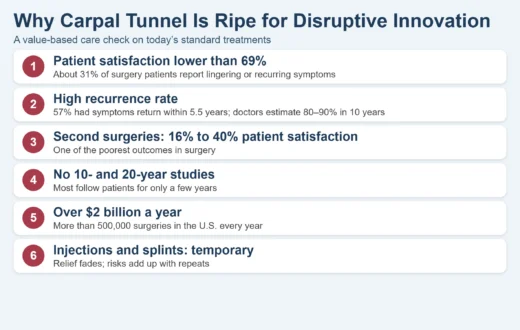
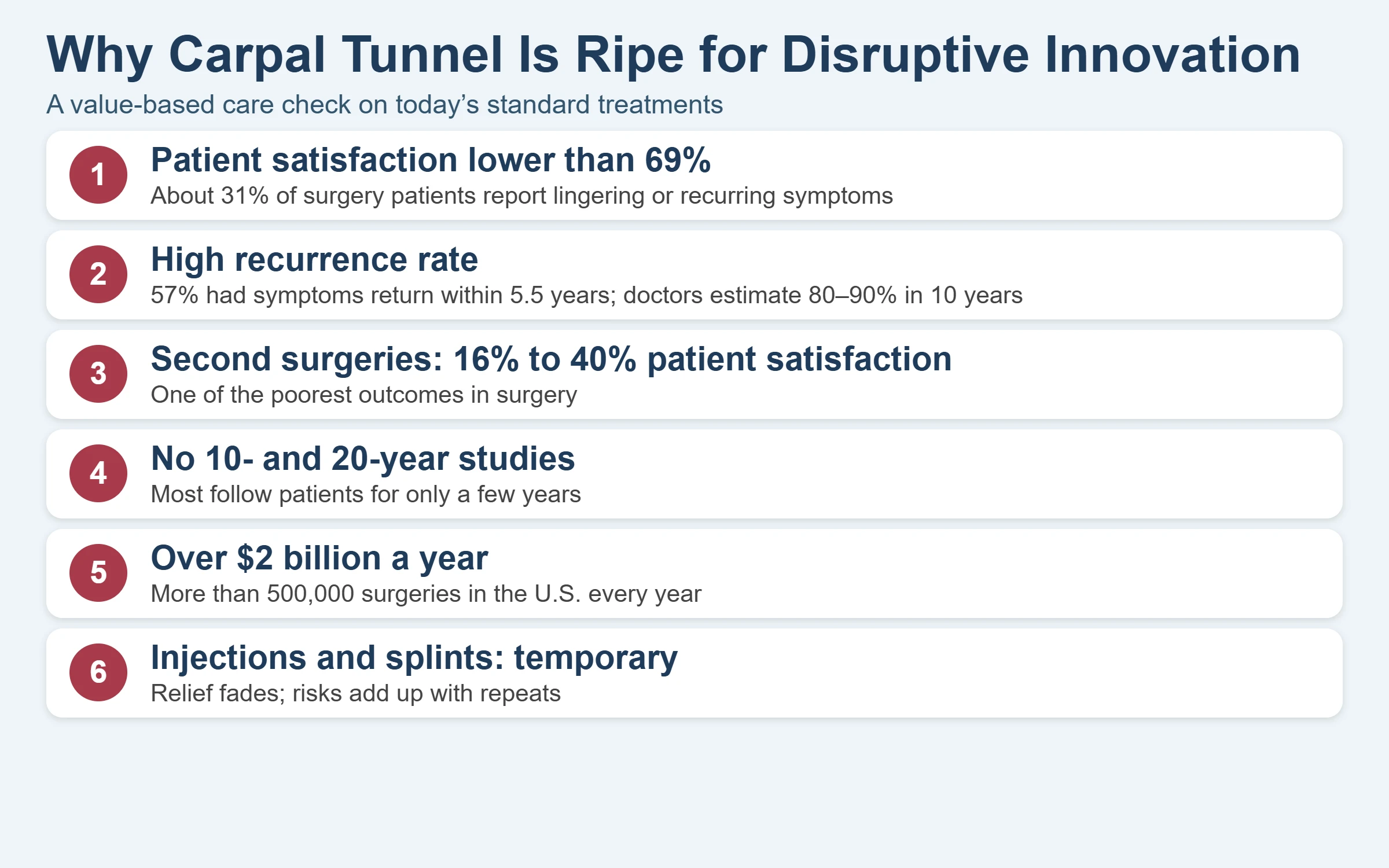
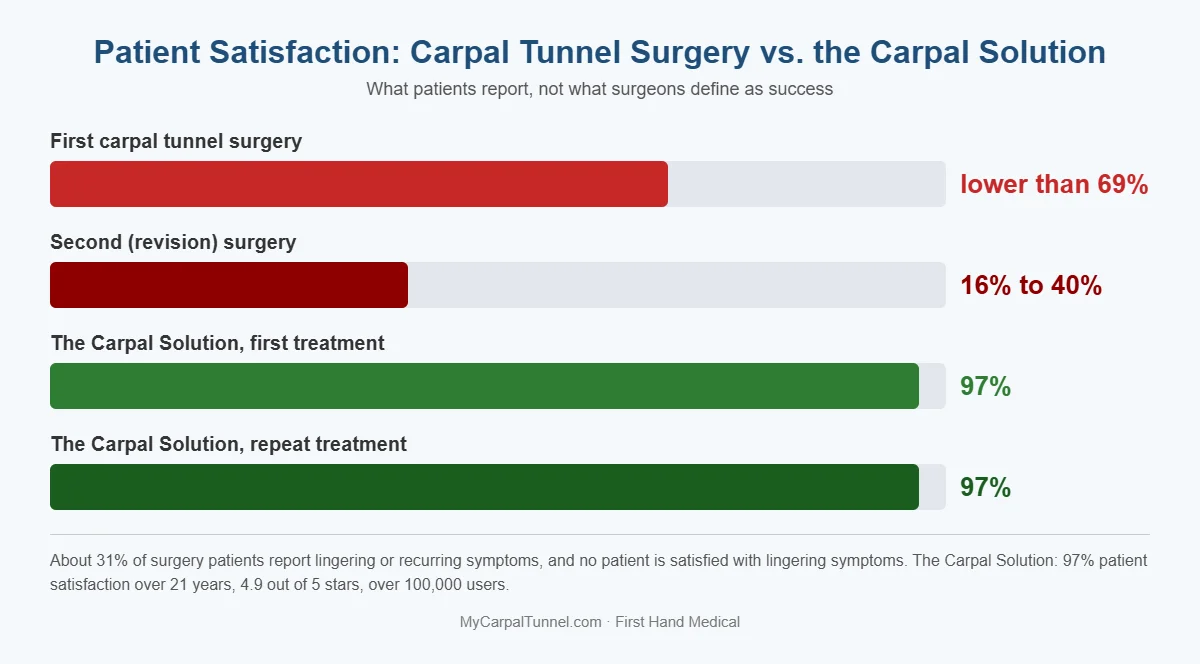
Carpal tunnel syndrome is ripe for disruptive innovation because the standard treatments fail the simplest test in value based care: do patients get a result they are satisfied with, at a cost the system can justify? Carpal tunnel surgery has a patient satisfaction rate lower than 69%, second surgeries fall to between 16% and 40%, almost no one has followed patients for 10 or 20 years, and the United States spends more than $2 billion a year on the operation. Injections and splints offer only temporary relief.
Our founders, Harvard Business School Professor Clayton M. Christensen and Dr. Jerome H. Grossman, MD, saw it in 2005. This article develops the case they made, point by point, with the evidence available today.
On This Page
- Low patient satisfaction. Lower than 69% after a first surgery, because about 31% of patients report lingering or recurring symptoms; 16% to 40% after a second.
- High recurrence rate. Even after a successful surgery, 57% of patients had symptoms return within 5.5 years in the highest published study; our doctors estimate 80 to 90% within 10 years from clinical experience.
- A different definition of success. Published “success rates” count patients who still have symptoms.
- Missing evidence. Almost no study has followed carpal tunnel patients for 10 or 20 years.
- High cost. More than 500,000 operations and over $2 billion a year in the United States.
- Temporary fixes. Steroid injections and splints relieve symptoms for a while but do not heal the tissue.
- A better option. A drug-free, at-home treatment with 97% patient satisfaction over 21 years and 4.9 out of 5 stars.
What Our Founders Saw in 2005: “No Area of Medicine Is More Primed for Disruption”
At the first board meeting of First Hand Medical in June 2005, two of the most respected voices in health care innovation explained why they joined as founders. Their words frame everything that follows.

Our founders’ ideas in print: The Innovator’s Dilemma by Clayton M. Christensen, and The Innovator’s Prescription by Christensen, Dr. Jerome H. Grossman and Dr. Jason Hwang.
“No area of medicine is more primed for disruption than the diagnosis and treatment of carpal tunnel syndrome (CTS). The patient satisfaction rate with surgery, steroid injections and splinting is low, with lots of complications, and CTS is a chronic recurring condition caused by entrapped lymph fluid and inflammation. There must be a simpler and better way to jump-start the body’s natural healing to disperse the entrapped inflammation.” — Dr. Jerome H. Grossman, MD, former CEO of New England Medical Center and Director of the Health Care Delivery Policy Program at Harvard’s Kennedy School
“Every once in a while, a new, simpler innovation comes along that solves a problem much more elegantly than the big, complex machinery that solved the problem historically… This type of innovation can also relieve some of the burden imposed on the healthcare delivery system. Eliminating unnecessary surgical procedures can free up limited resources and funding for other sectors of medicine that are screaming for attention.” — Professor Clayton M. Christensen, Harvard Business School
Dr. Grossman named the problem: low patient satisfaction across all three standard treatments, frequent complications, and a chronic, recurring condition driven by entrapped lymph fluid and inflammation. Professor Christensen named the opportunity: a simpler solution that frees up money and resources for the rest of medicine. Two decades later, the evidence below shows how right they were. Read their full statements in disruptive innovation in medicine.
What Is Value Based Care, and Why Carpal Tunnel Fails the Test
What is value based care? It is the idea that health care should be judged, and paid for, by the results patients actually get relative to what those results cost, rather than by how many procedures are performed. In a value based care world, a treatment that leaves a third of patients with lingering symptoms, takes months to recover from and costs billions of dollars a year would be the first place to look for something better.
Value Based Healthcare Measures What Patients Care About
Value based healthcare starts with the patient’s own verdict. A carpal tunnel patient wants three things: the numbness, tingling and pain gone, the use of their hands back, and no new problems from the treatment. Measured that way, today’s standard path for carpal tunnel (splint, then injection, then surgery) delivers mediocre value.
Disruptive innovation, the theory Harvard professor Clayton Christensen applied to health care, predicts exactly what happens next: a simpler, more affordable, more convenient option moves care out of the hospital and into the home.
In their book The Innovator’s Prescription, Christensen, Grossman and Dr. Jason Hwang opened with a line that fits carpal tunnel care exactly: “Today’s health-care industry screams for disruption.” Dr. Grossman spent his career arguing that better quality is also cheaper care. As he told an Institute of Medicine conference in 1991, “Investment in quality is the lowest cost way of achieving improved health status outcomes.” Read our doctors’ article on disruptive innovation in medicine.
Patient Satisfaction in Healthcare: Carpal Tunnel Surgery Ranks Near the Bottom
Dr. Grossman’s first point was that patient satisfaction is low. Patient satisfaction in healthcare is increasingly recognized as a measure of quality, and carpal tunnel surgery scores poorly on it. In a study of 1,268 operations, the patient-reported success of a first carpal tunnel release was 69%, which the author called a significant failure rate. Our doctors therefore state it plainly: carpal tunnel surgery has a patient satisfaction rate lower than 69%, because about 31% of patients report lingering or recurring symptoms, and no patient is satisfied with lingering symptoms. A review of 209 studies and 32,936 operations found that about 8% of patients say they are worse after surgery.
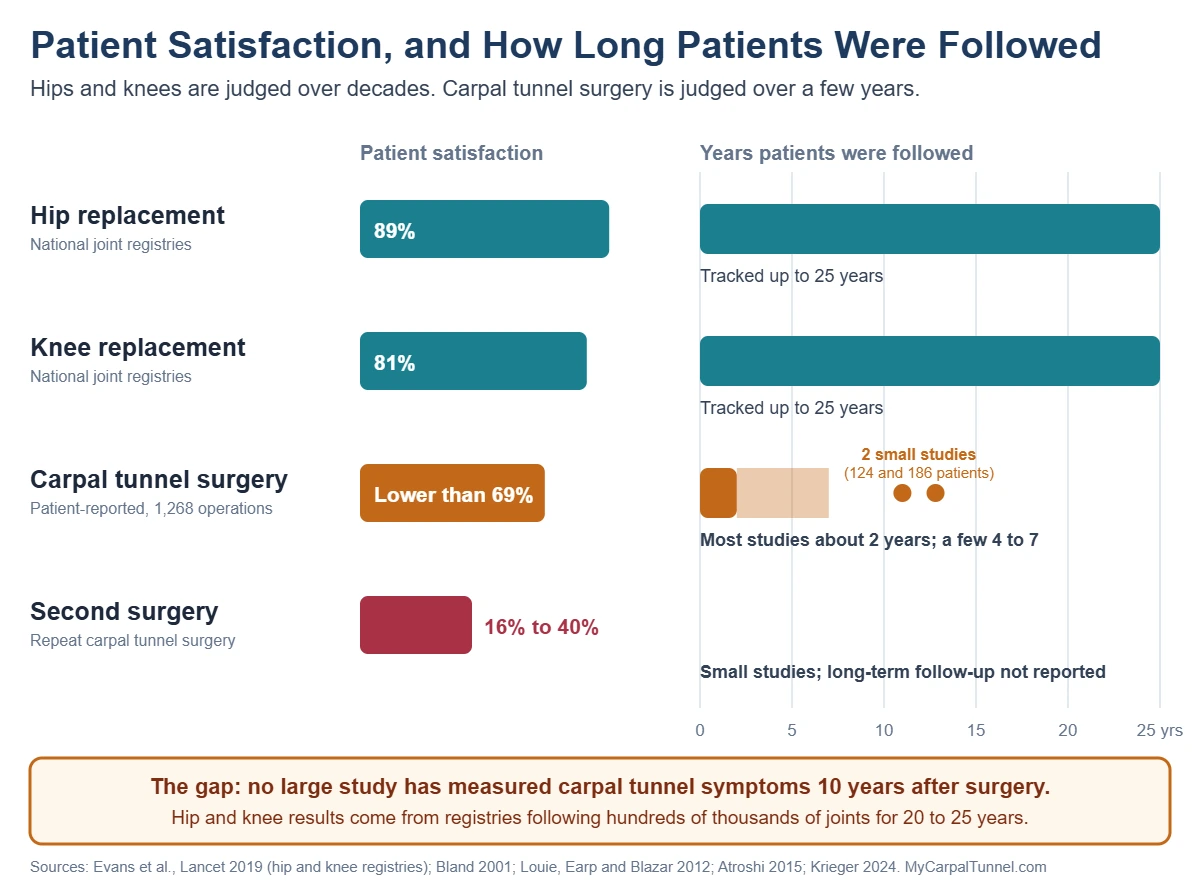
Look at the second column. Hip and knee replacement results come from national joint registries that follow hundreds of thousands of patients for 20 to 25 years. Carpal tunnel surgery is judged on a much shorter clock: most studies stop at about two years, a few reach four to seven, and only two small studies (124 and 186 patients) asked about symptoms more than 10 years later. That gap matters, because symptoms often start coming back about two years after surgery, so short studies can end before recurrence shows up. A satisfaction rate measured over two years is not the same promise as one measured over two decades.
Compare that with other orthopedic operations. In the Ontario joint replacement registry, 89% of hip replacement patients and 81% of knee replacement patients were satisfied. Second carpal tunnel surgeries do worse still, with a patient satisfaction rate between 16% and 40% based on lingering symptoms in the published literature. That makes carpal tunnel surgery one of the lowest patient satisfaction rates for surgery in medicine.
A Different Definition of Success Than the Rest of Surgery
How can surgeons report high success rates while patients report something else? The answer is in the definition. In much of the published carpal tunnel literature, “success” includes partial improvement: a patient who still has numbness, night symptoms or weak grip can be counted as a success if they are better than before. Carpal tunnel surgery is unusual in counting partial relief as success.
Patients see it differently. In medicine, the patient’s opinion rules, and patients expect a surgery, with its cost, risk and downtime, to end their symptoms. Lingering symptoms after surgery count as not satisfied. That gap between what researchers call success and what patients experience is why we report patient satisfaction, not “success rate.” Read the 31% problem and 6 carpal tunnel surgery myths.
Measuring Success the Way Patients Do
There is more than one way to define success in a study, and the definition chosen often decides the answer. When a study is designed to reach an intended result, it can miss what matters most in patient care: how the patient feels. At First Hand Medical, patient satisfaction is the measure we trust.
Some research on carpal tunnel surgery claims high success and little or no recurrence. Yet some of that research calls surgery a success when only part of the symptoms improve, and the patient keeps living with what is left. We do not rely on staged studies like these, because their idea of success is not the patient’s.
Patients judge by results. A surgery that leaves annoying symptoms behind does not satisfy anyone, and few people would choose the risks, recovery time and complications of carpal tunnel surgery unless they expected every symptom to go away. Value based care should be built on that standard.
We side with the patient’s perspective over contrived scientific results. Simpler medicine is smart medicine when it treats the root cause. It is not that complicated to get it right for the patient.
Evidence Based Medicine Needs 10- and 20-Year Carpal Tunnel Studies
Evidence based medicine depends on long-term data, and for carpal tunnel surgery that data is missing. Hip and knee replacements are followed for decades in national joint registries. Carpal tunnel release, performed more than 500,000 times a year in the United States, is rarely studied beyond a few years.
- Even after a successful surgery, symptoms often return: in the study with the highest published rate, 57% of patients had at least some symptoms return within 5.5 years (Nancollas, 1995).
- The only 10-year study counted reoperations, not symptoms (3.7%), which says nothing about whether patients were satisfied (Hankins, 2007). Only two small studies have tracked symptoms past 10 years.
- No study has followed patient satisfaction for 20 years.
- Our doctors’ estimate: from two decades of clinical experience, 80 to 90% of surgery patients see symptoms return within 10 years. This is not statistically researched; it is their best estimate until the work is done.
Why has no one followed carpal tunnel patients for decades, as other orthopedic fields do? We do not know, and we believe medical schools and hand surgery societies should fund those studies. Read recurrence after carpal tunnel surgery, with the full references.
Healthcare Costs: Over $2 Billion a Year for One Operation
Professor Christensen’s second point was cost. More than 500,000 carpal tunnel releases are performed each year in the United States, at a cost of over $2 billion, and that is before steroid injections, splints, nerve tests, therapy and time off work are added.
Rising Healthcare Costs and the Hidden Price of Downtime
Rising healthcare costs fall hardest on insurers, employers and patients, and carpal tunnel surgery carries costs that never appear on the surgical bill:
- Recovery time. Kaiser Permanente tells patients it usually takes 3 to 4 months to recover, and up to a year before hand strength returns.
- Pillar pain. Pain in the heel of the palm after surgery usually fades within three months but can last six months or more.
- Lost work. Weeks off the job, light duty, and workers’ compensation claims for people who use their hands for a living.
- Repeat care. When symptoms linger or return, the cycle of tests, injections and second surgeries begins again, with even lower patient satisfaction.
That is the burden Professor Christensen meant: money and medical resources spent on a treatment patients are often not satisfied with, which could fund “other sectors of medicine that are screaming for attention.”
Steroid Injections: Temporary Relief, Real Risks
Steroid injections were the second treatment Dr. Grossman named. They can quiet symptoms for a while, but the long-term record is weak:
- Most patients need more treatment. Reported rates of reinjection or surgery range from 10% to 81% within a year of the first injection; in a Mayo Clinic population study, only about one in three patients needed no further treatment over the following years.
- No lasting difference from placebo. In a randomized trial of 111 adults, five years after injection there was no difference in symptom improvement between two steroid doses and placebo.
- Risks add up. Injection can injure the median nerve (rare, fewer than 1 in 1,000), cause skin and fat changes, and with repeat shots raise the risk of nerve and tendon damage, which is why doctors limit how many one wrist can receive.
- They may affect later surgery. A 2014 study found preoperative steroid injections were associated with worse long-term results after carpal tunnel release.
An injection treats the inflammation for a few weeks or months; it does nothing to release the entrapped lymph fluid and swelling that keep coming back. Read corticosteroid injections for carpal tunnel.
Wrist Splints: Comfort, Not Healing
Splinting was the third treatment Dr. Grossman named, and our doctors’ position on it is firm. A splint holds the wrist in a neutral position, which can reduce pain from movement, but it does not promote healing from carpal tunnel syndrome. Splints are the right tool for fractures and sprains, where holding a joint still lets it heal. For carpal tunnel, a splint mostly shields the wrist from painful movement, at two separate costs:
- Muscle atrophy from disuse. Unused muscles weaken; healthy adults lost about 8% of muscle size and 23% of strength after just 14 days in a cast.
- Slower soft-tissue healing. A tight splint restricts blood circulation and lymph flow, reducing the nutrients needed for healing and slowing the clearing of the entrapped inflammation that causes carpal tunnel.
Our medical team has observed that splints give some relief at first but in the long run aggravate carpal tunnel symptoms. Use one only for temporary relief, not long term. Read why our doctors say avoid wrist splints.
Scar Tissue and Complications: “Lots of Complications”
Dr. Grossman also pointed to “lots of complications.” Carpal tunnel surgery cuts the ligament over the tunnel to make room for the nerve, but it does nothing about the inflammation that caused the problem. In our doctors’ clinical experience, cutting inflamed soft tissue creates scar tissue in a space that is already tight, and that scar tissue can press on the nerve again.
Our doctors report permanent incision tenderness, loss of grip strength and loss of dexterity in some patients, based on what those patients report. For people with arthritis and other inflammatory conditions, they say the risk of excessive scar tissue is off the charts. Read scar tissue after carpal tunnel surgery and who should avoid carpal tunnel surgery.
Patient Centered Care: A Simpler, Better Way to Jump-Start Natural Healing
Patient centered care asks what the patient needs, not what the system is set up to deliver. Dr. Grossman’s answer in 2005 was “a simpler and better way to jump-start the body’s natural healing to disperse the entrapped inflammation.” That is the job our doctors designed the Carpal Solution to do.
Swelling and entrapped inflammation in the soft tissue in and around the carpal tunnel squeeze the median nerve and restrict blood flow and lymphatic fluid transport. The Carpal Solution’s targeted passive stretching restores flexibility to the injured soft tissue, relieves pressure on the median nerve, relieves restrictions on blood circulation and lets lymph fluid flow freely to clear out the swelling. It is your body that does the healing; the Carpal Solution just jump-starts the natural healing preempted by excess pressure from inflammation and swelling.
- Simpler: worn at home while you sleep, with over 220 hours of targeted stretching in the six-week protocol.
- Better results for patients: 97% patient satisfaction over 21 years and 4.9 out of 5 stars on independent review sites like Google Reviews; over 100,000 people have used it.
- Faster: most people are better from their worst symptoms in two to three weeks, and about 90% reach complete remission in 6 weeks.
- No downtime: no needles, no incision, no anesthesia, no time off work.
- Lower cost: less than $100 per hand with shipping; billed under HCPCS code L3924, with typical insurance reimbursement of 70 to 80%.
- Repeatable: carpal tunnel is chronic and recurring, so preventive Carpal Solution nights, from once a week to once every six months, keep it in remission.
That is what Professor Christensen meant by a simpler innovation that solves the problem “much more elegantly than the big, complex machinery.”
Healthcare Quality Improvement: What Needs to Change

Healthcare quality improvement in carpal tunnel care does not need new technology. It needs the people who pay for and deliver care to act on what patients already report.
A Value Based Care Model for Carpal Tunnel
- Conservative-first, always. Everyone should try a well-reviewed conservative treatment for at least 12 weeks before considering surgery, following medicine’s “Do No Harm” principle.
- Measure what patients feel. Report patient satisfaction and lingering symptoms, not a “success rate” that counts partial relief.
- Fund the long-term studies. Follow carpal tunnel patients for 10 and 20 years, as joint registries do for hips and knees.
- Cover home treatment. Reimburse proven at-home care that patients rate highly.
- Use the waiting time. Patients wait weeks for appointments and tests; there is no reason to wait doing nothing when safe, drug-free treatment can start now.
Reducing Healthcare Costs Without Cutting Care
Reducing healthcare costs usually means hard trade-offs. Carpal tunnel is the rare case where the lower-cost option is also the one patients prefer. Patients and health insurers have the most to gain: fewer operations, fewer injections, fewer lost workdays and fewer repeat surgeries, with higher patient satisfaction. As Christensen and his co-authors wrote, disruption may look like a threat, but it “always proves to be an extraordinary growth opportunity.” Hand specialists, the healthcare delivery system and health insurers can lead that change. There has to be a better way, and there is.
Do No Harm Demands Better Value: Improving Carpal Tunnel Treatment

Value based care asks what each dollar buys in patient outcomes. Medicine’s oldest principle, “first, do no harm,” asks something even more basic: never accept avoidable harm when a gentler path exists. Together with conservative-first care, these principles place an obligation on the whole healthcare system to improve how carpal tunnel syndrome is treated.
By either yardstick the status quo falls short. Carpal tunnel surgery has a patient satisfaction rate lower than 69%, and second surgeries have a patient satisfaction rate between 16% and 40%. Symptoms return for many patients even after a successful operation. Steroid injections offer temporary relief, and splints comfort without healing.
That is not high-value care, and it does not honor Do No Harm. Healthcare quality improvement in carpal tunnel care starts by admitting it and changing the order of treatment, so the gentlest effective option always comes first.
Conservative First Should Be the Rule: What Insurers, Administrators and Clinicians Should Require
The case is stronger now because a better conservative treatment exists. The Carpal Solution has 97% patient satisfaction over 21 years and 4.9 out of 5 stars on independent review sites like Google Reviews, and over 100,000 people have used it. About 90% of people get complete remission in 6 weeks, and most are better from their worst symptoms in two to three weeks. Patient centered care means letting patients benefit from it before anyone reaches for a scalpel or a syringe.
At a minimum, the people who manage healthcare costs and quality should insist that patients try the conservative treatment with high patient satisfaction before more invasive procedures like surgery and steroid injections:
- Health insurers: make a documented trial of a high-satisfaction conservative treatment, at least 12 weeks, a condition of prior authorization for carpal tunnel surgery and steroid injections, and reimburse it under HCPCS code L3924. It is one of the most direct ways of reducing healthcare costs. See health insurance reimbursement.
- Healthcare administrators and health systems: build conservative-first care into order sets and care pathways, start treatment while patients wait for specialists, and measure patient satisfaction at 6 weeks and 12 months.
- Medical professionals: offer it at the first visit, follow patients’ own reports of their symptoms, and refer for surgery only when conservative care has truly failed or warning signs appear.
Rising healthcare costs make this urgent: carpal tunnel surgery alone costs over $2 billion a year. Trying the gentlest effective option first is good medicine, good stewardship and what patients deserve. See how this vision began in disruptive innovation in medicine.
When Healing Needs a Doctor’s Help and Professional Medical Evaluation
- Constant numbness that does not improve or loss of feeling in the fingertips that does not improve in 4 to 8 weeks.
- Extreme loss of the muscle at the base of the thumb, with loss of grip strength that does not improve over 6 to 8 weeks.
- Worsening symptoms over 6 to 8 weeks while using the best conservative treatments
- Symptoms that begin suddenly after hand or wrist trauma, a fracture or severe sprain from a fall or auto accident.
- Odd Symptoms that are not consistent with the Carpal Tunnel Symptoms listed on this website, that might be indicative of other nerve issues. A nerve conductivity study can clear up the confusion with minimal costs and not too much pain and no risk.
These signs may mean more advanced nerve involvement or a different condition and deserve professional medical evaluation and in person consultation. Home treatment can be used alongside professional in-person medical care while you wait for the healthcare delivery system to fit you into their schedule. There is no reason to wait doing nothing. You can start proven natural conservative treatment with good patient reviews while you wait for your appointments. If your symptoms start improving over 6 to 8 weeks, then you know you are on the right track and surgery is not necessary.
Frequently Asked Questions
Why is carpal tunnel syndrome ripe for disruptive innovation?
Carpal tunnel surgery has a patient satisfaction rate lower than 69%, second surgeries 16% to 40%, almost no 10- or 20-year studies, and costs more than $2 billion a year in the United States, while injections and splints give only temporary relief. A simpler, lower-cost option that patients rate highly fits the definition of disruptive innovation.
What is value based care?
Value based care judges and pays for health care by the results patients get relative to cost, instead of by the number of procedures performed.
How satisfied are patients with carpal tunnel surgery?
Our doctors report a patient satisfaction rate lower than 69%, because about 31% of patients report lingering or recurring symptoms. Hip and knee replacement patients report about 89% and 81% satisfaction in registry data.
How much does carpal tunnel surgery cost the health system?
More than 500,000 carpal tunnel releases are performed each year in the United States, costing over $2 billion, before injections, therapy and lost work time.
Do steroid injections cure carpal tunnel?
No. They give temporary relief; only about one in three patients needs no further treatment, and a five-year randomized trial found no lasting difference from placebo.
Are there long-term studies of carpal tunnel surgery?
Very few. Most follow patients for only a few years; the highest published recurrence rate is 57% within 5.5 years, and no study has followed patient satisfaction for 20 years.
Who founded First Hand Medical?
Harvard Business School Professor Clayton M. Christensen, Dr. Jerome H. Grossman, MD, and Jeff Conley, who held the first board meeting in June 2005.
Sources
- Evans JT et al. How long does a hip replacement last? (national registries, 15 to 25 years of follow-up). Lancet, 2019.
- Evans JT et al. How long does a knee replacement last? (national registries, up to 25 years). Lancet, 2019.
- Milone MT, et al. Analysis of Expected Costs of Carpal Tunnel Syndrome Treatment Strategies. Hand (N Y). 2019.
- Bland JD. Do nerve conduction studies predict the outcome of carpal tunnel decompression? Muscle & Nerve. 2001.
- Hip and knee arthroplasty outcomes in the Ontario Joint Replacement Registry (hip 89%, knee 81% satisfied). PubMed Central.
- Louie D, Earp B, Blazar P. Long-term outcomes of carpal tunnel release: a critical review of the literature. Hand. 2012.
- Evers S, et al. Corticosteroid injections for carpal tunnel syndrome: long-term follow-up in a population-based cohort. Plastic and Reconstructive Surgery. 2017.
- Extended Follow-up of Local Steroid Injection for Carpal Tunnel Syndrome: A Randomized Clinical Trial. PubMed Central. 2021.
- Preoperative corticosteroid injections are associated with worse long-term outcome of surgical carpal tunnel release. Acta Orthopaedica. 2014.
- Carpal tunnel syndrome: How effective are steroids? InformedHealth.org.
- Carpal Tunnel Release: What to Expect at Home. Kaiser Permanente.
- Pillar Pain After Carpal Tunnel Release. American Society for Surgery of the Hand.
- Wall BT, et al. Short-term muscle disuse leads to substantial losses in muscle size and strength. Acta Physiologica. 2014.
- Christensen CM, Grossman JH, Hwang J. The Innovator’s Prescription: A Disruptive Solution for Health Care (book excerpt). Harvard Business School Working Knowledge. 2009.
- Grossman JH. Where Do We Go From Here? Medicare: New Directions in Quality Assurance. Institute of Medicine. 1991.
Developed by First Hand Medical’s Team of Doctors and Medical Professionals
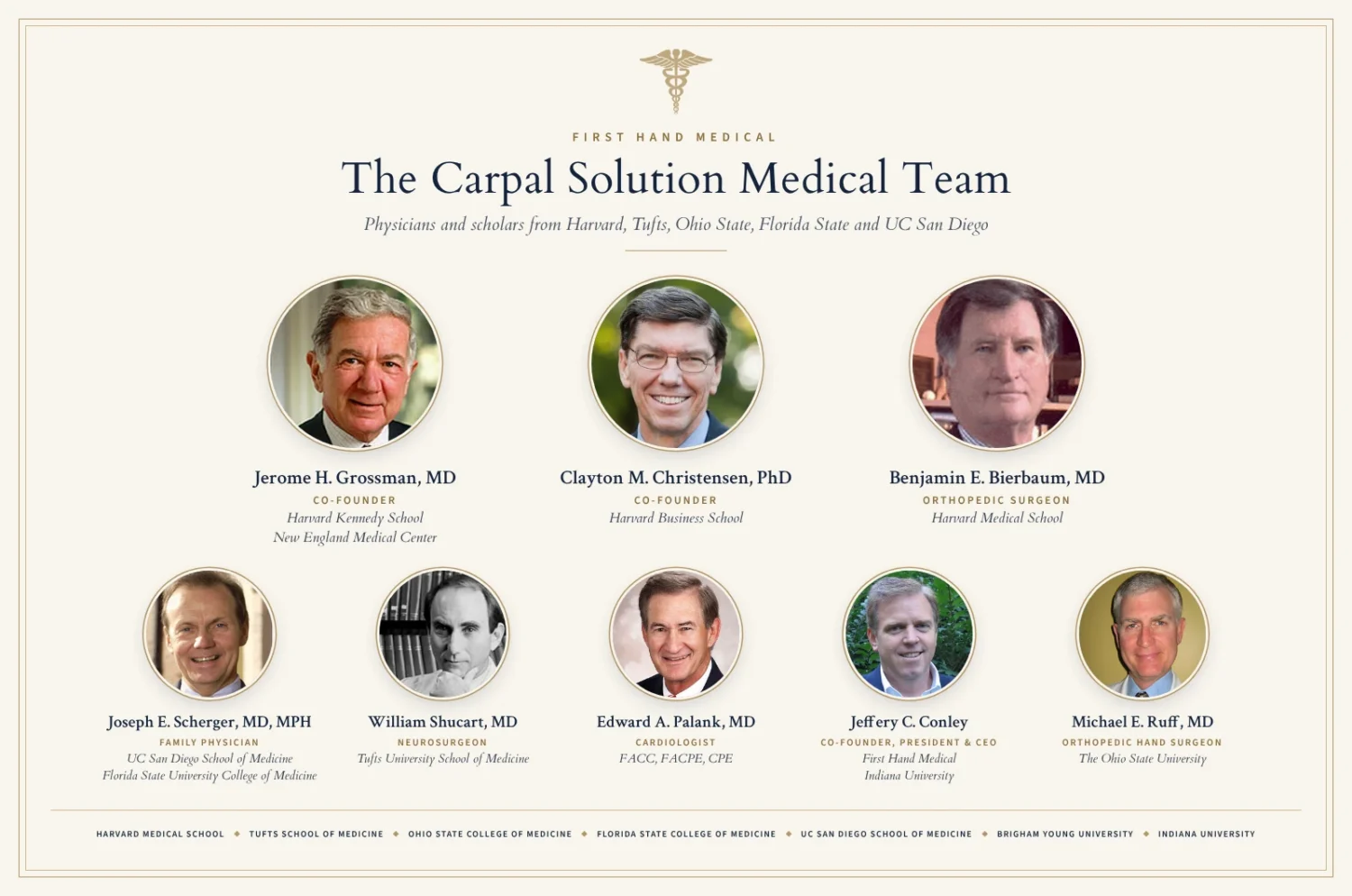
The Carpal Solution Treatment Kit was developed by our expert team of medical doctors who have worked at and led some of the top medical institutions in the World – Including Harvard Medical, Tufts Medical, UCSD Medical School, Florida State Medical School, and The Ohio State University Medical School. We treat root causes with clinically proven conservative treatments. The results: Quick Natural Relief of All Your Carpal Tunnel Symptoms without complications. Meet The Medical Team Backing The Carpal Solution at First Hand Medical

Order Your Six Week Carpal Tunnel Treatment Now
The ONLY treatment for carpal tunnel that comes with a no questions asked 30-Day Satisfaction Window and in-house dedicated pain relief team.

