 Created by renowned Harvard health care professionals.


Golf and Carpal Tunnel Pain: What Hand Pain Playing Golf Means
Nothing can be more frustrating to a passionate golfer than losing grip strength and painful hands when they are out on the golf course. With the Carpal Solution Treatment Kit you can prevent Carpal Tunnel even if you are playing golf 5 times per week. You just wear this comfortable stretching treatment during sleep that was developed by expert Doctors. Golfers worldwide depend on the Carpal Solution Treatment to keep their hands healthy
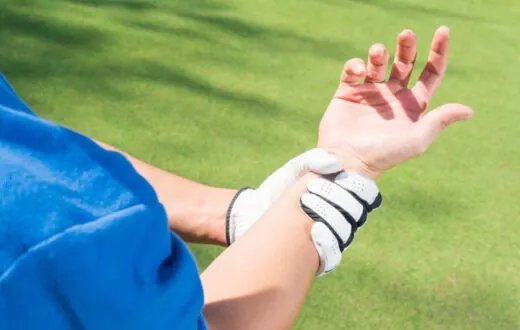

Written by Edward A. Palank, MD, FACC, cardiologist and author of The Golf Doc, with Julie Sunberg, Director of Marketing and Customer Service at First Hand Medical · Clinically reviewed by Alan Ward, MOT, OTR, Master Occupational Therapist and Vice President of Precision Rehabilitation · Last reviewed: November 2026
The last thing a golfer wants to hear is that hand pain, numb fingers and an aching wrist could cost them grip strength and feel. Yet golf and carpal tunnel pain often go together, because gripping, swinging and repeated impact add up over a season. When the nagging symptoms start, most golfers do not know what is causing them or where to turn. This guide helps you sort out what your hand pain playing golf may mean and what to do about it.
Table of Contents
Golf and Carpal Tunnel Pain: Quick Answer
Numbness or tingling in the thumb, index and middle fingers, especially at night or after a round, points to carpal tunnel syndrome. Pain on the inside of the elbow, a locking finger or sharp pain at the base of the palm point to other golf injuries.
For carpal tunnel, our doctors recommend nighttime passive stretching first, so there is no downtime from golf; most people are better from their worst symptoms in two to three weeks. For general background on golf and carpal tunnel prevention, see 5 ways golfers can protect their hands.
So, what can a frustrated and concerned golfer do when faced with the dreaded Carpal Tunnel Condition?
Hand Pain Playing Golf: Which Condition Is It?
Several golf injuries cause hand and wrist pain. Where it hurts, and how it feels, are good clues. Use this table as a guide, not a diagnosis.
| Condition | Where you feel it | Typical clues |
|---|---|---|
| Carpal tunnel syndrome | Thumb, index, middle and part of the ring finger | Numbness and tingling, often at night; weaker grip; dropping the club or a ball |
| Golfer’s elbow | Inside of the elbow, sometimes into the forearm | Pain when gripping or swinging; no finger numbness |
| Trigger finger | A finger or thumb | Catching or locking when you bend or straighten it |
| De Quervain’s tenosynovitis | Thumb side of the wrist | Pain when gripping or turning the wrist |
| Hook of hamate fracture | Base of the palm on the little-finger side | Sharp pain after a fat shot or hitting a root; sometimes numbness in the ring and little fingers |
| Wrist tendinitis | Back or front of the wrist | Aching that worsens with practice and eases with rest |
Some golfers have more than one of these at once. Sudden pain after a mishit, a visible deformity or pain that keeps you from gripping at all needs a prompt medical evaluation.

Why Golf Strains the Carpal Tunnel
Depending on skill, a golfer may take anywhere from about 68 to 125 strokes in an 18-hole round. Add range balls, practice-bunker shots, practice swings and the odd mulligan, and a good golfer often makes 150 to 200 high-intensity swings in a typical outing. Each one starts with a firm grip.
The muscles that grip the club live in the forearm, and their nine tendons pass through the carpal tunnel beside the median nerve. Hours of gripping, wrist hinging and the jolt of impact, especially off hard mats or when the club strikes the ground, inflame the tissue around those tendons. When that swelling is trapped inside the tunnel, it squeezes the nerve. The lead hand, which controls the club through impact, is often affected first.
Conditions add to the load. Hard, dry fairways and range mats send more shock through the club. Cold weather stiffens the hands and makes golfers grip tighter. Long weekends of back-to-back rounds give the tissue little time to recover, and many golfers also type, use tools or do yard work between rounds, so the hands rarely rest.
It is not hard to see why carpal tunnel can raise a golf score faster than a bad back. When a golfer loses grip strength, distance off the tee suffers, accuracy goes wacky and touch around the greens disappears.


There is hope. Did you know you can relieve carpal tunnel while you sleep?
Signs Your Golf Hand Pain Is Carpal Tunnel
- Numbness or tingling in the thumb, index, middle or part of the ring finger during or after a round
- Waking at night with numb hands that you have to shake out
- A weaker grip, or the club slipping or twisting at impact
- Losing feel on chips and putts
- Aching that runs from the wrist into the forearm
In our doctors’ two decades of clinical experience (not a published statistic), people with three or more of the common carpal tunnel symptoms can be about 95% confident they have carpal tunnel syndrome. Get an in-person evaluation and formal diagnosis; with that confidence, you can start a natural, non-invasive treatment while you wait. The average wait for a new-patient physician appointment is 31 days (AMN Healthcare, 2025); read more about waiting for carpal tunnel treatment. For general background, see the NINDS carpal tunnel syndrome fact sheet.
Golfers Can Heal Carpal Tunnel Naturally at Home without Surgery
Treating Golf and Carpal Tunnel Pain Without Losing Your Season
The key thing to remember is that carpal tunnel syndrome is chronic and recurring: it is managed, not cured. So golfers need a safe, convenient, natural therapy that does not cost them downtime or grip strength. The Carpal Solution fits. It was developed by Dr. Clyde E. Morgan, working with his wife and his patients with carpal tunnel.
It is not a stiff, restrictive wrist brace. Worn during sleep, this soft, Hypoallergenic (No Latex) device gently stretches the fascia and soft tissue around the carpal tunnel and relieves pressure on the median nerve. Because nothing is immobilized, you keep playing and practicing by day while the stretching works at night. See which therapy pack to order.
| Stage | Schedule | What most golfers notice |
|---|---|---|
| Weeks 1–2 | Every night | Most people are better from their worst symptoms in two to three weeks and sleep through the night again. |
| Weeks 3–6 | Every other night | Over 90% of people reach remission by 6 weeks. |
| Higher inflammation | 8 to 12 weeks | About 10% of people are 50–70% better at 6 weeks and need 8 to 12 weeks. |
| In season | Once a week to once every six months | Prevention nights while you keep playing. |
Over the six-week protocol it delivers over 220 hours of targeted passive stretching. Remission usually lasts 5 to 7 years for most people, ranging from 1 to 17 years. It has 97% patient satisfaction over 21 years and 4.9 out of 5 stars on independent review sites like Google Reviews, and over 100,000 people have used it over two decades.

Neurologists, including Dr. James S. Zu, MD, PhD, of Edison, New Jersey, call the Carpal Solution a better first line of defense for carpal tunnel syndrome. Read how a golfer conquered his carpal tunnel.
Why splints and surgery are poor fits for golfers
A splint holds the wrist in a neutral position, which can reduce pain from movement, but it does not promote healing from carpal tunnel syndrome. It causes muscle atrophy and stiffness, which is the last thing a golfer who depends on grip strength needs. Our medical team has observed that splints give some relief at first but aggravate symptoms in the long run.

Surgery means downtime and rehabilitation, and possible complications include infection, nerve injury, lasting loss of grip strength, reduced range of motion, wrist weakness and scarring. Carpal tunnel surgery has a patient satisfaction rate lower than 69%: about 31% of patients report lingering or recurring symptoms, and no patient is satisfied with lingering symptoms.
Even after a successful surgery, symptoms often return; 57% had at least some symptoms come back within 5.5 years in one study (Nancollas, 1995), and our doctors estimate 80 to 90% within 10 years from clinical experience (not a statistically researched figure).

The Carpal Solution is a Better First Line of Defense for CTS.
Grip, Swing and Equipment Tips for Golf and Carpal Tunnel Pain
- Lighten your grip. Most golfers squeeze harder than they need to. A lighter grip pressure reduces strain and often improves tempo.
- Check grip size. Grips that are too thin make you squeeze harder; a club fitter can size them for your hands.
- Soften the impact. Softer grips, graphite shafts and hitting off grass instead of hard mats reduce shock to the hands.
- Warm up gradually. Start with short wedge shots before full swings, and stretch the hands and forearms gently first.
- Pace your practice. Spread range sessions out rather than hitting large buckets back to back.
- Skip grip-strengthening drills while symptoms are active. Gentle daytime stretches (up to 6 sets of 10, holding each for 15 seconds with 30 seconds of rest) are a bonus.

How your golf pro and club fitter can help
A teaching pro can spot a grip that is too tight, too weak or too strong, and a swing that relies on flipping the wrists through impact instead of rotating the body. Small changes there reduce the load on the carpal tunnel and often improve ball striking. A club fitter can check grip size and material, shaft flex and club weight, and suggest options that soften the jolt of impact. Tell them about your hand symptoms so they can factor them in.
A simple pre-round hand routine
Before you hit a ball, take three minutes for your hands: open and close your fists slowly ten times, make gentle wrist circles in both directions, then hold each finger back gently for a few seconds without forcing it. Follow with a few slow half swings with a wedge before moving up to longer clubs. After the round, let your hands rest, keep them warm, and avoid carrying heavy bags or gripping tools right away.
Golf after carpal tunnel surgery
Some golfers come to us after surgery because symptoms lingered or returned. If that is you, wait 3 months after surgery before starting the Carpal Solution, and ease back into full swings with your doctor’s guidance. Grip strength can take months to return after surgery, so lighter grips, softer shafts and shorter practice sessions matter even more.
Older golfers: arthritis or carpal tunnel?
Many golfers play well into their sixties, seventies and beyond, when thumb-base arthritis and carpal tunnel are both common. Arthritis tends to cause aching and stiffness at the base of the thumb that is worse with use, while carpal tunnel causes numbness and tingling in the fingers, often at night. Diabetes and thyroid disease, more common with age, also raise the risk of carpal tunnel. An evaluation can sort out which you have, or whether you have both.
What delights golfers about the Carpal Solution is how simple and convenient it is. It lets them control their symptoms at home, cost-effectively, by relying on the body’s natural healing.
mycarpaltunnel.com is here to help you find relief.
There is no reason to keep suffering hand numbness, tingling or wrist pain, or to worry about the risk, expense and downtime of surgery. Be proactive: golfers can also use the Carpal Solution as prevention, with occasional nights from once a week to once every six months once symptoms are in remission. The Carpal Solution comes with a 30-Day Patient Satisfaction Guarantee, is billed under HCPCS code L3924, and many health insurance plans reimburse 70 to 80%.
Golf is a game for a lifetime. Treat hand pain playing golf early, give your hands the recovery they need, and keep a reliable, natural treatment ready for the next flare-up, so carpal tunnel does not take you off the course or add strokes to your card.
When Healing Needs a Doctor’s Help and Professional Medical Evaluation
- Constant numbness that does not improve or loss of feeling in the fingertips that does not improve in 4 to 8 weeks.
- Extreme loss of the muscle at the base of the thumb, with loss of grip strength that does not improve over 6 to 8 weeks.
- Worsening symptoms over 6 to 8 weeks while using the best conservative treatments
- Symptoms that begin suddenly after hand or wrist trauma, a fracture or severe sprain from a fall or auto accident.
- Odd Symptoms that are not consistent with the Carpal Tunnel Symptoms listed on this website, that might be indicative of other nerve issues. A nerve conductivity study can clear up the confusion with minimal costs and not too much pain and no risk.
These signs may mean more advanced nerve involvement or a different condition and deserve professional medical evaluation and in person consultation. Home treatment can be used alongside professional in-person medical care while you wait for the healthcare delivery system to fit you into their schedule. There is no reason to wait doing nothing. You can start proven natural conservative treatment with good patient reviews while you wait for your appointments. If your symptoms start improving over 6 to 8 weeks, then you know you are on the right track and surgery is not necessary.
Golf and Carpal Tunnel Pain: FAQ
Can golf cause carpal tunnel syndrome?
Golf can contribute. Repeated gripping, wrist hinging and the jolt of impact can inflame the tissue around the tendons in the carpal tunnel, and trapped swelling presses on the median nerve.
Why does my hand hurt after playing golf?
Common causes include carpal tunnel syndrome, golfer’s elbow, trigger finger, wrist tendinitis and, after a mishit, a hook of hamate fracture. Numbness or tingling in the thumb and first fingers points to carpal tunnel.
Can I keep playing golf with carpal tunnel?
Many golfers do while treating it, because the Carpal Solution works at night. Lighten your grip, pace your practice and see a doctor for constant numbness or weakness.
Which hand is affected in golfers?
Often the lead hand, which controls the club through impact, but both hands can be affected.
Should golfers wear a wrist brace?
Our doctors do not recommend rigid splints long term. They can reduce pain from movement but do not promote healing, and immobilization causes muscle atrophy and weaker grip.
Is it carpal tunnel or arthritis in my thumb?
Arthritis usually causes aching and stiffness at the base of the thumb. Carpal tunnel causes numbness and tingling in the thumb and first fingers, often at night. You can have both, so get an evaluation.
How fast can I get back to full practice?
Most people are better from their worst symptoms in two to three weeks. Build practice volume back gradually over the six-week protocol.
Sources
- National Institute of Neurological Disorders and Stroke. Carpal Tunnel Syndrome fact sheet.
- Journal of Ultrasound, 2012: anatomy of the carpal tunnel. PMC3558235.
- Bland JDP. Patient-reported outcome of 1,268 carpal tunnel operations. Muscle & Nerve, 2001. PubMed 11410921.
- Louie D, Earp B, Blazar P. Long-term outcomes of carpal tunnel release: a critical review of the literature. Hand, 2012 (reviews Nancollas 1995). PMC3418353.
- AMN Healthcare. 2025 Survey of Physician Appointment Wait Times.
Watch videos of people who “Cured” their Carpal Tunnel Naturally and Avoided the Risks of Carpal Tunnel Surgery!


By the numbers

100,000+
People who have used the Carpal Solution over two decades.

97%
Patient satisfaction

30-Day
30-Day Patient Satisfaction Guarantee


