 Created by renowned Harvard health care professionals.


Carpal Tunnel Testing Equipment Used: Jamar Hand Dynamometer and Pinch Tester
The Carpal Solution clinical trial used two pieces of testing equipment: a Jamar hand dynamometer for grip strength and a Jamar pinch tester for thumb strength. Here is how each works and what the numbers mean for carpal tunnel.
[object Window]Mfg. Sammons Preston, Inc. Jamar Pinch Tester
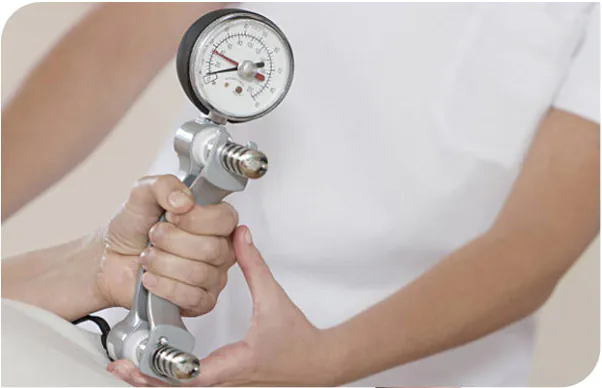
Mfg. Sammons Preston, Inc. Jamar 5 Position Dynamometer Grip Tester
The Dynamometer is the gold standard in measuring rehabilitation progress and for routine evaluation of hand and finger muscle function. It is particularly useful for patients with hand trauma and dysfunction due to Carpal Tunnel Syndrome. The Dynamometer represents an excellent way to track the hand’s response and progress associated with any hand muscle related therapy.
The Jamar Pinch Tester is a great way to isolate muscle strength of specific digits such as the thumb which can be missed in the testing with the Dynamometer.
Why Testing Equipment Matters for Carpal Tunnel
Carpal tunnel syndrome can slowly weaken the muscles at the base of the thumb, and many people notice a weaker grip or trouble pinching small objects before they notice any muscle loss. Objective testing equipment puts numbers on those changes. Instead of relying only on how the hand feels, a clinician can compare readings over time and see whether grip and pinch strength are improving, holding steady or declining.
How a Grip Strength Test Is Usually Done
The person sits with the elbow bent at about 90 degrees and the forearm in a neutral position. They squeeze the dynamometer handle as hard as they can, usually three times, and the readings are averaged. The same steps are repeated with the other hand so both sides can be compared. Using the same handle position each time helps keep results consistent.
How a Pinch Test Is Usually Done
Pinch gauges measure the strength of specific finger grips, such as tip pinch (thumb to index fingertip), key pinch (thumb against the side of the index finger) and three-jaw pinch (thumb against the index and middle fingers). These grips depend heavily on the thumb muscles, which is why pinch testing can show changes that a grip test may miss. Testing both hands also gives a useful baseline, since many people have one side that is naturally stronger.
Results from this testing equipment are most useful when they are tracked over the course of a treatment, such as the six week Carpal Tunnel protocol. You can learn more about the medical experts behind The Carpal Solution, and the NINDS carpal tunnel syndrome fact sheet describes other tests doctors may use, such as nerve conduction studies.
Jamar Hand Muscle Functionality Testing Equipment
JAMAR Hydraulic Hand Dynamometer
The JAMAR Hydraulic Hand Dynamometer is an indispensable tool, to generate accurate and objective data required for reimbursable hand and forearm rehabilitation services. The Jamar Hydraulic dynamometer gives accurate and clinically reproducible grip strength readings. The unit has an adjustable 5-position handle with adjustments from 1 3/8″ to 3 3/8″, in half-inch increments, allowing for full profile development of muscle, bone and tendon function in the hand, wrist and fingers.
The Peak-hold needle automatically retains the highest reading until reset. This maximum strength indicator facilitates accurate maximum strength readings. Use of average testing of three squeezes assures no anomalies and highly reproducible results. The Jamar Hand Dynamometer is ideal for routine screening of hand muscle function. It is also particularly useful for initial and ongoing evaluation of clients with hand trauma and dysfunction due to carpal tunnel syndrome. The Dynamometer represents an excellent way to track the hand’s response and progress associated with therapy. Isometric design ensures accurate, reproducible results.
The Jamar Hand Dynamometer is the definitive test for muscle functionality in the hand and has set the standard for measuring and analyzing hand dysfunction.
JAMAR Hydraulic Pinch Gauge
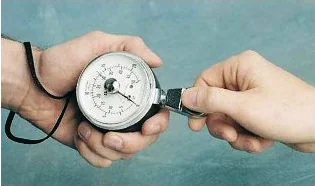 Unlike conventional pinch gauges, the JAMAR Hydraulic Pinch Gauge’s unique design allows accurate development of a true pinch pattern. A highly accurate pinch-force measurement, devoid of interference, is the result. The Red indicator needle remains at maximum reading until reset easing the reading of accurate measurements. It measures pinch force up to 45 lbs. The pinch test used in combination with the Jamar Hand Dynamometer provides conclusive data regarding hand functionality with reliable reproducibility.

How the Testing Equipment Was Used in the Trial
| Instrument | What it measured | How it was used |
|---|---|---|
| Jamar pinch tester | Force between the thumb tip and the end joint of the index finger | Three readings, averaged |
| Jamar hand dynamometer | Full-hand grip strength | Handle positions 1, 3 and 5; three squeezes at each, averaged |
Eighteen hands from eleven patients were tested before treatment and then on Monday, Wednesday and Friday during two weeks of nightly Carpal Solution use. Averaging three readings at each step kept a single unusually strong or weak squeeze from skewing the results.
What a Hand Dynamometer Tells You About Carpal Tunnel

A hand dynamometer measures grip, and grip depends on the forearm. The muscles that bend the fingers and thumb sit in the forearm, and their nine tendons pass through the carpal tunnel beside the median nerve: four flexor digitorum superficialis, four flexor digitorum profundus and the flexor pollicis longus (Journal of Ultrasound, 2012). When swelling crowds the tunnel and the hand is used less, strength and dexterity drop in the forearm, thumb and fingers.
The pinch tester adds detail the hand dynamometer can miss. Pinch depends heavily on the thenar muscles at the base of the thumb, which get their nerve supply from the median nerve. A falling pinch number is often the first objective sign that the nerve is under pressure; a rising one is a sign it is recovering.
To understand why strength can come back, start with pressure. Swelling and entrapped inflammation in the soft tissue in and around the carpal tunnel squeeze the median nerve and restrict blood flow and lymphatic fluid transport. The Carpal Solution’s targeted passive stretching restores flexibility to the injured soft tissue, relieves pressure on the median nerve, frees circulation and lets lymph fluid flow to clear out the swelling. It is your body that does the healing; the Carpal Solution just jump-starts it.
What the Testing Equipment Showed
After two weeks, 82% of participants had better sleep, less hand pain and significantly improved grip strength as muscle atrophy was overcome; one participant did not improve. Read the full clinical study results.
Participants who wore a cock-up splint stopped using it during the study. A splint holds the wrist in a neutral position, which can reduce pain from movement, but it does not promote healing from carpal tunnel syndrome, and disuse costs strength quickly: healthy adults lost about 8% of muscle size and 23% of strength after 14 days in a cast (Wall et al., Acta Physiologica, 2014). A hand dynamometer is exactly the kind of testing equipment that shows that loss, and its recovery.
The study was small, short and run by the company, so it cannot show how the therapy works for everyone. Two decades of patients add to it: 97% patient satisfaction over 21 years, 4.9 out of 5 stars on independent review sites like Google Reviews, and over 100,000 people who have used the Carpal Solution. Most people are better from their worst symptoms in two to three weeks; over 90% resolve in six weeks, and about 10% need 8 to 12 weeks.
Using Strength Testing Equipment in Your Own Care

Hand therapists and many doctors have the same kind of testing equipment in their offices. If yours measures grip with a hand dynamometer or checks pinch strength, ask for the numbers and keep them. Rechecking after a few weeks of treatment is a simple way to see objective progress alongside how your hands feel.
At home, track everyday tasks that use pinch and grip, such as opening jars, buttoning shirts or holding a cup, plus how often you wake at night and how numb your fingers are. While you heal, skip grip exercises, squeeze balls and putty; daytime stretches are a bonus, up to six sets of ten, holding each 15 seconds with 30 seconds of rest.
Strength numbers are one piece of the picture. Our doctors’ clinical experience is that people with three or more classic symptoms can be about 95% confident they have carpal tunnel syndrome; that is clinical experience, not a published statistic, so still see a doctor for a formal diagnosis, and see one promptly for constant numbness, weakness or thumb muscle thinning.
If you are waiting for an appointment, the average new-patient physician wait is 31 days (AMN Healthcare, 2025); see relief while waiting for carpal tunnel treatment. And if surgery is suggested, know that carpal tunnel surgery has a patient satisfaction rate lower than 69%: about 31% of patients report lingering or recurring symptoms, and no patient is satisfied with lingering symptoms.
When Healing Needs a Doctor’s Help and Professional Medical Evaluation
- Constant numbness that does not improve or loss of feeling in the fingertips that does not improve in 4 to 8 weeks.
- Extreme loss of the muscle at the base of the thumb, with loss of grip strength that does not improve over 6 to 8 weeks.
- Worsening symptoms over 6 to 8 weeks while using the best conservative treatments
- Symptoms that begin suddenly after hand or wrist trauma, a fracture or severe sprain from a fall or auto accident.
- Odd Symptoms that are not consistent with the Carpal Tunnel Symptoms listed on this website, that might be indicative of other nerve issues. A nerve conductivity study can clear up the confusion with minimal costs and not too much pain and no risk.
These signs may mean more advanced nerve involvement or a different condition and deserve professional medical evaluation and in person consultation. Home treatment can be used alongside professional in-person medical care while you wait for the healthcare delivery system to fit you into their schedule. There is no reason to wait doing nothing. You can start proven natural conservative treatment with good patient reviews while you wait for your appointments. If your symptoms start improving over 6 to 8 weeks, then you know you are on the right track and surgery is not necessary.
Testing Equipment FAQ
What testing equipment did the Carpal Solution study use?
A Jamar pinch tester and a Jamar five-position hand dynamometer, made at the time by Sammons Preston, Inc.
Why use a hand dynamometer for carpal tunnel?
It measures grip strength, which depends on the forearm muscles whose tendons pass through the carpal tunnel, so it shows how much function has been lost and whether it is returning.
Why test pinch separately?
Pinch relies on the thumb muscles the median nerve supplies, so it can show changes a grip test misses.
Why were handle positions 1, 3 and 5 used?
Together they cover the full range of hand muscle action, from a wide grip to a narrow one.
Can I buy a hand dynamometer to use at home?
Consumer grip gauges exist, but readings vary between devices. If you use one, use the same device and position each time, and share the numbers with your doctor or therapist.
How accurate is a hand dynamometer?
The Jamar hydraulic hand dynamometer gives reproducible grip readings when it is used the same way each time: the same handle position, the same arm position and an average of three squeezes. That consistency is what makes it useful for tracking change over weeks.
Does weak grip always mean carpal tunnel?
No. Arthritis, tendon injuries and nerve problems in the neck can also weaken grip and pinch. Testing equipment shows how much strength has changed; a doctor’s exam shows why.
How soon can grip strength improve?
In the trial, grip strength improved within two weeks for most participants. In everyday practice, strength keeps improving through the six-week protocol, which adds up to over 220 hours of targeted stretching, as normal hand use returns.
What should I do if my strength is not improving?
Everyone is different. About 10% of people, usually those with excess systemic inflammation, need 8 to 12 weeks. If you have not started feeling relief by the fourth week, call First Hand Medical, and see your doctor about any warning signs listed above.

Order Your Six Week Carpal Tunnel Treatment Now
The ONLY treatment for carpal tunnel that comes with a no questions asked 30-Day Patient Satisfaction Guarantee and in-house dedicated pain relief team.


Email Our Experts Your Carpal Tunnel Questions