 Created by renowned Harvard health care professionals.


Is Carpal Tunnel a Disability? Work, Lost Time and Your Options
Carpal Tunnel is one of the most costly disabilities to companies in lost time at work by employees. Companies tend to categorize workers as either healthy productive employees or ones that have been injured and are pursuing the benefits afforded by workers compensation insurance. Most employees want to be considered as healthy, productive reliable workers and most are. There is no reason to allow Carpal Tunnel to disrupt your work life or cause a major disability. Doctors have developed a reliable home treatment to keep CTS in check. It is called the Carpal Solution. You can treat yourself at night during sleep and nobody has to know. It is private, safe and it has patient satisfaction of over 97%. Learn what you can do!

Written by Jeff Conley, President, First Hand Medical · Medically reviewed by Joseph E. Scherger, MD, MPH, family physician and clinical professor, UC San Diego School of Medicine · Last reviewed: November 2026
Is carpal tunnel a disability? It can be, depending on how much it limits you and which program is asking. For most people, though, the real question is how to keep working and keep earning while carpal tunnel slows them down. This guide covers lost time at work, work restrictions, the Americans with Disabilities Act, short-term disability and Social Security, and how to stay ahead of symptoms.
This page is general information, not legal or financial advice. For your situation, talk with your employer’s HR team, your benefits administrator or a qualified attorney.
On this page:
- Carpal Tunnel and Lost Time at Work
- Can You Work With Carpal Tunnel?
- Is Carpal Tunnel a Disability?
- Workplace Accommodations for Carpal Tunnel
- Documenting Carpal Tunnel for Work and Disability Claims
- Time Off Work for Carpal Tunnel Surgery
- Staying Productive Without Downtime
- When Healing Needs a Doctor’s Help
- FAQ
Carpal Tunnel and Lost Time at Work
Carpal tunnel is one of the most costly workplace conditions in lost time. According to the U.S. Bureau of Labor Statistics, among major disabling workplace injuries and illnesses in 1999, median days away from work were highest for carpal tunnel syndrome, at 27 days, ahead of fractures at 20 days and amputations at 18 days (BLS, The Economics Daily).
Most people want to be seen as healthy, productive workers. So when the first signs of carpal tunnel appear, it is common to dismiss them and hope they go away. Many workers do not even recognize the early carpal tunnel symptoms. Ignoring them often lets the problem become chronic. Employers, physicians and workers alike find that early recognition and proactive treatment help prevent extended downtime and lost earnings, and protect self-esteem, too.

“The results were incredible! My Carpal Tunnel symptoms were present for several weeks before being treated. My hands, shoulders and right side were in pain, inhibiting many of my common job activities. After using the Carpal Tunnel Solution for a few days, I felt the relief I was hoping for. By the end of the six week Carpal Solution protocol, my symptoms were resolved and I was able to return to my job activities which had previously aggravated my symptoms”.
Sharon, Nurse.

Can You Work With Carpal Tunnel?
 Most people can, especially when they catch it early. Without treatment, though, carpal tunnel can lead to lapses in quality, dropped objects, accidents and lost time. Your doctor may recommend temporary carpal tunnel work restrictions, such as:
- Limits on forceful gripping, pinching or vibrating tools.
- Regular micro-breaks from keyboard, mouse or assembly work.
- Rotating between different tasks during the shift.
- Ergonomic changes such as a neutral-wrist keyboard, a different mouse or tool handles with a better grip.
Read more about how to prevent carpal tunnel on the job.
Is Carpal Tunnel a Disability?
“Disability” means different things in different programs, so the answer depends on which one you are asking about.
The Americans with Disabilities Act (ADA)
Under the ADA, carpal tunnel can qualify as a disability when it substantially limits a major life activity, such as performing manual tasks. There is no automatic yes or no. In a 2002 carpal tunnel case, the U.S. Supreme Court stressed that an individualized assessment is especially necessary for a condition like carpal tunnel, whose symptoms vary widely from person to person (Toyota Motor Mfg. v. Williams). Congress later broadened the ADA’s definition of disability in the ADA Amendments Act of 2008.
If carpal tunnel affects your work, you can ask your employer for a reasonable accommodation. The free Job Accommodation Network (JAN) from the U.S. Department of Labor offers practical accommodation ideas, such as ergonomic equipment, adjusted tasks and scheduled breaks.
Carpal Tunnel Short Term Disability
Many employers offer short-term disability insurance that can replace part of your pay while you recover, for example after carpal tunnel surgery. Coverage, waiting periods and benefit amounts depend on your plan, so check with HR or your benefits administrator. Work-related cases may fall under workers’ compensation instead (see carpal tunnel workers’ compensation).
Social Security Disability
Social Security has no separate listing for carpal tunnel syndrome. Claims are generally evaluated under its peripheral neuropathy listing, 11.14, which requires severe limitations in two extremities, or by showing that the condition prevents any substantial work for at least 12 months (SSA Blue Book, Neurological Disorders). Because carpal tunnel usually responds to treatment, it rarely qualifies on its own.
Workplace Accommodations for Carpal Tunnel
Whether or not carpal tunnel is a disability in your case, simple accommodations often keep people working comfortably. Many of them cost little or nothing. Common examples from the Job Accommodation Network and occupational health practice include:
- An ergonomic keyboard, a vertical or trackball mouse and a padded, adjustable wrist rest.
- Speech-to-text software to cut down on typing.
- Tool handles with thicker, softer grips, and low-vibration or powered tools.
- Job rotation, so the same hand motions are not repeated all shift.
- Scheduled micro-breaks for gentle stretching.
- A temporary change of duties while symptoms settle.

Under the ADA, the usual first step is to tell your employer, preferably in writing, that a medical condition is affecting your work and that you need a change. Your employer may ask for a note from your doctor describing your limits, not your full medical record. From there, the two of you work out an accommodation that is effective and reasonable for the business.
Documenting Carpal Tunnel for Work and Disability Claims
If you think you may need work restrictions, short-term disability, workers’ compensation or Social Security, good records make every step easier. Helpful documentation includes:
- A formal diagnosis from your doctor, often confirmed with a nerve conduction study.
- Written work restrictions that describe what you can and cannot do, and for how long.
- A simple symptom diary: when numbness, tingling or pain happens, what you were doing and how it affected your work or sleep.
- Records of the treatments you have tried and how you responded.

So, is carpal tunnel a disability for you? The honest answer is that it depends on how severe your symptoms are, how long they last and which program is deciding. The better question for most people is how to keep carpal tunnel from getting to that point, which is where early, conservative treatment comes in.

RIGHT HAND INSTRUCTIONS:
Apply the Carpal Solution before Retiring to Bed in 3 Easy Steps
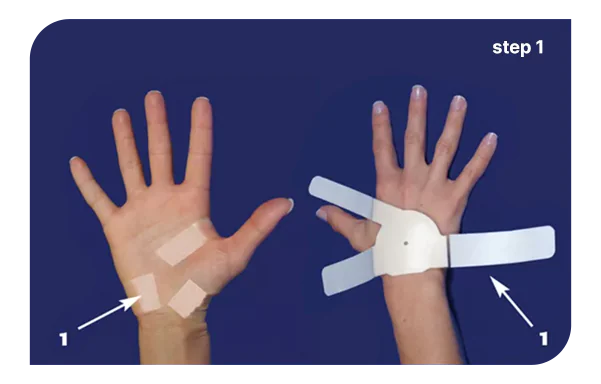
STEP 1: Place the Carpal Solution on the Back of the hand as shown with adhesive side down. Attach 1st strap below little finger securing it on the palm. Tear away excess tape to prevent overlap of straps on palm.
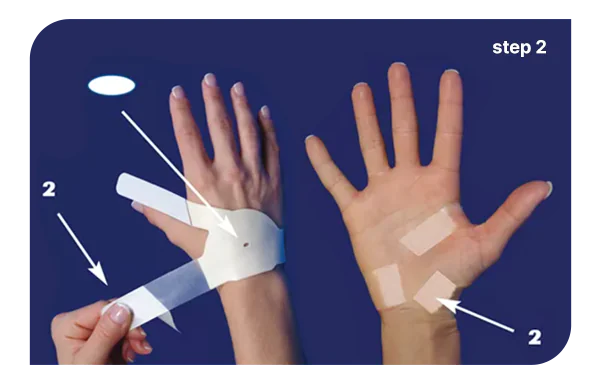
STEP 2: Self apply the appropriate tension to the Carpal Solution with 2nd strap below the thumb and attached on palm side of hand as shown. Adjust tension by stretching circular hole on back of hand in the elastic centerpiece to an oval shape. The diameter should be at least 1.5 times the original.
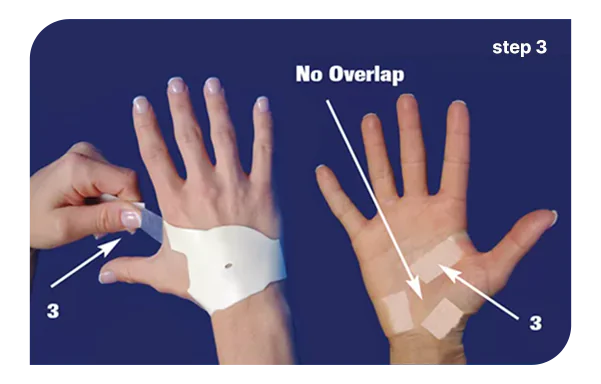
STEP 3: Self apply the appropriate tension to the Carpal Solution with 3rd strap above the thumb. Tear-away straps should be aligned so there is no overlap of straps on palm side of hand. The Carpal Solution begins to relieve symptoms usually within twenty minutes of placement.
Time Off Work for Carpal Tunnel Surgery
Return to work after carpal tunnel surgery varies widely with the procedure and the job. Desk work often resumes sooner, while heavy manual work can take much longer, and in our doctors’ clinical experience rehabilitation and muscle recovery can take up to a year. Results are also uncertain: carpal tunnel surgery has a patient satisfaction rate lower than 69%, because about 31% of patients report lingering or recurring symptoms and no patient is satisfied with lingering symptoms. That is why our doctors recommend conservative treatment first and surgery only as a last resort.
Staying Productive Without Downtime
For people whose work is being compromised by carpal tunnel, the Carpal Solution is a cost-effective way to stay on the job. The reasons people cite most:
- It brings most people’s worst symptoms under control in two to three weeks, and about 90% get complete remission in six weeks.
- It works during sleep, so there is no downtime, no lost time at work and no lost earnings from treatment.
- It is private: worn at night at home, so no one has to know.
- It is comfortable, with no restrictive splints or rigid braces.
- It is billed under HCPCS code L3924, and many health insurance plans reimburse 70 to 80% of the cost.
The Carpal Solution was developed by doctors so patients could manage carpal tunnel proactively, sleep through the night and stay employed. It gently stretches three key points on the palm around the carpal tunnel for 7 to 8 hours a night, over 220 hours in the six-week protocol. That restores flexibility to the soft tissue, relieves pressure on the median nerve and lets blood and lymph fluid flow freely to clear out the swelling. It is your body that does the healing; the Carpal Solution jump-starts it. Unlike a splint, it does not immobilize the hand, so there is no muscle atrophy.
Over 100,000 people have used the Carpal Solution over two decades, with 97% patient satisfaction over 21 years and 4.9 out of 5 stars on independent review sites like Google Reviews. Neurologists, including Dr. James S. Zu, MD, PhD, of Edison, New Jersey, call it a better first line of defense for carpal tunnel syndrome, and it comes with a 30-Day Satisfaction Window.
Over two decades, our doctors have found that people with three or more of the carpal tunnel symptoms listed on this website can be about 95% confident they have carpal tunnel syndrome. This is clinical experience, not a published statistic. Getting a formal diagnosis from your doctor is still good practice, and it is needed for work restrictions, insurance and disability claims, but you do not have to wait to start treatment. A new-patient appointment now takes an average of 31 days (AMN Healthcare, 2025).
When Healing Needs a Doctor’s Help and Professional Medical Evaluation
- Constant numbness that does not improve or loss of feeling in the fingertips that does not improve in 4 to 8 weeks.
- Extreme loss of the muscle at the base of the thumb, with loss of grip strength that does not improve over 6 to 8 weeks.
- Worsening symptoms over 6 to 8 weeks while using the best conservative treatments
- Symptoms that begin suddenly after hand or wrist trauma, a fracture or severe sprain from a fall or auto accident.
- Odd Symptoms that are not consistent with the Carpal Tunnel Symptoms listed on this website, that might be indicative of other nerve issues. A nerve conductivity study can clear up the confusion with minimal costs and not too much pain and no risk.
These signs may mean more advanced nerve involvement or a different condition and deserve professional medical evaluation and in person consultation. Home treatment can be used alongside professional in-person medical care while you wait for the healthcare delivery system to fit you into their schedule. There is no reason to wait doing nothing. You can start proven natural conservative treatment with good patient reviews while you wait for your appointments. If your symptoms start improving over 6 to 8 weeks, then you know you are on the right track and surgery is not necessary.
Carpal Tunnel Disability FAQ
Is carpal tunnel a disability under the ADA?
It can be, if it substantially limits a major life activity such as manual tasks. It is decided case by case, so talk with your employer or a qualified advisor.
Can you get Social Security disability for carpal tunnel?
It is possible but uncommon. Social Security has no separate carpal tunnel listing and generally evaluates it under peripheral neuropathy, which requires severe, long-lasting limitations.
Can you work with carpal tunnel?
Most people can, with early treatment, short breaks, ergonomic changes and, when needed, temporary carpal tunnel work restrictions from a doctor.
How much time off work is needed for carpal tunnel surgery?
It varies with the procedure and the job; heavy manual work usually needs more time than desk work. Ask your surgeon and your employer about your situation.
Does short-term disability cover carpal tunnel?
Many employer plans do when your doctor certifies that you cannot work, for example after surgery. Check your plan’s terms with HR.

The answer is clear. You need to try a treatment with no risk, no recovery time and a higher success rate before you consider surgery.
Watch videos of people who “Cured” their Carpal Tunnel Naturally and Avoided the Risks of Carpal Tunnel Surgery!