Created by renowned Harvard health care professionals.


Carpal Tunnel Clinical Study Results: Better Sleep and Grip Strength in Two Weeks

Written by Jeff Conley, President, First Hand Medical · Medically reviewed by Benjamin E. Bierbaum, MD, orthopedic surgeon and clinical professor of orthopedic surgery at Harvard Medical School · Last reviewed: November 2026
These carpal tunnel clinical study results come from a small two-week study of the Carpal Solution. Eleven people with carpal tunnel symptoms, 18 hands in all, wore the Carpal Solution every night. Their sleep and hand strength were measured before and during treatment. This page explains what was found, what it shows about grip strength and carpal tunnel, and where the study has limits.
On this page:
- How the Study Was Set Up
- Sleep Interruption Results
- Grip Strength and Carpal Tunnel Results
- Why One Participant Did Not Improve
- What These Results Can and Cannot Tell You
- How the Results Compare With Splints and Surgery
- How to Track Your Own Progress
- Signs of Grip Weakness
- How the Carpal Solution Works
- When to See a Doctor
- FAQ
How the Study Was Set Up
The study ran for two weeks. All participants were instructed to wear the Carpal Solution every night, using a new one each night. Base readings were recorded before treatment began, and participants returned three times a week, on Monday, Wednesday and Friday, for repeat testing. You can read the full carpal solution test procedure and the study participants and objectives.
Two tools measured hand function. A Jamar pinch tester recorded how hard each person could squeeze between the thumb and index finger. A Jamar dynamometer recorded grip strength at positions 1, 3 and 5, which together cover the full range of hand muscle action. Each test was done three times and averaged, so one unusually strong or weak squeeze could not skew the data. See the testing equipment for details.
Volunteers received free samples of the Carpal Solution and feedback on their grip strength, and no other compensation. There was no control group, and the study was run by First Hand Medical, the company that makes the Carpal Solution. Keep that in mind as you read the carpal tunnel clinical study results below.
Why measure hand strength at all? Symptoms such as pain and numbness are real but subjective, and they can change from day to day. Pinch and grip readings add an objective number that can be compared with each person’s own starting point. Using both kinds of measures gives a more complete picture than either one alone.
Carpal Tunnel Clinical Study Results: Sleep Interruption
Sleep loss is one of the hardest parts of carpal tunnel syndrome, so it comes first here. Numbness and pain often wake people at night, partly because the wrist tends to curl during sleep and adds pressure on the median nerve. So the first question in these carpal tunnel clinical study results was simple: did people sleep better?
At the end of the two weeks, 82% of participants experienced relief from carpal tunnel symptoms and a meaningful improvement in hand function on grip strength testing. One participant had no relief, and a second had only minor relief. The sleep results broke down this way:
- 18% of participants eliminated sleep interruption from hand pain after just two weeks of treatment
- 64% reported a significant reduction in how often hand pain interrupted their sleep
- 9% reported minor improvement but still had sleep interruption
- 9% reported no improvement
With 11 participants, each person is about 9% of the group, so these percentages reflect two, seven, one and one people. Based on these limited carpal tunnel clinical study results, we are optimistic that the Carpal Solution can relieve the intense pain and sleep interruptions that carpal tunnel often causes. Read more about sleep loss from carpal tunnel.
Grip Strength and Carpal Tunnel: What the Tests Showed
Grip strength and carpal tunnel are closely linked. When the median nerve is under pressure, the thumb and hand muscles it supplies can weaken, and over time they can waste away. When tracking grip strength and carpal tunnel recovery, pinch and grip readings are a practical way to see whether a treatment is helping those muscles recover.
Tables 1 through 5 of the study report summarize the pinch and grip data, and Table 5 brings all of it together for quick comparison. Improvements varied between positions 1, 3 and 5 and the pinch test. That is expected, because each participant’s job and hand use patterns lead to different soft tissue injury, tendon strain, median nerve impingement and muscle atrophy.
As pain is relieved and a person returns to full activity, their unique hand use pattern also shapes how grip strength comes back as muscle atrophy is overcome. The right and left hands of the same person often improve at different rates. Hand size and muscle mass also change the absolute readings from person to person.
As would be expected in grip strength and carpal tunnel testing, the people with the weakest starting readings had the largest percentage improvements. All participants improved in at least one of the tests.
Why the Pinch Test Matters
The pinch test is especially useful for measuring grip strength and carpal tunnel changes. The median nerve supplies several of the small muscles at the base of the thumb, including the ones that pull the thumb away from the palm and turn it toward the fingers. When the nerve is compressed, these muscles weaken first, and pinching becomes harder. Many people notice it as dropping things, trouble with buttons, or difficulty opening jars. A stronger pinch reading suggests those thumb muscles are getting a better nerve signal again.
Average Improvement for Each Hand
The most meaningful number in these carpal tunnel clinical study results is the Average Improvement across all tests for each hand. Among participants who had significant relief, Average Improvement ranged from 15.22% in the right hand of patient 8 to 125.36% in the right hand of patient 5.
Patient 3 improved 97.22% in the right hand and 80.83% in the left. That gap reflects how differently each hand is used. As carpal tunnel pain eases, the dominant hand usually responds more quickly on grip strength testing.
| Measure | Result after two weeks |
|---|---|
| Participants | 11 people, 18 hands |
| Relief from carpal tunnel symptoms | 82% of participants |
| Sleep interruption eliminated or significantly reduced | 82% of participants (18% eliminated, 64% significantly reduced) |
| More than 40% Average Improvement in grip strength | 6 of 11 participants (55%) |
| 20% or greater Average Improvement in grip strength | 14 of 18 hands (78%) |
| Range of Average Improvement among those with relief | 15.22% to 125.36% |
Six of the eleven participants (55%) had more than a 40% Average Improvement in grip strength in just two weeks. Fourteen of the eighteen hands treated (78%) had an Average Improvement of 20% or more. For grip strength and carpal tunnel, that is a meaningful change in a short time.
Why One Participant Did Not Improve
Honest carpal tunnel clinical study results include the people a treatment did not help. Patient 10 improved only 14% in position 1 and not at all in the other three positions tested on the left hand, with only minor improvement on the right. This person also had no improvement in sleep. We concluded that the Carpal Solution was not effective for patient 10.
Other medical conditions were most likely involved. Many conditions are well documented to complicate carpal tunnel syndrome, including diabetes, rheumatoid arthritis and other autoimmune disorders, gout, hypothyroidism, tenosynovitis of the flexor tendons, ganglion cysts, muscle and tendon variations, and soft tissue tumors. Identifying these was beyond the scope of the study.
The Carpal Solution is best suited to carpal tunnel symptoms brought on by repetitive stress. If another condition is part of the picture, it needs its own care from your doctor. One example is this mother’s journey with carpal tunnel and hypothyroidism.
Patient 10 also shows why the test method behind these carpal tunnel clinical study results mattered. Doctors often test only one grip position because of time limits, and one position gives a limited view of progress. By testing several positions plus the pinch test, and averaging three tries at each, the study took a fuller look at hand function and avoided false positives.
What These Carpal Tunnel Clinical Study Results Can and Cannot Tell You
The carpal tunnel clinical study results on this page come from a limited study. Eleven participants is a small group, two weeks is shorter than the full six-week protocol, and without a control group we cannot fully separate the effect of the device from the natural ups and downs of symptoms. The study was not designed to prove that the Carpal Solution works for everyone.
What it does show is a consistent direction. Most participants slept better, most hands got stronger, and the one person who did not improve likely had other conditions. Those carpal tunnel clinical study results match what we see in practice: the Carpal Solution has 97% patient satisfaction over 21 years, a 4.9 out of 5 star rating, and has helped over 100,000 people over two decades.
Because the protocol lasts six weeks for chronic carpal tunnel, the participants who responded more slowly were likely the more chronic cases. We would expect them to keep gaining grip strength and, in time, stop waking up from hand pain. Most people are better from their worst symptoms in two to three weeks, and over 90% reach remission by 6 weeks. About 10% are 50 to 70% better at 6 weeks and need 8 to 12 weeks.
For the study team’s summary, read the clinical study conclusion and the clinical review of the passive stretching protocol. The NINDS carpal tunnel syndrome fact sheet gives general background, and your doctor can explain how these findings apply to you.
How These Carpal Tunnel Clinical Study Results Compare With Splints and Surgery
Grip strength and carpal tunnel recovery matter because the most common first treatments can weaken the hand. A splint holds the wrist in a neutral position, which can reduce pain from movement, but it does not promote healing from carpal tunnel syndrome. It causes muscle atrophy and stiffness, and our medical team has observed that splints give some relief at first but aggravate symptoms in the long run.

Immobilization works against grip strength and carpal tunnel recovery, weakening the very muscles this study measured. In one study of healthy young men, 14 days in a cast cost about 8% of muscle size and 23% of strength (Wall et al., 2014). Forearm muscle atrophy is a serious sign and should never be ignored.
Carpal tunnel surgery has a patient satisfaction rate lower than 69%: about 31% of patients report lingering or recurring symptoms, and no patient is satisfied with lingering symptoms. Between 16% and 40% of patients end up having a second surgery.
Even after a successful surgery, symptoms often return. In one study, 57% had at least some symptoms come back within 5.5 years (Nancollas, 1995, reviewed by Louie et al., 2012), and our doctors estimate 80 to 90% within 10 years from clinical experience (not a statistically researched figure).
Many people also face a wait. The average wait for a new-patient appointment is 31 days (AMN Healthcare, 2025). Read how to get relief while waiting for carpal tunnel treatment.
Study Conclusions
The study’s authors drew these conclusions:
- For the majority of people with carpal tunnel symptoms, the Carpal Solution provided significant improvement in a relatively short treatment period. After two weeks, 82% of participants reported better sleep, less hand pain and improved grip strength.
- Anyone with carpal tunnel symptoms should still see a licensed physician to confirm the diagnosis and look for the likely cause.
- In the author’s years of clinical experience with patients, people who continue repetitive hand work often return to the Carpal Solution for two to three nights a month to keep symptoms under control.
- Eleven participants is not a statistically significant population. The authors recommended future studies of the full six-week protocol, with larger groups followed for several months, to further document the results.
- Even so, the study offers a proof of principle that the Carpal Solution relieves pain and symptoms for a large share of people with carpal tunnel, especially when it is caused by repetitive stress, and supports it as a first line of defense: less invasive, less expensive and without the risks and downtime of surgery.
Since the study, more than 100,000 people have used the Carpal Solution over two decades, with 97% patient satisfaction over 21 years. See clinical documentation of the Carpal Solution.
How to Track Your Own Progress
You do not need a lab to learn from these carpal tunnel clinical study results. The study tracked two things, sleep and hand strength, and you can follow the same two signals at home. A simple log takes less than a minute a day and gives you and your doctor something concrete to discuss.
- Night wakings: each morning, write down how many times hand pain or numbness woke you.
- Morning symptoms: rate numbness, tingling and pain from 0 to 10 when you get up.
- Everyday tasks: note whether buttons, jar lids, keys or holding a phone feel easier or harder.
- Dropped objects: keep a rough count of how often things slip from your hand.
Do not test your strength by squeezing hard or using a hand gripper while you are healing; that adds pressure inside the carpal tunnel. If you want a measured number, ask your doctor or therapist to check grip strength with a dynamometer at your visits, the same type of device used to produce these carpal tunnel clinical study results.
Signs That Grip Strength and Carpal Tunnel Are Connected for You
When it comes to grip strength and carpal tunnel, weakness is often a later sign than numbness or tingling, so it deserves attention. Common signs include dropping things, clumsiness with fine tasks, a weaker pinch between the thumb and fingers, and trouble with buttons or small objects. Flattening or hollowing of the fleshy pad at the base of the thumb is a sign of muscle wasting and should be checked by a doctor promptly.
In our clinical experience, if you have three or more classic symptoms, such as night numbness, tingling in the thumb, index and middle fingers, and a weakening grip, it is about 95% likely to be carpal tunnel syndrome. A doctor can confirm the diagnosis with an exam and, if needed, a nerve conduction study.
How the Carpal Solution Works
The Carpal Solution is a soft, Hypoallergenic (No Latex) device worn during sleep. It gently stretches the soft tissue around the carpal tunnel for 6 to 8 hours a night, relieving pressure on the median nerve and supporting the body’s natural healing. Over the six-week protocol it delivers over 220 hours of targeted passive stretching. See how the Carpal Solution works and the six-week protocol.
| Stage | Schedule | What most people notice |
|---|---|---|
| Weeks 1–2 | Every night | Most people are better from their worst symptoms in two to three weeks. |
| Weeks 3–6 | Every other night | Over 90% of people reach remission by 6 weeks. |
| Higher inflammation | 8 to 12 weeks | About 10% of people are 50–70% better at 6 weeks and need 8 to 12 weeks. |
| After remission | Once a week to once every six months | Prevention nights keep symptoms away. |
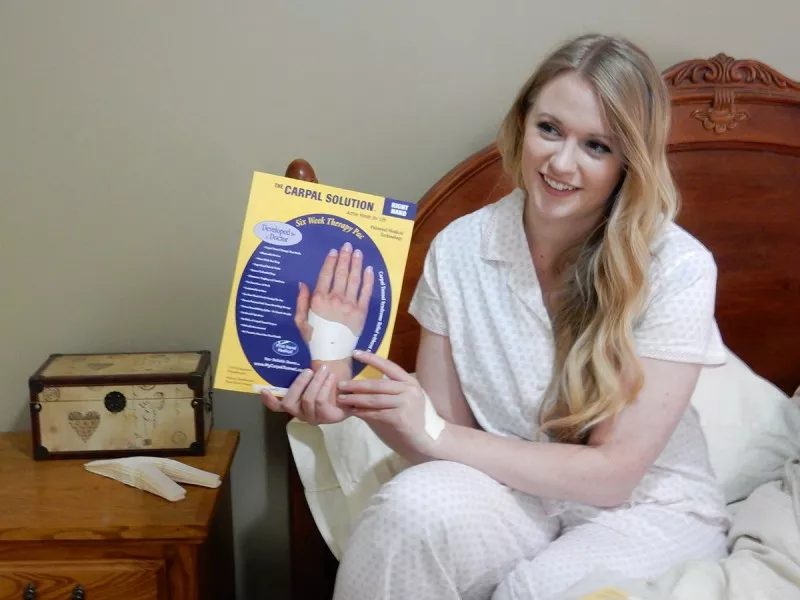
Neurologists, including Dr. James S. Zu, MD, PhD, of Edison, New Jersey, call the Carpal Solution a better first line of defense for carpal tunnel syndrome.

Daytime stretches are a bonus: up to 6 sets of 10, holding each for 15 seconds and resting 30 seconds. While you are healing, skip grip exercises, squeeze balls and putty, and let grip strength return as the nerve recovers; in these carpal tunnel clinical study results, that is what happened for most participants.
Compression gloves worn during the day can also help by increasing circulation and protecting the hand from bumps. Gloves by day with the Carpal Solution at night is one of the best combination therapies.
After remission, prevention nights once a week to once every six months help keep symptoms away. Remission usually lasts 5 to 7 years, ranging from 1 to 17 years. If you have had carpal tunnel surgery, wait 3 months before starting. The Carpal Solution comes with a 30-Day Patient Satisfaction Guarantee, is billed under HCPCS code L3924, and many plans reimburse 70 to 80%.
When Healing Needs a Doctor’s Help and Professional Medical Evaluation
- Constant numbness that does not improve or loss of feeling in the fingertips that does not improve in 4 to 8 weeks.
- Extreme loss of the muscle at the base of the thumb, with loss of grip strength that does not improve over 6 to 8 weeks.
- Worsening symptoms over 6 to 8 weeks while using the best conservative treatments
- Symptoms that begin suddenly after hand or wrist trauma, a fracture or severe sprain from a fall or auto accident.
- Odd Symptoms that are not consistent with the Carpal Tunnel Symptoms listed on this website, that might be indicative of other nerve issues. A nerve conductivity study can clear up the confusion with minimal costs and not too much pain and no risk.
These signs may mean more advanced nerve involvement or a different condition and deserve professional medical evaluation and in person consultation. Home treatment can be used alongside professional in-person medical care while you wait for the healthcare delivery system to fit you into their schedule. There is no reason to wait doing nothing. You can start proven natural conservative treatment with good patient reviews while you wait for your appointments. If your symptoms start improving over 6 to 8 weeks, then you know you are on the right track and surgery is not necessary.
Carpal Tunnel Clinical Study Results: FAQ
How many people were in the study?
Eleven people with carpal tunnel symptoms took part, for a total of 18 hands. Each wore the Carpal Solution every night for two weeks.
What percentage of participants got relief?
In these carpal tunnel clinical study results, 82% of participants experienced relief from carpal tunnel symptoms. 18% eliminated sleep interruption from hand pain, and 64% significantly reduced it.
What did the study show about grip strength and carpal tunnel?
Yes. Every participant improved in at least one test. Six of eleven people (55%) had more than a 40% Average Improvement, and 14 of 18 hands (78%) improved by 20% or more.
Why did the study last only two weeks?
It was designed as an early look at sleep and at grip strength and carpal tunnel recovery. The full protocol is six weeks, so slower responders, likely the more chronic cases, had not finished treatment when testing ended.
Was the study independent?
No. First Hand Medical, which makes the Carpal Solution, ran the study, and there was no control group. Read these carpal tunnel clinical study results with that in mind, and ask your doctor what they mean for you.
Should I do grip exercises to rebuild strength?
Not while you are healing. Grip exercises, squeeze balls and putty add pressure inside the carpal tunnel. In this study, grip strength improved as symptoms eased.

Order Your Six Week Carpal Tunnel Treatment Now
The ONLY treatment for carpal tunnel that comes with a no questions asked 30-Day Patient Satisfaction Guarantee and in-house dedicated pain relief team.