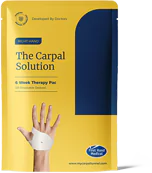
 Created by renowned Harvard health care professionals.


Carpal Tunnel Treatment Options: How to Choose the Right Path
Carpal tunnel treatment options range from changes in how you use your hands to nighttime stretching, therapy, injections and surgery, and picking the wrong one first can cost you months.
This guide breaks down each option, what the evidence shows and how our doctors view it, so you can choose a path to quick, low-risk relief, starting with conservative treatment and keeping surgery as the last resort.


That is what patients are looking for when they search for a “carpal tunnel cure” or carpal tunnel relief without surgery, and it is why more than 100,000 people have used it over two decades, with 97% patient satisfaction and 4.9 out of 5 stars in independent reviews on sites like Google Reviews. Read more in Carpal Tunnel “Cure”: The Honest Truth and a Plan for Life.
Written by Julie Sunberg, Director of Marketing and Customer Service at First Hand Medical · Medically reviewed by Michael E. Ruff, MD, orthopedic hand surgeon and associate clinical professor of orthopedic surgery at Ohio State University · Last reviewed: November 2026
Table of Contents
Carpal Tunnel Treatment Options: Quick Answer
Carpal tunnel treatment options range from changes in how you use your hands, to nighttime stretching, therapy, medication, injections and surgery. Medicine recommends starting with the least invasive option and moving to stronger steps only when needed. Our doctors’ first choice is the Carpal Solution, worn at night, combined with fewer aggravating activities, better ergonomics and gentle daytime stretches. Surgery is the last resort.
This guide walks through each option in detail: what it does, what the evidence shows, its trade-offs, and how our medical team views it. For a one-page comparison table, see carpal tunnel syndrome treatment: 7 options compared.

Before You Compare Carpal Tunnel Treatment Options: Confirm It Is Carpal Tunnel
The right treatment starts with the right diagnosis. Carpal tunnel syndrome typically causes numbness, tingling or pain in the thumb, index, middle and part of the ring finger, often worse at night. Our doctors’ two decades of clinical experience is that people with three or more of the common carpal tunnel symptoms can be about 95% confident they have carpal tunnel syndrome; that is clinical experience, not a published statistic.
A doctor can confirm it and rule out look-alikes such as a pinched nerve in the neck. Learn about carpal tunnel tests.
Getting that appointment can take time. The average new-patient doctor appointment takes 31 days (AMN Healthcare, 2025). With three or more typical symptoms, you can safely start a non-invasive treatment while you wait; read about relief while waiting for carpal tunnel treatment.
8 Carpal Tunnel Treatment Options, One by One
1. Nighttime Stretching With the Carpal Solution
What it does: the first of the carpal tunnel treatment options our doctors recommend is a thin, flexible device worn while you sleep that gently stretches the soft tissue at three points around the carpal tunnel for six to eight hours. That steady stretch helps open the tunnel and lets the swelling trapped around the median nerve disperse.
What to expect: the protocol is every night for two weeks, then every other night for four weeks, for over 220 hours of stretching. Most people are better from their worst symptoms in two to three weeks, and over 90% reach remission by six weeks. About 10% need 8 to 12 weeks. Remission usually lasts 5 to 7 years for most people, ranging from 1 to 17 years.
Our doctors’ view: the first-line treatment. It has 97% patient satisfaction over 21 years and 4.9 out of 5 stars, works without downtime and can be repeated whenever symptoms return. Neurologists, including Dr. James S. Zu, MD, PhD, of Edison, New Jersey, call it a better first line of defense for carpal tunnel syndrome.
2. Activity Changes and Ergonomics
What it does: reduces the repeated strain that feeds the swelling: shorter sessions, a lighter grip, straighter wrists, tools with larger handles and regular breaks. For desk work, see our guide to ergonomic tools for carpal tunnel.
Our doctors’ view: always part of the plan. On its own it rarely clears established symptoms, but every other treatment works better with it. See the best mouse for carpal tunnel.
3. Daytime Stretches and Nerve Glides
What it does: gentle wrist, finger and forearm stretches, tendon glides and nerve glides keep the tissue moving. Our doctors suggest up to 6 sets of 10 a day, holding 15 seconds and resting 30 seconds.
Our doctors’ view: a helpful bonus. Daytime routines alone depend on long-term discipline, which is most people’s weak point, so they work best alongside nighttime treatment. Skip grip balls, putty and squeezing exercises while you are healing. See the best exercises for carpal tunnel.
4. Physical and Occupational Therapy
What it does: a therapist can add manual therapy, TENS, interferential current, workplace advice and a supervised home program.
Our doctors’ view: these therapies accelerate healing alongside the Carpal Solution rather than replacing it. See occupational therapy for carpal tunnel and physical therapy for carpal tunnel.
5. Wrist Splints
What it does: a splint holds the wrist in a neutral position, which can reduce pain from movement.
Our doctors’ view: a splint does not promote healing from carpal tunnel syndrome. It causes muscle atrophy and stiffness, and its tight compression restricts blood circulation and lymphatic fluid exchange, which slows the dispersion of entrapped swelling, the root cause of carpal tunnel syndrome. Our medical team has observed that splints give some relief at first but aggravate symptoms in the long run.
Immobilization is great for fractures and sprains, but not for carpal tunnel syndrome. In one study, two weeks in a cast reduced muscle size by about 8% and strength by about 23% (Wall and colleagues, 2014).
6. Oral Medication
What it does: over-the-counter anti-inflammatory pills ease pain for some people. A Cochrane review of non-surgical treatments found that anti-inflammatory pills, diuretics and vitamin B6 were no better than placebo for carpal tunnel symptoms, while short courses of oral steroids gave short-term benefit (O’Connor and colleagues, 2003).
Our doctors’ view: short-term help at most. Pills do not clear the trapped swelling, and long-term use has side effects. See vitamin B6 and supplements for carpal tunnel.
7. Steroid Injections
What it does: a corticosteroid injected into the carpal tunnel can calm symptoms quickly. In a randomized trial, injections reduced symptoms at 10 weeks compared with placebo, but by one year most patients in every group had gone on to surgery: 73% after placebo and 61% to 64% after a steroid injection (Atroshi and colleagues, 2013).
Our doctors’ view: temporary relief that does not change the swelling cycle that caused the problem.
8. Surgery
What it does: carpal tunnel release cuts the ligament that forms the roof of the tunnel to make more room for the nerve.
Our doctors’ view: the last resort. Carpal tunnel surgery has a patient satisfaction rate lower than 69%: about 31% of patients report lingering or recurring symptoms, and no patient is satisfied with lingering symptoms (Bland, Muscle & Nerve, 2001). A surgery that leaves symptoms behind is not a successful surgery.
Even after a successful surgery, symptoms often come back: 57% of patients had at least some symptoms return within five and a half years (Nancollas et al., 1995).
Based on two decades of clinical experience, our doctors estimate symptoms return for 80 to 90% of patients within 10 years; this is not a statistically researched figure, but their best estimate until the work is done to follow carpal tunnel patients for 10 years or more, as other orthopedic fields do for hip and knee replacements. Second surgeries are needed in 16% to 40% of cases.
Carpal Tunnel Treatment Options for Special Situations

Pregnancy
Fluid retention in pregnancy often brings on carpal tunnel symptoms, and many cases ease after delivery. Drug-free options such as gentle stretching, rest and the Carpal Solution are usually preferred; check with your doctor or midwife before starting any treatment.
After Carpal Tunnel Surgery
If symptoms linger or come back after surgery, conservative treatment is still worth trying. Wait 3 months after surgery before starting the Carpal Solution.
Persistent Symptoms
About 10% of people, often those with higher overall inflammation, respond more slowly. They are usually 50 to 70% better at six weeks and reach remission with a longer course and a few extra steps. See the persistent symptoms protocol.
Heavy Hand Use at Work
Dentists, mechanics, musicians, nurses and computer workers often cannot take time off. A nighttime treatment lets you keep working while you heal; pair it with ergonomic changes and short breaks during the day.
Advanced Symptoms
Constant numbness, thinning of the muscle at the base of the thumb or real loss of grip strength need prompt medical attention. The muscles that bend the fingers and thumb are in the forearm, so weakness can show up in the forearm, thumb and fingers. Conservative treatment can still help, and your doctor can tell you whether more is needed.
A 5-Question Checklist for Choosing Carpal Tunnel Treatment Options
- Does it treat the cause? Relief that lasts comes from dispersing the swelling trapped in the carpal tunnel.
- What are the risks and downtime? Start with options that let you keep working and caring for your family.
- Can I stick with it? A treatment you will actually use for six weeks beats one you abandon.
- What do patients say? Look at patient satisfaction, not just whether a treatment “works” by a narrow definition.
- Can I repeat it? Carpal tunnel syndrome is chronic and recurring, so a treatment you can repeat at home is valuable.
For most people weighing carpal tunnel treatment options, those answers point to the same plan: the Carpal Solution at night, better habits during the day, therapy to speed things up when needed, and surgery only as a last resort. See how to apply the Carpal Solution and the six week carpal tunnel protocol. With a prescription for a hand finger orthosis, it can be reimbursed under HCPCS code L3924, typically at 70% to 80%.
When Healing Needs a Doctor’s Help and Professional Medical Evaluation
- Constant numbness that does not improve or loss of feeling in the fingertips that does not improve in 4 to 8 weeks.
- Extreme loss of the muscle at the base of the thumb, with loss of grip strength that does not improve over 6 to 8 weeks.
- Worsening symptoms over 6 to 8 weeks while using the best conservative treatments
- Symptoms that begin suddenly after hand or wrist trauma, a fracture or severe sprain from a fall or auto accident.
- Odd Symptoms that are not consistent with the Carpal Tunnel Symptoms listed on this website, that might be indicative of other nerve issues. A nerve conductivity study can clear up the confusion with minimal costs and not too much pain and no risk.
These signs may mean more advanced nerve involvement or a different condition and deserve professional medical evaluation and in person consultation. Home treatment can be used alongside professional in-person medical care while you wait for the healthcare delivery system to fit you into their schedule. There is no reason to wait doing nothing. You can start proven natural conservative treatment with good patient reviews while you wait for your appointments.
If your symptoms start improving over 6 to 8 weeks, then you know you are on the right track and surgery is not necessary.
Sources
- O’Connor D, Marshall S, Massy-Westropp N. Non-surgical treatment (other than steroid injection) for carpal tunnel syndrome. Cochrane Database of Systematic Reviews. 2003.
- Atroshi I, Flondell M, Hofer M, Ranstam J. Methylprednisolone injections for the carpal tunnel syndrome: a randomized, placebo-controlled trial. Annals of Internal Medicine. 2013;159(5):309–317.
- Bland JD. Do nerve conduction studies predict the outcome of carpal tunnel decompression? Muscle & Nerve. 2001;24(7):935–940. PubMed.
- Nancollas MP, et al. Long-term results of carpal tunnel release. Journal of Hand Surgery (British). 1995. Reviewed in Louie, Earp and Blazar, Hand, 2012. PMC3418353.
- Wall BT, et al. Acta Physiologica. 2014. doi:10.1111/apha.12190.
- AMN Healthcare. Survey of physician appointment wait times, 2025.
Carpal Tunnel Treatment Options: Frequently Asked Questions
About the word “cure”: Many patients tell us the Carpal Solution “cured” their carpal tunnel, and “carpal tunnel cure” is one of the most searched phrases in this field. Our position is that carpal tunnel syndrome is a chronic, recurring condition that cannot be “cured”. The Carpal Solution is the next best thing: it lets you control symptoms conveniently at home, without downtime, surgical risks, scar tissue or complications.