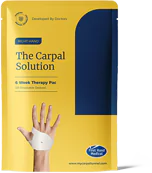
 Created by renowned Harvard health care professionals.


Carpal Tunnel Study Participants and Study Objectives
The study objectives of the Carpal Solution clinical trial were relief of nighttime pain, numbness and broken sleep, and improvement in grip and pinch strength. Here is who the eleven carpal tunnel study participants were and how each objective was measured.

Written by Julie Sunberg, Director of Marketing and Customer Service at First Hand Medical · Medically reviewed by Benjamin E. Bierbaum, MD, orthopedic surgeon and clinical professor of orthopedic surgery at Harvard Medical School · Last reviewed: November 2026
Study Objectives of the Carpal Solution Clinical Trial

The study objectives of the Carpal Solution clinical trial were simple: find out whether the therapy relieves carpal tunnel symptoms, and measure how hand strength changes. The trial was documented in a technical paper by Dr. Clyde E. Morgan, DC, who developed the Carpal Solution. This page explains who the carpal tunnel study participants were, what each objective measured and why, and how to read the results.
For the full overview of the paper, see our Carpal Solution clinical review. For general medical background on the condition, see the NINDS carpal tunnel syndrome fact sheet.
Who Took Part: The Carpal Tunnel Study Participants
The trial involved eleven pre-qualified carpal tunnel study participants. Seven of them had symptoms in both hands and included both hands in the study, so eighteen hands were tracked in all.
At the start, every participant reported the classic symptoms of carpal tunnel syndrome. All had routine sleep interruption from hand pain and numbness, which is typical, because symptoms are usually most pronounced at night. All reported some degree of hand dysfunction and loss of grip strength, which limited how fully they could use their hands in daily activities.
That profile matters when you read the study objectives. These were not people with a little occasional tingling. They were carpal tunnel study participants whose symptoms were already affecting sleep and hand function, the same point at which many people start looking for treatment.
Study Objective 1: Nighttime Pain, Numbness and Sleep
The first of the two study objectives was relief of nighttime hand pain and numbness and the sleep interruption they cause. Night is when carpal tunnel usually hurts most, and lost sleep spills into everything else: energy, mood and work.
To see why night symptoms are so common, start with pressure. Swelling and entrapped inflammation in the soft tissue in and around the carpal tunnel squeeze the median nerve and restrict blood flow and lymphatic fluid transport, so the nerve becomes irritated, short of oxygen and compressed. Many people also sleep with their wrists bent, which adds to the pressure inside the tunnel.
The Carpal Solution is worn during sleep. Its targeted passive stretching restores flexibility to the injured soft tissue, relieves pressure on the median nerve, frees blood circulation and lets lymph fluid flow to clear out the swelling. It is your body that does the healing; the Carpal Solution just jump-starts it. Tracking sleep and nighttime symptoms was the most direct way to see whether that was happening.
Study Objective 2: Grip and Pinch Strength

The second of the study objectives was improvement in hand muscle strength and function, measured with a Jamar grip strength dynamometer and a Jamar pinch test. Strength gives an objective number that can be compared before and after treatment, which pain scores alone cannot do.
Strength matters in carpal tunnel because of the anatomy. The muscles that bend the fingers and thumb are in the forearm, and their nine tendons pass through the carpal tunnel beside the median nerve: four flexor digitorum superficialis, four flexor digitorum profundus and the flexor pollicis longus (Journal of Ultrasound, 2012). The thenar muscles at the base of the thumb get their nerve supply from the median nerve too. When the nerve is compressed and the hand is used less, strength and dexterity fall in the forearm, thumb and fingers.
That loss is why immobilization is a concern. A splint holds the wrist in a neutral position, which can reduce pain from movement, but it does not promote healing, and disuse costs muscle quickly: healthy adults lost about 8% of muscle size and 23% of strength after 14 days in a cast (Wall et al., Acta Physiologica, 2014). The grip objective tested whether strength could come back instead.
How the Study Objectives Were Measured
Participants wore the Carpal Solution every night for two weeks, using a new one each night. Baseline readings were taken before treatment, and participants returned on Monday, Wednesday and Friday each week for repeat testing.
| Study objective | What was measured | How |
|---|---|---|
| Nighttime symptoms and sleep | Hand pain, numbness and sleep interruption | Participant reports at each visit |
| Grip strength | Force of a full-hand squeeze | Jamar dynamometer at handle positions 1, 3 and 5 |
| Pinch strength | Force between thumb and index finger | Jamar pinch tester |
Each strength test was done three times and averaged, so one unusually strong or weak squeeze could not skew the data. The three dynamometer handle positions together cover the full range of hand muscle action. Details are on the Carpal Solution test procedure and testing equipment pages.
What the Study Found
After two weeks, 82% of the carpal tunnel study participants had better sleep, less reported hand pain and significantly improved grip strength as muscle atrophy was overcome. One participant did not improve in any of the symptoms tracked. The paper concludes that for most people with carpal tunnel symptoms, the Carpal Solution provides significant improvement in a relatively short treatment period, and it recommends seeing a licensed physician to confirm the diagnosis.
Both study objectives moved together, which is what you would expect if pressure on the nerve was coming down: less numbness and pain at night, and more strength during the day. Read the full clinical study results and the study conclusion.
What the Study Objectives Did Not Cover
The stated study objectives focus on symptom relief and hand strength over two weeks. They do not cover how results hold up over many months, and there was no comparison group receiving a different treatment. A study with eleven participants is small, and it was run by the company behind the product, so it cannot show exactly how the therapy works for everyone. The paper itself says further evaluation should focus on long-term results five to ten years after treatment.
That does not make the findings useless. They are a starting point, and two decades of patient experience since then fill in much of the rest: 97% patient satisfaction over 21 years, 4.9 out of 5 stars on independent review sites like Google Reviews, and over 100,000 people who have used the Carpal Solution. Neurologists, including Dr. James S. Zu, MD, PhD, of Edison, New Jersey, call it “a better first line of defense.”
How the Findings Compare With Other Options

The trial measured the same things people care about with any carpal tunnel treatment: sleep, pain and hand strength. Carpal tunnel surgery has a patient satisfaction rate lower than 69%, because about 31% of patients report lingering or recurring symptoms and no patient is satisfied with lingering symptoms. Even after a successful surgery, 57% had at least some symptoms return within five and a half years (Nancollas et al., 1995, reviewed in Louie, Earp and Blazar, 2012). Read why the recurrence numbers are so poorly studied.
Many people also wait weeks for appointments and tests; the average new-patient physician appointment wait is 31 days (AMN Healthcare, 2025). A non-invasive therapy you can start at home relieves sleep loss and numbness in the meantime. See our guide to relief while waiting for carpal tunnel treatment.
Applying the Study Objectives to Your Own Progress
You can use the same two study objectives to track your own results. Each morning, note how many times you woke up, how numb your fingers were and how your grip felt. A simple weekly log turns “I think it is better” into something you can see and share with your doctor.
Compare your symptoms with those of the carpal tunnel study participants: nighttime pain, numbness, broken sleep and weaker grip. Our doctors’ clinical experience is that people with three or more classic symptoms can be about 95% confident they have carpal tunnel syndrome; that is clinical experience, not a published statistic, so still get an in-person diagnosis, and see a doctor promptly for constant numbness, weakness or thumb muscle thinning. Our carpal tunnel symptoms page lists the signs.
The full protocol runs six weeks, beyond the two weeks the trial measured, and adds up to over 220 hours of targeted stretching. Most people are better from their worst symptoms in two to three weeks, and over 90% resolve in six weeks; about 10% need 8 to 12 weeks. Questions worth asking your doctor: which symptoms matter most in my case, how should I track my progress, and what should I try first?
When Healing Needs a Doctor’s Help and Professional Medical Evaluation
- Constant numbness that does not improve or loss of feeling in the fingertips that does not improve in 4 to 8 weeks.
- Extreme loss of the muscle at the base of the thumb, with loss of grip strength that does not improve over 6 to 8 weeks.
- Worsening symptoms over 6 to 8 weeks while using the best conservative treatments
- Symptoms that begin suddenly after hand or wrist trauma, a fracture or severe sprain from a fall or auto accident.
- Odd Symptoms that are not consistent with the Carpal Tunnel Symptoms listed on this website, that might be indicative of other nerve issues. A nerve conductivity study can clear up the confusion with minimal costs and not too much pain and no risk.
These signs may mean more advanced nerve involvement or a different condition and deserve professional medical evaluation and in person consultation. Home treatment can be used alongside professional in-person medical care while you wait for the healthcare delivery system to fit you into their schedule. There is no reason to wait doing nothing. You can start proven natural conservative treatment with good patient reviews while you wait for your appointments. If your symptoms start improving over 6 to 8 weeks, then you know you are on the right track and surgery is not necessary.
Study Objectives FAQ
What were the study objectives?
Two: relief of nighttime hand pain, numbness and sleep interruption, and improvement in hand muscle strength and function measured with a Jamar dynamometer and pinch test.
How many carpal tunnel study participants were there?
Eleven pre-qualified participants. Seven had symptoms in both hands and included both, for eighteen hands in total.
How long did the study last?
Two weeks, with testing three times a week. The standard Carpal Solution protocol is six weeks.
Did everyone improve?
No. 82% improved in sleep, pain and grip strength; one participant did not improve in any tracked symptom.
Why measure grip strength for carpal tunnel?
Because the forearm muscles that power grip send their tendons through the carpal tunnel, and the median nerve supplies the thumb muscles. Strength gives an objective measure alongside how people feel.

Order Your Six Week Carpal Tunnel Treatment Now
The ONLY treatment for carpal tunnel that comes with a no questions asked 30-Day Patient Satisfaction Guarantee and in-house dedicated pain relief team.