 Created by renowned Harvard health care professionals.



Written by Julie Sunberg, Director of Marketing and Customer Service at First Hand Medical · Medically reviewed by William Shucart, MD, neurosurgeon, clinical professor of neurosurgery at New England Medical Center and former chair of neurosurgery at Tufts · Last reviewed: November 2026
Table of Contents
If you have numbness, tingling in the fingers, pain at night or a weakening grip from repetitive work, playing a musical instrument, or a hobby like woodworking or knitting, you may have some form of carpal tunnel syndrome. The next question is usually which carpal tunnel tests you need, what they involve and how much you can trust the results.
This guide walks through the carpal tunnel tests doctors actually use, from simple hand maneuvers in the exam room to nerve conduction studies and ultrasound, along with what each one can and cannot tell you.
Carpal Tunnel Tests at a Glance
| Test | What it checks | How accurate | Comfort |
|---|---|---|---|
| Symptom history and hand diagram | Where and when symptoms occur | The foundation of diagnosis | No discomfort |
| Phalen’s test | Whether bending the wrist brings on tingling | About 68% sensitivity, 73% specificity | Brief tingling |
| Tinel’s sign | Whether tapping over the nerve causes tingling | About 50% sensitivity, 77% specificity | Brief tingling |
| Carpal compression (Durkan) test | Whether pressure over the tunnel brings on symptoms | About 64% sensitivity, 83% specificity | Brief tingling |
| Nerve conduction study | How fast signals travel along the median nerve | The most common confirming test, but can miss mild cases | Mild, brief shocks |
| Ultrasound | Swelling of the median nerve at the tunnel entrance | About 78% sensitivity, 87% specificity in a meta-analysis | No discomfort |
Accuracy figures for the exam tests come from a systematic review by MacDermid and Wessel (2004), and for ultrasound from a meta-analysis by Fowler and colleagues (2011). No single test is perfect, which is why doctors combine them.
Your Symptoms Are the First Test
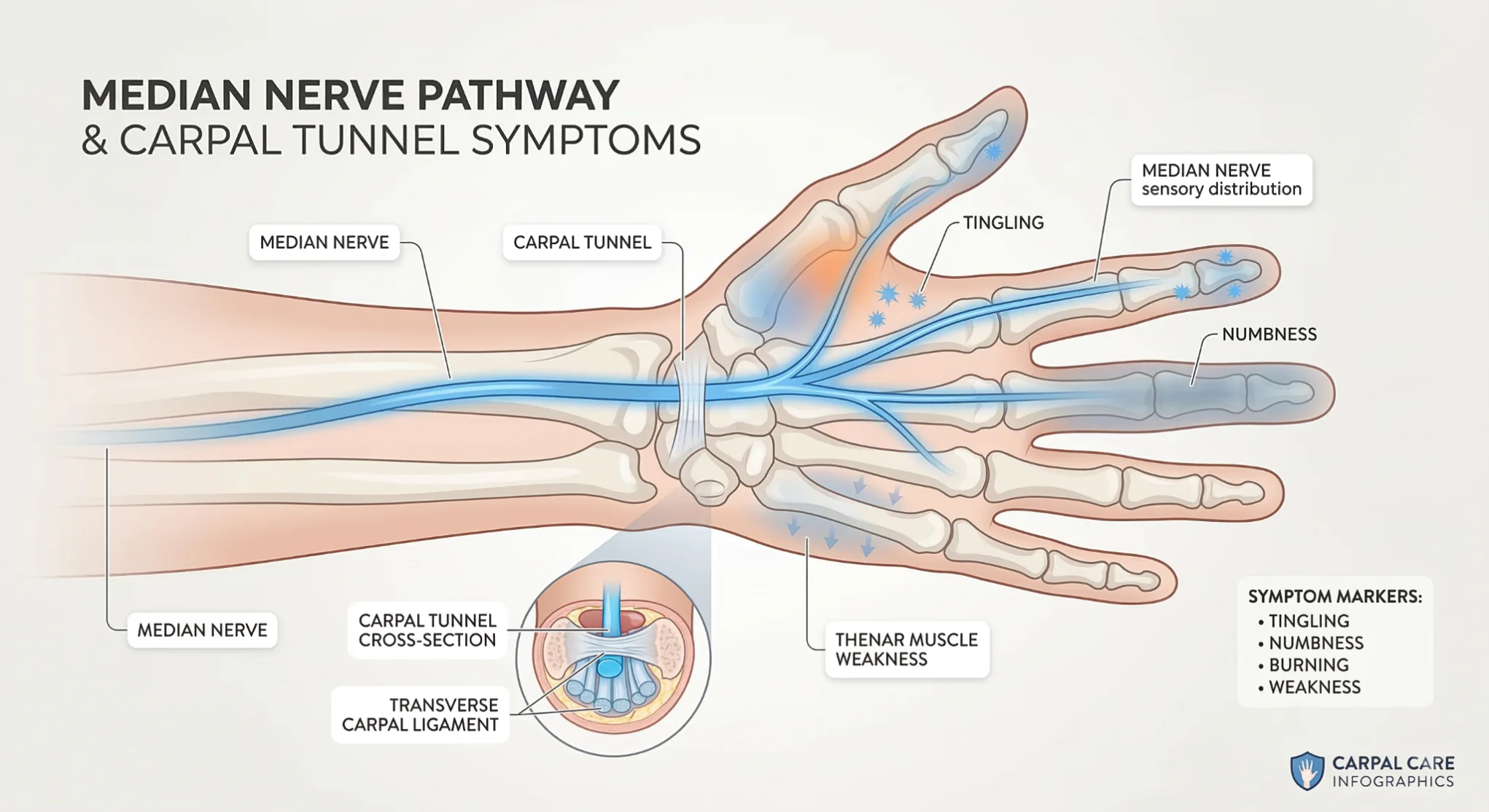
Most carpal tunnel tests start with a conversation, not a machine. Your doctor will ask where the numbness and tingling are, when they happen and what brings them on. The classic pattern is numbness, tingling or pain in the thumb, index, middle and part of the ring finger, often worse at night or first thing in the morning, with relief from shaking the hand.
Our medical team’s two decades of clinical experience is that people with three or more of the common carpal tunnel symptoms can be about 95% confident they have carpal tunnel syndrome. That figure comes from clinical experience, not from a published statistic. You should still get an in-person evaluation and formal diagnosis from a doctor. Learn more about how carpal tunnel is diagnosed.
6 Physical Exam Tests Doctors Use
These quick carpal tunnel tests are done in the exam room and take only a few minutes. Each tries to reproduce your symptoms or measure a change in feeling or strength.
- Phalen’s test. You hold the wrists fully bent, backs of the hands together, for up to 60 seconds. Tingling in the thumb, index or middle finger suggests median nerve compression.
- Tinel’s sign. The doctor taps lightly over the median nerve at the front of the wrist. A tingle shooting into the fingers is a positive result. It is fairly specific but misses many cases.
- Carpal compression test (Durkan’s test). The doctor presses firmly over the carpal tunnel for up to 30 seconds. In the 2004 review, it had the best balance of accuracy of the three common maneuvers.
- Reverse Phalen’s test. The wrists are held bent backward, palms together, as in a prayer position.
- Sensory testing. Light-touch filaments, vibration or two-point discrimination check how well you can feel with the fingertips. Loss of two-point discrimination usually appears only in more advanced cases.
- Thumb strength and muscle check. The doctor looks for thinning of the muscle at the base of the thumb and tests how strongly you can lift the thumb. Like two-point discrimination, this is specific but tends to show up late.
A 2023 meta-analysis by Dabbagh and colleagues concluded that no single maneuver is reliable on its own, and that doctors should combine provocative tests with sensory tests, hand diagrams and questionnaires for the best accuracy.
Nerve Conduction Study and EMG
A nerve conduction study is the carpal tunnel test most doctors use to confirm the diagnosis. Small surface electrodes are placed on the hand and wrist, and mild electrical pulses measure how fast signals travel along the median nerve. When the nerve is compressed in the carpal tunnel, signals slow down as they cross the wrist.
The test is quick and generally well tolerated. Some people find the pulses uncomfortable, others barely notice them. It is sometimes paired with electromyography (EMG), in which a fine needle checks the electrical activity of the thumb muscles. The study can also help rule out other problems, such as a pinched nerve in the neck, that can look like carpal tunnel.
A nerve conduction study tells your doctor how much the nerve is affected, which helps judge severity. It does not, by itself, tell you which treatment to choose.
Ultrasound of the Median Nerve
Ultrasound is a painless imaging test that measures the size of the median nerve where it enters the carpal tunnel. A compressed nerve tends to swell just before the tunnel. In a meta-analysis by Fowler and colleagues (2011), ultrasound had a sensitivity of 77.6% and a specificity of 86.8%. It can also show swollen tendon linings or other causes of pressure.
Ultrasound is especially useful when symptoms point clearly to carpal tunnel but the nerve conduction study is normal. In one study of patients with clinical carpal tunnel and normal nerve studies, ultrasound found an abnormality in 73% of them (Journal of Pain Research, 2018).
Questionnaires and Hand Diagrams
Many clinics use structured carpal tunnel tests on paper. The Boston Carpal Tunnel Questionnaire scores symptom severity and hand function. A hand diagram, where you shade the areas of numbness and tingling, helps show whether the pattern matches the median nerve. Scoring tools such as the CTS-6 combine six symptoms and exam findings into a single probability score.
These tools are free, painless and useful for tracking progress. Scoring yourself before and after treatment gives you a clear picture of how much you have improved.
What Carpal Tunnel Tests Can Miss
Not everyone who passes carpal tunnel tests with flying colors is in the clear. Nerve conduction studies often miss early and mild carpal tunnel syndrome, because the nerve may still conduct normally even while swelling in the tunnel is causing symptoms. In the 2018 ultrasound study above, about 27% of patients with clear clinical signs of carpal tunnel had normal nerve conduction results.
That matters because carpal tunnel syndrome is easiest to treat early. Repetitive strain problems can be hard to control once they settle in, so it is important to act on early signs rather than wait for a test to turn abnormal. A normal test result with typical symptoms is a reason to keep watching and start conservative care, not a reason to ignore the problem.
Carpal tunnel tests also cannot see the root cause directly. Carpal tunnel syndrome is caused by swelling trapped in the tight space of the carpal tunnel, where the median nerve shares room with the nine tendons that bend the fingers and thumb (4 FDS, 4 FDP and 1 FPL). The swelling presses on the nerve and restricts blood circulation and lymphatic fluid exchange. Tests measure the effect on the nerve; treatment needs to address the swelling.
What to Do While You Wait for Testing
Getting carpal tunnel tests usually means waiting: for a first appointment, for a referral to a neurologist and for the nerve study itself. The average wait for a new-patient doctor appointment is 31 days (AMN Healthcare, 2025). Read about relief while waiting for carpal tunnel treatment, and try our self-test for carpal tunnel to bring clear notes to your appointment.
With three or more typical symptoms, you do not have to wait in pain. You can start a safe, natural, non-invasive treatment developed by doctors while you wait for testing. The Carpal Solution is worn at night while you sleep and has 97% patient satisfaction over 21 years, a 4.9 out of 5 star rating, and has been used by over 100,000 people over two decades. If your symptoms include constant numbness, weakness, thinning of the thumb muscle or symptoms after an injury, tell your doctor’s office so they can see you sooner.
After the Diagnosis: Treatment Options

Medicine starts with conservative treatment, and surgery is the last resort. The Carpal Solution gently stretches the soft tissue of the hand and wrist during sleep, which helps the trapped swelling disperse. Over the six-week protocol it provides over 220 hours of stretching. Most people feel their worst symptoms ease in two to three weeks, and over 90% reach remission by 6 weeks. About 10% need 8 to 12 weeks and are 50 to 70% better at 6 weeks.
Remission usually lasts 5 to 7 years for most people, ranging from 1 to 17 years, and a prevention treatment from once a week to once every six months helps keep it there. Neurologists, including Dr. James S. Zu, MD, PhD, of Edison, New Jersey, call the Carpal Solution a better first line of defense for carpal tunnel syndrome.
A splint holds the wrist in a neutral position, which can reduce pain from movement, but it does not promote healing from carpal tunnel syndrome. It causes muscle atrophy and stiffness, and its tight compression restricts blood circulation and lymphatic fluid exchange, which slows the dispersion of entrapped swelling, the root cause of carpal tunnel syndrome. Our medical team has observed that splints give some relief at first but aggravate symptoms in the long run. Immobilization is great for fractures and sprains, but not for carpal tunnel syndrome.
Carpal tunnel surgery has a patient satisfaction rate lower than 69%: about 31% of patients report lingering or recurring symptoms after surgery, and no patient is satisfied with lingering symptoms (Bland, Muscle & Nerve, 2001). Second surgeries are needed in 16% to 40% of cases. If you have had surgery, wait 3 months before starting the Carpal Solution.
The articles on MyCarpalTunnel.com are written or reviewed by doctors committed to minimally invasive treatment, and include myth-busting information about carpal tunnel syndrome. You can also read about the clinical testing behind the Carpal Solution itself on our Carpal Solution test procedure page. Visit your physician to confirm your self-diagnosis, and there is no reason to delay a safe treatment developed by doctors.
Neurologists, including Dr. James S. Zu, MD, PhD, of Edison, New Jersey, call the Carpal Solution a better first line of defense for Carpal Tunnel Syndrome. Patients simply call it: “My Carpal Tunnel “Cure”!”
Carpal tunnel syndrome is a chronic, recurring condition that cannot be cured, but the Carpal Solution is the next best thing: it controls symptoms at home without downtime, risks, scar tissue or complications.
Click to “Like Us” on Face Book and read what real people who have used the Carpal Solution have to say about this remarkable Carpal Tunnel Treatment.
You can view more detailed video user reviews of The Carpal Solution in 7 different languages on our YouTube video channel called: MyCarpalTunnelSolution
You can learn more about Carpal Tunnel Testing and Carpal Tunnel Testing Equipment
When Healing Needs a Doctor’s Help and Professional Medical Evaluation
- Constant numbness that does not improve or loss of feeling in the fingertips that does not improve in 4 to 8 weeks.
- Extreme loss of the muscle at the base of the thumb, with loss of grip strength that does not improve over 6 to 8 weeks.
- Worsening symptoms over 6 to 8 weeks while using the best conservative treatments
- Symptoms that begin suddenly after hand or wrist trauma, a fracture or severe sprain from a fall or auto accident.
- Odd Symptoms that are not consistent with the Carpal Tunnel Symptoms listed on this website, that might be indicative of other nerve issues. A nerve conductivity study can clear up the confusion with minimal costs and not too much pain and no risk.
These signs may mean more advanced nerve involvement or a different condition and deserve professional medical evaluation and in person consultation. Home treatment can be used alongside professional in-person medical care while you wait for the healthcare delivery system to fit you into their schedule. There is no reason to wait doing nothing. You can start proven natural conservative treatment with good patient reviews while you wait for your appointments. If your symptoms start improving over 6 to 8 weeks, then you know you are on the right track and surgery is not necessary.
Frequently Asked Questions About Carpal Tunnel Tests
What is the most accurate test for carpal tunnel?
No single test is perfect. A nerve conduction study is the most common confirming test, but it can miss mild cases. Doctors get the best accuracy by combining your symptom history with exam tests, and sometimes ultrasound.
Are carpal tunnel tests painful?
Exam tests like Phalen’s and Tinel’s only cause brief tingling. A nerve conduction study uses mild electrical pulses that some people find uncomfortable for a moment. Ultrasound is painless.
Can I have carpal tunnel with a normal nerve conduction test?
Yes. Early and mild carpal tunnel syndrome often shows normal nerve conduction. In one study, about 27% of patients with clear clinical signs had normal results, and ultrasound found changes in most of them.
Can I test for carpal tunnel at home?
You can try Phalen’s test and Tinel’s sign at home and keep a hand diagram of your symptoms, but they are screening tools, not a diagnosis. See our self-test for carpal tunnel, and confirm the diagnosis with your doctor.
Do I need a test before starting treatment?
You should get a formal diagnosis, but with three or more typical symptoms you can safely start a non-invasive treatment like the Carpal Solution while you wait for your appointment.
Which doctor does carpal tunnel tests?
Your family doctor can do the exam tests. Nerve conduction studies are usually done by a neurologist or a physical medicine and rehabilitation doctor.
Sources
- MacDermid JC, Wessel J. Clinical diagnosis of carpal tunnel syndrome: a systematic review. Journal of Hand Therapy. 2004;17(2):309–319.
- Dabbagh A, MacDermid JC, et al. Diagnostic test accuracy of provocative maneuvers for the diagnosis of carpal tunnel syndrome: a systematic review and meta-analysis. Physical Therapy. 2023. PMC10294560.
- Fowler JR, Gaughan JP, Ilyas AM. The sensitivity and specificity of ultrasound for the diagnosis of carpal tunnel syndrome: a meta-analysis. Clinical Orthopaedics and Related Research. 2011. PMC3048245.
- Sensitivity of high-resolution ultrasonography in clinically diagnosed carpal tunnel syndrome patients with hand pain and normal nerve conduction studies. Journal of Pain Research. 2018;11. PMC6044364.
- Bland JD. Do nerve conduction studies predict the outcome of carpal tunnel decompression? Muscle & Nerve. 2001;24(7):935–940.
- AMN Healthcare. Survey of physician appointment wait times, 2025.

Order Your Six Week Carpal Tunnel Treatment Now
The ONLY treatment for carpal tunnel that comes with a no questions asked 30-Day Patient Satisfaction Guarantee and in-house dedicated pain relief team.


