Created by renowned Harvard health care professionals.


Carpal Tunnel and Sleep: Can Lost Sleep Affect Your Brain?
Numb, tingling hands that wake you night after night take a toll on memory, focus and mood. Our doctors explain how carpal tunnel sleep loss can affect the brain.


Written by Julie Sunberg, Director of Marketing and Customer Service at First Hand Medical · Medically reviewed by Michelle Robin, DC, chiropractor and wellness expert, founder of Your Wellness Connection, Kansas City · Last reviewed: November 2026
Carpal tunnel and sleep are closely linked. Numb, tingling or aching hands are often worst at night, and many people wake again and again to shake them out. Over weeks and months, that broken sleep takes a toll on memory, focus and mood. Below, Benjamin from Austin, Texas asks whether sleep loss from carpal tunnel can affect the brain. First, here is why carpal tunnel disrupts sleep, what lost sleep does to the body and brain, and how to sleep through the night again.
Key Points
- Carpal tunnel symptoms are often worst at night, so carpal tunnel and sleep problems usually go together.
- Ongoing sleep loss affects attention, memory, mood and overall health.
- Sleeping pills and pain medication do not treat the cause, and can leave you groggy.
- Treating the swelling while you sleep is the most direct way to get your sleep back.
Table of Contents
Carpal Tunnel and Sleep: Why Symptoms Strike at Night
To understand carpal tunnel and sleep, start with the anatomy. The carpal tunnel is a narrow passage at the base of the palm, where the median nerve runs beside the nine tendons that bend the fingers and thumb. A day of typing, gripping and texting leaves that soft tissue swollen. At night, the wrists tend to curl, fluid settles in the hands, and you lie still for hours, so pressure on the nerve rises. The result is tingling, numbness and aching that wake you up, often several times a night. Read more about numbness in hands at night and hands that fall asleep at night.
The best pillow for carpal tunnel is one that keeps your wrists straight while you sleep. Our doctors recommend using pillows to support the arms and keep the wrists in a neutral position.
Carpal Tunnel and Sleep Loss: What It Does to the Brain and Body
Adults need at least seven hours of sleep a night, according to the CDC. When it comes to carpal tunnel and sleep, that target is often out of reach. When carpal tunnel cuts that short night after night, the effects add up:
- Slower thinking and poorer memory. Sleep is when the brain sorts and stores what you learned during the day.
- Shorter temper and low mood. Irritability, anxiety and a “short fuse” are common with ongoing sleep loss.
- More mistakes and accidents. Drowsy driving and errors at work rise when you are tired.
- Health effects over time. Long-term short sleep is linked to higher blood pressure, weight gain and a weaker immune system.
- More pain. With carpal tunnel and sleep loss together, poor sleep lowers pain tolerance, so carpal tunnel feels worse, which disrupts sleep even more.
That cycle is why carpal tunnel and sleep need to be treated together, by treating the cause.
Carpal Tunnel and Sleep: How to Sleep Through the Night
- Keep your wrists straight. Use pillows so your wrists do not curl under your chin or body. Doctors recommend a simple carpal tunnel pillow setup over a rigid splint: a pillow under or beside each arm keeps the wrists neutral all night.
- Do not sleep on your hands or arms, and avoid tucking your hands under the pillow.
- Put devices down an hour before bed. Scrolling with a bent wrist adds pressure right before sleep.
- Treat the swelling while you sleep. The Carpal Solution is worn at night. Its six-week protocol gives over 220 hours of targeted passive stretching that restores flexibility to the injured soft tissue, relieves pressure on the median nerve and lets blood and lymph fluid flow freely to clear out the swelling. Most people are better from their worst symptoms in two to three weeks, and many sleep through the night well before the six weeks are up.
For sleeping positions and more tips, see how to sleep with carpal tunnel.

For carpal tunnel and sleep problems, sleeping pills and pain medication may help you get through a night, but they do not relieve pressure on the nerve, and many people find they leave them groggy the next day. Splints are the right tool for fractures and sprains, where holding a joint still lets it heal. For carpal tunnel, a splint mostly shields the wrist from painful movement, at two separate costs: unused muscles weaken (muscle atrophy), and restricted blood circulation and lymph flow reduce the nutrients needed for healing and slow the clearing of inflammation, so soft tissue heals more slowly. Use one only for temporary relief, not long term.
For carpal tunnel and sleep, the Carpal Solution is the treatment our doctors recommend first. It has 97% patient satisfaction over 21 years and 4.9 out of 5 stars on independent review sites like Google Reviews. Carpal tunnel surgery has a patient satisfaction rate lower than 69%: about 31% of patients report lingering or recurring symptoms, and no patient is satisfied with lingering symptoms. For background, see the CDC on sleep and the NINDS carpal tunnel syndrome fact sheet.
When Healing Needs a Doctor’s Help and Professional Medical Evaluation
- Constant numbness that does not improve or loss of feeling in the fingertips that does not improve in 4 to 8 weeks.
- Extreme loss of the muscle at the base of the thumb, with loss of grip strength that does not improve over 6 to 8 weeks.
- Worsening symptoms over 6 to 8 weeks while using the best conservative treatments
- Symptoms that begin suddenly after hand or wrist trauma, a fracture or severe sprain from a fall or auto accident.
- Odd Symptoms that are not consistent with the Carpal Tunnel Symptoms listed on this website, that might be indicative of other nerve issues. A nerve conductivity study can clear up the confusion with minimal costs and not too much pain and no risk.
These signs may mean more advanced nerve involvement or a different condition and deserve professional medical evaluation and in person consultation. Home treatment can be used alongside professional in-person medical care while you wait for the healthcare delivery system to fit you into their schedule. There is no reason to wait doing nothing. You can start proven natural conservative treatment with good patient reviews while you wait for your appointments.
If your symptoms start improving over 6 to 8 weeks, then you know you are on the right track and surgery is not necessary.
Carpal Tunnel and Sleep: FAQ
Why does carpal tunnel wake me up at night?
Curled wrists, settled fluid and hours without movement raise pressure on the median nerve during sleep, so tingling and numbness wake you up.
Can sleep loss from carpal tunnel affect my brain?
Ongoing sleep loss affects attention, memory and mood in anyone. Getting your sleep back by treating carpal tunnel helps reverse those effects.
Are sleeping pills a good idea for carpal tunnel and sleep problems?
They do not treat the cause and can leave you groggy. Talk with your doctor before using them, and treat the swelling that wakes you.
How soon can I sleep better?
Most people are better from their worst symptoms in two to three weeks with the Carpal Solution, and many notice fewer wake-ups within the first week or two.
Is it normal for carpal tunnel and sleep problems to start together?
Yes. For many people, waking at night with numb or tingling hands is the very first sign of carpal tunnel, before any daytime symptoms. That is why carpal tunnel and sleep problems so often start together.
Does treating carpal tunnel improve sleep?
Yes. When the swelling around the nerve goes down, the night-time tingling and numbness ease, and sleep usually improves first. Patients often tell us that better sleep is the change they notice most.
What is the link between carpal tunnel and sleep position?
Curling the wrists, sleeping on your hands or tucking them under the pillow all raise pressure on the median nerve. Keeping the wrists straight with pillows is one of the simplest carpal tunnel and sleep fixes. For people with carpal tunnel insomnia, a carpal tunnel pillow routine plus treating the cause at night is often what finally brings back a full night of sleep.
In short, carpal tunnel and sleep loss feed each other, and treating the cause at night breaks the cycle.
Benjamin’s Question
Question from Benjamin in Austin, Texas
I have been experiencing routine sleep loss from achy numb hands. At first, I thought I was sleeping on my arms and cutting off circulation to my hands, but then I read on your website from that sleep loss was a common symptom of Carpal Tunnel Syndrome. The problem is I now feel like this is slowing down my brain. I cannot think as quickly, nor as clearly and I get upset much more easily and have a short fuse. Can Sleep Loss from Carpal Tunnel affect my brain in this way? I tried sleeping pills and pain medication but they give me brain fog and make me irritable. I hate this feeling. What do you recommend?
Answers from Doctors at First Hand Medical
Chronic sleep loss is a common symptom of Carpal Tunnel Syndrome (CTS). Like you, most people believe that their sleep posture is causing their hands to “fall asleep” and then wakes them up. The reality is that for many people the first symptoms to show up from Carpal Tunnel is that their hands “fall asleep” at night during sleep causing them to wake up.
 There are multiple factors going on that trigger this response and routine awaking with numb or even painful hands and wrists.
First, Carpal Tunnel Syndrome is caused by trapped inflammation that builds up and puts pressure on the Median Nerve in the Carpal Tunnel at the base of the hand. The trapped inflammation also restricts full blood circulation which becomes worst at night during sleep when the muscles are still and not moving.
Second, Sleep is when our body’s healing processes go into hyperdrive repairing injuries and restoring brain function. A key part of restorative sleep is REM Sleep (Rapid Eye Movement Sleep). When our body’s go into REM Sleep the brain is very active with dreams. During REM Sleep our bodies go into a semi-paralysis state to prevent us from acting out our dreams. REM Sleep is essential for good health and for mental sanity.
To illustrate the point, it can be helpful to explore the extremes.
One sleep expert Doctor recently commented to me:
“If a person is completely deprived of REM Sleep for 2 months, they will go insane and risk death.”
 Dr. Charles Czeisler, a Harvard Medical School sleep expert, a consultant to NASA and the CIA, testified at the wrongful-death trial of AEG Live associated with the death of Michael Jackson said: “If the singer had not died on June 25, 2009, of an overdose of Propofol, the lack of REM sleep may have taken his life within days anyway.” “Michael Jackson went 60 days without REM sleep.” “He may be the only human to have ever gone 60 days without REM Sleep.” “Propofol deprives patient of vital REM sleep.” “Lab Rats die after five weeks of getting no REM sleep”, he said.
Czeisler testified that: “The coma induced by propofol leaves a patient with the same refreshed feeling of a good sleep, but without the benefits that genuine sleep delivers in repairing brain cells and the body.”
CNN Entertainment Article: Expert: Michael Jackson went 60 days without real sleep
These statements from sleep experts illustrates how important REM Sleep is to our mental health.
When your body drops into REM Sleep, it stops moving almost completely, and goes into a state of semi-paralysis. This lack of muscle movement causes blood circulation, that is already restricted to the hand due to trapped inflammation in and around the Carpal Tunnel, to be reduced further.
Of course, Blood circulation is aided by muscle movement.
Yet Carpal Tunnel wakes you up during REM Sleep with Numb Achy Hands depriving you of REM Sleep.So, when the injured hand is trying to repair itself during sleep, it cannot get the healing nutrients it needs. Nor can it effectively access the fluid exchange needed for natural healing through the lymph system due to the pressure from the trapped inflammation and the lack of muscle movement. So, the hand starts to ache and becomes numb waking the person up and preventing the REM Sleep that Brain urgently needs.
Your body gets stuck in a: “Catch 22” Scenario.
Some patients are awakened 4 or 5 times per night. Each time they fall into REM Sleep, their hands wake them up. It can take hours of sleeping for your body to fall into REM Sleep. It doesn’t just happen when you first fall asleep.
So, when a patient is being regularly interrupted and awakened from sleep by numb and aching hands, it can be very difficult to get the REM sleep you need.
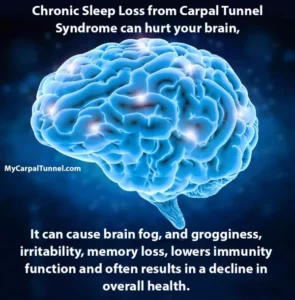
People who are deprived of REM Sleep report:
Less Server Cases
- Brain Fog
- Irritability
- A Short Temper
- Day Time Grogginess
- Slow Reflexes
- Slower Response Times to mental challenges
- Less Patience
- Less tolerance for stress
More Server Cases
- Memory loss
- Lower Immune System Function
- Reduced T-Cells Production – which are key to the body’s ability to destroy virus infected cells or cancerous cells
- More susceptibility to Illness – more frequent respiratory illness can common colds
- Hallucinations
- Inability to notice you have made mistakes
- Learning Disabilities
- Difficulty making decisions
- Difficulty dealing with complexity
You have likely been experiencing this phenomena to one degree or another. Routine sleep interruption from numb and painful hands is one of the most common symptoms of the Carpal Tunnel Condition. It can be quite confusing for most people that are suffering with CTS.
It can be hard to think clearly and find the right solution when a person is suffering with this type of a condition. No worry’s we can help you.
Most people get some REM sleep every night, but being deprived of any of the most restorative type of sleep is not good over the long run.
Chronic Sleep Deprivation over many months or years can lead to a lot of serious issues including:
- Lowering the body’s Immune Response which can increase the risks of cancer and other chronic diseases
- Raise Inflammation levels which is a precursor to auto-immune diseases and many other chronic diseases
- Increased risks of Depression, Anxiety, Mental Stress and potentially lead to Mental Illness
- Frequently Leads to Hypertension (High Blood Pressure)
- Leads to Heart Disease
- Increased risks of Stroke
- Results in Hormone Imbalances
- Higher risks of Type II Diabetes
- Higher risks of Kidney Disease
- Increases the onset of Obesity
- Day Time Sleepiness and lower productivity at work which creates more stress and anxiety
- Increased Risk of Accidents while driving or operating equipment or any activity that requires safety while moving
- Irritability which can damage social relationships at home and at work which leads to more mental stress.
This is why we, the Doctors at First Hand Medical say:

So, to answer your question and summarize: Yes, definitely chronic sleep loss caused by Carpal Tunnel Syndrome can negatively affect your brain function, your mental health and your overall health.
CTS is not something to be taken lightly.
What can be Done to Prevent Carpal Tunnel from destroying your healthy life?
The good news is that you can take proactive steps at home to jump-start your body’s natural healing and take control of Carpal Tunnel Syndrome Symptoms in just a few weeks. You can put Carpal Tunnel in complete remission in 6 weeks for most people. It might take 10 weeks for a few people with persistent carpal tunnel symptoms. There is absolutely no reason to allow CTS to wreck-havoc and destroy your health. The Carpal Solution has 97% patient satisfaction among people with Carpal Tunnel Syndrome. Most people get relief of their worst symptoms in two to three weeks and complete remission of CTS in 6 weeks. CTS then stays in remission for years for most people.

The truth is there is no permanent fix for CTS. Carpal Tunnel reoccurs even after surgery for most.
However, there is a Permanent Solution.
Even though CTS comes back in 5 to 7 years after successful treatment with the Carpal Solution, it is easy to put it back in remission with this safe and reliable nighttime stretching treatment.
So, while no treatment is a permanent cure for this chronic, recurring condition, the Carpal Solution is the next best thing for most patients: a convenient home treatment you can repeat whenever symptoms return, without downtime, risks, scar tissue or complications.
The Carpal Solution comes with a 30-Day Satisfaction Window.
Start the Risk-Free Trial Today

Order Your Six Week Carpal Tunnel Treatment Now
The ONLY treatment for carpal tunnel that comes with a no questions asked 30-Day Satisfaction Window and in-house dedicated pain relief team.
Watch videos of people who “Cured” their Carpal Tunnel Naturally and Avoided the Risks of Carpal Tunnel Surgery!






References:
Extent and Health Consequences of Chronic Sleep Loss and Sleep Disorders
https://www.ncbi.nlm.nih.gov/books/NBK19961/
Institute of Medicine (US) Committee on Sleep Medicine and Research; Colten HR, Altevogt BM, editors.
Washington (DC): National Academies Press (US); 2006.
Sleep Disorders and Sleep Deprivation: An Unmet Public Health Problem.
https://www.ncbi.nlm.nih.gov/books/NBK19956/
Institute of Medicine (US) Committee on Sleep Medicine and Research; Colten HR, Altevogt BM, editors.
Washington (DC): National Academies Press (US); 2006.
Dream Deprived: A Modern Epidemic?
Michelle Carr Ph.D. (Dream Factory, Psychology Today)
Michelle Carr, Ph.D, is a researcher at Swansea University Sleep Laboratory. She holds a PhD in Biomedical Science from the University of Montreal, where she conducted research at the Dream and Nightmare Laboratory. Prior to that, she received dual degrees, a BS in Brain and Cognitive Science and a BA in Psychology, from the University of Rochester in 2010. Her work focuses on the role of REM sleep and dreams in emotional memory, along with comparative studies of nightmare disorder and PTSD. Other research interests include sleep paralysis, lucid dreaming, consciousness studies, and the use of dreamwork in psychology.
https://www.psychologytoday.com/us/blog/dream-factory/201708/dream-deprived-modern-epidemic