 Created by renowned Harvard health care professionals.


Carpal Tunnel Syndrome Guide 2026: Symptoms, Treatment and Prevention
This carpal tunnel syndrome guide exists for one reason: waking up with numb, tingling fingers, or struggling to keep a grip on your morning coffee, shouldn't be something you just live with. It’s tempting to brush off early carpal tunnel symptoms, but that trapped inflammation is actively pinching off the blood flow your body needs to heal itself. Ignoring the warning signs only allows the cycle to progress, eventually trapping you in a frustrating loop of muscle-weakening splints, temporary steroid shots, or a coin-flip surgery. Discover why conventional treatments often fail and how you can break the cycle of pain naturally while you rest.

Written by Julie Sunberg, Director of Marketing and Customer Service at First Hand Medical · Medically reviewed by Benjamin E. Bierbaum, MD, orthopedic surgeon and hand specialist, clinical professor of orthopedic surgery at Harvard Medical School · Last reviewed: November 2026
If you wake up at night with numb, tingling hands, or you struggle to grip a coffee cup, open a jar or type for more than a few minutes without pain, you are not alone. Carpal tunnel syndrome (CTS) is one of the most common nerve problems in the hand, and the confusion about what causes it, how to spot it and what actually works can feel as overwhelming as the condition itself.
This carpal tunnel syndrome guide brings everything together in one place. Think of it as your home base: the essentials on each topic, written plainly, with links to our in-depth articles when you want to go deeper.
Table of Contents
Carpal Tunnel Syndrome Guide: Quick Answer
Carpal tunnel syndrome is caused by swelling trapped inside the narrow carpal tunnel at the base of the palm. That swelling squeezes the median nerve and blocks the circulation the body needs to heal. Our doctors recommend conservative care first, with nighttime passive stretching as the anchor treatment: most people are better from their worst symptoms in two to three weeks, and about 90% get complete remission in six weeks. Surgery is the last resort; it has a patient satisfaction rate lower than 69%.
Carpal Tunnel Syndrome Guide: What It Really Is
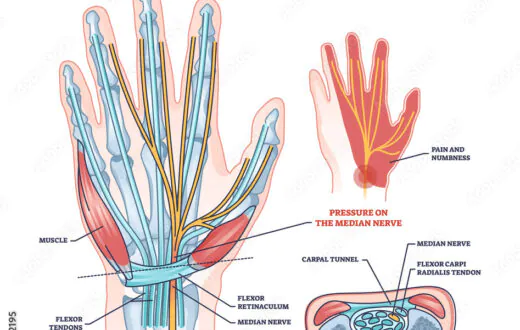
At its core, carpal tunnel syndrome is caused by trapped inflammation in the carpal tunnel, a narrow passage at the base of the palm. Nine tendons from the forearm muscles pass through it beside the median nerve: four flexor digitorum superficialis, four flexor digitorum profundus and the flexor pollicis longus. These are the tendons that bend your fingers and thumb, which is why the forearm muscles matter so much in carpal tunnel syndrome.
When the tissue around those tendons swells and the swelling cannot escape, it does two things at once. It compresses the median nerve, which causes the numbness, tingling and pain. And it pinches off the blood flow and lymphatic drainage your body needs to clear the swelling and heal itself.
That is the real catch with carpal tunnel syndrome. It is not just that something is inflamed; the body’s natural healing is being blocked at the same time. Compression, poor circulation and more trapped swelling feed each other in a cycle that tends to worsen without the right intervention. The National Institute of Neurological Disorders and Stroke describes it as one of the most common nerve compression disorders.
Carpal tunnel syndrome is also chronic and recurring. It can be controlled and put into long remission, but it tends to return when the hand use or inflammation that caused it continues. Read more: What causes carpal tunnel syndrome?
Recognizing the Symptoms
Carpal tunnel symptoms can creep up gradually or seem to arrive all at once. This carpal tunnel syndrome guide lists the most common signs:
- Numbness or tingling in the thumb, index, middle and part of the ring finger
- Pain or burning that can radiate up the forearm, sometimes toward the shoulder
- Weakness in the hand and dropping things more often than usual
- Waking at night and needing to shake out your hands
- Trouble with fine motor tasks like buttoning a shirt or texting
- In longer-standing cases, weakness in the forearm and thinning of the muscle at the base of the thumb
In our doctors’ two decades of clinical experience (not a published statistic), people with three or more of these symptoms can be about 95% confident they have carpal tunnel syndrome. You should still get an in-person evaluation and formal diagnosis. With that confidence, though, you can start a natural, non-invasive treatment while you wait for the appointment.
The wait is real. The average wait for a new-patient physician appointment is 31 days (AMN Healthcare, 2025), and seeing a neurologist or hand surgeon often takes longer. Read more about waiting for carpal tunnel treatment.
Many medical conditions are linked to carpal tunnel syndrome. Pregnancy, diabetes, thyroid disorders, rheumatoid arthritis and fluid retention can all trigger or worsen it. Understanding what is behind your symptoms makes a real difference in choosing treatment. Read more: Carpal tunnel symptoms and diagnosis.
Carpal Tunnel Syndrome Guide to Conventional Treatments: An Honest Look
If you have seen a doctor about carpal tunnel, you have probably been offered one or more of the standard options. This carpal tunnel syndrome guide explains what each one does, and does not do, in plain terms.
Oral pain and anti-inflammatory medication
Pills can take the edge off pain, but they do not address the trapped swelling. A Cochrane review found that anti-inflammatory pills, diuretics and vitamin B6 were no better than placebo for carpal tunnel symptoms, while short courses of oral steroids gave only short-term benefit (O’Connor and colleagues, 2003). Long-term use carries real side effects, so for a condition that can recur for years, pills alone are not a sustainable plan.
Wrist splints
Splints are the right tool for fractures and sprains, where holding a joint still lets it heal. For carpal tunnel, a splint mostly shields the wrist from painful movement, at two separate costs: unused muscles weaken (muscle atrophy), and restricted blood circulation and lymph flow reduce the nutrients needed for healing and slow the clearing of inflammation, so soft tissue heals more slowly. Use one only for temporary relief, not long term.
In one study, healthy adults lost about 8% of muscle size and 23% of strength after 14 days in a cast (Wall et al., Acta Physiologica, 2014). A tight splint also restricts blood circulation and lymphatic fluid exchange, which slows the dispersion of entrapped swelling, the root cause of carpal tunnel syndrome.
Our medical team has observed that splints give some relief at first but aggravate symptoms in the long run.

Steroid injections
A corticosteroid injected into the carpal tunnel can calm symptoms quickly, but the relief is usually temporary. In a randomized trial, injections reduced symptoms at 10 weeks compared with placebo, yet by one year most patients in every group had gone on to surgery: 73% after placebo and 61% to 64% after a steroid injection (Atroshi and colleagues, 2013). Injections do not change the swelling cycle that caused the problem.
Carpal tunnel surgery
Surgery cuts the ligament that forms the roof of the tunnel to make more room for the nerve. It sounds definitive, but the reality is different. Carpal tunnel surgery has a patient satisfaction rate lower than 69%: about 31% of patients report lingering or recurring symptoms, and no patient is satisfied with lingering symptoms. A surgery that leaves symptoms behind is not a successful surgery. About 8% of patients say their condition is worse afterward, and second surgeries have a patient satisfaction rate of only 16% to 40%.
Even after a successful surgery, symptoms often return: 57% had at least some symptoms come back within 5.5 years in one study (Nancollas, 1995). Our doctors estimate 80 to 90% within 10 years from two decades of clinical experience; that is their best estimate, not a statistically researched figure. Surgery also brings the risks of any operation: scarring, nerve injury, infection and downtime. Read more: Carpal tunnel treatment options compared and recurrence after surgery.
A Better First Step: The Carpal Solution
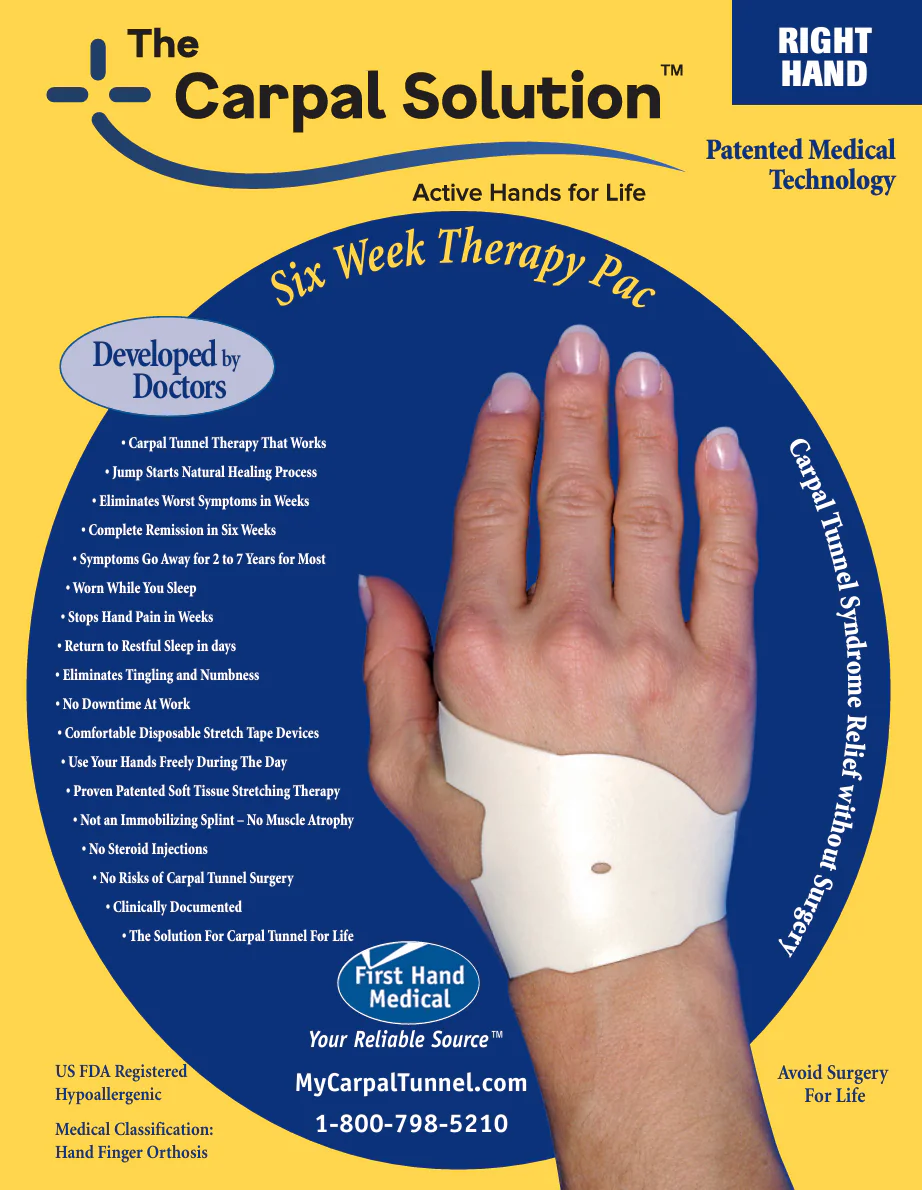 If pills mask symptoms, splints weaken the hand, injections wear off and surgery satisfies fewer than 69% of patients, what does this carpal tunnel syndrome guide recommend first? Our doctors developed the Carpal Solution, a soft, Hypoallergenic (No Latex) device you wear at night while you sleep. Instead of restricting movement like a splint, it gently stretches the soft tissue around the carpal tunnel to relieve pressure on the median nerve.
Just as important, the stretch helps restore the blood circulation and lymphatic drainage your body needs to clear the trapped swelling on its own. Over the six-week protocol, it delivers over 220 hours of targeted passive stretching, and because it works while you sleep, it does not depend on daily discipline.
| Stage | Schedule | What most people notice |
|---|---|---|
| Weeks 1–2 | Every night | Most people are better from their worst symptoms in two to three weeks. |
| Weeks 3–6 | Every other night | About 90% of people get complete remission in six weeks. |
| Higher inflammation | 10 to 12 weeks | About 10% of people, usually with excess systemic inflammation, are 40 to 70% better at six weeks and reach full remission in 10 to 12 weeks. |
| After remission | Once a week to once every six months | Prevention nights if hand-intensive work continues. |
The Carpal Solution has 97% patient satisfaction over 21 years and 4.9 out of 5 stars on independent review sites like Google Reviews, and over 100,000 people have used it over two decades. Neurologists, including Dr. James S. Zu, MD, PhD, of Edison, New Jersey, call the Carpal Solution a better first line of defense for carpal tunnel syndrome.
Remission usually lasts 5 to 7 years for most people, but everyone is different; people have gone as long as 17 years and as little as 1 year between treatments. It comes with a 30-Day Satisfaction Window, is billed under HCPCS code L3924, and many health insurance plans reimburse 70 to 80%. Learn more: How the Carpal Solution works.
Carpal Tunnel Syndrome Guide to Prevention: Staying Ahead of It
Whether you want to keep carpal tunnel from developing or keep it from coming back after treatment, this carpal tunnel syndrome guide recommends a few habits:
- Take regular breaks from repetitive hand and wrist work; set a timer if you need to.
- Keep your wrists close to neutral when typing, using a mouse or working with tools, and loosen your grip.
- Do gentle daytime stretches as a bonus: up to 6 sets of 10, holding each for 15 seconds with 30 seconds of rest.
- Skip grip, squeeze-ball and putty exercises while symptoms are active; save aerobic conditioning for after remission.
- Manage underlying conditions such as diabetes and thyroid disease with your doctor.
- Act on early symptoms; carpal tunnel is much easier to control before it becomes severe.
The Carpal Solution also works well as prevention. After remission, prevention nights from once a week to once every six months help keep symptoms away for people whose work keeps their hands busy. If you have had carpal tunnel surgery, wait 3 months after surgery before starting. Read more: Preventing carpal tunnel syndrome.
Who Is Most at Risk?
Carpal tunnel syndrome can affect anyone, but as this carpal tunnel syndrome guide explains, some groups face a higher likelihood:
Understanding carpal tunnel syndrome starts with knowing who gets carpal tunnel. It is most common in women, adults over 40, people with diabetes or thyroid conditions, pregnant women, and anyone who repeats the same hand motions all day.
- People who do repetitive hand work: office and computer workers, assembly line workers, musicians, hairstylists, dental professionals and many trades
- Pregnant women, because fluid retention raises pressure in the carpal tunnel
- People with diabetes, thyroid conditions or rheumatoid arthritis
- Adults over 40, and women in particular, who are about three times more likely than men to develop it, according to the National Institute of Neurological Disorders and Stroke
- People with previous wrist injuries or fractures

If you fall into any of these groups, being proactive about hand health is one of the best things you can do for yourself. Read more: Carpal tunnel risk factors.
Explore the Complete Carpal Tunnel Syndrome Guide Library
This guide is the hub. Each topic below has a deeper article:
- What causes carpal tunnel? How trapped inflammation and related conditions drive the syndrome.
- Symptoms and diagnosis: how to recognize carpal tunnel early and get a proper diagnosis.
- Treatment options compared: splints, medication, injections, surgery and what our doctors recommend first.
- How the Carpal Solution works: the nighttime stretching therapy explained.
- Prevention strategies: habits and early steps to stay symptom-free.
- Risk factors: whether your job, health history or lifestyle raises your risk.
- Waiting for treatment: how to get relief while you wait for appointments.
- Patient reviews: real people who found relief with the Carpal Solution.
You Do Not Have to Live With Carpal Tunnel Pain

Carpal tunnel syndrome can feel isolating and frustrating, especially when the treatments you have been offered either fall short or carry trade-offs that seem worse than the condition. You have real options, and this carpal tunnel syndrome guide is here whenever you need it. Start conservatively, give your body the conditions it needs to clear the trapped swelling, and save surgery for the last resort.
If you are ready to take the next step, explore the Carpal Solution or order your Carpal Solution therapy pack.
This carpal tunnel syndrome guide is for education and is not a substitute for professional medical advice. If you have hand or wrist symptoms, see a healthcare provider for a proper diagnosis.
When Healing Needs a Doctor’s Help and Professional Medical Evaluation
- Constant numbness that does not improve or loss of feeling in the fingertips that does not improve in 4 to 8 weeks.
- Extreme loss of the muscle at the base of the thumb, with loss of grip strength that does not improve over 6 to 8 weeks.
- Worsening symptoms over 6 to 8 weeks while using the best conservative treatments
- Symptoms that begin suddenly after hand or wrist trauma, a fracture or severe sprain from a fall or auto accident.
- Odd Symptoms that are not consistent with the Carpal Tunnel Symptoms listed on this website, that might be indicative of other nerve issues. A nerve conductivity study can clear up the confusion with minimal costs and not too much pain and no risk.
These signs may mean more advanced nerve involvement or a different condition and deserve professional medical evaluation and in person consultation. Home treatment can be used alongside professional in-person medical care while you wait for the healthcare delivery system to fit you into their schedule. There is no reason to wait doing nothing. You can start proven natural conservative treatment with good patient reviews while you wait for your appointments. If your symptoms start improving over 6 to 8 weeks, then you know you are on the right track and surgery is not necessary.
Carpal Tunnel Syndrome Guide: FAQ
Who is this carpal tunnel syndrome guide for?
Anyone with numbness, tingling, night pain or a weakening grip, and anyone helping a family member decide what to do. This carpal tunnel syndrome guide is a starting point, not a diagnosis; see a doctor for an evaluation.
What is the first treatment to try for carpal tunnel syndrome?
Our doctors recommend conservative care first, anchored by nighttime passive stretching with the Carpal Solution. Most people are better from their worst symptoms in two to three weeks.
Can carpal tunnel syndrome be cured?
No. Carpal tunnel syndrome is chronic and recurring and cannot be cured, by surgery or anything else. The Carpal Solution is the next best thing, controlling symptoms at home without downtime, risks, scar tissue or complications.
Do wrist splints help carpal tunnel?
A splint can reduce pain from movement but does not promote healing, and immobilization causes muscle atrophy. Our doctors do not recommend splints as a long-term option.
How long does a steroid injection last?
Relief is usually temporary. In one trial, most patients had gone on to surgery within a year whether they received a steroid injection or a placebo.
How successful is carpal tunnel surgery?
Carpal tunnel surgery has a patient satisfaction rate lower than 69%, because about 31% of patients report lingering or recurring symptoms. Second surgeries have a patient satisfaction rate of 16% to 40%.
Can I start treatment before my doctor’s appointment?
If you have three or more classic symptoms and no signs of severe nerve compression, a safe, non-invasive treatment can relieve symptoms while you wait. Tell your doctor what you have started.
Sources for This Carpal Tunnel Syndrome Guide
- National Institute of Neurological Disorders and Stroke. Carpal Tunnel Syndrome.
- Journal of Ultrasound, 2012: anatomy of the carpal tunnel. PMC3558235.
- O’Connor D et al. Non-surgical treatment (other than steroid injection) for carpal tunnel syndrome. Cochrane Database of Systematic Reviews, 2003.
- Atroshi I et al. Methylprednisolone injections for the carpal tunnel syndrome: a randomized, placebo-controlled trial. Annals of Internal Medicine, 2013.
- Wall BT et al. Muscle disuse during immobilization. Acta Physiologica, 2014. doi:10.1111/apha.12190.
- Bland JDP. Patient-reported outcome of 1,268 carpal tunnel operations. Muscle & Nerve, 2001. PubMed 11410921.
- Bland JDP. Review of 209 studies (32,936 operations) of carpal tunnel surgery outcomes. Muscle & Nerve, 2007.
- Louie D, Earp B, Blazar P. Long-term outcomes of carpal tunnel release: a critical review of the literature. Hand, 2012 (reviews Nancollas 1995). PMC3418353.
- AMN Healthcare. 2025 Survey of Physician Appointment Wait Times.


