Created by renowned Harvard health care professionals.


Nerves in the Hand: Which Nerve Controls Which Finger (Median, Ulnar and Radial)
The three main nerves in the hand, the median, ulnar and radial nerve, each serve different fingers. Our doctors explain which nerve controls which finger, where nerves get squeezed, and how to take the pressure off naturally so your body can heal.

Nerves in the Hand: What Our Doctors Want You to Know
Written by Julie Sunberg, Director of Marketing and Customer Service, First Hand Medical · Medically reviewed by Dr. William Shucart, MD, neurosurgeon, clinical professor of neurosurgery, New England Medical Center, former chair of neurosurgery, Tufts · Last reviewed: November 2026
Three main nerves in the hand, the median, ulnar and radial nerve, carry every touch, tingle and command between your fingers and your brain. Knowing which nerve controls which finger is the fastest way to make sense of numbness, tingling or pain: the fingers that feel it point to the nerve, and the nerve points to the place where it is being squeezed. Most of the time that place is the carpal tunnel at the wrist, where swelling presses on the median nerve. Our doctors’ message is reassuring: a squeezed nerve can usually be relieved at home, naturally, by taking the pressure off and letting your body heal.
On This Page
Key points
- Median nerve: thumb, index, middle and half the ring finger. It is the only nerve that runs through the carpal tunnel.
- Ulnar nerve: pinky and the other half of the ring finger. It bypasses the carpal tunnel through Guyon’s canal.
- Radial nerve: the back of the hand on the thumb side. It powers the forearm muscles that lift the wrist and fingers.
- Conservative-first care that follows medicine’s “Do No Harm” principle takes the pressure off squeezed nerves in the hand.
The 3 Main Nerves in the Hand: Median, Ulnar and Radial Nerve
The nerves in the hand begin in the neck. Five nerve roots, C5 through T1, leave the spinal cord, weave together in the brachial plexus near the collarbone and travel down the arm as three main nerves: the median, ulnar and radial nerve. Each one carries two kinds of signals: feeling coming in from the skin, and commands going out to the muscles.
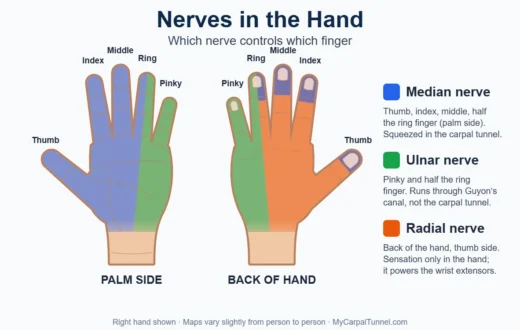
- Median nerve: feeling on the palm side of the thumb, index, middle and half the ring finger. It powers most of the forearm muscles that bend the wrist, fingers and thumb, plus the thenar muscles at the base of the thumb. It passes through the carpal tunnel.
- Ulnar nerve: feeling in the pinky and half the ring finger. It powers most of the small muscles inside the hand that spread the fingers and steady a fine grip. It passes through Guyon’s canal.
- Radial nerve: feeling on the back of the hand, thumb side. It powers the forearm muscles that lift (extend) the wrist, fingers and thumb, but no muscles inside the hand itself.
Think of the median ulnar radial nerve trio as three phone lines into one house. Each line serves different rooms, so the room that goes quiet tells you which line is in trouble, and roughly where.
Which Nerve Controls Which Finger? Innervation of the Hand
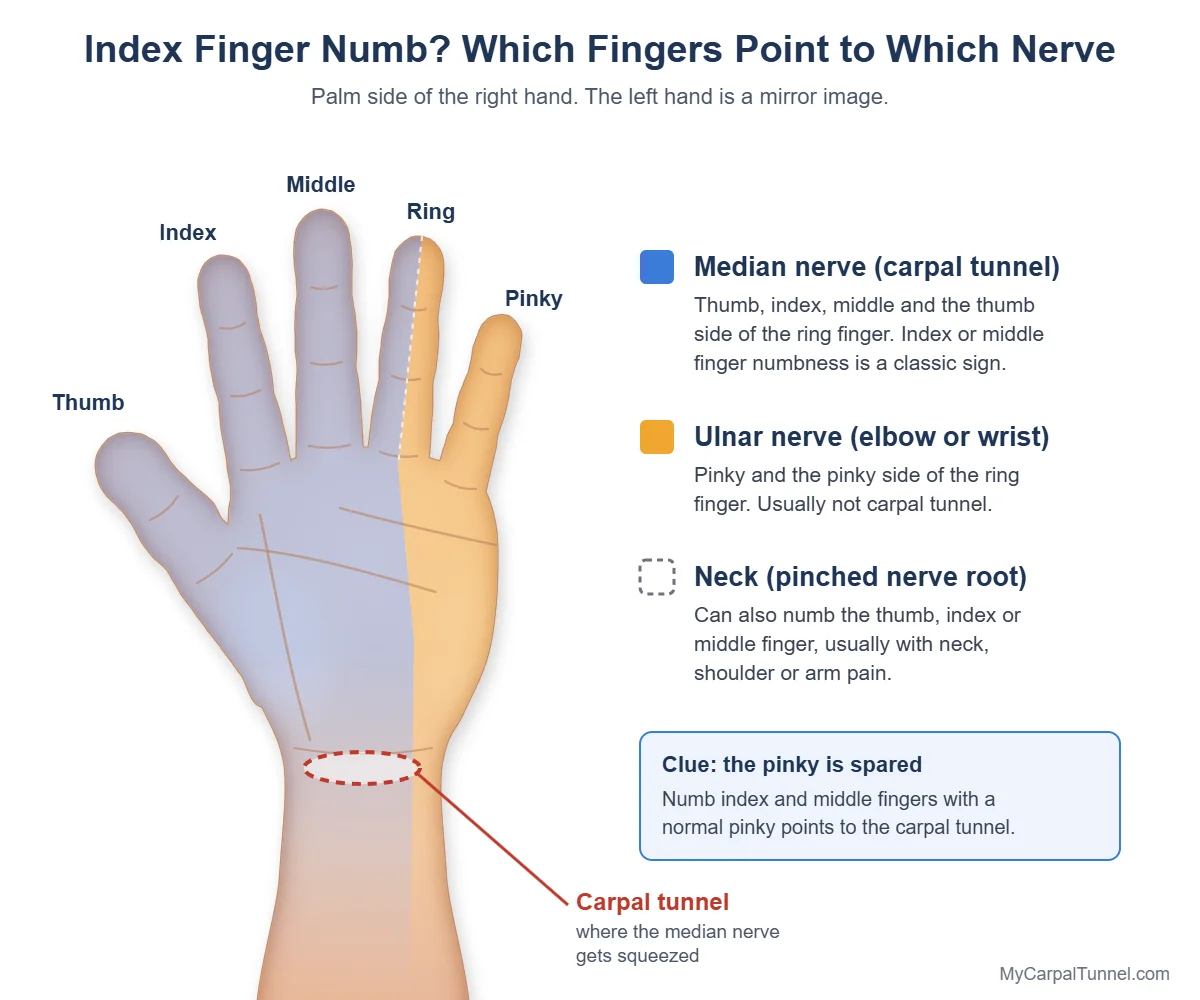
The innervation of the hand follows a simple map. On the palm side, the median nerve supplies the thumb, index finger, middle finger and the thumb-side half of the ring finger, and the ulnar nerve supplies the pinky and the other half of the ring finger. The ring finger is split right down the middle, which makes it one of the best clues a doctor has.
On the back of the hand the map shifts. The superficial radial nerve covers the thumb side of the back of the hand, the ulnar nerve covers the pinky side, and the median nerve wraps over the fingertips of the thumb, index and middle finger, including the skin around the nails.
A Built-In Clue: The Palm Is Spared in Carpal Tunnel
The skin over the ball of the thumb gets its feeling from the palmar cutaneous branch of the median nerve. That branch leaves the main nerve above the wrist and travels over the carpal tunnel instead of through it, which is why carpal tunnel numbness usually stays in the fingers while the palm feels normal.
Quick Finger Check
- Thumb, index and middle finger: median nerve, most often squeezed at the carpal tunnel. See index finger numbness.
- Pinky and half the ring finger: ulnar nerve, usually squeezed at the elbow or Guyon’s canal.
- Back of the thumb and hand: radial nerve.
- Every finger or the whole hand: more than one nerve, the neck, or a whole-body cause such as diabetes. Talk with your doctor.
The Median Nerve and the Carpal Tunnel
The median nerve is the nerve in the hand most often in trouble, and the carpal tunnel is the reason. It is the only nerve that passes through the tunnel, squeezed in beside nine tendons: four from the flexor digitorum superficialis, four from the flexor digitorum profundus and one from the flexor pollicis longus. Those tendons belong to the forearm muscles that bend your fingers and thumb, so every grip sends them sliding past the nerve. Learn more in where is the carpal tunnel, carpal tunnel anatomy and tendons in the wrist.
Carpal tunnel syndrome starts with pressure. Swelling and entrapped inflammation in the soft tissue in and around the carpal tunnel squeeze the median nerve and restrict blood flow and lymphatic fluid transport. The nerve becomes irritated, short of oxygen and compressed. That is when the thumb, index and middle finger tingle, go numb or wake you up at night.
The median nerve also moves things. Its recurrent motor branch powers the thenar muscles that bring the thumb across to the fingers, and long-standing pressure can weaken pinch and thin the muscle at the base of the thumb (see thenar eminence pain). Higher up, it powers the forearm flexor muscles, so carpal tunnel affects strength and dexterity in the forearm, thumb and fingers, not just feeling.
Ulnar Nerve Distribution: Pinky and Ring Finger
The ulnar nerve distribution covers the pinky, the pinky-side half of the ring finger and the pinky edge of the hand, front and back. The ulnar nerve does not pass through the carpal tunnel. It enters the hand through Guyon’s canal, a separate tunnel formed by two small wrist bones, the pisiform and the hook of the hamate. Inside the hand it powers the interossei, the small muscles that spread and close the fingers, and the adductor pollicis that pulls the thumb in for a strong pinch.
The most common place the ulnar nerve gets pinched is the elbow, at the cubital tunnel, the “funny bone” spot. Leaning on your elbows or sleeping with your arms tightly bent can press on it. Pressure at the wrist, from long bike rides or tools that push into the heel of the hand, can squeeze it in Guyon’s canal.
Our doctors report that “customers and patients say that the Carpal Solution helps them with their pinky finger numbness and pinky finger pain.” Read more about a numb pinky and ring finger.
Radial Nerve and the Superficial Radial Nerve: Back of the Hand
The radial nerve runs down the back of the arm and powers the muscles that straighten the elbow and lift the wrist, fingers and thumb. Near the elbow it splits in two: a deep motor branch, and the superficial radial nerve, a purely sensory branch that runs under the skin of the forearm to the back of the hand on the thumb side.
Near the wrist the superficial radial nerve lies just under the skin, so pressure, rubbing or a tight band around the lower forearm can irritate it. Doctors call this Wartenberg’s syndrome, or cheiralgia paresthetica: burning, tingling or numbness on the back of the thumb and hand. A loose watchband and bracelets that do not dig in are an easy first step.
Higher up, pressure on the radial nerve in the upper arm, such as falling asleep with an arm hooked over a chair back, can cause a temporary wrist drop. Because the radial nerve never enters the carpal tunnel, numbness on the back of the hand alone is not a typical carpal tunnel sign.
Finger Nerves, Digital Nerves and Nerves in Fingertips
Every finger has its own wiring. After crossing the palm, the median and ulnar nerves branch into digital nerves. Each finger has two palmar digital nerves running along its sides to the tip, plus two smaller dorsal digital nerves on the back. These finger nerves are why a cut along the side of a finger can numb just one edge of the fingertip.
The nerves in fingertips end in some of the most sensitive touch receptors in the body, which is why fingertip numbness is so noticeable: buttons, coins, a phone screen, a needle and thread. When the fingertips of the thumb, index and middle finger go numb together, the problem is usually not in the fingers at all but upstream at the wrist. See numb fingertips, fingertip pain and a pinched nerve in the finger.
Hand Dermatomes: When the Problem Starts in the Neck
Not every tingling finger is a wrist problem. Hand dermatomes are strips of skin served by a single nerve root in the neck: roughly C6 for the thumb (and often the index finger), C7 for the middle finger and C8 for the ring finger and pinky. A pinched nerve root in the neck, called cervical radiculopathy, can make fingers tingle in a dermatome pattern.
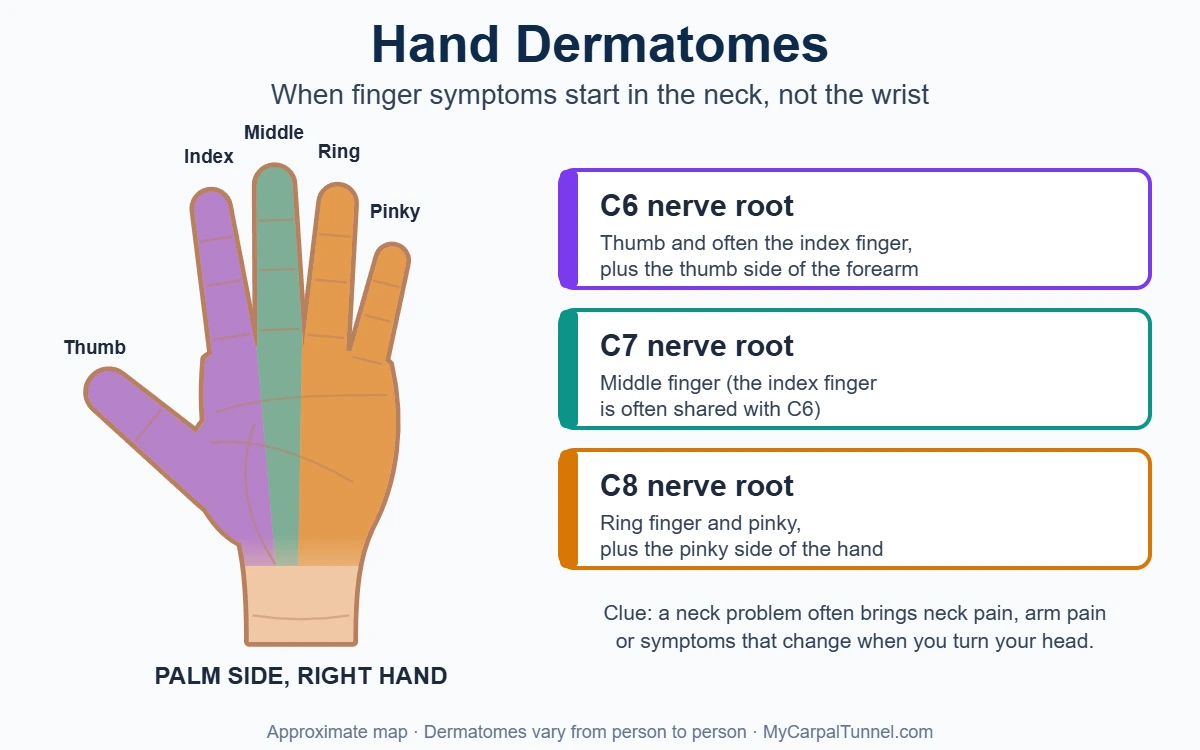
- Clues for the neck: neck pain or stiffness, pain running down the arm, symptoms that change when you turn or tilt your head, or a pattern that does not split the ring finger.
- Clues for the wrist: symptoms at night, shaking the hand out helps, the ring finger is split, and the palm feels normal.
Some people have pressure in more than one place. A nerve conduction study can sort out the confusion at minimal cost and with no risk.
Where Nerves in the Hand Get Squeezed
The nerves in the hand can be pinched at three main levels: the neck, the elbow and forearm, and the wrist.

- Nerves in wrist: carpal tunnel syndrome (median nerve) is by far the most common. Guyon’s canal syndrome (ulnar nerve) and Wartenberg’s syndrome (superficial radial nerve) are much less common.
- Elbow and forearm: cubital tunnel syndrome (ulnar nerve), radial tunnel syndrome (radial nerve) and pronator syndrome (median nerve). See carpal tunnel and elbow pain.
- Neck: a pinched nerve root, following the hand dermatomes above.
Carpal tunnel syndrome is common enough that almost 5 million U.S. workers had it in 2010, according to CDC researchers. If your fingers point to the median nerve, there is no reason to wait in pain for the healthcare delivery system to fit you into its schedule. Read our doctors’ advice on waiting for carpal tunnel treatment, and see how symptoms feel in nerve pain in hand and shooting pain in fingers.
How Our Doctors Take the Pressure Off Nerves in the Hand
Medicine’s oldest rule is “first, do no harm,” and it fits squeezed nerves perfectly: start with the gentlest treatment that takes the pressure off, and give the nerve time to recover. Pressure is the problem, so relieving pressure is the treatment.
At Night: The Carpal Solution
The Carpal Solution’s targeted passive stretching restores flexibility to the injured soft tissue, relieves pressure on the median nerve, relieves restrictions on blood circulation and lets lymph fluid flow freely to clear out the swelling. It is your body that does the healing; the Carpal Solution just jump-starts the natural healing preempted by excess pressure from inflammation and swelling.
- Over 220 hours of targeted stretching in the six-week protocol, while you sleep.
- Most people are better from their worst symptoms in two to three weeks.
- About 90% of people get complete remission in 6 weeks; the other 10%, with excess systemic inflammation, usually need 10 to 12 weeks.
- 97% patient satisfaction over 21 years and 4.9 out of 5 stars on independent review sites like Google Reviews. Over 100,000 people have used it.
During the Day
- Keep wrists straight. Neutral wrists at the keyboard and pillows at night lower the pressure in the carpal tunnel.
- Give your elbows a break. Avoid leaning on them and sleeping with arms tightly bent, to protect the ulnar nerve.
- Loosen tight bands. A loose watchband protects the superficial radial nerve.
- Cold water plunge after hand-heavy days: hands and forearms in water at about 43°F for 20 minutes, never colder than 41°F (44 to 48°F with Raynaud’s, diabetic nerve issues or poor circulation).
- Gentle stretches, no squeezing. Forearm stretches help; skip squeeze balls and putty while healing.
- Splints only for short-term relief. A splint holds the wrist in a neutral position, which can reduce pain from movement, but it does not promote healing. Unused muscles weaken (muscle atrophy), and a splint also restricts blood circulation and lymph flow, which slows soft-tissue healing. See why our doctors avoid wrist splints.
Surgery Is the Last Resort
Our doctors recommend a well-reviewed conservative treatment for at least 12 weeks before considering surgery. Carpal tunnel surgery has a patient satisfaction rate lower than 69%, because about 31% of patients report lingering or recurring symptoms, and no patient is satisfied with lingering symptoms. Second surgeries have a patient satisfaction rate between 16% and 40%. Even after a successful surgery, symptoms often return: 57% of patients had at least some symptoms come back within 5.5 years in the Nancollas study, and our doctors’ estimate from two decades of clinical experience, not statistically researched, is 80 to 90% within 10 years. Read more about recurrence after surgery.
Our doctors’ two decades of clinical experience is that people with three or more of the carpal tunnel symptoms listed on this website can be about 95% confident they have carpal tunnel syndrome. Get an in-person evaluation, and start natural treatment while you wait. If symptoms linger, follow our Persistent Symptoms Protocol.
When Healing Needs a Doctor’s Help and Professional Medical Evaluation
- Constant numbness that does not improve or loss of feeling in the fingertips that does not improve in 4 to 8 weeks.
- Extreme loss of the muscle at the base of the thumb, with loss of grip strength that does not improve over 6 to 8 weeks.
- Worsening symptoms over 6 to 8 weeks while using the best conservative treatments
- Symptoms that begin suddenly after hand or wrist trauma, a fracture or severe sprain from a fall or auto accident.
- Odd Symptoms that are not consistent with the Carpal Tunnel Symptoms listed on this website, that might be indicative of other nerve issues. A nerve conductivity study can clear up the confusion with minimal costs and not too much pain and no risk.
These signs may mean more advanced nerve involvement or a different condition and deserve professional medical evaluation and in person consultation. Home treatment can be used alongside professional in-person medical care while you wait for the healthcare delivery system to fit you into their schedule. There is no reason to wait doing nothing. You can start proven natural conservative treatment with good patient reviews while you wait for your appointments. If your symptoms start improving over 6 to 8 weeks, then you know you are on the right track and surgery is not necessary.
Frequently Asked Questions
What are the nerves in the hand?
The three main nerves in the hand are the median, ulnar and radial nerve. They start as nerve roots C5 through T1 in the neck and end as digital nerves in each finger.
Which nerve controls which finger?
The median nerve controls feeling in the thumb, index, middle and half the ring finger. The ulnar nerve covers the pinky and the other half of the ring finger. The radial nerve covers the back of the hand on the thumb side.
What is the ulnar nerve distribution?
The ulnar nerve distribution is the pinky, the pinky-side half of the ring finger and the pinky edge of the hand. The ulnar nerve enters the hand through Guyon’s canal, not the carpal tunnel.
Where is the superficial radial nerve?
The superficial radial nerve is a sensory branch of the radial nerve that runs under the skin of the forearm to the back of the hand on the thumb side. Tight bands at the wrist can irritate it.
What are hand dermatomes?
Hand dermatomes are areas of skin served by one nerve root in the neck: roughly C6 for the thumb, C7 for the middle finger and C8 for the ring finger and pinky.
What are digital nerves?
Digital nerves are the finger nerves. Each finger has two palmar digital nerves along its sides to the tip and two smaller dorsal digital nerves on the back.
Which nerves in wrist cause carpal tunnel syndrome?
Only the median nerve. It is the only nerve that passes through the carpal tunnel, where swelling and entrapped inflammation squeeze it.
How do I relieve a squeezed nerve in my hand naturally?
Take the pressure off the nerve: the Carpal Solution at night, straight wrists, no leaning on elbows, loose watchbands, a cold water plunge at about 43°F for 20 minutes and gentle stretches without squeeze balls.
Sources
- Anatomy, Shoulder and Upper Limb, Hand Cutaneous Innervation. StatPearls.
- Hand Nerve Compression Syndromes. StatPearls, NCBI Bookshelf.
- Anatomy, Shoulder and Upper Limb, Ulnar Nerve. StatPearls, NCBI Bookshelf.
- Anatomy, Shoulder and Upper Limb, Radial Nerve. StatPearls.
- Median Nerve Injury. StatPearls, NCBI Bookshelf.
- Anatomy, Shoulder and Upper Limb, Median Nerve. StatPearls.
- Cheiralgia Paresthetica (Wartenberg Syndrome). StatPearls.
- Anatomy, Shoulder and Upper Limb, Hand Bones (digital nerves). StatPearls.
- Upper limb dermatomes. GPnotebook.
- Ultrasound anatomy of the carpal tunnel (nine flexor tendons). Journal of Ultrasound, 2012.
- Luckhaupt SE et al. Prevalence and work-relatedness of carpal tunnel syndrome in the working population. Am J Ind Med, 2013.
- Bland JD. Do nerve conduction studies predict the outcome of carpal tunnel decompression? Muscle & Nerve, 2001.
- Louie D, Earp B, Blazar P. Long-term outcomes of carpal tunnel release (includes Nancollas 1995). Hand, 2012.
- Wall BT et al. Short-term muscle disuse lowers myofibrillar protein synthesis and induces muscle atrophy. Acta Physiologica, 2014.

Developed by First Hand Medical’s Team of Doctors
The Carpal Solution Treatment Kit was developed by our expert team of medical doctors who have worked at and led some of the top medical institutions in the World – Including Harvard Medical, Tufts Medical, UCSD, UF Health, and The Ohio State University. We treat root causes with clinically proven conservative treatments. The results: Quick Natural Relief of All Your Carpal Tunnel Symptoms without complications.

Order Your Six Week Carpal Tunnel Treatment Now
The ONLY treatment for carpal tunnel that comes with a no questions asked 30-Day Satisfaction Window and in-house dedicated pain relief team.