 Created by renowned Harvard health care professionals.


Index Finger Numb? Index and Middle Finger Numbness or Pain: 5 Causes and Natural Relief
If your index finger is numb or your middle finger is numb, the median nerve is the usual suspect, most often pinched in the carpal tunnel. Learn what your fingers are telling you, 5 common causes, how to tell nerve pain from joint pain, and how to relieve it naturally.
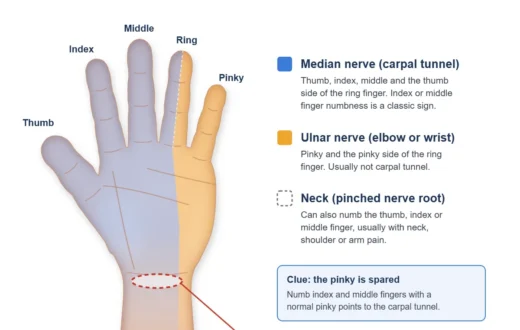

Index Finger Numb? What Your Fingers Are Telling You
Written by Jeff Conley, President, First Hand Medical · Medically reviewed by Dr. William Shucart, MD, neurosurgeon, clinical professor of neurosurgery, New England Medical Center, and former chair of neurosurgery at Tufts · Last reviewed: November 2026
If your index finger is numb, or your middle finger is numb too, your fingers are giving you a useful clue. Those two fingers, along with the thumb and half of the ring finger, are served by the median nerve, and the most common place that nerve gets squeezed is the carpal tunnel at the wrist. This guide explains what index and middle finger numbness or pain usually means, how to tell a pinched nerve from a sore joint, and how to relieve it naturally, conservative-first.
On This Page
At a glance:
- Index finger numb, middle finger numb, pinky normal: classic median nerve pattern, most often carpal tunnel.
- Worse at night or first thing in the morning: another strong carpal tunnel clue.
- Pain at one knuckle with stiffness: more likely a joint problem such as arthritis.
- Numbness with neck or arm pain: a pinched nerve in the neck is possible.
- Most everyday cases respond to gentle, conservative care you can start at home tonight.
Why Index and Middle Finger Numbness Points to the Median Nerve
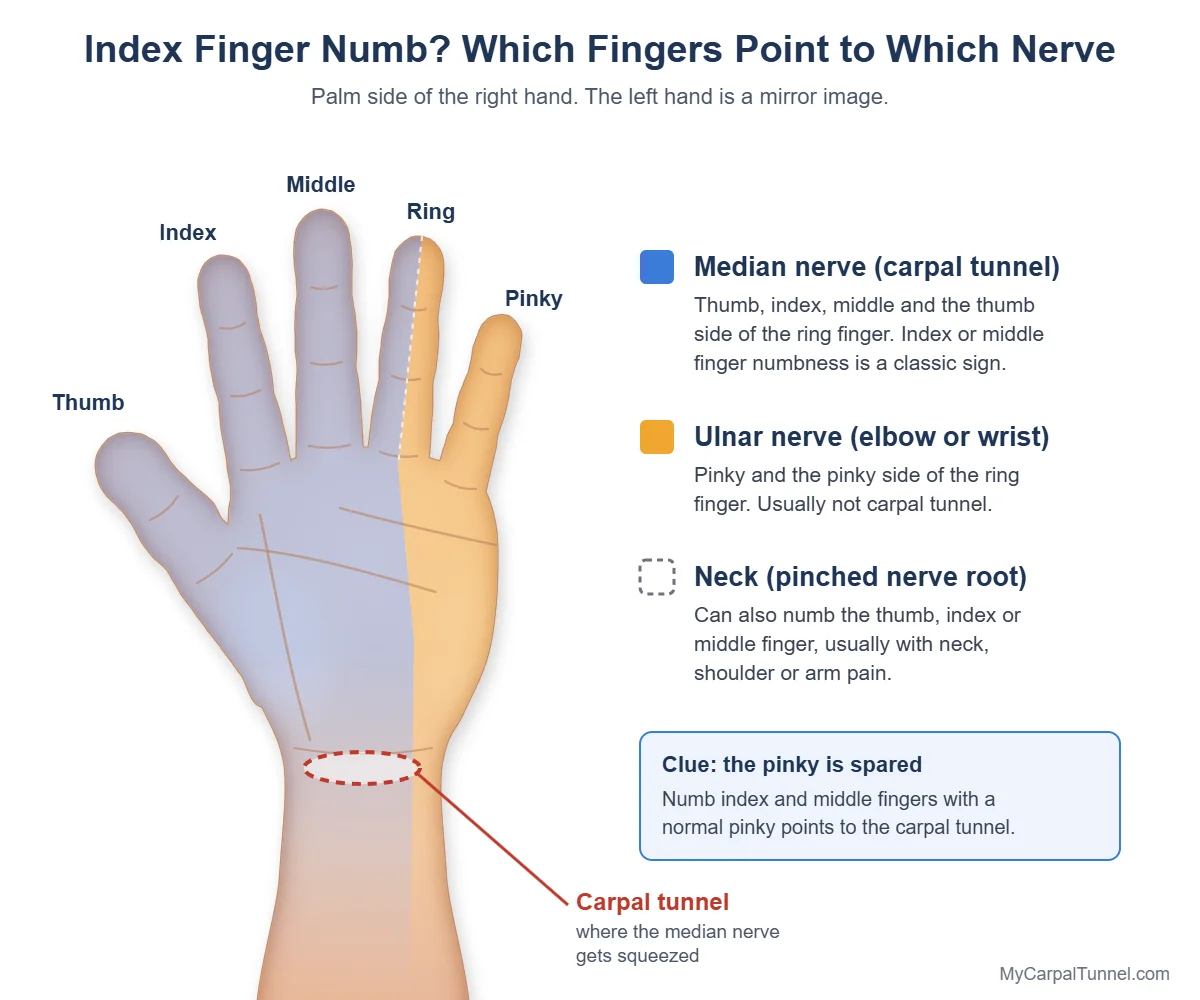
The median nerve runs from the neck down the arm and through the carpal tunnel, a narrow passage at the base of the palm formed by the eight carpal bones and a tough ligament. It shares that tunnel with nine tendons from the forearm muscles that bend your fingers and thumb. When the soft tissue in and around the tunnel swells, pressure builds on the nerve and its blood and lymph flow, and the fingers it serves start to tingle, go numb or ache.
That is why numbness in index finger and middle finger, with a normal pinky, is such a strong clue. The ulnar nerve, which runs past the elbow, serves the pinky and the other half of the ring finger, so a numb pinky usually points somewhere else. If you also notice thumb numbness or weakness at the base of the thumb, the median nerve is even more likely involved. Over time, untreated pressure can weaken the forearm and thumb muscles, which affects grip, strength and dexterity.
Middle Finger Numb or Index Finger Numb? 5 Common Causes
When your middle finger is numb or your index finger is numb, these are the most common reasons, from most to least likely:
- Carpal tunnel syndrome. By far the most common cause. Symptoms often start at night, come and go, and are eased by shaking the hand. Typing, gripping tools, phones and steering wheels make it worse.
- Sleeping on a bent wrist. Curling the wrists under a pillow squeezes the carpal tunnel for hours. If your fingers wake up numb, see how to sleep with carpal tunnel.
- A pinched nerve in the neck. A nerve root at the neck can numb the thumb, index or middle finger, usually with neck, shoulder or arm pain.
- Nerve irritation in the forearm. Less often, the median nerve is pinched higher up in the forearm, with aching in the forearm itself.
- Body-wide conditions. Diabetes, thyroid conditions, pregnancy and vitamin B12 deficiency can make nerves more sensitive and add swelling. Numbness in both hands is a reason to mention these to your doctor.
If only one hand is affected, our guide to tingling in one hand walks through the warning signs, including the rare emergency signs of a stroke.
Pain in Pointer Finger and Middle Finger Pain: Nerve or Joint?
Pain in pointer finger or middle finger pain can come from the nerve or from the joints and tendons, and the treatment is different. Nerve pain tends to come with numbness, tingling or burning, follows the thumb, index and middle fingers, and is worse at night. Joint pain is usually pinpointed at a knuckle and comes with stiffness.
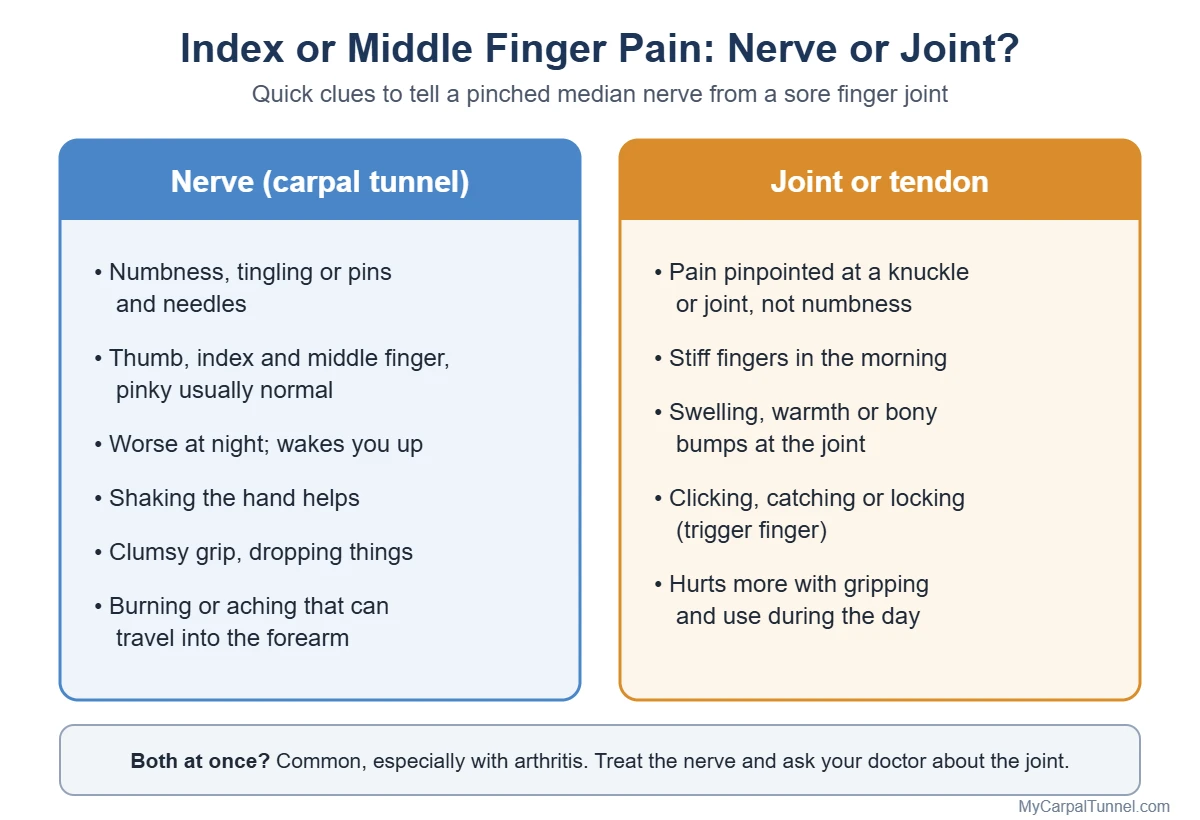
- Pain in index finger with numbness or pins and needles: think nerve first. See our guide to nerve pain in the hand.
- Index finger aching deep in the finger, worse after a long day of gripping: often nerve and tendon strain together.
- Middle finger pain at joint, with morning stiffness or a bony bump: often osteoarthritis. See carpal tunnel and arthritis.
- A finger that clicks, catches or locks: trigger finger, a tendon problem in the palm.
Many people have both at once. Relieving pressure on the nerve often makes the remaining joint pain easier to sort out with your doctor.
Pain Between Thumb and Index Finger
Pain between thumb and index finger, in the web of the hand or the fleshy pad at the base of the thumb, has a few common sources:
- The thenar muscles. These thumb-base muscles are powered by the median nerve. Aching, weakness or thinning here, together with a numb index finger, points to carpal tunnel.
- Thumb base arthritis. A deep ache where the thumb meets the wrist, worse when pinching, opening jars or turning keys.
- Overuse. Texting, gripping a mouse or tools, and repetitive pinching can strain the muscles between the thumb and pointer finger.
For more on thumb-side pain, see wrist pain and hand joint pain and our wrist pain location chart.
Is It Carpal Tunnel? A Quick Self-Check
Ask yourself these questions:
- Is my index finger numb, my middle finger numb, or my thumb tingling, while my pinky feels normal?
- Do symptoms wake me at night or show up first thing in the morning?
- Does shaking or flicking my hand bring the feeling back?
- Am I dropping things or fumbling with buttons and small objects?
- Do my hands go numb while driving, holding a phone or typing?
In our doctors’ two decades of clinical experience, people with three or more of the carpal tunnel symptoms listed on this site can be about 95% confident they have carpal tunnel. That is clinical experience, not a published statistic. You should still get an in-person evaluation and formal diagnosis, and simple office tests such as the Phalen test and Tinel sign help. With that confidence, you can start a natural, non-invasive treatment while you wait for your appointment. See a doctor promptly for constant numbness, weakness or thinning of the thumb muscle.
Nurse Kathy, a registered nurse who used the Carpal Solution, described exactly this pattern before treatment: “I could hardly close my index finger to my thumb.”
How to Relieve Numbness in Middle Finger and Index Finger Naturally
If you are wondering how to relieve numbness in middle finger and index finger, start with conservative-first care that follows medicine’s “first, do no harm” principle. The goal is to take pressure off the median nerve so your body can do the healing. You can start tonight, even while you are waiting for a doctor’s appointment.
- Passive stretching at night with the Carpal Solution. Swelling and entrapped inflammation in and around the carpal tunnel squeeze the median nerve and restrict blood flow and lymph fluid. The Carpal Solution’s targeted passive stretching restores flexibility to that soft tissue, relieves pressure on the nerve and lets lymph fluid flow freely to clear the swelling. It is your body that does the healing; the Carpal Solution jump-starts it while you sleep.
- Keep your wrists straight at night. Use pillows to keep your wrists neutral instead of curled under your chin or pillow.
- Gentle daytime stretches. If your day allows, up to 6 sets of 10 stretches, holding each for 15 seconds with 30 seconds of rest, speed things along. Skip squeeze balls and grip putty while you heal.
- Break up repetitive work. Short pauses every 30 minutes from typing, phones and tools give the tunnel a rest.

Most people are better from their worst symptoms in two to three weeks. The six-week protocol delivers over 220 hours of targeted stretching, and about 90% of people reach complete remission in 6 weeks. The other 10%, usually people with excess systemic inflammation, are 40 to 70% better at 6 weeks and reach full remission in 10 to 12 weeks. Over 100,000 people have used the Carpal Solution over two decades, with 97% patient satisfaction and 4.9 out of 5 stars on independent review sites like Google Reviews.
Splints are the right tool for fractures and sprains, where holding a joint still lets it heal. For carpal tunnel, a splint mostly shields the wrist from painful movement, at two separate costs: unused muscles weaken (muscle atrophy), and restricted blood circulation and lymph flow reduce the nutrients needed for healing and slow the clearing of inflammation, so soft tissue heals more slowly. Use one only for temporary relief, not long term. If numbness lingers, our Persistent Symptoms Protocol adds techniques that help clear stubborn inflammation. Order the Carpal Solution to start tonight.
What About Surgery?
Surgery cuts the ligament over the carpal tunnel to make room for the nerve. It is a last resort, not a first step. About 31% of patients report lingering or recurring symptoms after surgery, so carpal tunnel surgery has a patient satisfaction rate lower than 69%, because no patient is satisfied with lingering symptoms. Even after a successful operation, symptoms often return, as our page on recurrence after carpal tunnel surgery explains. Our doctors recommend trying a well-reviewed conservative treatment for at least 12 weeks before considering an operation.
When Healing Needs a Doctor’s Help and Professional Medical Evaluation
- Constant numbness that does not improve or loss of feeling in the fingertips that does not improve in 4 to 8 weeks.
- Extreme loss of the muscle at the base of the thumb, with loss of grip strength that does not improve over 6 to 8 weeks.
- Worsening symptoms over 6 to 8 weeks while using the best conservative treatments
- Symptoms that begin suddenly after hand or wrist trauma, a fracture or severe sprain from a fall or auto accident.
- Odd Symptoms that are not consistent with the Carpal Tunnel Symptoms listed on this website, that might be indicative of other nerve issues. A nerve conductivity study can clear up the confusion with minimal costs and not too much pain and no risk.
These signs may mean more advanced nerve involvement or a different condition and deserve professional medical evaluation and in person consultation. Home treatment can be used alongside professional in-person medical care while you wait for the healthcare delivery system to fit you into their schedule. There is no reason to wait doing nothing. You can start proven natural conservative treatment with good patient reviews while you wait for your appointments. If your symptoms start improving over 6 to 8 weeks, then you know you are on the right track and surgery is not necessary.
Frequently Asked Questions About Index and Middle Finger Numbness
Why is my index finger numb?
The most common reason your index finger is numb is pressure on the median nerve in the carpal tunnel at the wrist, especially if your middle finger or thumb tingles too and your pinky feels normal. Sleeping on a bent wrist and a pinched nerve in the neck are other common causes.
Is middle finger numbness always carpal tunnel?
No, but it is the most common cause. Middle finger numbness with index finger and thumb symptoms, worse at night, points to carpal tunnel. Numbness with neck or arm pain can come from the neck, and numbness in both hands can be linked to diabetes or thyroid conditions.
How do I relieve numbness in my middle finger?
Take pressure off the median nerve: keep your wrists straight at night, break up repetitive work, do gentle stretches, and use passive stretching at night with the Carpal Solution. Most people are better from their worst symptoms in two to three weeks.
Why do I have pain between my thumb and index finger?
Pain between the thumb and index finger often comes from the thenar muscles, which the median nerve powers, from arthritis at the base of the thumb, or from overuse such as texting and gripping. Numbness along with the pain points to carpal tunnel.
When should I worry about a numb index finger?
See a doctor promptly for constant numbness, weakness or thinning of the thumb muscle, numbness that started after an injury, or symptoms that keep getting worse. Sudden numbness with face, speech, vision or balance changes is an emergency: call 911.
Sources
- Carpal tunnel anatomy: the median nerve and nine flexor tendons. Journal of Ultrasound, 2012 (PMC3558235).
- Bland JD. Patient-reported outcomes of 1,268 carpal tunnel operations. Muscle & Nerve, 2001 (PubMed 11410921).
- Louie D, Earp B, Blazar P. Review of long-term outcomes and recurrence after carpal tunnel release. Hand, 2012 (PMC3418353).
- Wall BT, et al. Muscle size and strength lost after 14 days of immobilization. Acta Physiologica, 2014.
- Luckhaupt SE, et al. Carpal tunnel syndrome among U.S. workers. American Journal of Industrial Medicine, 2013 (PMC4557701).

Developed by First Hand Medical’s Team of Doctors
The Carpal Solution Treatment Kit was developed by our expert team of medical doctors who have worked at and led some of the top medical institutions in the World – Including Harvard Medical, Tufts Medical, UCSD, UF Health, and The Ohio State University. We treat root causes with clinically proven conservative treatments. The results: Quick Natural Relief of All Your Carpal Tunnel Symptoms without complications.

Order Your Six Week Carpal Tunnel Treatment Now
The ONLY treatment for carpal tunnel that comes with a no questions asked 30-Day Satisfaction Window and in-house dedicated pain relief team.

