Created by renowned Harvard health care professionals.


Working With Carpal Tunnel: Falling Behind at Work?
Sore, numb hands slow you down on the job, and night symptoms steal the sleep you need to keep up. Our doctors answer a reader who is falling behind at work because of carpal tunnel.


Falling Behind at Work With Carpal Tunnel Syndrome
Written by Julie Sunberg, Director of Marketing and Customer Service at First Hand Medical · Clinically reviewed by Alan Ward, MOT, OTR, Master Occupational Therapist and Vice President of Precision Rehabilitation · Last reviewed: November 2026
Working with carpal tunnel syndrome is hard. Sore, numb hands slow you down on the job, and night symptoms steal the sleep you need to keep up. This page answers a reader’s question about falling behind at work, then gives simple steps that help: a better desk setup, short breaks, better sleep and a natural treatment you use at night so you never have to take time off.
On This Page

“I am falling behind at work due to Carpal Tunnel Symptoms and I think it is causing me to have chronic sleep loss as well. Is all of this from Carpal Tunnel Syndrome? What can I do to get ahead of this depressing condition?”
Margret, Long Island, New York
Our Answer: There Is a Smarter Approach
Sometimes we get so focused on achieving our goals that we are too driven to stop and figure out a more efficient way to achieve them.
This is a common scenario when someone is suffering with Carpal Tunnel Syndrome due to a heavy workload on the job. Hands get sore and achy, and people often experience chronic sleep deprivation as you have described, a classic symptom of Carpal Tunnel Syndrome that often catches people by surprise.
The time it takes to perform a task gets longer, but we keep pushing through, determined not to slow down or give in to the pain. You can keep pushing ahead through the pain, but it will catch up to you, and then you may not be able to work at all for a while.
Irritability sets in, and a person in this situation will often upset or even destroy relationships that are key to a strong team environment, making the situation worse by losing cooperation from colleagues.
Investing in good ergonomics at your workstation (see proper ergonomics in the workplace and ergonomics in the office) and getting a natural treatment developed by doctors is the right approach to become more efficient and manage this chronic hand condition. The Carpal Solution has 97% patient satisfaction over 21 years and 4.9 out of 5 stars on independent review sites like Google Reviews. Most people are better from their worst symptoms in two to three weeks, and about 90% get complete remission in 6 weeks.
Be proactive about your hand health and your productivity at work. Don’t let this chronic hand condition rule your life. You rule it!
Neurologists, including Dr. James S. Zu, MD, PhD, of Edison, New Jersey, call the Carpal Solution a better first line of defense for Carpal Tunnel Syndrome.
Patients say: “The Carpal Solution is my natural Carpal Tunnel ‘Cure’!”
Practical Steps for Working With Carpal Tunnel
Falling behind because of sore, numb hands is stressful, but a few changes during the day can help you keep pace while you treat the cause.
Carpal Tunnel Desk Setup
A good carpal tunnel desk setup keeps your wrists straight and your arms relaxed. The best desk for carpal tunnel is one you can adjust, so the work surface sits at or just below elbow height whether you sit or stand. Place the keyboard and mouse close to your body so your elbows rest near your sides. Keep your wrists straight and floating while you type, not bent up or resting hard on the edge of the desk. A chair at the right height, with your feet flat and your shoulders relaxed, takes extra strain off your arms and hands. For a full ergonomic desk setup for carpal tunnel, use our ergonomic checklist. A keyboard wrist rest supports your palms during pauses.
Build Short Breaks Into Your Day
Set a reminder to pause for a minute or two every 30 to 60 minutes. Use that time to shake out your hands, open and close your fingers, and do a few gentle carpal tunnel stretching exercises. Switching between tasks that use your hands in different ways can also help.
Protect Your Sleep
Poor sleep makes it harder to focus and stay patient with coworkers. Avoid sleeping with your wrists curled under your pillow, and treat night-time numbness early so it does not keep waking you up. Learn more about how to sleep with carpal tunnel and the common carpal tunnel symptoms, including sleep loss.
Talk to Your Employer and Your Doctor
If your hands are slowing you down, let your manager know. Simple changes, such as a different keyboard, voice typing or a lighter mix of tasks for a few weeks, may be easy to set up, and many employers are open to small adjustments like these. A doctor can confirm the diagnosis and help you choose a treatment plan. If your condition is affecting your job long term, read Is Carpal Tunnel a Disability?
How to Work With Carpal Tunnel While You Treat It
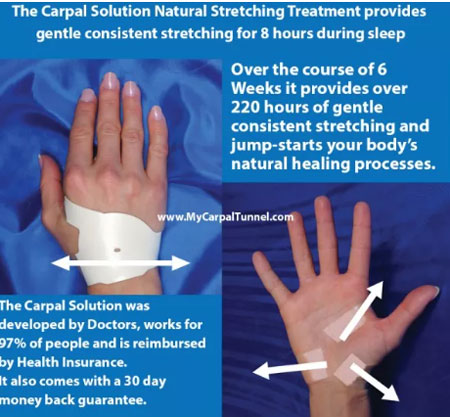
If you are wondering how to work with carpal tunnel and still get better, the answer is a treatment that fits around your job. The Carpal Solution is worn at night while you sleep, so there is no downtime and no time off work. Swelling and entrapped inflammation in the soft tissue around the carpal tunnel squeeze the median nerve and restrict blood flow and lymph fluid. Over the six-week protocol, more than 220 hours of gentle, targeted stretching restore flexibility to that soft tissue and relieve the pressure, and your body does the healing.
Surgery is different. It usually means time away from hand-intensive work, and carpal tunnel surgery has a patient satisfaction rate lower than 69%: about 31% of patients report lingering or recurring symptoms after surgery (Bland, Muscle & Nerve, 2001), and no patient is satisfied with lingering symptoms. Our doctors recommend surgery only as a last resort. Read more in Carpal Tunnel Surgery.
You also do not have to wait to get started. The average new-patient doctor appointment takes 31 days (AMN Healthcare, 2025). Our doctors’ experience is that people with three or more of the symptoms listed on this website can be about 95% confident they have carpal tunnel syndrome; this is clinical experience, not a published statistic. Get an in-person evaluation and formal diagnosis from your doctor, and start the Carpal Solution while you wait. Read more in The Waiting in Healthcare, or follow the simple plan in How to Relieve Carpal Tunnel Pain.
We are confident you are going to like the Carpal Solution Nighttime Stretching Treatment. There is no reason to suffer, put your life on hold and work longer hours getting less and less done due to numb, achy hands. You can put it all behind you with the Carpal Solution.
Working With Carpal Tunnel: Common Questions
Can I keep working with carpal tunnel?
Most people can keep working with carpal tunnel while they treat it, especially when they adjust their workstation, take short breaks and use a treatment that works at night. The Carpal Solution is worn while you sleep, so it does not take you away from your job. If your hands are getting steadily weaker or numbness is constant, see your doctor promptly.
What is the best desk setup for carpal tunnel?
The best desk setup for carpal tunnel keeps your wrists straight and your elbows close to your sides. Put the keyboard and mouse near the edge of the desk, set your chair so your feet are flat and your shoulders relax, and avoid resting your wrists on a hard edge while you type. Our ergonomic checklist walks through each step.
Should I wear a wrist splint at work?
Splints are the right tool for fractures and sprains, where holding a joint still lets it heal. For carpal tunnel, a splint mostly shields the wrist from painful movement, at two separate costs: unused muscles weaken (muscle atrophy), and restricted blood circulation and lymph flow reduce the nutrients needed for healing and slow the clearing of inflammation, so soft tissue heals more slowly. Use one only for temporary relief, not long term. Our doctors recommend a passive stretching treatment like the Carpal Solution instead. Read why our doctors say to avoid wrist splints.
How long until working with carpal tunnel gets easier?
Most people are better from their worst symptoms in two to three weeks with the Carpal Solution. About 90% get complete remission in 6 weeks; the other 10%, often people with excess inflammation in the body or very heavy hand use, are 40 to 70% better at 6 weeks and reach full remission in 10 to 12 weeks.
Do I need time off work for carpal tunnel?
Not usually. A natural treatment at night lets you keep your normal schedule. Surgery is the option that usually requires time away from hand-intensive work, which is one more reason our doctors recommend conservative treatment first and surgery only as a last resort.
When Healing Needs a Doctor’s Help and Professional Medical Evaluation
- Constant numbness that does not improve or loss of feeling in the fingertips that does not improve in 4 to 8 weeks.
- Extreme loss of the muscle at the base of the thumb, with loss of grip strength that does not improve over 6 to 8 weeks.
- Worsening symptoms over 6 to 8 weeks while using the best conservative treatments
- Symptoms that begin suddenly after hand or wrist trauma, a fracture or severe sprain from a fall or auto accident.
- Odd Symptoms that are not consistent with the Carpal Tunnel Symptoms listed on this website, that might be indicative of other nerve issues. A nerve conductivity study can clear up the confusion with minimal costs and not too much pain and no risk.
These signs may mean more advanced nerve involvement or a different condition and deserve professional medical evaluation and in person consultation. Home treatment can be used alongside professional in-person medical care while you wait for the healthcare delivery system to fit you into their schedule. There is no reason to wait doing nothing. You can start proven natural conservative treatment with good patient reviews while you wait for your appointments. If your symptoms start improving over 6 to 8 weeks, then you know you are on the right track and surgery is not necessary.