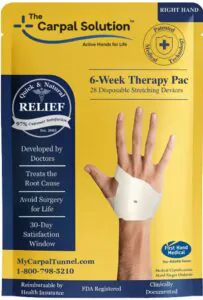
Created by renowned Harvard health care professionals.


Swollen Fingers: 8 Common Causes of Puffy Fingers and Swollen Hands, and When to Worry
Swollen fingers mean fluid and inflammation are building up faster than your body can clear them. Our doctors look first at the carpal tunnel when swelling comes with tingling in the thumb, index and middle fingers. Here are the 8 common causes, when to worry, and natural relief at home that treats the root cause.


Swollen Fingers: What Puffy Fingers and Swollen Hands Are Telling You
Written by Julie Sunberg, Director of Marketing and Customer Service at First Hand Medical · Medically reviewed by Joseph E. Scherger, MD, MPH, family physician and clinical professor, UC San Diego School of Medicine · Last reviewed: November 2026
Swollen fingers mean fluid and inflammation are collecting in the soft tissue faster than the body clears them. Most puffy fingers are harmless and pass as you move your hands, but swelling that keeps returning is the body asking for help. Our doctors pay close attention to swollen fingers that come with tingling in the thumb, index and middle fingers, because entrapped inflammation in the carpal tunnel is the root cause of carpal tunnel syndrome. This guide covers the 8 common causes of swollen fingers, what a swollen finger joint or swollen knuckle means, when one hand swollen needs care, and how to reduce swelling in hands at home.
On This Page
At a glance:
- Most puffy fingers come from fluid pooling overnight, heat, salt or long walks, and ease as you move.
- Swollen fingers with tingling in the thumb, index and middle fingers point to carpal tunnel and entrapped inflammation.
- A swollen finger joint or swollen knuckle that is stiff in the morning points to arthritis.
- Get prompt care for a red, hot, throbbing finger, swelling after an injury, or one hand swollen with pain in the arm.
- Relief at home: keep blood and lymph moving, and treat the root cause instead of holding the hand still.
Why Are My Fingers Swollen? 8 Common Causes
If you are asking “why are my fingers swollen?”, notice when the swelling shows up and what comes with it. These are the 8 common causes of swollen fingers.
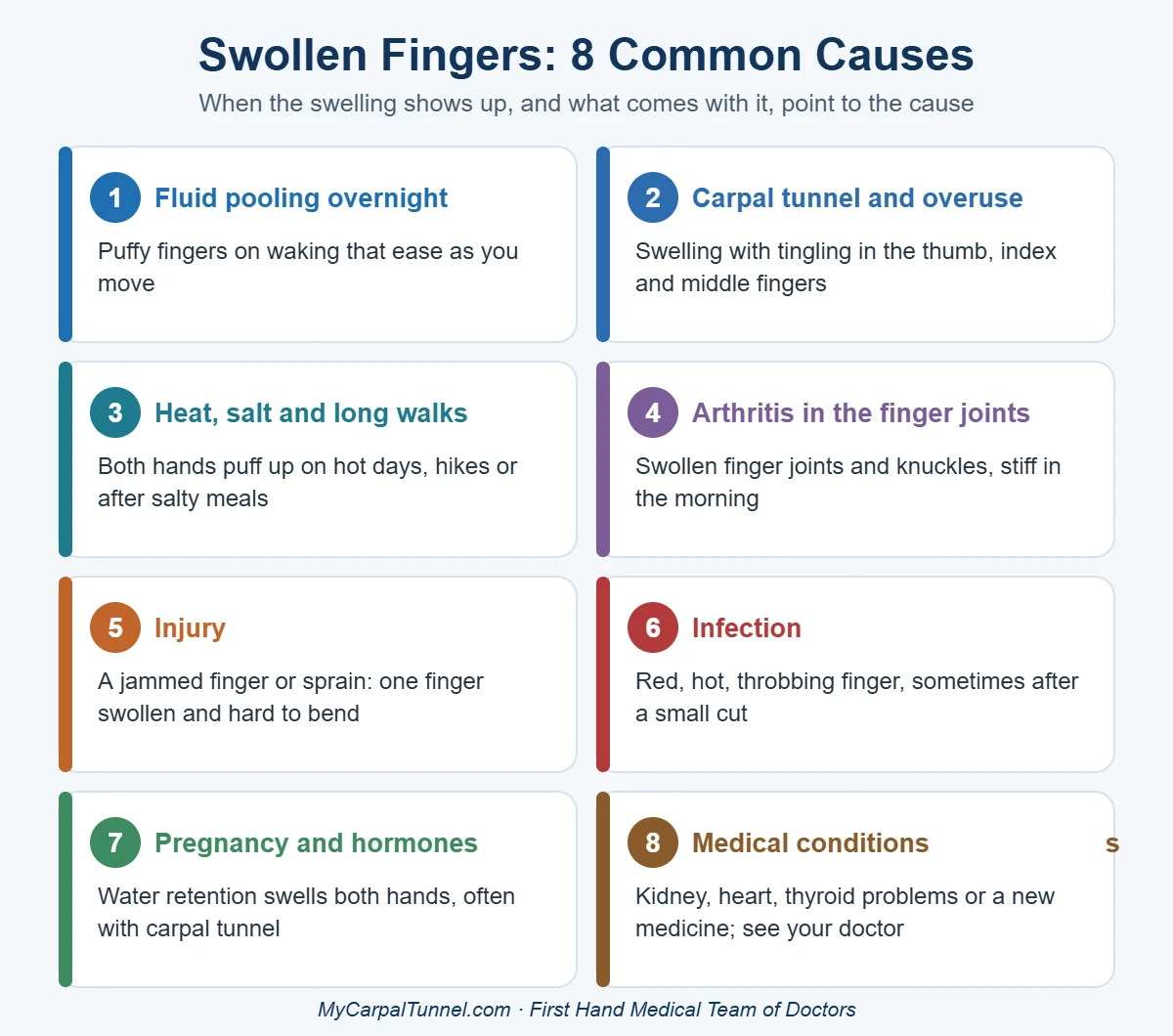
- Fluid pooling overnight. Hands that lie still for hours collect fluid, so puffy fingers on waking are common and ease as you move.
- Carpal tunnel and overuse. Repetitive gripping, typing and texting inflame the soft tissue in and around the carpal tunnel. The swelling squeezes the median nerve, so the fingers feel puffy and stiff and tingle or go numb.
- Heat, salt and long walks. Hot weather, salty meals and long walks or hikes with the arms swinging can swell both hands for a few hours.
- Arthritis in the finger joints. Osteoarthritis and rheumatoid arthritis cause a swollen finger joint, a swollen knuckle and morning stiffness; see carpal tunnel and arthritis.
- Injury. A jammed finger, sprain or fracture swells quickly and is hard to bend; see hand injuries that mimic carpal tunnel.
- Infection. A finger that is red, hot, throbbing and swollen, often after a small cut, needs prompt care.
- Pregnancy and hormones. Water retention swells both hands and often brings carpal tunnel with it; see pregnancy water retention and carpal tunnel.
- Medical conditions and medicines. Thyroid, kidney or heart problems and some medicines can cause swollen hands; see thyroid conditions and the hands, and ask your doctor about new or lasting swelling.
Swollen Hands in the Morning and Puffy Fingers on Waking
Swollen hands in the morning are one of the most common reasons people look up swollen fingers. During sleep the hands lie still, so the muscles are not pumping fluid back toward the heart, and the wrists often curl, which raises pressure in the carpal tunnel for hours. Fluid that collected during the day has nowhere to go.
Puffy fingers that ease within half an hour of moving are usually just fluid. Swollen hands in the morning that come with numbness or tingling, or that wake you at night, point to swelling trapped in the carpal tunnel. If morning aching is your main symptom, see hand pain in the morning.
Swollen Fingers From Heat, Hikes and Travel
Hot days, long walks and long flights all make swollen fingers more likely, because blood vessels widen in the heat and fluid settles in hands that hang at your sides or sit still for hours. A few habits help: swing your arms and open and close your hands while you walk, use hiking pole straps loosely, raise your hands now and then, drink water, and go easy on salty snacks. On long flights or drives, stretch your fingers and wrists every half hour. Swelling from heat or travel should fade within a day; swelling that lingers or comes with tingling deserves a closer look.
Swollen Finger Joint or Swollen Knuckle: My Finger Is Swollen and Hurts to Bend
When the swelling sits right at a swollen finger joint or swollen knuckle, the joint itself is usually involved. If your finger is swollen and hurts to bend, think about what came first:
- A bump, fall or jammed finger: a sprain or fracture. Get it checked, especially if the finger looks crooked or will not bend.
- Morning stiffness in several joints: arthritis. A swollen knuckle on both hands, with stiffness lasting more than half an hour, deserves a doctor’s evaluation.
- A red, hot finger held slightly bent, with pain along its length: possible infection of the tendon sheath. See a doctor the same day.
- Swelling with tingling in the thumb, index and middle fingers: the carpal tunnel.
How to treat a swollen finger depends on the cause: rest and protection for an injury, prompt care for infection, and gentle movement with relief of the pressure at the wrist for carpal tunnel.
One Hand Swollen: When Swelling on One Side Needs Care
One hand swollen while the other looks normal usually has a local cause: an injury, a bite or sting, an infection, a tight ring or watch, or carpal tunnel in the hand you use most. Swelling after surgery or a lymph node removal on that side also matters.
See a doctor promptly if one hand is swollen with a red, hot, streaking area or fever, if the whole arm swells with pain or a heavy feeling, or if the swelling follows an injury. These signs need an in-person evaluation, not home care alone.
Swollen Fingers and Carpal Tunnel: The Swelling Is the Root Cause
Our doctors put it simply: carpal tunnel starts with pressure. Swelling and entrapped inflammation in the soft tissue in and around the carpal tunnel squeeze the median nerve and restrict blood flow and lymphatic fluid transport. The nerve becomes irritated, short of oxygen and compressed. Because the swelling also slows the lymph flow that would carry it away, it tends to feed itself, which is why swollen fingers and carpal tunnel so often travel together. Read more in the root cause of carpal tunnel: trapped inflammation and inflammation vs. swelling.
The muscles that bend the fingers are in the forearm, and their nine tendons pass through the carpal tunnel beside the median nerve. When the tissue around those tendons swells, the fingers feel puffy and stiff, the forearm aches, and the thumb, index and middle fingers tingle.
Is Your Swelling From Carpal Tunnel?
Our doctors’ experience over two decades is that people with three or more of the carpal tunnel symptoms listed on this site can be about 95% confident they have carpal tunnel (clinical experience, not a published statistic). Get an in-person evaluation and a formal diagnosis, and start a natural, non-invasive treatment while you wait. See a doctor promptly for constant numbness, weakness or thinning of the thumb muscle.
How to Reduce Swelling in Hands: How to Treat Swollen Fingers at Home
Conservative-first care follows medicine’s oldest rule: first, do no harm. The way to reduce swelling in hands is to help the body clear it: keep blood and lymph moving, cool new inflammation, and take the pressure off the median nerve.
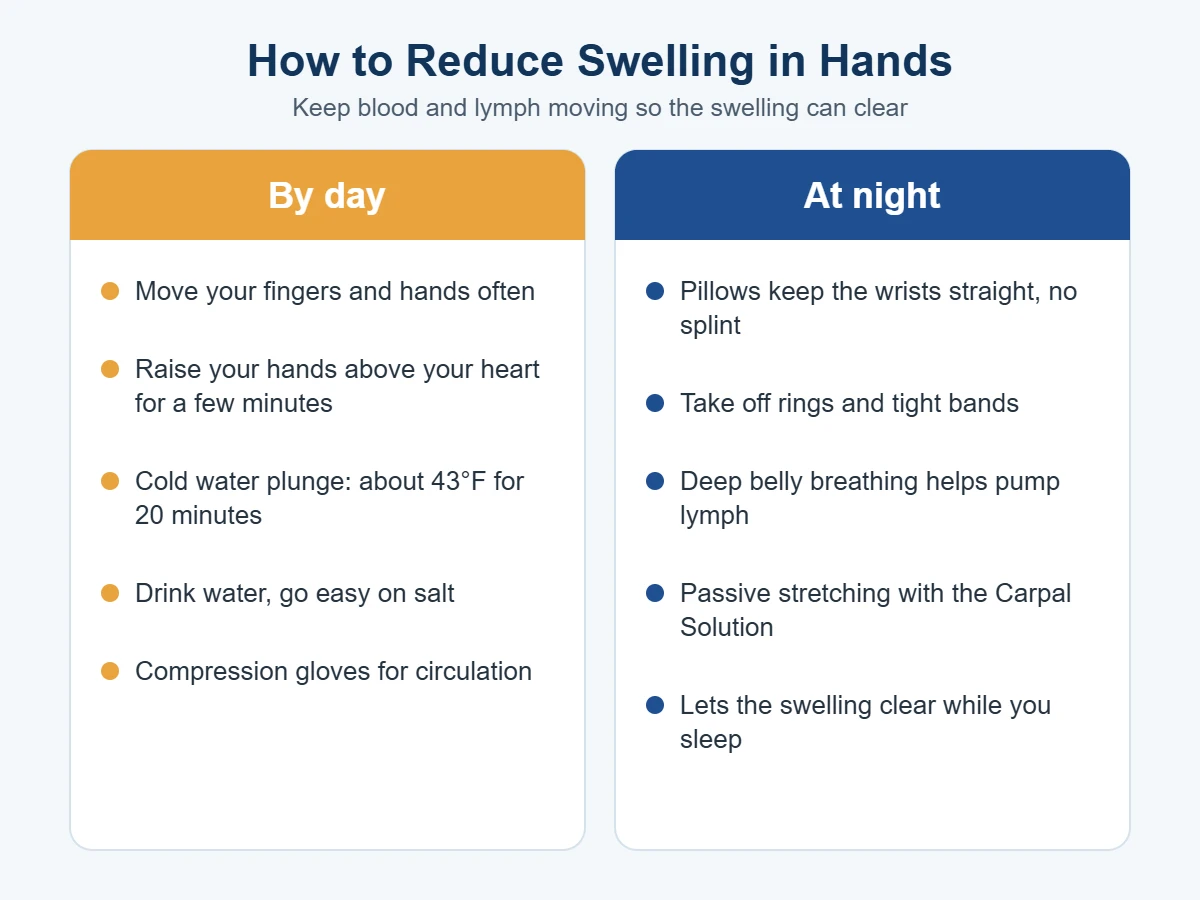
- Move your fingers and hands often. Moving muscles pump fluid back toward the heart; make a soft fist and open wide a few times every hour.
- Raise your hands above your heart for a few minutes several times a day.
- Cool new inflammation with a cold water plunge: hands and forearms in water at about 43°F for 20 minutes, never colder than 41°F. If you have Raynaud’s, diabetic nerve problems or poor circulation, use 44 to 48°F and be more careful.
- Drink enough water and go easy on salt. Good hydration and electrolytes help the body move fluid.
- Breathe deeply. Slow belly breathing helps pump the lymph system, since most lymph nodes sit around the core.
- Wear compression gloves by day. They can increase blood circulation and cushion the hands from everyday bumps. See compression gloves for hand swelling.
- Take off rings, watches and tight bands while your fingers are swollen.
- Keep your wrists straight at night with pillows instead of a splint.
- Stretch passively at night with the Carpal Solution.
Why a Splint Does Not Reduce Swelling
Splints are the right tool for fractures and sprains, where holding a joint still lets it heal. For carpal tunnel, a splint mostly shields the wrist from painful movement, at two separate costs: unused muscles weaken (muscle atrophy), and restricted blood circulation and lymph flow reduce the nutrients needed for healing and slow the clearing of inflammation, so soft tissue heals more slowly. Use one only for temporary relief, not long term. Read why our doctors recommend that you avoid wrist splints.
The Carpal Solution: Clearing the Swelling at Home While You Sleep
Our doctors developed the Carpal Solution to treat the root cause. Its targeted passive stretching restores flexibility to the injured soft tissue, relieves pressure on the median nerve, relieves restrictions on blood circulation and lets lymph fluid flow freely to clear out the swelling. It is your body that does the healing; the Carpal Solution just jump-starts the natural healing preempted by excess pressure from inflammation and swelling.

- Over 220 hours of targeted stretching in the six-week protocol, while you sleep.
- Most people are better from their worst symptoms in two to three weeks.
- About 90% get complete remission in 6 weeks; the other 10%, usually people with excess systemic inflammation, are 40 to 70% better at six weeks and reach full remission in 10 to 12 weeks.
- 97% patient satisfaction over 21 years and 4.9 out of 5 stars on independent review sites like Google Reviews. Over 100,000 people have used it.
If swollen fingers keep coming back, our Persistent Symptoms Protocol adds home techniques that help clear stubborn inflammation, and managing carpal tunnel inflammation for life explains how to keep it in remission.
What About Surgery?
Surgery is the last resort. Carpal tunnel surgery has a patient satisfaction rate lower than 69%, because about 31% of patients report lingering or recurring symptoms after surgery, and no patient is satisfied with lingering symptoms. Even after a successful operation, symptoms often return, as our page on recurrence after carpal tunnel surgery explains. Our doctors recommend trying a well-reviewed conservative treatment for at least 12 weeks before considering an operation. The average wait for a new-patient appointment is 31 days, so start while you wait for carpal tunnel treatment.
When Healing Needs a Doctor’s Help and Professional Medical Evaluation
- Constant numbness that does not improve or loss of feeling in the fingertips that does not improve in 4 to 8 weeks.
- Extreme loss of the muscle at the base of the thumb, with loss of grip strength that does not improve over 6 to 8 weeks.
- Worsening symptoms over 6 to 8 weeks while using the best conservative treatments
- Symptoms that begin suddenly after hand or wrist trauma, a fracture or severe sprain from a fall or auto accident.
- Odd Symptoms that are not consistent with the Carpal Tunnel Symptoms listed on this website, that might be indicative of other nerve issues. A nerve conductivity study can clear up the confusion with minimal costs and not too much pain and no risk.
These signs may mean more advanced nerve involvement or a different condition and deserve professional medical evaluation and in person consultation. Home treatment can be used alongside professional in-person medical care while you wait for the healthcare delivery system to fit you into their schedule. There is no reason to wait doing nothing. You can start proven natural conservative treatment with good patient reviews while you wait for your appointments. If your symptoms start improving over 6 to 8 weeks, then you know you are on the right track and surgery is not necessary.
Frequently Asked Questions About Swollen Fingers
Why are my fingers swollen?
The most common causes are fluid pooling overnight, heat, salt and long walks, carpal tunnel and overuse, arthritis, injury, infection, pregnancy, and some medical conditions or medicines. Swollen fingers with tingling in the thumb, index and middle fingers point to carpal tunnel.
Why are my hands swollen in the morning?
During sleep the hands lie still, so fluid is not pumped away, and curled wrists raise pressure in the carpal tunnel. Puffy fingers that ease within half an hour are usually fluid; morning swelling with numbness or tingling points to carpal tunnel.
How do you reduce swelling in hands?
Move your fingers often, raise your hands, cool new inflammation with a cold water plunge at about 43°F for 20 minutes, drink water and go easy on salt, keep your wrists straight at night with pillows, and take pressure off the median nerve with the Carpal Solution.
What does a swollen knuckle mean?
A swollen knuckle or swollen finger joint usually involves the joint itself: arthritis if it is stiff in the morning and on several fingers, or an injury if it followed a bump or jammed finger. Lasting joint swelling deserves an evaluation by your doctor.
My finger is swollen and hurts to bend. What should I do?
Rest it, take off any ring, and cool it. Get it checked if it followed an injury, looks crooked, or will not bend. A red, hot finger held slightly bent with pain along its length needs care the same day.
When should I worry about one hand swollen?
See a doctor promptly if one hand is swollen with redness, warmth, streaks or fever, if the whole arm swells with pain, or if the swelling follows an injury.
Sources
- Carpal tunnel anatomy: the median nerve and nine flexor tendons. Journal of Ultrasound, 2012.
- Anatomy, Shoulder and Upper Limb, Median Nerve. StatPearls (NCBI Bookshelf).
- Wall BT, et al. Short-term muscle disuse leads to substantial losses in muscle size and strength. Acta Physiologica, 2014.
- Bland JD. Patient-reported outcomes of 1,268 carpal tunnel operations. Muscle & Nerve, 2001 (PubMed 11410921).
- AMN Healthcare. 2025 Survey of Physician Appointment Wait Times (average 31 days for a new-patient appointment).

Developed by First Hand Medical’s Team of Doctors
The Carpal Solution Treatment Kit was developed by our expert team of medical doctors who have worked at and led some of the top medical institutions in the World – Including Harvard Medical, Tufts Medical, UCSD, UF Health, and The Ohio State University. We treat root causes with clinically proven conservative treatments. The results: Quick Natural Relief of All Your Carpal Tunnel Symptoms without complications.

Order Your Six Week Carpal Tunnel Treatment Now
The ONLY treatment for carpal tunnel that comes with a no questions asked 30-Day Satisfaction Window and in-house dedicated pain relief team.