 Created by renowned Harvard health care professionals.



Written by Julie Sunberg, Director of Marketing and Customer Service at First Hand Medical · Medically reviewed by Joseph E. Scherger, MD, MPH, family physician and clinical professor at the UC San Diego School of Medicine · Last reviewed: November 2026
Table of Contents
How Pregnancy Water Retention Affects Your Hands
Pregnancy water retention and carpal tunnel often go hand in hand, and the extra fluid can put pressure on the median nerve at the wrist. Swollen hands during pregnancy are common, and this water retention carpal tunnel connection is a frequent cause of hand numbness and tingling in expecting mothers.
A “pickles and ice cream” image is fairly accurate in describing the unique food cravings –and aversions–that sometimes accompany pregnancy. A pregnant woman’s taste bud changes often reflect changes in her nutritional needs. Such changes are partly due to the rapidly increasing nourishment needs of the developing fetus and partly to other physiological variations that affect absorption and metabolism of nutrients. The accelerated growth rate is typical of any early stage biological process and can often take a newly pregnant woman by surprise. These changes and increase in appetite help insure normal development of the baby and help fulfill the subsequent demands of lactation and nursing a new born infant.
Women who have been diligent about controlling their personal weight through careful and even restrictive diets before pregnancy are usually wisely counseled to proactively increase their caloric, protein and overall nourishment during pregnancy.
Throughout pregnancy the developing fetus could be put at risk by any kind of restrictive diet. During these nine months every moment in the womb counts for full normal development of a healthy baby. In fact, there is a critical relationship between maternal weight gain and the healthy growth and development of the baby in the womb. It is just one of the many sacrifices a mother-to-be tends to make for the gift of life. The time to control weight again will be after a successful delivery of a healthy baby.
Unfortunately, natural maternal increases in weight combined with common water retention can cause a lot of unwanted side effects. One of the most common and annoying is the on-set of Carpal Tunnel Syndrome.

About 1 in 3 pregnant women report carpal tunnel symptoms (see the research below). Often pregnancy is the first encounter of many recurring symptom flare-ups that women experience over the course of an active life with this potentially disabling condition.
Water retention, hormonal changes, and increased weight that are normal during pregnancy are known to contribute to swollen tissue around the base of the hand and wrist. Some women crave salty foods during pregnancy, and a lot of sodium can add to water retention. Depending on the anatomical configuration of each woman’s hand, even slight increases in the size of soft tissue can pinch the Median Nerve that runs through the Carpal Tunnel resulting in pain and numbness for the mother-to-be in her hands, wrists, arms and or shoulders and even in the neck.
One of the most distressing symptoms for any CTS sufferer, but especially for a pregnant mother-to-be, is the intensification of the symptoms at night during sleep. Like a fully nourished diet, a restful night’s sleep is also essential to the normal and healthy development of the baby and to the maintenance of the mother’s own health. This is why it is so important to gain control of CTS symptoms quickly and non-invasively before they extract a toll on both mother and baby.

Pregnancy Water Retention: What Expecting Mothers Should Know
Carpal tunnel symptoms are common in pregnancy. In a study of 639 pregnant women, 34% reported carpal tunnel symptoms, mostly mild to moderate and more often after 32 weeks. Women with more fluid retention were about 1.8 times as likely to have symptoms, and the symptoms were linked to sleep problems (Meems et al., BJOG, 2015). Reported rates vary widely depending on how carpal tunnel is measured (Padua et al., Muscle & Nerve, 2010).
Many women improve after delivery, but not all. In that same review, symptoms persisted in more than half of women 1 year after delivery and in about 30% after 3 years. That is why pregnancy water retention can be a woman’s first encounter with a condition that may return later in life. For general background, see the NINDS carpal tunnel syndrome fact sheet.
Swollen Hands During Pregnancy: When Swelling Is Not Normal
Some swelling of the hands and feet is normal in pregnancy. Sudden or severe swelling of the face or hands, especially with a headache that won’t go away, vision changes, upper belly pain or sudden weight gain, can be a sign of preeclampsia. Call your obstetric provider right away or go to an emergency room (Preeclampsia Foundation). Raise any hand numbness or pain at your prenatal visits too, especially if it wakes you at night.
7 Simple Ways to Ease Pregnancy Water Retention in Your Hands

Pregnancy water retention is normal, but these everyday steps can take some pressure off the median nerve. Check with your obstetric provider about what is right for you.
- Keep your wrists straight at night. Bent wrists raise pressure in the carpal tunnel, which is one reason symptoms peak during sleep.
- Raise your hands. Propping your arms on a pillow while you rest helps fluid drain away from your hands.
- Move often. Gentle walking and changing positions help circulation. Avoid sitting or standing still for long periods.
- Go easy on very salty processed foods. A lot of sodium can add to water retention; follow your provider’s nutrition advice rather than cutting back on your overall diet.
- Drink enough water. Staying hydrated is part of a healthy pregnancy and does not make water retention worse.
- Break up repetitive hand work. Typing, phone use and gripping tools can all aggravate symptoms. Take short breaks and relax your grip. Avoid squeeze-ball, grip and putty exercises while your hands are sore.
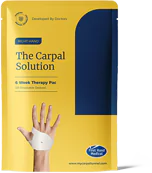
- Treat symptoms at night without medication. The Carpal Solution gently stretches the soft tissue while you sleep, giving over 220 hours of targeted stretching in six weeks.
Why Rigid Splints Are Not the Best Answer
Rigid wrist splints are often suggested in pregnancy, but immobilizing any limb causes muscle atrophy over time. A splint holds the wrist in a neutral position, which can reduce pain from movement, but it does not promote healing from carpal tunnel syndrome. It causes muscle atrophy and stiffness, and its tight compression restricts blood circulation and lymphatic fluid exchange, which slows the dispersion of entrapped swelling, the root cause of carpal tunnel syndrome. Our medical team has observed that splints give some relief at first but aggravate symptoms in the long run. Immobilization is great for fractures and sprains, but not for carpal tunnel syndrome. In one study, healthy adults lost about 8% of muscle size and 23% of strength after just 14 days with a leg in a cast (Wall et al., Acta Physiologica, 2014). The Carpal Solution stretches the tissue instead of holding it still, so it does not immobilize the hand.
Waiting for an Appointment?
Everyone waits in healthcare. The average wait for a new-patient physician appointment is 31 days (AMN Healthcare, 2025), and a referral to a specialist can add more. Mention your symptoms at your next prenatal visit, and ask your provider about starting a drug-free treatment for pregnancy water retention symptoms in your hands while you wait. Learn more in The Waiting in Healthcare. For the full picture of carpal tunnel during pregnancy, see Pregnancy and Carpal Tunnel.
Don’t Let Pregnancy Water Retention Rob You of Sleep
Many women with pregnancy water retention have found that nightly application of Carpal Solution Therapy developed by Dr. Clyde Morgan is effective in controlling their CTS symptoms without side effects of systemic pain medication, the discomfort and muscle atrophy associated with splints or the potentially harmful effects of steroid injections.

You will be amazed at how much better you feel after a sound night’s sleep with no more worries about carpal tunnel.
If pregnancy water retention has brought on CTS pain that keeps you from sleeping when you and your growing baby need healthy, uninterrupted sleep the most, you would likely benefit from the natural healing that results from Carpal Solution Therapy. By helping you sleep without pain medication, it supports the rest you and your growing baby need. The thin, comfortable hand orthosis (not a rigid splint) retrains the soft tissue and is made from carefully selected elastic materials that are Hypoallergenic (No Latex) and latex-free.
While you sleep, The Carpal Solution gently stretches the soft tissue at the base of the hand and opens up the area surrounding the Carpal Tunnel for better circulation with nutrient rich blood. It enhances the body’s natural healing and at the same time relieves pressure on the Median Nerve without the side effects of medication.
After the Baby Arrives: When Pregnancy Water Retention Fades

Pregnancy water retention usually eases in the weeks after delivery, but carpal tunnel symptoms do not always leave with it. In the Padua review, more than half of women still had symptoms 1 year after delivery. New mothers also spend hours lifting, carrying and feeding a baby, often with their wrists bent, which can keep symptoms going.
- Support your baby’s weight with your forearms and a nursing pillow rather than your bent wrists.
- Keep your wrists straight while you hold your phone or bottle during night feeds.
- Keep using the Carpal Solution at night until you reach remission. After that, maintenance nights from once a week to once every six months help keep symptoms away.
In our doctors’ two decades of experience, people with three or more of the common carpal tunnel symptoms can be about 95% confident they have carpal tunnel syndrome (this is clinical experience, not a published statistic). You should still get a formal diagnosis. See your provider promptly for constant numbness, weakness or thinning of the thumb muscles.

Don’t put up with the numbness and tingling of pregnancy water retention any longer. The soft tissue therapy provided by The Carpal Solution is drug-free and non-invasive, backed by more than two decades of clinical experience. Order The Carpal Solution today and get ready for your new born.
Neurologists are nerve experts. Neurologists, including Dr. James S. Zu, MD, PhD, of Edison, New Jersey, call the Carpal Solution a better first line of defense for Carpal Tunnel Syndrome, and patients often call it their “Carpal Tunnel Cure.” The Carpal Solution earns 97% patient satisfaction over 21 years and 4.9 out of 5 stars on independent review sites like Google Reviews. It will likely work for you too.
It is the only treatment for Carpal Tunnel that comes with a 30-Day Patient Satisfaction Guarantee and it is reimbursable by health insurance with a prescription (HCPCS L3924); First Hand Medical reports 70% to 80% reimbursement.
Carpal tunnel surgery has a patient satisfaction rate lower than 69%, because about 31% of patients report lingering or recurring symptoms, and no patient is satisfied with lingering symptoms. The Carpal Solution carries none of the risks of surgery, and First Hand Medical has eliminated any financial risk of trying the Carpal Solution.
Frequently Asked Questions About Pregnancy Water Retention and Carpal Tunnel
Why does pregnancy water retention cause carpal tunnel?
Extra fluid and hormonal changes can swell the soft tissue in the narrow carpal tunnel at the wrist. Even a little swelling can squeeze the median nerve, causing numbness, tingling and pain in the thumb and first fingers, often worse at night.
Is the Carpal Solution safe during pregnancy?
It is drug-free and non-invasive. It is worn on the hands at night and made from Hypoallergenic (No Latex), latex-free materials. As with anything during pregnancy, check with your obstetric provider before you start.
Will carpal tunnel from pregnancy water retention go away after I give birth?
Many women improve after delivery, but in one review symptoms persisted in more than half of women after 1 year and in about 30% after 3 years. Treating symptoms early helps protect your sleep now and after the baby arrives.
How fast does the Carpal Solution work for pregnancy water retention symptoms?
In our doctors’ two decades of clinical experience, most people feel relief of their worst symptoms in two to three weeks, and over 90% reach remission within 6 weeks. Remission usually lasts 5 to 7 years for most people, though it ranges from 1 to 17 years depending on hand use and inflammation.
Does the Carpal Solution cure carpal tunnel?
Patients often call it their “cure,” but carpal tunnel syndrome is chronic and recurring and cannot be cured. The Carpal Solution is the next best thing: it controls symptoms at home without downtime, risks, scar tissue or complications.
When Healing Needs a Doctor’s Help and Professional Medical Evaluation
- Constant numbness that does not improve or loss of feeling in the fingertips that does not improve in 4 to 8 weeks.
- Extreme loss of the muscle at the base of the thumb, with loss of grip strength that does not improve over 6 to 8 weeks.
- Worsening symptoms over 6 to 8 weeks while using the best conservative treatments
- Symptoms that begin suddenly after hand or wrist trauma, a fracture or severe sprain from a fall or auto accident.
- Odd Symptoms that are not consistent with the Carpal Tunnel Symptoms listed on this website, that might be indicative of other nerve issues. A nerve conductivity study can clear up the confusion with minimal costs and not too much pain and no risk.
These signs may mean more advanced nerve involvement or a different condition and deserve professional medical evaluation and in person consultation. Home treatment can be used alongside professional in-person medical care while you wait for the healthcare delivery system to fit you into their schedule. There is no reason to wait doing nothing. You can start proven natural conservative treatment with good patient reviews while you wait for your appointments. If your symptoms start improving over 6 to 8 weeks, then you know you are on the right track and surgery is not necessary.
Watch videos of people who “Cured” their Carpal Tunnel Naturally and Avoided the Risks of Carpal Tunnel Surgery!