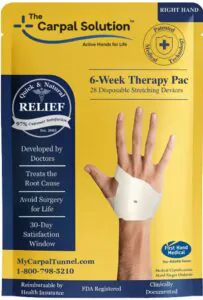
 Created by renowned Harvard health care professionals.

William Shucart, M.D.
Clinical Professor of Neurosurgery New England Medical Center. Former Chair Department of Neurosurgery Tufts Medical School. Investor and Advisory Board First Hand Medical.


Articles Written by Doctor William Shucart, MD, Neurosurgeon on this website:
Carpal Tunnel Syndrome Symptoms
 Dr. William Shucart is a leading Neurosurgeon and Nerve Expert. He is enthusiastic about facilitating a non-surgical therapy for Carpal Tunnel because carpal tunnel surgery has a patient satisfaction rate lower than 69%: about 31% of patients report lingering or recurring symptoms, and no patient is satisfied with lingering symptoms. He was Professor and chair of the department of Neurosurgery at Tufts Medical School and the New England Medical Center for over a decade. Previously, Dr. Shucart was a Professor and chair of the department of neurosurgery at the State University of New York Downstate Medical Center
His clinical interests have been primarily in the areas of cerebrovascular and pituitary disease.
He has held several positions in organized medicine, including director and chair of the American Board of Neurological Surgery, member and chair of the Residency Review Committee for neurosurgery, President of the Society of University Neurosurgeons, President of the Society of Neurological Surgeons, Chair of the Advisory Council for Neurosurgery of the American College of Surgeons, President of the New England Neurosurgical Society, Director and Vice–President of the American Association of Neurological Surgeons. Dr. Shucart as a leading Neurosurgeon quickly recognized the value of a much better first line of defense for Carpal Tunnel Syndrome that the Carpal Solution Therapy offers.
The Carpal Solution Therapy can help people all over the world avoid the risks and potential complications of Surgery with a simple easy to apply treatment at home during sleep. It will enable people everywhere to conveniently treat themselves in the comfort and convenience of home. Products like the Carpal Solution helps reinforce the trend in medicine that is accelerating towards less invasive treatment protocols. For those for whom the Carpal Solution might not work, they can always resort to Carpal Tunnel Surgery to relieve pressure on the Median nerve. As is usually the case, Surgery, should be considered the last resort.
A graduate of the University of Missouri and Washington University. Dr. Shucart received his neurosurgical training at the Neurological Institute of Columbia-Presbyterian Hospital.
Table of Contents
William Shucart’s Career in Neurosurgery
Dr. William A. Shucart trained at the Neurological Institute of Columbia-Presbyterian Hospital in New York. In 1970 he came to Tufts and the New England Medical Center in Boston with Dr. Bennett M. Stein, who had been named chair of the neurosurgery division. In 1975 he left to become chair of neurosurgery at the State University of New York Downstate Medical Center in Brooklyn.
He returned to Tufts in 1981 as chairman of neurosurgery and director of the neurosurgery residency program, roles he held until 2005. During those years St. Elizabeth’s Hospital and the Boston VA Medical Center became part of the Tufts program, and a neurosurgical research laboratory was established. He also served as chief of neurosurgery at Beth Israel Deaconess Medical Center in Boston in 1996 and 1997.
Training the Next Generation of Neurosurgeons
For more than two decades, Dr. Shucart trained neurosurgery residents in the Tufts neurosurgery program, several of whom went on to lead departments and training programs of their own. Today the Shucart Award, presented at the New England Neurosurgical Society meeting for the best medical student oral presentation, carries his name.
Why a Neurosurgeon Supports Conservative Care for the Median Nerve
 Neurosurgeons spend their careers working with nerves, and the median nerve is the nerve at the center of carpal tunnel syndrome. It runs from the forearm through the carpal tunnel at the wrist, beside the nine tendons that bend the fingers and thumb. When swelling and entrapped inflammation build up in the soft tissue in and around the tunnel, they squeeze the nerve and restrict blood flow and lymphatic fluid transport. The result is numbness, tingling, pain and, over time, weakness in the thumb and fingers.
Dr. William Shucart’s view is that pressure on the median nerve should first be relieved with the least invasive treatment that works. The Carpal Solution’s gentle passive stretching, applied at home during sleep, relieves pressure on the nerve and lets lymph fluid flow freely to clear out the swelling, without the risks, downtime or scar tissue of surgery. Our patients report 97% patient satisfaction over 21 years, with 4.9 out of 5 stars on independent review sites like Google Reviews. Surgery remains available as the last resort.
Surgery as the Last Resort
A nerve that has been compressed needs relief, but the way that relief is delivered matters. Carpal tunnel release cuts the transverse carpal ligament to make more room for the median nerve. It does nothing about the swelling and entrapped inflammation that caused the pressure, and it leaves scar tissue in the palm.
That is why symptoms so often come back. Even after a successful surgery, 57% of patients in one study had at least some symptoms return within 5.5 years (Nancollas, 1995; reviewed in Louie, Earp and Blazar, Hand, 2012). Our doctors estimate from two decades of clinical experience that 80 to 90% of patients see symptoms return within 10 years; that figure has not been statistically researched, because few studies follow patients that long. A second carpal tunnel surgery has a patient satisfaction rate of only 16% to 40% in the published literature.
For William Shucart, a neurosurgeon who has spent a career on the nervous system, the conclusion is straightforward: start with a safe, conservative treatment that relieves pressure on the median nerve, give it time to work, and keep surgery as the last resort. See When to Get Carpal Tunnel Surgery for more.
Articles Medically Reviewed by Dr. Shucart
Dr. William Shucart reviews articles on this site that deal with the nerves of the hand and wrist, including:
- Permanent Nerve Damage in CTS: how long a compressed median nerve takes to recover, and why early relief matters
- Persistent Hand Numbness: causes of numbness in the hand, and when numbness is an emergency
- What Is a Palmar Cutaneous Neuroma?: a nerve injury that can follow carpal tunnel surgery
- Is Carpal Tunnel a Disease?: the difference between a syndrome and a disease

Further Reading
A Neurosurgeon's View on Carpal Tunnel Care
As a neurosurgeon, carpal tunnel is something Dr. Shucart understands from the nerve’s point of view. The median nerve does not need to be cut free in most cases; it needs relief from the pressure of swollen, inflamed soft tissue around it.
That is why this neurosurgeon’s carpal tunnel advice matches the rest of our medical team: start with conservative care that relieves pressure on the nerve and helps the body clear the swelling, and keep surgery as the last resort. Anyone with constant numbness, weakness or thinning of the thumb muscles should see a doctor promptly.