Created by renowned Harvard health care professionals.


Does Carpal Tunnel Surgery Cause Scar Tissue?
It is good to know in advance what the potential complications might be, recovery times associated with surgery, success rates and potential for repeat surgical procedures. Scar tissue is the heart of many issues for Carpal Tunnel Surgery.

Written by Julie Sunberg, Director of Marketing and Customer Service at First Hand Medical · Medically reviewed by Michael E. Ruff, MD, orthopedic hand surgeon and associate clinical professor of orthopedic surgery at Ohio State University · Last reviewed: November 2026
Table of Contents
Question by Cynthia – Plano, Texas
 I was told that my hand pain, hand numbness and occasional wrist pain is likely Carpal Tunnel Syndrome. My friend had surgery and was not happy. He said surgery causes scar tissue which can make the condition worse. It that true? Does Carpal Tunnel Surgery Cause Scar Tissue? Is there a better treatment option?
Answer by Doctors:
Great questions, most patients don’t consider the issue of scar tissue with Carpal Tunnel Surgery. They often get rushed off to a surgical procedure before they know what to expect.
Scar Tissue Associated with Carpal Tunnel Surgery
 It is good to know in advance what the potential complications might be, recovery times associated with surgery, success rates and potential for repeat surgical procedures. Scar tissue is the heart of many issues for Carpal Tunnel Surgery.
Almost any surgery is going to result in a fair amount of scar tissue formation. When incisions are made during surgery, the body’s soft tissue heals by creating scar tissue to patch things back together. This body’s healing process forms a web of crisscrossing tissue in an emergency effort to patch and hold the unexpected severed tissue together.
This tissue is different from normal tissue by necessity because it has to hold to areas of normal tissue together and prevent splitting open or tearing again. As years go by the unique patch work of scar tissue will be filled in with normal growth tissue that strengthens and repairs the area that was severed. However, the web of scar tissue remains for the rest of one’s life.
For most areas of the body, scar tissue formation is not a big deal because the scar tissue is relatively small compared to the size of the body part being cut or the size of the organ being extracted.
However, with Carpal Tunnel Surgery, any scar tissue formation can create complications because the space is so tight and there are so many tendons, tendon sheaths, blood vessels, muscles, nerves, fascia tissue and epidermis packed into an already limited space with a lot of moving parts.
For instance, the nine flexor tendons that control the use of your fingers and thumb all run from the tips of your fingers and thumb, through the Carpal Tunnel and then attach to muscles in the forearm that allows your hands and fingers to move and work with dexterity, ease and beauty.
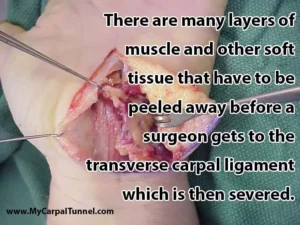 At the risk of being too graphic, the picture to the left gives a good idea of the amount of muscle tissue under the surface of the skin that gets disrupted, severed and peeled away and must scar back together in the healing process. In an open release, the skin, the fat beneath it and a layer of tough tissue called the palmar fascia are opened before the surgeon reaches the transverse carpal ligament, which is then cut.
The transverse carpal ligament is a thick, strong band of tissue that forms the roof of the carpal tunnel and helps hold the arch of the wrist bones together. After this ligament is severed it also must generate scar tissue to heal and reconnect. Sometimes the healing results in more space in the Carpal Tunnel, sometimes it results in the same space and sometimes it results in less space depending on how much scar tissue is formed.
 Scar tissue on the skin surface can be unsightly and destroy the beauty of the natural anatomy, but the scar tissue below the surface in the muscle tissue, around the tendon sheaths and fascia tissue and in the transverse carpal ligament can be a lot more problematic from a functional point of view. Scar tissue can limit movement, it can be the source of lasting tenderness and lost grip strength for some people, and it can create pressure on the Median Nerve.
Scar tissue is the most common reason that Carpal Tunnel Symptoms, such as hand numbness, hand pain and wrist pain gets worse after surgery than before surgery. This worsening of the Carpal Tunnel Condition happens to about 8% of people post-surgery (Bland, Muscle & Nerve, 2007: a review of 209 studies covering 32,936 operations).
Sometimes carpal tunnel scar tissue will result in the same symptoms post-surgery as before.
Once scar tissue has formed there is not a lot that can be done from a surgical point of view. More surgeries will only create more scar tissue exacerbating the issues with discomfort, pressure on the nerve and pain from movement.
People with conditions such as rheumatoid arthritis or diabetes may heal differently and can face a higher risk of complications with a surgical procedure, so it is worth discussing this with your doctor.
Scar Tissue After Carpal Tunnel Surgery: 5 Things to Know
- Every carpal tunnel release leaves scar tissue. The skin, the palmar fascia and the transverse carpal ligament are all cut, and each heals with scar tissue.
- Scar tenderness is common in the first months. Many people have a tender scar or pain at the base of the palm, often called pillar pain, while the tissue heals. For most it eases over time, but for some it lingers.
- Scar tissue inside the wrist can crowd the nerve again. Depending on how the ligament heals, the tunnel can end up with more room, the same room or less room than before.
- Surgery outcomes are not as reliable as many patients expect. Carpal tunnel surgery has a patient satisfaction rate lower than 69%: in a study of 1,268 operations, patient-reported success was 69% (Bland, Muscle & Nerve, 2001), and about 31% of patients report lingering or recurring symptoms. No patient is satisfied with lingering symptoms.
- A second surgery adds more scar tissue. Second carpal tunnel surgeries have a patient satisfaction rate between 16% and 40%, based on lingering symptoms reported in the published medical literature.
How often carpal tunnel symptoms come back after a “successful surgery” has rarely been studied beyond a few years. The highest published rate is 57% of patients with at least some symptoms returning within five and a half years (Nancollas et al., 1995, reviewed in Louie, Earp and Blazar, Hand, 2012).
Based on two decades of clinical experience with patients, our doctors estimate that symptoms return for 80 to 90% of patients within 10 years of surgery. This is not a statistically researched figure. It is their best estimate until the work is done to follow carpal tunnel patients for 10 years or more, as other orthopedic fields do for hip and knee replacements.
Why so little certainty? Published recurrence rates range from about 4% to 57%, a spread that shows how poorly this question has been studied. Studies define recurrence differently, follow patients for only a few years and lose many of them along the way. The lowest figures count only repeat operations, a biased approach that ignores patient satisfaction and the patient’s perspective, so they are not credible. Read more about carpal tunnel recurrence after surgery.
Getting to surgery also means waiting: for appointments, a nerve test, insurance approval and an opening in a busy surgeon’s schedule. A safe, non-invasive treatment can relieve the sleep loss, numbness and pain while you wait.
Is there a Better Treatment Option for Carpal Tunnel Syndrome other than Surgery?
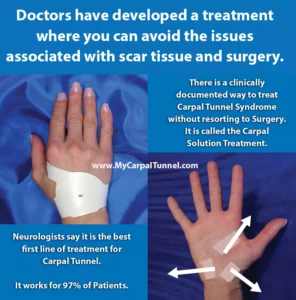 There is a way that most people can avoid this issues associated with scar tissue generation and carpal tunnel surgery. Doctors have developed a natural stretching treatment that is 97% patient satisfactionful for people with carpal tunnel syndrome.
The treatment is easily done at home during sleep when the body is in its natural restorative state. It is called the carpal solution treatment. It works by gently stretching the soft tissue in and around the carpal tunnel, restoring flexibility restoring circulation and relieving pressure on the median nerve. Once the pressure is gone carpal tunnel goes into remission and your body’s natural healing process takes over the way it did before you had this devastating syndrome.
Even after a failed surgery where scar tissue formation has made Carpal Tunnel Syndrome Symptoms worse, there is hope for natural relief and treatment. Many people with lingering symptoms after surgery have found relief with the Carpal Solution stretching treatment. Our doctors recommend waiting three months after surgery before starting. The Carpal Solution restores nutrient rich blood circulation to injured tissue and restores flexibility to injured soft tissue.
Scar From Carpal Tunnel Surgery: Lumps, Massage and Healing
Most people who search for scar tissue after carpal tunnel surgery want to know two things: is what I am feeling normal, and what can I do about it? Here are our doctors’ answers.
The Carpal Tunnel Release Scar: What to Expect
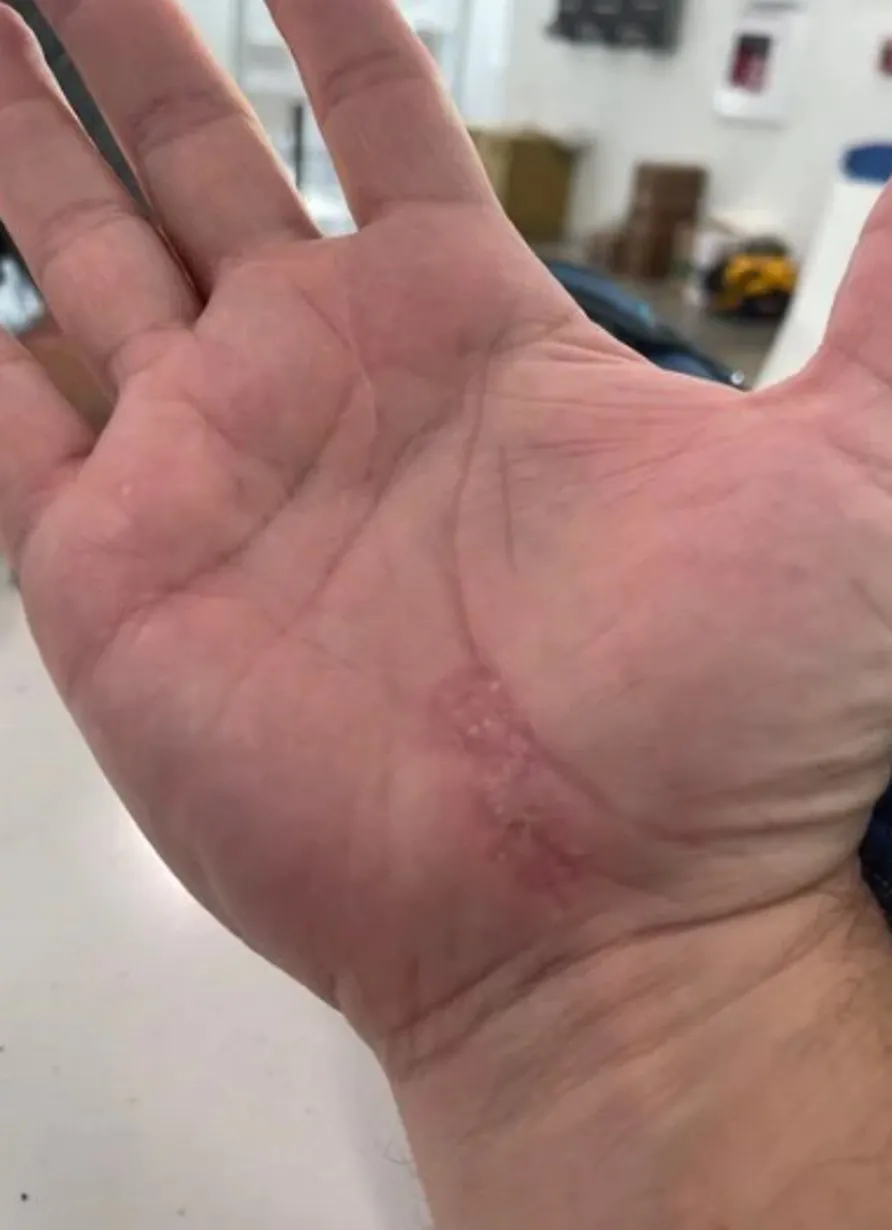
A carpal tunnel release scar from open surgery is usually a short line in the palm, in line with the ring finger; endoscopic surgery leaves one or two smaller scars at the wrist crease or palm. For the first weeks the carpal tunnel release scar is pink, firm and tender, then it slowly flattens and fades over months. Thickening, a hard lump under the scar, or tenderness that lasts are signs of the scar tissue problems described below.
Scar From Carpal Tunnel Surgery: What Is Normal?
A scar from carpal tunnel surgery is usually a short line in the palm (open release) or a small mark at the wrist crease (endoscopic). For the first few months the scar is often pink, firm and tender, and the area under it can feel thick. Carpal tunnel scar tissue forms deeper too, where the transverse carpal ligament was cut and has to scar back together.
Hard Lump in Palm of Hand After Carpal Tunnel Surgery
A hard lump in the palm of the hand after carpal tunnel surgery is usually thick scar tissue under the incision. Thick scar tissue after carpal tunnel release often softens over three to six months. Call your surgeon if the lump keeps growing, or if you notice redness, warmth, drainage, fever or new numbness.
Healing a Carpal Tunnel Surgery Scar
Healing a carpal tunnel surgery scar starts with protecting the incision until it is fully closed and your surgeon says it is ready. After that, keep the skin moisturized, protect the scar from the sun, and ask your surgeon whether silicone gel or sheets are right for you.
Carpal Tunnel Scar Massage
Carpal tunnel scar massage, once your surgeon clears it, helps soften the scar and keep the skin moving over the tissue below. Use firm, slow circles and short strokes along and across the scar with a little lotion for about five minutes, a few times a day. It may feel tender, but it should not cause sharp pain.
How to Break Up Scar Tissue After Carpal Tunnel Surgery
How to break up scar tissue after carpal tunnel surgery, or scar tissue in the hand from any cause, comes down to steady, gentle work over weeks: scar massage, gentle tendon glides, and passive stretching that restores flexibility to the soft tissue. Forcing it with aggressive stretching or grip exercises tends to inflame it. Post-surgery patients can start the Carpal Solution about three months after surgery; its gentle nighttime stretching helps keep the healing tissue flexible.
Scar tissue is one reason carpal tunnel surgery has a patient satisfaction rate lower than 69%: about 31% of patients report lingering or recurring symptoms. If you have not had surgery yet, see alternatives to carpal tunnel surgery.
If You Already Have Scar Tissue From Surgery
Once scar tissue has formed, another operation is rarely the answer. Gentle, consistent stretching can help scar tissue become more flexible and restore circulation to the hand.
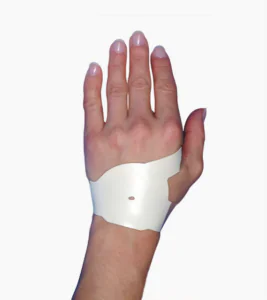
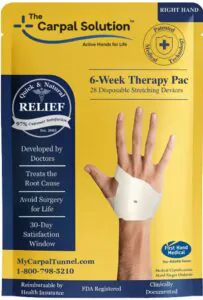
The Carpal Solution is a medically prescribed passive stretching device worn at night. It gently stretches the soft tissue in and around the carpal tunnel, delivering more than 220 hours of targeted stretching over the six-week protocol. After surgery, our doctors recommend waiting three months before starting, so the incision can heal fully.
For a step-by-step plan, see our doctors’ recommendations for persistent carpal tunnel symptoms and symptoms after carpal tunnel surgery.
Avoiding Scar Tissue in the First Place
The surest way to avoid surgical scar tissue is to relieve the pressure on the nerve without surgery. For most people with mild to moderate carpal tunnel syndrome, conservative care should come first, and surgery should be the last resort.
With the Carpal Solution, most people feel their worst symptoms ease in two to three weeks, and about 90% get complete remission in six weeks. Over two decades, more than 100,000 people have used it, with 97% patient satisfaction and 4.9 out of 5 stars on independent review sites like Google Reviews.
When Healing Needs a Doctor’s Help and Professional Medical Evaluation
- Constant numbness that does not improve or loss of feeling in the fingertips that does not improve in 4 to 8 weeks.
- Extreme loss of the muscle at the base of the thumb, with loss of grip strength that does not improve over 6 to 8 weeks.
- Worsening symptoms over 6 to 8 weeks while using the best conservative treatments
- Symptoms that begin suddenly after hand or wrist trauma, a fracture or severe sprain from a fall or auto accident.
- Odd Symptoms that are not consistent with the Carpal Tunnel Symptoms listed on this website, that might be indicative of other nerve issues. A nerve conductivity study can clear up the confusion with minimal costs and not too much pain and no risk.
These signs may mean more advanced nerve involvement or a different condition and deserve professional medical evaluation and in person consultation. Home treatment can be used alongside professional in-person medical care while you wait for the healthcare delivery system to fit you into their schedule. There is no reason to wait doing nothing. You can start proven natural conservative treatment with good patient reviews while you wait for your appointments. If your symptoms start improving over 6 to 8 weeks, then you know you are on the right track and surgery is not necessary.
Scar tissue adds to the problem for people who are already prone to inflammation. Read Who Should Avoid Carpal Tunnel Surgery? Inflammatory Conditions and Other Red Flags.
Scar Tissue and Carpal Tunnel Surgery: Frequently Asked Questions
Does carpal tunnel surgery cause scar tissue?
Yes. Every carpal tunnel release leaves scar tissue in the skin, the palmar fascia and the cut transverse carpal ligament as they heal.
Can scar tissue cause carpal tunnel symptoms to come back?
It can. Scar tissue inside the wrist can crowd the median nerve again, which is one reason some people have lingering or recurring symptoms after surgery.
How long does scar tenderness last after carpal tunnel surgery?
For most people, scar tenderness and pain at the base of the palm ease over the first several months. For some, it lingers longer.
Can scar tissue be stretched?
Yes. Gentle, consistent stretching can help scar tissue become more flexible. Wait three months after surgery before starting the Carpal Solution.
Is there a carpal tunnel cure?
No. Carpal tunnel syndrome is chronic and recurring and cannot be cured, by surgery or anything else. The Carpal Solution is the next best thing, controlling symptoms at home without downtime, risks, scar tissue or complications.