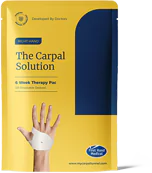
 Created by renowned Harvard health care professionals.


Seven non-surgical options backed by research or patient reviews, the popular treatments that fall short, and how to build a plan you can start tonight.
Carpal tunnel non-surgical treatment is where care should start for most people with mild to moderate carpal tunnel syndrome (CTS). The hard part is choosing. Devices, exercises, therapy, pills, injections and home remedies all promise relief, and the evidence behind them varies widely.
This guide narrows the field to 7 options that work, based on Cochrane reviews, the 2024 American Academy of Orthopaedic Surgeons (AAOS) guideline, randomized trials and patient reviews. It also shows which popular treatments fall short, and how to combine the best options into one simple plan.
Key Takeaways
- Carpal tunnel non-surgical treatment is the recommended first step for mild to moderate CTS, and randomized trials show conservative care reduces the need for surgery.
- The options that work best relieve pressure on the median nerve and work on the tissue around it: gentle stretching, nerve gliding, a neutral wrist and healthy habits.
- Pills, supplements, magnets and injections offer little or only short-term benefit.
- The best place to start is The Carpal Solution, a physician-developed overnight stretching kit rated 4.9 out of 5 stars on Google Reviews.
- Combining options, such as passive stretching at night plus a short daytime routine, can speed recovery.
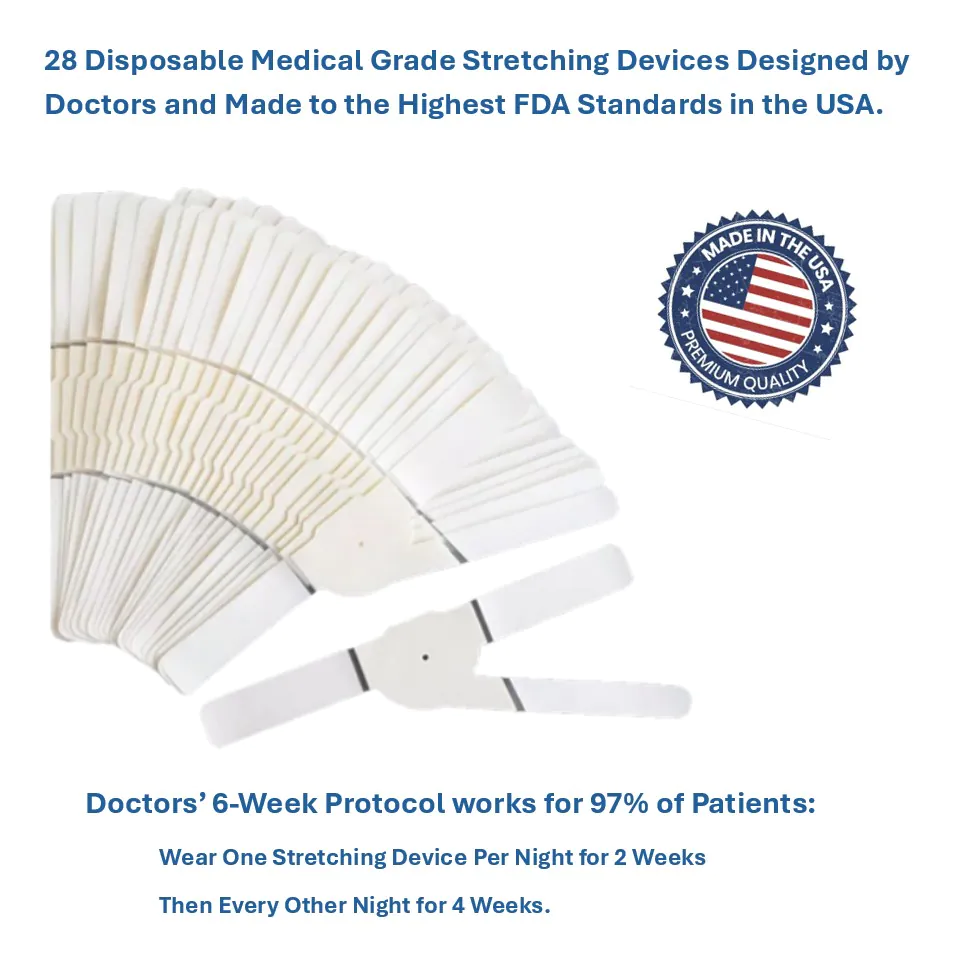
Table of Contents
Why Carpal Tunnel Non-Surgical Treatment Comes First
Medicine follows a conservative hierarchy: start with the least invasive treatment that can work, and escalate only if needed. For carpal tunnel, that principle is backed by evidence:
- Many cases are responsive. In a two-year study of untreated patients (Clinical Neurophysiology, 2008), about 48% improved and 29% stayed stable. A multicenter study in Neurology (2001) also found significant overall improvement.
- Conservative care reduces surgery. A randomized trial (Journal of Physiotherapy, 2020) found a home program cut conversion to surgery from 80% to 59%. In a JAMA trial (2002), 59% of patients who started with a splint never needed surgery over 18 months.
- CTS often recurs, so a treatment that is safe to repeat matters. The risks of injections and surgery compound with repetition.
Read the full reasoning in Why Start With the Best Conservative Treatment First and the evidence review Carpal Tunnel Treatment Without Surgery.
How non-surgical treatment relieves carpal tunnel
CTS is driven by pressure on the median nerve inside the carpal tunnel. That pressure restricts blood flow and lymph drainage. Fluid and inflammation become trapped, the tissue stiffens, and pressure rises further.
Effective carpal tunnel non-surgical treatment interrupts that cycle: it relieves pressure, restores circulation and drainage, and gives the nerve time to recover. See The Root Cause of Carpal Tunnel: Trapped Inflammation.
7 Carpal Tunnel Non-Surgical Treatment Options That Work
The seven options below share three features. They work on the tissue around the nerve, they are safe to repeat, and they are supported by clinical research, patient reviews or both. Here is how they compare at a glance:
| Option | What supports it | Time needed |
|---|---|---|
| 1. The Carpal Solution (overnight passive stretching) | Builds on the elastic-stretch approach supported by taping meta-analyses; rated 4.9/5 on Google Reviews; company-reported 97% success | A minute at bedtime; works while you sleep |
| 2. Elastic therapeutic taping | Meta-analyses (2023, 13 trials; 2025, 14 trials): improved pain and function in mild to moderate CTS | Skilled application, often by a therapist |
| 3. Structured home program with nerve gliding | Randomized trial (2020): surgery 59% vs 80% at 24 weeks | A few minutes, several times a day |
| 4. Neutral wrist at night | Cochrane (2012, 19 trials): limited short-term evidence; JAMA (2002): 59% avoided surgery over 18 months | Overnight |
| 5. Daytime stretching and yoga | Cochrane (2012): limited evidence for exercise alone; one trial: yoga reduced pain at 8 weeks | Up to 6 sets a day |
| 6. Wrist-friendly ergonomics | Carpal tunnel pressure is lowest with the wrist near straight (JBJS, 1995) | Ongoing habits |
| 7. Managing whole-body risk factors | Diabetes, thyroid disease, excess weight and inflammatory conditions are recognized CTS risk factors | Ongoing, with your doctor |
1. Overnight Passive Stretching With The Carpal Solution
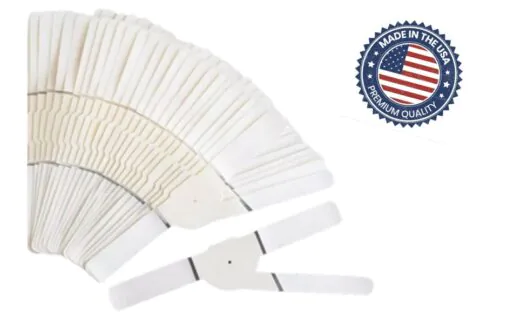
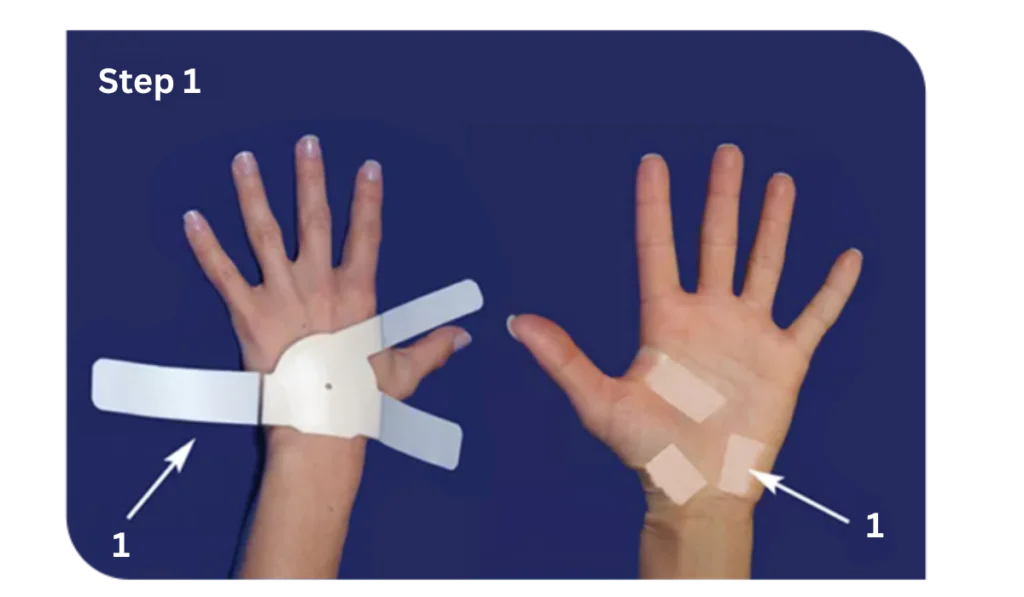
The Carpal Solution is a carpal tunnel non-surgical treatment kit developed by physicians at First Hand Medical. At bedtime you apply a disposable stretching device made of two types of medical-grade elastic tape in a patented design.
The device applies gentle, targeted stretch to three key areas around the carpal tunnel while you sleep. The goal is to restore flexibility, relieve pressure on the median nerve and reopen drainage of trapped fluid and inflammation.
Why it works: stiff soft tissue improves with total time under gentle stretch (Journal of Hand Therapy, 1994). Six to eight hours a night adds up to more than 220 hours over the six-week protocol (as calculated by First Hand Medical), during the hours when symptoms usually peak.
- Doesn’t immobilize: unlike a rigid splint, it allows natural movement.
- Safe to repeat: no needles, drugs, incisions or downtime. It is FDA registered and made with hypoallergenic materials in an ISO 13485-certified facility.
- Physician-developed: by a team including co-founders Dr. Jerome H. Grossman, MD (former Harvard professor and president of New England Medical Center) and Dr. Joseph E. Scherger, MD, MPH, inventor and musculoskeletal clinician Dr. Clyde E. Morgan, DC, and orthopedic hand surgeon Dr. Michael E. Ruff, MD.
| Review platform | Average rating | Number of reviews |
|---|---|---|
| Google Reviews | 4.9 / 5 | 69 |
| 4.8 / 5 | 314 | |
| Birdeye | 4.8 / 5 | 271 |
| Trustpilot | 4.6 / 5 | 41 |
Ratings as displayed on MyCarpalTunnel.com, November 2026. First Hand Medical reports more than 500,000 people helped since 2005 and a 97% success rate in its clinical experience, with relief of the worst symptoms in about three weeks and remission in about six weeks for most patients. See How The Carpal Solution Works, the Clinical Documentation and reviews from real patients.
2. Elastic Therapeutic Taping
Elastic (kinesiology) tape applied over the wrist and palm gently lifts and stretches the skin and soft tissue. Two meta-analyses, one in 2023 covering 13 trials and one in 2025 covering 14 trials, found it improved pain and function in mild to moderate CTS. The quality of that evidence was rated low to moderate.
The drawback is technique: results depend on how the tape is applied, so it is usually done by a therapist. The Carpal Solution was designed to deliver a similar elastic stretch in a pre-shaped device you can apply yourself, every night. See Natural Carpal Tunnel Treatment: Backed by Evidence.
3. A Structured Home Program With Nerve Gliding
Nerve and tendon gliding exercises slide the median nerve and finger tendons gently through the carpal tunnel. They are a core part of the home program tested in a multicentre randomized trial (Journal of Physiotherapy, 2020). Combined with education and night positioning, the program cut conversion to surgery from 80% to 59% at 24 weeks.
Do gliding sequences slowly, a few times a day, and never push into pain or tingling. Step-by-step instructions are in Carpal Tunnel Exercise: Passive Stretching at Night Is Best.
4. Keeping the Wrist Neutral at Night
Many people sleep with their wrists curled, which raises pressure inside the carpal tunnel. Pressure is lowest with the wrist near straight, at about 2 degrees of extension (Journal of Bone and Joint Surgery, 1995).
A Cochrane review of 19 trials (2012) found limited evidence that night splints help in the short term. In a JAMA trial (2002), surgery produced better results at 18 months (90% vs 75%), yet 59% of patients who started with a splint never needed surgery.
The caveat: prolonged rigid immobilization can add stiffness. A flexible approach that supports the wrist while still stretching the tissue is the better long-term choice. See Best Wrist Brace for Carpal Tunnel and why to avoid rigid splints and braces.
5. A Daytime Stretching Routine (and Yoga)
Daytime stretches add treatment time to your day. On their own, the evidence is modest: a Cochrane review of 16 trials (2012) rated it limited and very low quality, while one small trial found yoga reduced pain at 8 weeks compared with splinting.
Where daytime stretching shines is in combination. We recommend up to 6 sets of 10 repetitions per day, holding each stretch for 15 seconds with 30 seconds of rest between, if it fits into your day. The daily discipline is hard to maintain, but pairing a daytime routine with passive stretching at night can accelerate recovery.
See Best Exercises for Carpal Tunnel: The Day-and-Night Program, Carpal Tunnel Stretches, stretches you can do at your desk and Yoga and Carpal Tunnel Stretches.
6. Wrist-Friendly Ergonomics and Activity Changes
- Keep wrists straight at the keyboard, mouse, phone and steering wheel.
- Take movement breaks every 30 to 60 minutes during hand-intensive work.
- Ease up on force: avoid grip trainers and forceful, repetitive gripping while healing; use a lighter grip and larger handles.
- Sleep smart: avoid sleeping on your hands or with wrists tucked under your pillow.
See How to Prevent Carpal Tunnel and Carpal Tunnel Home Remedies: Developed by Doctors Are Best.
7. Managing Whole-Body Risk Factors
Diabetes, thyroid disease, excess weight, inflammatory arthritis and fluid retention are recognized risk factors for CTS. Working with your doctor to manage them supports every other carpal tunnel non-surgical treatment on this list.
See How Systemic Inflammation Fuels CTS and the Persistent Symptoms Protocol.
Popular Non-Surgical Treatments That Fall Short
Not every carpal tunnel non-surgical treatment earns its place. Cochrane reviews and the 2024 AAOS guideline found that these options offer little or only temporary benefit:
| Treatment | What the evidence shows |
|---|---|
| NSAIDs (ibuprofen, naproxen) | No better than placebo for CTS (Cochrane 2003) |
| Diuretics | No better than placebo (Cochrane 2003) |
| Vitamin B6 | No significant improvement (Cochrane 2003) |
| Oral steroids | Short-term improvement at 2–4 weeks; side effects make repeated courses hard to justify (Cochrane 2003) |
| Corticosteroid injection | Short-term relief; AAOS 2024: strong evidence of no long-term improvement |
| PRP injection | AAOS 2024: strong evidence of no long-term benefit |
| Magnetic wristbands | Magnet therapy showed no benefit vs placebo (Cochrane 2003) |
| Chiropractic and laser acupuncture | No symptom benefit vs placebo or control (Cochrane 2003) |
| Compression gloves | Little evidence for CTS |
| Therapeutic ultrasound | One trial showed benefit at 7 weeks to 6 months; pooled short-term data not significant (Cochrane 2003) |
Steroid injections deserve a special note. In a placebo-controlled trial (Annals of Internal Medicine, 2013), 73–81% of injected patients still had surgery within a year. For a ranked comparison of every option against surgery, see Alternatives to Carpal Tunnel Surgery.
Combining Options: Your Carpal Tunnel Non-Surgical Treatment Plan
The best results usually come from combining several options rather than relying on one. Here is a simple plan:
| Phase | What to do |
|---|---|
| Day 1 | Take the Self Test, check for warning signs, talk with your doctor, and start The Carpal Solution at bedtime. |
| Weeks 1–2 | One device every night. Keep wrists straight, stop grip trainers and avoid intense overuse. |
| Weeks 3–6 | One device every other night. Add nerve gliding and up to 6 sets of 10 daytime stretches if it fits your day. |
| Months 2–3 | Continue good habits. First Hand Medical recommends a three-month trial before considering invasive options. |
| Long term | Repeat the protocol or use preventive nights if symptoms return. |
For a detailed version with troubleshooting, see How to Fix Carpal Tunnel Without Surgery. Waiting on appointments or nerve tests? See why every patient should start treating carpal tunnel syndrome now, and our comparison What Is the Best Carpal Tunnel Treatment to Start to Avoid Surgery?
What Carpal Tunnel Non-Surgical Treatment Costs
| Option | Typical cost structure | If symptoms return |
|---|---|---|
| The Carpal Solution | $99.95 per hand for 6 weeks; 30-day money-back guarantee; may be reimbursable | Another kit or preventive nights |
| Rigid splint | One-time purchase | Low |
| Hand therapy | Per-visit fees and co-pays | Additional visits |
| Steroid injection | Office visit and procedure fees | Additional procedures; number usually limited |
| PRP injection | Often out of pocket | High |
| Surgery (for comparison) | Surgeon, facility and anesthesia fees, plus time off work | Revision surgery, with poorer outcomes |
See Health Insurance Reimbursement, Medicare Reimbursement and Costs of Carpal Tunnel Surgery.
Non-Surgical Treatment in Special Situations
- Pregnancy: drug-free, non-invasive care is usually preferred, and pregnancy-related CTS often improves after delivery. See I Am Pregnant. What Treatment Can I Do?
- Blood thinners: avoiding injections and surgery can be especially appealing. See Treatment on Blood Thinners.
- Arthritis and autoimmune conditions: symptoms may recur more often, so repeatable treatment matters. See Carpal Tunnel and Arthritis.
- Hand-intensive jobs: read stories from hair stylists, dentists, construction workers and nurses.
- After surgery: for lingering symptoms, First Hand Medical recommends waiting at least three months after surgery before starting The Carpal Solution, so surgically disturbed tissue can heal first. See What If Carpal Tunnel Surgery Fails?
When Non-Surgical Treatment Is Not Enough
- Constant numbness that never goes away, or loss of feeling in the fingertips
- Wasting of the muscle at the base of the thumb
- Weakness when pinching or gripping, or rapidly worsening symptoms
- Symptoms after a wrist injury, or in the little finger, whole arm or neck
These signs call for prompt medical evaluation, and surgery may be appropriate for severe cases. Non-surgical treatment can be used alongside medical care but does not replace it. If your diagnosis is uncertain, see Should I Get a Nerve Conduction Study?
Carpal Tunnel Non-Surgical Treatment FAQs
What is the most effective carpal tunnel non-surgical treatment?
Options that work on the tissue around the nerve and deliver enough treatment time show the most promise. We recommend starting with The Carpal Solution, which provides more than 220 hours of overnight stretching in six weeks and is rated 4.9 out of 5 stars on Google Reviews.
Does non-surgical treatment for carpal tunnel really work?
For many people, yes. Randomized trials show conservative care reduces the need for surgery, and studies of untreated patients show many cases improve or stay stable.
How long should I try non-surgical treatment before considering surgery?
First Hand Medical recommends at least three months with The Carpal Solution for mild to moderate symptoms, unless warning signs such as constant numbness or thumb muscle wasting appear.
Are steroid injections a good non-surgical option?
They can provide short-term relief, but the 2024 AAOS guideline found strong evidence that they do not provide long-term improvement.
Can I combine non-surgical treatments?
Yes. The best results usually come from combining passive stretching at night with The Carpal Solution, wrist-neutral habits, gentle nerve gliding, a daytime stretching routine and attention to whole-body health.
Is carpal tunnel non-surgical treatment covered by insurance?
Coverage varies. The Carpal Solution may be reimbursable by health insurance or Medicare; First Hand Medical’s support team can help at (800) 798-5210.
More Guides in This Series
- Carpal Tunnel Inflammation: The Key to Managing Carpal Tunnel for Life
- Carpal Tunnel Treatment at Home: Why Care Is Moving Home
- Carpal Tunnel Cure: The Honest Truth and a Plan for Life
- Carpal Tunnel Treatment Without Surgery: Backed by Evidence
- Natural Carpal Tunnel Treatment: Backed by Evidence
- How to Fix Carpal Tunnel Without Surgery
- How to Heal Carpal Tunnel Without Surgery
- Carpal Tunnel Relief Without Surgery: From Minutes to Years
- Alternatives to Carpal Tunnel Surgery
- Carpal Tunnel Syndrome Remedy: Relief for Every Symptom
- Best Exercises for Carpal Tunnel: The Day-and-Night Program
- 6 Carpal Tunnel Surgery Myths
- Carpal Tunnel Surgery Success Rates: Patients vs Surgeons
The Bottom Line
Carpal tunnel non-surgical treatment is where care should start for most people, and the 7 options above give you a clear path. The research is just as clear about what falls short: pills, supplements, magnets and injections offer little lasting benefit.
The options that work relieve pressure on the median nerve, work on the surrounding tissue, deliver enough treatment time and can be safely repeated. Start with The Carpal Solution: physician-developed, used at home while you sleep, and rated 4.9 out of 5 stars by patients on Google.
Start Non-Surgical Treatment Tonight: Order The Carpal Solution
Questions? Call (800) 798-5210
References
- American Academy of Orthopaedic Surgeons. Management of Carpal Tunnel Syndrome Evidence-Based Clinical Practice Guideline. May 18, 2024. aaos.org/cts2cpg
- O’Connor D, Marshall S, Massy-Westropp N, Pitt V. Non-surgical treatment (other than steroid injection) for carpal tunnel syndrome. Cochrane Database Syst Rev. 2003;(1):CD003219. doi:10.1002/14651858.CD003219
- Page MJ, Massy-Westropp N, O’Connor D, Pitt V. Splinting for carpal tunnel syndrome. Cochrane Database Syst Rev. 2012;(7):CD010003. doi:10.1002/14651858.CD010003
- Page MJ, O’Connor D, Pitt V, Massy-Westropp N. Exercise and mobilisation interventions for carpal tunnel syndrome. Cochrane Database Syst Rev. 2012;(6):CD009899. doi:10.1002/14651858.CD009899
- Atroshi I, Flondell M, Hofer M, Ranstam J. Methylprednisolone injections for the carpal tunnel syndrome: a randomized, placebo-controlled trial. Ann Intern Med. 2013;159(5):309–317.
- Lewis KJ, Coppieters MW, Ross L, et al. Group education, night splinting and home exercises reduce conversion to surgery for carpal tunnel syndrome: a multicentre randomised trial. J Physiother. 2020;66(2):97–104. doi:10.1016/j.jphys.2020.03.007
- Gerritsen AAM, de Vet HCW, Scholten RJPM, et al. Splinting vs surgery in the treatment of carpal tunnel syndrome: a randomized controlled trial. JAMA. 2002;288(10):1245–1251.
- Padua L, Padua R, Aprile I, et al. Multiperspective follow-up of untreated carpal tunnel syndrome: a multicenter study. Neurology. 2001;56(11):1459–1466.
- Ortiz-Corredor F, Enríquez F, Díaz-Ruíz J, Calambas N. Natural evolution of carpal tunnel syndrome in untreated patients. Clin Neurophysiol. 2008;119(6):1373–1378.
- Weiss ND, Gordon L, Bloom T, So Y, Rempel DM. Position of the wrist associated with the lowest carpal-tunnel pressure: implications for splint design. J Bone Joint Surg Am. 1995;77(11):1695–1699.
- Flowers KR, LaStayo P. Effect of total end range time on improving passive range of motion. J Hand Ther. 1994;7(3):150–157.
- Tomás-Escolar A, et al. Short-term effectiveness of kinesio taping in conservative treatment of carpal tunnel syndrome: a systematic review and meta-analysis. Physiother Res Int. 2023;28(3):e2026.
- Li Z, Liu X, He S, et al. Kinesio taping can relieve symptoms and enhance functions in patients with mild-to-moderate carpal tunnel syndrome: a systematic review and meta-analysis. Physiother Theory Pract. 2025;41(9):1936–1951.
This article is for educational purposes and does not replace personal medical advice. Consult your healthcare provider about your symptoms and treatment options. Results reported by First Hand Medical reflect the company’s clinical experience and patient reports; individual results vary. MyCarpalTunnel.com is the website for The Carpal Solution.